American filmmaker John Cassavetes (1929-1989) made only nine independent films during a quarter century, but those films affected the cinema culture of the 1960s to the 1980s in unprecedented ways. With a close nucleus of actors and crew members on his team, including his wife Gena Rowlands, Peter Falk, and Ben Gazzara, Cassavetes created films that explored the gritty side of human relationships. He staunchly advocated the right of actors and filmmakers to full artistic freedom over their work. Attracting both fervent admirers and harsh critics, Cassavetes's films have garnered prestigious awards in the US and Europe and continue to evoke strong reactions.
Starting in New York with his first film Shadows (1959), Cassavetes moved on to the West Coast with Faces (1968), Husbands (1970), Minnie and Moskowitz (1971), A Woman Under the Influence (1974), The Killing of a Chinese Bookie (1976), Opening Night (1977), Gloria (1980), and Love Streams (1984). He also directed several studio films, which often rankled his independent streak that rebelled against a loss of artistic freedom. Cassavetes's work in the theater and his performances in numerous television programs and films, including The Dirty Dozen (1967) and Rosemary's Baby (1968), made him, as a director, fiercely protective of his actors' right to self-expression.
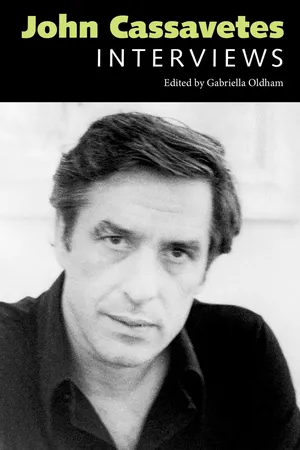
Cassavetes's contributions to film as actor, writer, director, producer, and cinematographer at a time of radical changes in cinema history continue to inspire independent filmmakers to challenge creative restrictions and celebrate actors' artistic contributions. John Cassavetes: Interviews captures this "maverick" streak of an intensely personal filmmaker who was passionate about his art.
- 196 pages
- English
- ePUB (mobile friendly)
- Available on iOS & Android
eBook - ePub
About this book
Information
Subtopic
Film & VideoDialogue on Film, No. 4: John Cassavetes, Peter Falk
American Film Institute / 1971
From AFI’s Harold Lloyd Master Seminar with John Cassavetes © 1971, used courtesy of American Film Institute.
John Cassavetes is one of the few directors to emerge from the underground of independent and/or student film production. His first film, Shadows, which he discusses below, placed him in the front ranks of the New York independents loosely clustered around Jonas Mekas’s New American Cinema. Cassavetes won the first Independent Film Award given by Film Culture.
Eight years later he made Faces, which firmly established him as a major talent and, in the process, launched John Marley, Lynn Carlin, and Seymour Cassel, as well as Gena Rowlands (Cassavetes’s wife). Faces toured the festival circuit and went on to become a commercial success. Since Faces, Cassavetes has made two films with major studio backing, Husbands and Minnie and Moskowitz, in addition to continuing his own career as an actor.
With Cassavetes at this seminar, held in January 1971, was Peter Falk, who worked with Cassavetes in Husbands. Fellows and faculty of the Center joined Cassavetes and Falk in a long and often heated discussion of his career.
Just People on the Streets: Shadows
Q: How did you come to make Shadows? You were in an acting group, weren’t you?
John Cassavetes: Shadows was an experiment in acting. I was an actor and it happened by accident, the way you get into acting or anything else. I was working in a workshop with a lot of people; one day they were doing an experiment. I said it’d make a terrific film and they started building a set, doing everything, and it was fortunate that I had some money. I went on a radio program and people sent in dollar bills and we started to make this film and we were young. I didn’t know anything about filmmaking. I would say, “Print that,” only there wasn’t anybody there to write that down and we ended up with everything printed.
Those were people I knew and liked, cared for, loved and respected, and they were just people on the streets; people that I associated myself with in my mind. At the end of Shadows, the last day of shooting, I couldn’t turn on the camera. I was so fed up with doing it because there was no love of the craft or the idea or anything. We’re doing this experiment and now it’s the last day, nobody’s here except McEndree and me. He couldn’t turn on the camera and I couldn’t turn on the camera and Ben Gazzara was standing there asking, “Are you going to roll this thing or not?” We’re just standing there looking at each other. We couldn’t turn on this camera because it had been such a hassle.
Q: How did you direct the people in that film?
JC: There was a guy named David Pokitillow that we used a lot; one of the people who hadn’t acted before. He played the boyfriend and was a chess player and a violinist. He did the first scene and said, “Listen, that’s it.” And as you know, that can’t be it. “You have got to do this.” He said, “No, I don’t want to do this.” So he promised me he’d do a scene running through the park. He didn’t show up. We were standing out there in the park. I knew where he lived and I ran over to his house with a couple of other guys. “John, I’m with a girl for chrissake. I’m not an actor, God, I’m so fat and ugly and I don’t want to do this. I don’t want to. I just hate it. I hate you.” So I said, “David, you have got to do it. If you do it, I swear to God, I’ll get you a chess set.” I knew he loved chess. “You get the chess set. You come back with the chess set and then I’ll do it.” So we ran out like a bunch of idiots, got the chess set, came back. He says, “Put it by the door so I can see it.” He opens the door and he says, “OK, I’ll do it.”
So, we get down to the park. There’s a scene with Tony Ray and I said, “Hey, you run after him.” He said, “I’m not running for anybody.” I said, “Please, you can run twenty yards?” He said no. I said, “Please run twenty yards.” I’m reduced to nothing. And I’m standing there in the sunlight and the cold and everything and Benny says, “Jesus, man, I’d just deck him.” “David, what can I give you?” He said, “A Stradivarius.” “I can’t give you a Stradivarius. You know I can’t afford a Stradivarius, but maybe we can rent it for you.” So he ran twenty yards. He said, “That’s it.” He went home.
Getting People to Do Things
Q: Was working with your friends harder than working with professionals, in a production with a bigger budget?
JC: The whole experience of getting people to do things was incredible. I didn’t know what I was doing really. None of us knew what we were doing. When lighting a scene we didn’t know what we were doing. We even did the music. I asked Charlie Mingus. I said, “Charlie, would you like to do this?” “Yeah, what is it?” “A film.” Charlie said he’d do it for nothing. He worked six months on the music and he wrote a minute and a half’s worth of music. I don’t know that that’s wrong.
He said, “Listen, man, would you do me a favor? You have got to do something for me.” “Sure, sure,” I say. “Listen, I’ve got all these cats that are shitting all over the floor. Can you have a couple of your people come up and clean the cat shit? I can’t work; they shit all over my music.” So we went up with scrubbing brushes and cleaned up the thing. Now he says, “I can’t work in this place. It’s so clean. I’ve got to wait for the cats to shit.” Finally we get it together to record. So, double session, three hours, double session with the projectionist sitting there and I’m watching. He’s got fourteen seconds worth of music. Everybody’s saying, “Why don’t you just tell Charlie to improvise.” All the advice then starts. So then he’s got to improvise and he loves to sing and he started to sing and he played. He made everyone switch their instruments. So I said to Charlie, “Charlie, Charlie, it was great; it really sounded great. Everything sounds great. The noise comes out; it really sounds great. It’s perfect for the picture.” He says, “Man, I got to work six more months.” He went away.
Q: Did Mingus finish the film?
JC: Later, I looked for Charlie. He went down to Tijuana. So, I get ahold of Shafi Hadi, and I say, “Shafi, listen, we got to fill in some music here. Do you know where Charlie is? We can’t find him. I mean I got to finish this picture. I’ve been on it for three years now.” So he said, “OK, I’ll come over. We’ll do an improvisation. I’ve gotta have a hundred bucks.” I said, “OK, you’ve got a hundred.” So he came in and he played. It was terrific. He played the story of his life to music. He played for an hour. He said, “Tell me a story. Tell me a story. Tell me a story of myself.” I would sit down and tell him a story.
A Bargain to Be More Honest
Q: Faces was shot under the same conditions, wasn’t it?
JC: Faces was very much the same only we had been through all that. So I knew it was going to take a long time. I have a lot of love for actors, so I found every actor I could that was as frustrated as me, every actor that wanted to express something and felt that he was great and had been cheated, and people that just felt there would never be a chance in the world for them. No matter if they worked or didn’t work, they were finished.
Q: What kept all those very singularly unique individuals from tearing each other apart?
JC: The bargain was with those people to really be more honest. I enjoyed it. I enjoyed that feeling of cooperation, of working with people that you could respect, of working with people that loved what they were doing. And the crew loved what they were doing. There were times when George Sims or somebody shooting a scene would be laughing so hard that the camera would shake. This didn’t make the actors feel bad; it made them feel good. It made them feel terrific. That was some kind of communication. That third eye was good.
Q: What was your idea for Faces?
JC: I wrote it out of a lot of anger and dismay with society. I was unhappy with the way things were going in life. So I wrote this very bitter piece and the actors took it and couldn’t make it bitter. That was their insight, their discovery, their feeling for people.
We went up to Toronto to screen the film. When the audience saw the house, they went, “Uhhhh …” You could hear it vocally. I started laughing and the people that were with us started laughing, too, because we felt, “Hey, geez, we learned something. We know something now before they see the film that they won’t know.” Nobody was disappointed that the picture wasn’t well received, because all our rewards were in the making of the picture and in what we felt about it. I’ll never have an experience like that again in my life, where everything just went perfectly because the people were perfect.
Husbands
Q: How did you come up with Husbands?
JC: We started working on Husbands as a natural extension of people wanting to continue their lives in work; use what you think you’ve learned and try to find the subject and deepen it. The only thing you do learn is that you can’t go for ten cents and expect to come up with a million. You have to go for everything. You have to go, whether you fail or you don’t fail, for what will make us better when we’re finished, whether we win or we lose.
Q: What was your approach to the structure of Husbands? What was the motivation? What did you start with?
JC: Falk, Gazzara, and myself started with ourselves and a kind of a simple idea of a guy dying; what it would mean to us if one of us, if one of our close friends died. How would we handle it? Our problem was: What did we want to get out of the movie? I’m always delighted, we all are, to make people laugh. I thought, “Oh, Jesus, we’ve got a comedy that says nothing, absolutely nothing. It’s terrific.” And then Benny read the script and he said, “Jesus Christ, this is shit. It’s about nothing. There’s no character, nothing. Who am I? What’s in it?” From there until two and a half years later when we finished, Benny would always say, and he still says, “Are you going to make some changes?” And while Peter liked the script, it’s harder for me to work with Peter than to work with Ben. When you write something for Ben that he likes, he smiles. He gets excited or he kisses you, or something. With Peter, it’s always the same. I say, “What do you think, Peter?” He says, “Uhhh … uhhh … ehh.” Whether he likes it or he doesn’t like it, whether it’s expressing anything that he wants to say, is very hard to determine.
Q: How did you work out what you were going to do? Did you talk it all out in advance?
JC: From the very beginning we made a pact that we would try to find whatever truth was left in ourselves and talk about that. Sometimes the scenes would reflect things that we didn’t like to find out; how idiotic we were, or how little we had to do with ourselves, how uptight we were. We felt that it was important to find a way to have the courage to put that out on a line for whatever it was, even if the picture itself would not be exciting. One of the reasons we did that is because, I think, all three of us felt one thing, and one thing very strongly. That was the idea that there wasn’t enough individual expression, bad or good. You have to have the courage to be bad and really express what you want to say. So, throughout the thing, our professionalism got in the way and our egos as well.
Q: That’s discipline you’re talking about. You’re not going to allow yourself to say anything. Is that what you mean by discipline?
JC: As director, I went under the assumption that sooner or later Peter would know what he was doing and sooner or later Ben would know what he was doing, and we’d wait it out until we did know what we were doing. Then, that would be close to what the characters would want to express, for whatever reasons. I was shocked by Peter’s choices. I mean, it really surprised me that he would go off in a certain direction.
Everything Is Strength
Q: For Husbands what was in the script, and what did you improvise on the set?
JC: What happens is: everything is strength. How much strength do you have? Before you get to improvise on any kind of level, we would have to know that no matter what we did, we would be OK. We had to know the material that well. We could improvise the rehearsal and come out great. We all have the instinct that if we got in front of the camera that that kind of delicate improvisation without any theatricality would lose some of its ease. All of a sudden there would be cameras, cables, guys around, people saying, “We can’t move this thing over there,” and suddenly the actors would receive very little importance. And you start to fight to preserve what you have and you start pushing, and all of a sudden, it’s gone. What had been terribly concentrated in rehearsals would dissipate.
So I found that by writing scenes that we might never use, and writing them again and again and again, that everything that we had written and improvised was, therefore, in our minds, used and usable. We had investigated, then studied it. We knew what we were capable of saying to each other and doing with each other, so we got to the point where we could just give any kind of improvisation. The singing scene, for example, was an improvisation. We had a scene written, but it wasn’t very good. It wasn’t very clear. It just seemed that these people were there, the extras that had been hired to cover the set. I didn’t like the scene that we were doing, so I just said, “Let’s improvise this scene here. Put beer on the table and whiskey on the table.” I didn’t know what we would do. We started and I knew that Peter and Ben would catch on, and that the rest of the people would pick it up, because they weren’t going to break the reality.
Q: Did you like working as a director who didn’t say anything?
JC: I hated it. It’s terrible. It’s painful, and terrible, and too disciplined for me. What happened was that, in a scene, it was really an emotional improvisation. I felt that I couldn’t gain anything by using direction to make the scene better, telling Peter to all of a sudden behave in a certain way, creating a situation as you usually do in a film. You create a situation. The lack of action was what the picture was about, you see, so if I stimulated action by directing, it would be bad, wrong. Sometimes the guys would just sit there. I mean, somebody dies; I don’t know anybody that knows anything to do. I couldn’t tell you now what I would do in a situation like that.
Q: Husbands has less a cinéma-vérité feel than the earlier films. Did you mean it to be less “realistic”?
JC: Films are usually restricted to realism because films are really a shorthand, the way they have been done. They’re a shorthand for living and people understand that shorthand. You have certain labels, like a home run, a double, a single, a triple—baseball jargon—which you use to describe a very powerful scene. Different kinds of things stir the emotional things in you. Films are still predicated on incidents. Incidents are exciting. They set off one thing. You recognize certain incidents, and you go with them. Husbands is really a picture about people that feel, but it’s done more intellectually than I would like. I get bored seeing two people that are supposed to be in love, who kiss, screw, or whatever they do. I get bored by that because they’re only supposed to do those things...
Table of contents
- Cover
- Title Page
- Copyright
- Contents
- Introduction
- Chronology
- Filmography
- His’n and Her’n
- What’s Wrong with Hollywood
- The Chip’s Off His Shoulder
- Mr. John Cassavetes on the Actor and Improvisation
- Cassavetes and Pogostin in “Artistic” Clash with Universal
- Masks and Faces: John Cassavetes in an Interview with David Austen
- Man of Many Shattered Faces
- The Director/Actor: A Talk with John Cassavetes
- Dialogue on Film, No. 4: John Cassavetes, Peter Falk
- Movie Journal
- John Cassavetes, Gena Rowlands, Peter Falk on Movies, Madness, and Myths
- A Woman Under the Influence: An Interview with John Cassavetes
- John Cassavetes, A Woman Under the Influence
- A Conversation with John Cassavetes
- A Director of Influence, John Cassavetes
- Interview with John Cassavetes
- John Cassavetes in Los Angeles
- Cassavetes on Cassavetes
- Talk Show
- John Cassavetes Gets His Reward
- Cassavetes: Making of a Movie Maker
- Cassavetes: “Show Me the Magic”
- Retracing the Stream of Love
- The Lost Interview: John Cassavetes
- Resources
- Index
Trusted by 375,005 students
Access to over 1.5 million titles for a fair monthly price.
Study more efficiently using our study tools.
Frequently asked questions
Yes, you can cancel anytime from the Subscription tab in your account settings on the Perlego website. Your subscription will stay active until the end of your current billing period. Learn how to cancel your subscription
No, books cannot be downloaded as external files, such as PDFs, for use outside of Perlego. However, you can download books within the Perlego app for offline reading on mobile or tablet. Learn how to download books offline
Perlego offers two plans: Essential and Complete
- Essential is ideal for learners and professionals who enjoy exploring a wide range of subjects. Access the Essential Library with 800,000+ trusted titles and best-sellers across business, personal growth, and the humanities. Includes unlimited reading time and Standard Read Aloud voice.
- Complete: Perfect for advanced learners and researchers needing full, unrestricted access. Unlock 1.5M+ books across hundreds of subjects, including academic and specialized titles. The Complete Plan also includes advanced features like Premium Read Aloud and Research Assistant.
We are an online textbook subscription service, where you can get access to an entire online library for less than the price of a single book per month. With over 1.5 million books across 990+ topics, we’ve got you covered! Learn about our mission
Look out for the read-aloud symbol on your next book to see if you can listen to it. The read-aloud tool reads text aloud for you, highlighting the text as it is being read. You can pause it, speed it up and slow it down. Learn more about Read Aloud
Yes! You can use the Perlego app on both iOS and Android devices to read anytime, anywhere — even offline. Perfect for commutes or when you’re on the go.
Please note we cannot support devices running on iOS 13 and Android 7 or earlier. Learn more about using the app
Please note we cannot support devices running on iOS 13 and Android 7 or earlier. Learn more about using the app
Yes, you can access John Cassavetes by Gabriella Oldham in PDF and/or ePUB format, as well as other popular books in Media & Performing Arts & Film & Video. We have over 1.5 million books available in our catalogue for you to explore.