In the summer of 1964 medical professionals, mostly white and northern, organized the Medical Committee for Human Rights (MCHR) to provide care and support for civil rights activists organizing black voters in Mississippi. They left their lives and lucrative private practices to march beside and tend the wounds of demonstrators from Freedom Summer, the March on Selma, and the Chicago Democratic Convention of 1968. Galvanized and sometimes radicalized by their firsthand view of disenfranchised communities, the MCHR soon expanded its mission to encompass a range of causes from poverty to the war in Vietnam. They later took on the whole of the United States healthcare system. MCHR doctors soon realized fighting segregation would mean not just caring for white volunteers, but also exposing and correcting shocking inequalities in segregated health care. They pioneered community health plans and brought medical care to underserved or unserved areas.
Though education was the most famous battleground for integration, the appalling injustice of segregated health care levelled equally devastating consequences. Award-winning historian John Dittmer, author of the classic civil rights history Local People: The Struggle for Civil Rights in Mississippi, has written an insightful and moving account of a group of idealists who put their careers in the service of the motto "Health Care Is a Human Right."
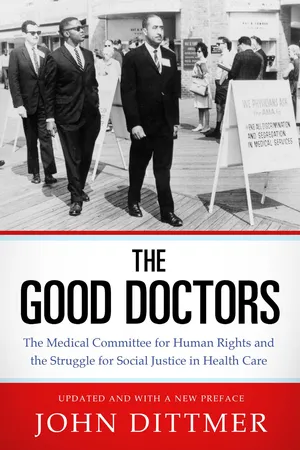
eBook - ePub
The Good Doctors
The Medical Committee for Human Rights and the Struggle for Social Justice in Health Care
- 332 pages
- English
- ePUB (mobile friendly)
- Available on iOS & Android
eBook - ePub
The Good Doctors
The Medical Committee for Human Rights and the Struggle for Social Justice in Health Care
About this book
Information
CHAPTER 1
The Good Doctors
During the summer of 1963 civil rights activity intensified throughout the South. Direct action protests rocked Birmingham, Greensboro, Atlanta, and more than a hundred other cities in eleven southern states. The unleashing of police dogs on demonstrators in Birmingham helped persuade President Kennedy to submit a civil rights bill to Congress, which debated its controversial provisions throughout the summer and into the fall. Although the section desegregating public accommodations such as restaurants and hotels was the most prominent feature of the bill, the provision calling for an end to discrimination in federally assisted programs was of special interest to advocates of equal treatment in medical facilities.
In 1946 Congress had passed the Hospital Survey and Construction Act, more commonly called the Hill-Burton Act, after its principal sponsors. The law, providing millions of dollars of federal funds annually for hospital construction and expansion, stated that the facilities be available to “all persons … without discrimination on account of race, creed, or color.” Senator Lister Hill of Alabama then added the following wording: “But an exception shall be made in cases where separate hospital facilities are provided for separate population groups, if the plan makes equitable provision on the basis of need for facilities and services of like quality for each such group.” This separate-but-equal clause was, in the words of political scientist David Barton Smith, “the only one in federal legislation of this century that explicitly permitted the use of federal funds to provide racially exclusionary services.”1
The Hill-Burton Act in practice did not provide equal hospital facilities for blacks. Ninety hospitals that had received federal construction grants from Hill-Burton refused to accept black patients, and as we have seen, throughout the South hospitals that did admit blacks subjected them to inferior and unhealthy accommodations. The National Medical Association had long opposed Hill-Burton, and in l963 congressmen Adam Clayton Powell Jr. and John Dingell vowed to fight the discriminatory clause when the act came up for renewal. At the same time, the NAACP Legal Defense Fund had filed suit in federal court, maintaining that Hill-Burton as written and interpreted was unconstitutional.2
On July 17 Walter Lear, representing the Medical Committee for Civil Rights, testified before the House Judiciary Committee, then holding hearings on the Kennedy civil rights bill. Lear supported the measure, noting that it would “clearly invalidate the ‘separate but equal’ clause of the Hill-Burton Act.” But the point of his testimony was to expand the public accommodations section of the measure to include “non-profit, non-governmental hospitals, nursing homes, clinics, and other health facilities which provide an essential public service that would otherwise be provided by government agencies.” “It seems anomalous,” he told Congressman Powell, “that commercial enterprises serving the general public should be covered by this legislation but that non-profit hospitals serving the general public are not.” This provision for expanded coverage was added to the final bill.3
Lear’s congressional testimony is evidence of the credibility the Medical Committee had acquired in a short time. That summer its first newsletter went out to ten thousand health care personnel, including the entire membership of the NMA. Fund-raising letters resulted in enough money to pay Lear’s business expenses, and the American Friends Service Committee provided space in its New York office. A national advisory board included such luminaries as Paul Dudley White, who had been President Eisenhower’s personal physician. MCCR meetings attracted nurses, dentists, and other health care workers in addition to physicians. The group stepped up its attack on the AMA, which had refused to “use its well-known and greatly respected strength to help desegregate hospitals, medical societies, and all other aspects of medicine and health services.” Unwilling to come out against the Jim Crow provisions of Hill-Burton, the AMA stood by its pallid 1950 resolution that “constituent and component societies having restrictive membership provisions based on race, study this question, with a view to taking such steps as they may elect to eliminate such restrictive provisions.” As earlier, AMA leaders consistently maintained that they could not force state and local societies to admit black members.4
On July 31, 1963, Lear and Mike Holloman submitted a list of questions to AMA president Edward R. Annis. They asked if Dr. Annis opposed racial segregation in general, and in particular the racially exclusive policies of medical societies and the segregation of patients in hospitals. Annis did not respond, but the issue would not go away. The AMA adopted a strategy to ignore MCCR and start talking to the less confrontational National Medical Association.5
The MCCR Atlantic City protest had an impact on the NMA, for here a predominantly white group of physicians had taken the lead in attacking racial segregation in medicine while the major black medical society sat on the sidelines. “We’re friendly with the AMA,” explained John T. Givens, the NMA’s executive secretary. “I wouldn’t do anything to embarrass them.” But shortly after the MCCR demonstration, NMA president John A. Kenney Jr. asked AMA officials for a meeting “to discuss racial problems in organized medicine,” and the AMA agreed, suggesting its headquarters in Chicago as the site. That session, and its immediate aftermath, symbolized the changes taking place in the NMA leadership. On Tuesday, July 2, President Kenney and a delegation of black physicians met with AMA officials and agreed to hold further discussions, in which NMA representatives would lay out “specific charges of injustices against Negro physicians.” The next day NMA president-elect, Kenneth Clement, was part of an NAACP-sponsored demonstration outside the AMA headquarters. Marching with Clement were Montague Cobb and two other members of the NMA board. When asked about the apparent rift in the NMA, Kenney replied that Clement had been invited to the meeting with the AMA, but he had refused to attend. “He’d rather picket,” observed Kenney, concluding that “there is a new militancy in our organization.”6
The AMA reached out, briefly, to members of the black medical association. In August its president-elect, Norman A. Welch, addressed a plenary session of the NMA convention. Assuring delegates that the AMA opposed racial discrimination, he conceded that some county medical societies still refused to admit black physicians. “You are impatient and I don’t blame you,” he said, but he could only point to the earlier meeting between representatives of the two groups as a sign of progress. And Welch reaffirmed his earlier statement that he would not interfere with those southern medical societies that barred black doctors from membership.7
By the end of the summer of 1963, the Medical Committee for Civil Rights had more than two hundred active members, most but not all from the New York City area. To demonstrate their visibility, and to show support for the civil rights movement, MCCR made plans for medical people to participate as a group in the March on Washington. More than two hundred health care workers assembled in Washington on the morning of August 28. The MCCR contingent lobbied members of Congress and had lunch at a local restaurant before assembling for the march itself. Lear recalls that day as “a very moving experience. What was very special was the range of support we had for the medical contingent, much broader than for the picketing of the AMA. The NMA turned out, marching under the MCCR banner, as did the American Nurses Association.”8
MCCR assisted civil rights workers in an unheralded program that began during the summer of 1963. While attending the IMHOTEP conference in Atlanta that spring, Lear stopped by the Student Nonviolent Coordinating Committee office to talk with executive secretary James Forman, who agreed to lend SNCC support to the MCCR project. During the course of their conversation, Forman mentioned that a number of SNCC veterans were “getting very burned out, and they really needed to get away and rest up.” Lear immediately thought of “the lovely summer homes in Westchester County and on Long Island of a number of the physicians I knew,” and when he got back to New York he asked Trudy Orris to take on this project.9
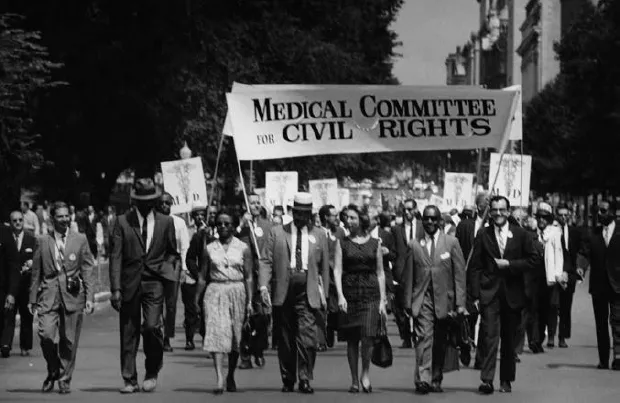
Health care workers at the March on Washington. Dr. Walter Lear is in the front row, right. (Institute of Social Medicine and Community Health)
Born Gertrude Weissman, Trudy came from a poor family in New York. A full-time factory worker at age fourteen, she was active in the labor movement and at an early age became involved in the Communist Party. During World War II she was elected union steward at the clothing store where she worked. By that time she had met and married a young physician named Leo Orris. Brought up in a conservative, orthodox Jewish home, Leo became interested in socialism while in college. “In the thirties and forties if you were not a young leftist who were you? If you had any progressive ideas you were a leftist.” Orris served as a military doctor during World War II. During the l950s the Orrises supported accused atomic spies Julius and Ethel Rosenberg and became involved in the civil rights movement. Leo belonged to the Physicians Forum, and he was in that small group of physicians who picketed the AMA in Atlantic City. Trudy was the more politically involved of the two. An official in the Women’s International League for Peace and Freedom, she also became committed to the black protest movement. In early 1963 she took their sixteen-year-old son Peter with her on a freedom ride to Maryland, and responded enthusiastically when Lear told her of his plans for a rest-andrecreation retreat for civil rights workers.10
During the summer of 1963, Trudy Orris made weekly trips to New York bus and train stations to meet arriving black SNCC activists. She showed them the city, gave them some orientation about the upper-middleclass families they would be staying with, and then sent them off to Westchester, Fire Island, and Martha’s Vineyard vacation homes to enjoy a week of beach time, movies, good food, and conversation. At the end of the week, each host family held a fund-raising party, which raised twentyfive thousand dollars for SNCC that summer. SNCC made all the decisions about who would participate in the program, with Forman taking an active role and spending some time in New York himself. He and other SNCC leaders selected people suffering from burnout (or “battle fatigue,” as it would later be called). Most never suspected they had been singled out for any reason except to raise money for SNCC. The summer R & R program was a great success, and it was repeated the following year. Trudy Orris and the white women who supported her worked hard so that the young black activists they admired so much could enjoy a carefree week before returning to the dangerous life of a SNCC field secretary in the Deep South.11
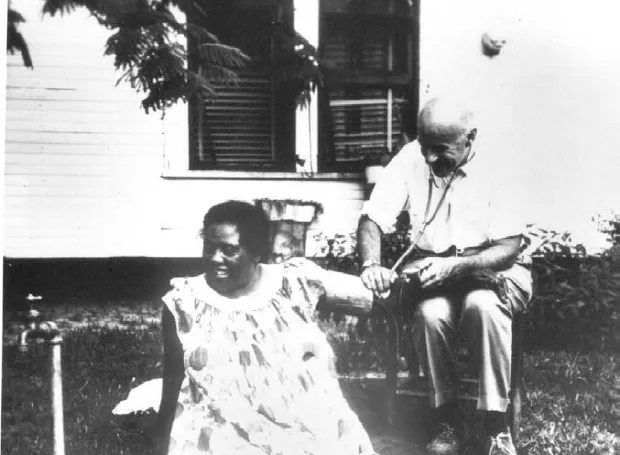
Dr. Leo Orris examining Mrs. Fannie Lou Hamer, Ruleville, Mississippi, summer 1964. (Institute of Social Medicine and Community Health)
After his eventful trip to Atlantic City, Dr. Robert Smith returned to Jackson and his job at the state mental hospital. He had met a number of progressive northern physicians at the AMA protest, who told him to call on them if he ever needed assistance, a promise he would remember. Smith did not return home a conquering hero, however, at least not in the eyes of the local medical establishment. To have one’s picture prominently displayed in the New York Times—the symbol of the left-wing, integrationist press—was not the kind of visibility a young black physician desired if he wanted to continue to ply his trade in Mississippi. Smith resumed his work as the Tougaloo physician, attended movement meetings in the evenings, and recruited people for the March on Washington, although he did not go himself. He soon gained a reputation as the “doctor to the movement,” as civil rights activists came to him with a variety of minor complaints as well as more serious physical and emotional problems. Often he would be called out of the city to treat victims of police abuse. With only a handful of black physicians in Jackson, most of whom were nearing retirement age, Smith saw most of the COFO workers himself.12
Although Smith had managed to stay out of trouble, his visibility as a civil rights activist and physician proved to be too much for his boss at the state mental hospital, who fired him in October of 1963. By then he knew he was not going to be drafted and was free to return to Chicago, where a residency in ob/gyn had been held open for him. Such a move would have benefited him professionally. But by now he was firmly committed to the black freedom struggle in his native state, and with the support of people like Dr. Britton, Bob Smith opened his own practice in the heart of the black community, near Jackson State College.13
In the spring and summer of 1963, the movement was at high tide, with massive demonstrations in cities like Birmingham and Greensboro, the March on Washington, Martin Luther King Jr.’s “I have a dream” speech, and President Kennedy’s civil rights bill, which promised to end the Jim Crow system in the South. But then came the September church bombing in Birmingham with the death of four young black girls, followed by the assassination of John Kennedy on November 22. While movement activists did not regard Kennedy as a civil rights champion, his death came as a blow, especially since his successor, Lyndon Johnson, was a southerner with few civil rights credentials. And as the congressional debate over the civil rights bill dragged on month after month, supporters in the North became discouraged as well.
Walter Lear did not need to read the newspapers to know that the civil rights movement had lost some of its momentum. In the late spring he had put together the Medical Committee for Civil Rights. Within a short time nearly everyone in the medical profession knew of its existence, and it had gained credibility with the major civil rights organizations and their leaders. By late summer MCCR made plans to conduct health surveys in hospitals in ten southern cities, to increase its pressure on the AMA, and to expand its base by recruiting nurses, dentists, and other health workers. As with the movement as a whole, however, MCCR experienced a decline during the fall of 1963. It did not survive into the new year.14
One major problem was lack of funding. According to Lear, he was “putting full time into MCCR work,” and “could not afford to do that without being paid.” At a steering committee meeting in late June, the question of putting him on salary was “deferred until the future activity and strength and finances [were] clarified.” Attempts to raise money through mass mailings to physicians were unsuccessful, and by the fall the organization had contracted debts it could not pay. According to Lear, “We did not have the skill or energy to raise a lot of money.” But to say that MCCR folded because it went broke is to beg the question. Civil rights for African Americans was not fashionable that fall. Without dramatic headlines of racial confrontations in the South, many white liberals, including physicians, turned their attention elsewhere.15
As for Walter Lear, he accepted a position as deputy commissioner for the Department of Health in the city of Philadelphia, and “after a month or so I closed the Medical Committee for Civil Rights.” The unpaid MCCR bills followed him to Philadelphia, where he was hounded by creditors representing the Occidental Restaurant, where the medical group had dined before the March on Washington. It seems that some of the doctors had not paid for their meals, and as the coordinator he was held responsible. After sympathizing with the restaurant management about “the organization [MCCR] that took advantage of you and me [and is] now defunct,” Lear paid the bill out of his own pocket. He would not be among the founding members of the Medical Committee for Human Rights.16
Mississippians, both black and white, faced the new year with foreboding. In early 1964 Jim Crow still held sway in the Magnolia State, with black Mississippians relegated to inferior jobs, schools, and health care. Many black physicians had either retired or left the state. Almost no younger doctors were choosing to follow Dr. Smith’s example and live and work in ...
Table of contents
- Cover
- Title Page
- Dedication
- Copyright
- Contents
- Preface
- Prologue: Two Roads to Atlantic City
- 1. The Good Doctors
- 2. Freedom Summer in Mississippi
- 3. The Medical Arm of the Civil Rights Movement
- 4. Selma and Jackson
- 5. Summer 1965
- 6. The Last March
- 7. The War at Home
- 8. The Medical Arm of the New Left
- 9. The Young Turks
- 10. Health Care Is a Human Right
- 11. Years of Decline
- Coda
- Afterword: The MCHR Legacy
- Acknowledgments
- Notes
- Index
Trusted by 375,005 students
Access to over 1.5 million titles for a fair monthly price.
Study more efficiently using our study tools.
Frequently asked questions
Yes, you can cancel anytime from the Subscription tab in your account settings on the Perlego website. Your subscription will stay active until the end of your current billing period. Learn how to cancel your subscription
No, books cannot be downloaded as external files, such as PDFs, for use outside of Perlego. However, you can download books within the Perlego app for offline reading on mobile or tablet. Learn how to download books offline
Perlego offers two plans: Essential and Complete
- Essential is ideal for learners and professionals who enjoy exploring a wide range of subjects. Access the Essential Library with 800,000+ trusted titles and best-sellers across business, personal growth, and the humanities. Includes unlimited reading time and Standard Read Aloud voice.
- Complete: Perfect for advanced learners and researchers needing full, unrestricted access. Unlock 1.5M+ books across hundreds of subjects, including academic and specialized titles. The Complete Plan also includes advanced features like Premium Read Aloud and Research Assistant.
We are an online textbook subscription service, where you can get access to an entire online library for less than the price of a single book per month. With over 1.5 million books across 990+ topics, we’ve got you covered! Learn about our mission
Look out for the read-aloud symbol on your next book to see if you can listen to it. The read-aloud tool reads text aloud for you, highlighting the text as it is being read. You can pause it, speed it up and slow it down. Learn more about Read Aloud
Yes! You can use the Perlego app on both iOS and Android devices to read anytime, anywhere — even offline. Perfect for commutes or when you’re on the go.
Please note we cannot support devices running on iOS 13 and Android 7 or earlier. Learn more about using the app
Please note we cannot support devices running on iOS 13 and Android 7 or earlier. Learn more about using the app
Yes, you can access The Good Doctors by John Dittmer in PDF and/or ePUB format, as well as other popular books in History & North American History. We have over 1.5 million books available in our catalogue for you to explore.