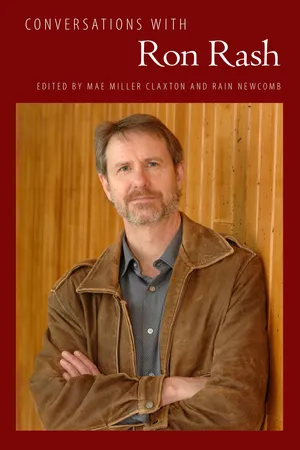
Since the publication of Serena in 2008 earned him a nomination for the PEN/Faulkner fiction prize, Ron Rash (b. 1953) has gained attention as one of the South's finest writers. Rash draws upon his family's history in Appalachia, where most members have worked with their hands as farmers or millworkers. In the Grit Lit or Rough South genre, Rash maintains a prominent place as a skilled craftsman and triple threat, publishing four collections of poetry, six short story collections, and six novels. Though best known as an Appalachian writer, Rash's reach has grown to extend well beyond Appalachia and the American South, spreading to an international audience. Conversations with Ron Rash collects twenty-two interviews with the award-winning author and provides a look into Rash's writing career from his first collection of short stories, The Night the New Jesus Fell to Earth in 1994 through his 2015 novel, Above the Waterfall. The collection includes four interviews from outside the United States, two of which appear in English for the first time. Spanning sixteen years, these interviews demonstrate the disciplined writing process of an expert writer, Rash's views of literature on a local and a global scale, his profound respect for the craft of the written word, and his ongoing goal to connect with his readers.
- 212 pages
- English
- ePUB (mobile friendly)
- Available on iOS & Android
eBook - ePub
Conversations with Ron Rash
About this book
Information
Ron Rash
From The Morning News. Copyright Robert Birnbaum/Our Man in Boston. Reprinted by permission.
Writer Ron Rash has written three books of poetry—Eureka Mill, Among the Believers, and Raising the Dead—and two collections of short stories, The Night the New Jesus Fell to Earth and Casualties. He is also author of two novels, One Foot in Eden and Saints at the River, and one children’s book, The Shark’s Tooth. His writing has been published in Yale Review, Georgia Review, Oxford American, New England Review, Southern Review, Shenandoah and others. Rash’s awards include the Appalachian Writers Association’s Book of the Year and ForeWord Magazine’s Gold Medal for Best Literary Novel, both for his 2002 debut novel, One Foot in Eden. Ron Rash’s family has lived in the southern Appalachian Mountains since the eighteenth century, and the region is the primary focus of his writing. He grew up in Boiling Springs, N.C., and graduated from Gardner-Webb University and Clemson University. He is currently the Parris Distinguished Professor of Appalachian Studies at Western Carolina University.
In Saints at the River, the small South Carolina town of Tamassee becomes embroiled in a headline-grabbing controversy after a twelve-year-old girl drowns in the Tamassee River and her body is trapped in its depths. Maggie Glenn, a twenty-eight-year-old newspaper photographer, has been sent back to her hometown to document the escalating standoff between the girl’s parents, who want to retrieve her body, and environmentalists convinced the rescue operation will damage the river and set a dangerous precedent. Maggie, who left the town ten years earlier and has done her best to avoid her father during that time, now finds herself revisiting her painful past. A budding romance with the reporter who accompanies her to cover the story is burdened by his own troubled history.
As Ron Rash reveals in the chat below, this story exhibits two of his primary concerns: children and the environment. Additionally and not surprisingly, we talk about southern writing and a host of connected and unconnected issues. It is a great pleasure to present this wonderful writer whom I discovered the old-fashioned way—serendipitously.
Robert Birnbaum: Do you get above the Mason-Dixon line often?
Ron Rash: No. Not a lot.
RB: How many times in the last year?
RR: I’d say three. About a week, total.
RB: How does it feel? Do you feel it?
RR: Oh, yeah. I can tell the difference. In large part because of the way people react to the way I talk. [chuckles] One thing that’s been really exciting for me is having readers outside the South. That’s what we all hope as writers, that our work transcends the region. If it’s significant at all, it has to.
RB: You have been at this for a while, so perhaps you might have noticed whether mainstream America has shifted its way of accepting southern writing.
RR: In a sense, as a southern writer you are almost always fighting certain stereotypes. There are certain expectations of a southern novel. There’s going to be a crazy aunt in the attic and probably a couple of bodies in the basement, and you always have these kind of bizarre characters. But at the same time, a lot of that’s true. [laughs] One thing I am pretty much convinced of is that we are all kind of crazy in the world—some groups hide it better than others, maybe. Southerners seem to revel in their oddness at times.
RB: Southerners do seem to be good at telling those stories about their oddities.
RR: That is something that is positive—that people expect southerners to tell stories, and southerners are good at that. It’s part of our culture.
RB: As opposed to mid-westerners? Or westerners?
RR: Well, why is it that the South has produced so few philosophers yet so many novelists? There is something—we express ourselves with story. Once again, it’s not like every other culture doesn’t. A number of my favorite writers—I love Philip Roth’s work. He comes from a culture that’s probably the antithesis of a southern culture, at least within the United States. I grew up hearing stories, and it was a very natural part of my life.
RB: Years ago when I spoke to Reynolds Price, I was operating under the bias that southern writers were being marginalized, that the writing was quaint but not universal. So what I am trying to get at is whether there has been a change in the stature of southern writing.
RR: Yeah. Right now, as compared to the ’30s and ’40s, when you had an emphasis on people like O’Connor and in the ’50s, Welty, Warren, and Faulkner, right now I find it interesting, that at least nationally, when I read the New York Times Book Review, how few southern writers are recognized as being among the greatest. I think Cormac McCarthy, Barry Hannah, William Gay are writing as well as anybody in this country and yet you hear about McCarthy but you rarely—
RB: You consider McCarthy to be a southern writer?
RR: Yeah he grew up in—
RB: I know where he grew up, but you still consider him a Southern writer? [He grew up in Knoxville, Tennessee—eds.]
RR: Oh, yeah, we claim him. [laughs]
RB: This regionalizing just seems to point to Jim Harrison’s notion of geographical fascism [mentioned in the “Tracking” section of The Summer I Didn’t Die]—suggesting some stratum of quality.
RR: I agree. Ultimately McCarthy and Hannah and Gay are great writers, and I have always been a little leery of any adjective in front of writer—whether it’s Jewish writer or southern writer. Because very often there is a sense of “just.” “Just a southern writer.”
RB: Not exactly a compliment or a superlative.
RR: And also not getting at what matters. If the writer—if McCarthy doesn’t transcend the South or Barry Hannah, they are probably not that significant anyway. I think they do.
RB: It does seem that southern readers are extremely loyal and supportive of their writers.
RR: Well, yeah, southerners like to read southern writers—it’s just that tradition since Faulkner and O’Connor—there’s regional pride in our writers and support of them. That’s a wonderful thing.
RB: Is the South still the same?
RR: No. It’s always changing. At the same time, what I find interesting is how it seems to both change and not change. Just when you think there’s no such thing as a distinctive southern culture, I see something that says it will always be like this.
RB: Was One Foot in Eden considered a so-called breakout book for you?
RR: Yeah, it did, more so than any [other] books I have written.
RB: You’re including your poetry?
RR: I’ve written three books of poetry and two books of short stories, but today novels just have much higher visibility than poetry.
RB: It is a pleasant surprise that short story collections seem to keep being pumped out.
RR: Well, what happened with One Foot in Eden was that it sold much, much more than anything I had ever written, and it got reviewed in places I had never been reviewed.
RB: Why do you think?
RR: Novels—more people buy novels and they just seem to get more attention than a book of poems.
RB: But why you, now, a writer from South Carolina? What were the reviews like?
RR: They were very positive—at least the ones I saw. Probably the best one I got was in the Los Angeles Times. To me that was a good sign that as “regional” as the book was, ultimately there was something in it that transcended the region.
RB: I liked the opening of Saints at the River, which I had picked up unaware of anything about you and never got further into it until we arranged to talk but I did for some inexplicable reason read One Foot in Eden and was mightily impressed with it. It was an enthralling book. When I came back to Saints at the River, the protagonist, the woman photographer, didn’t convince me. The prose was fine and fluid and the story was interesting, but it didn’t move me in the way your first novel did. What do you think? Do you look at all your children in the same way?
RR: Well, that’s just it. You’re being asked to choose your children—which one’s your favorite. [pauses] To me, if I had to choose between those books, I would choose One Foot in Eden myself. Part of it is because it was the first novel I had ever written. I don’t know—I have some readers who like Saints better. I guess it depends on what you are looking for. For me the language is more interesting in One Foot—which is something that’s important to me as a poet.
RB: I loved that story that is included in some of the biographical notes about your grandfather reading stories to you except he couldn’t read so he made them up.
RR: Oh yeah, it had an impact on me.
RB: Did you learn that much later?
RR: I figured it out pretty early. Probably in third or fourth grade. At the time it was just wonderful [laughs] that his stories could just change.
RB: Is the ...
Table of contents
- Cover
- Half title
- Title
- Copyright
- Contents
- Introduction
- Chronology
- Interview with Ron Rash
- An Interview with Ron Rash
- The Power of Blood-Memory: A Conversation
- Language Can Be Magical: An Interview with Ron Rash
- Ron Rash
- Ron Rash Speaks with Karen Spears Zacharias
- “The Natural World is the Most Universal of Languages”: An Interview with Ron Rash
- Words with Ron Rash
- Twisting the Radio Dial: An Interview with Ron Rash
- An Interview with Ron Rash
- Ron Rash: Harmony Republic Interview
- Christophe Dupuis Interviews Ron Rash
- Kill Your Darlings in Conversation with Ron Rash
- Interview with Ron Rash, 2011
- Ron Rash: Shaped by the Land, Torn Apart by Intolerance
- Ron Rash, Redux
- Encounter with Ron Rash: Hell in Eden
- “Nothing Gold” Stays Long in Appalachia
- An Interview with Author Ron Rash
- An Interview with Ron Rash
- Interview with Ron Rash
- Above the Waterfall by Ron Rash, and Talk with Author
- Additional Resources
- Index
Trusted by 375,005 students
Access to over 1.5 million titles for a fair monthly price.
Study more efficiently using our study tools.
Frequently asked questions
Yes, you can cancel anytime from the Subscription tab in your account settings on the Perlego website. Your subscription will stay active until the end of your current billing period. Learn how to cancel your subscription
No, books cannot be downloaded as external files, such as PDFs, for use outside of Perlego. However, you can download books within the Perlego app for offline reading on mobile or tablet. Learn how to download books offline
Perlego offers two plans: Essential and Complete
- Essential is ideal for learners and professionals who enjoy exploring a wide range of subjects. Access the Essential Library with 800,000+ trusted titles and best-sellers across business, personal growth, and the humanities. Includes unlimited reading time and Standard Read Aloud voice.
- Complete: Perfect for advanced learners and researchers needing full, unrestricted access. Unlock 1.5M+ books across hundreds of subjects, including academic and specialized titles. The Complete Plan also includes advanced features like Premium Read Aloud and Research Assistant.
We are an online textbook subscription service, where you can get access to an entire online library for less than the price of a single book per month. With over 1.5 million books across 990+ topics, we’ve got you covered! Learn about our mission
Look out for the read-aloud symbol on your next book to see if you can listen to it. The read-aloud tool reads text aloud for you, highlighting the text as it is being read. You can pause it, speed it up and slow it down. Learn more about Read Aloud
Yes! You can use the Perlego app on both iOS and Android devices to read anytime, anywhere — even offline. Perfect for commutes or when you’re on the go.
Please note we cannot support devices running on iOS 13 and Android 7 or earlier. Learn more about using the app
Please note we cannot support devices running on iOS 13 and Android 7 or earlier. Learn more about using the app
Yes, you can access Conversations with Ron Rash by Mae Miller Claxton,Rain Newcomb in PDF and/or ePUB format, as well as other popular books in Literature & Literary Biographies. We have over 1.5 million books available in our catalogue for you to explore.