Timothy E. Wise presents the first book to focus specifically on the musical content of yodeling in our culture. He shows that yodeling serves an aesthetic function in musical texts. A series of chronological chapters analyzes this musical tradition from its earliest appearances in Europe to its incorporation into a range of American genres and beyond. Wise posits the reasons for yodeling's changing status in our music. How and why was yodeling introduced into professional music making in the first place? What purposes has it served in musical texts? Why was it expunged from classical music? Why did it attach to some popular music genres and not others? Why does yodeling now appear principally at the margins of mainstream tastes?
To answer such questions, Wise applies the perspectives of critical musicology, semiotics, and cultural studies to the changing semantic associations of yodeling in an unexplored repertoire stretching from Beethoven to Zappa. This volume marks the first musicological and ideological analysis of this prominent but largely ignored feature of American musical life.
Maintaining high scholarly standards but keeping the general reader in mind, the author examines yodeling in relation to ongoing cultural debates about singing, music as art, social class, and gender. Chapters devote attention to yodeling in nineteenth-century classical music, the nineteenth-century Alpine-themed song in America, the Americanization of the yodel, Jimmie Rodgers, and cowboy yodeling, among other topics.
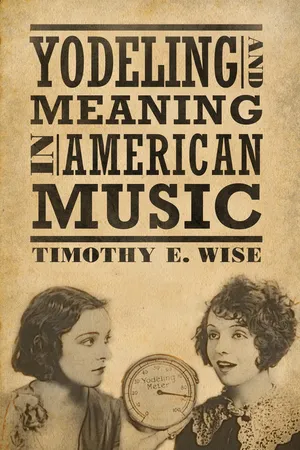
- 272 pages
- English
- ePUB (mobile friendly)
- Available on iOS & Android
eBook - ePub
Yodeling and Meaning in American Music
About this book
Trusted by 375,005 students
Access to over 1.5 million titles for a fair monthly price.
Study more efficiently using our study tools.
Information
Subtopic
Ethnomusicology1
CLASSIFYING YODELED EFFECTS IN POPULAR MUSIC
Yodel Species
AS A PRELUDE TO THE DISCUSSIONS OF YODELING IN THE LATER CHAPters of this book, this chapter outlines a way of classifying yodeled vocal effects commonly heard in popular music. The intention is to provide a definition of yodeling that is meaningful and useful for the description of popular music vocal styles and at the same time to challenge some of the ways yodeling has been conceptualized previously. This approach, I hope, will facilitate a more precise description of the kinds of yodeling that have become a part of English-language popular music singing styles, for yodeling, whether people call it that or not, is a common feature of contemporary popular singing styles. Along the way I will mention a number of mood categories associated with these various forms of yodeling, but my purpose in this chapter is to place the spotlight on the ideological implications of the use of such techniques. Specifically, my thesis is that the audible break in the vocal register while singing became, and continues to be, a significant marker delineating the aesthetics of the “popular” from that of the “classical.”
The yodel effects this chapter deals with, although certainly not completely unknown in European classical singing, were nevertheless gradually expunged from art music’s conventional practice over the course of the late nineteenth and early twentieth centuries. To cite only one example, the soprano’s part in the Tirolese towards the end of Rossini’s Il Viaggio a Rheims, “Piu vivace e piu fecondo,” was very likely yodeled in early performances, which seems not to be the case today.
Additionally, during the vogue for Alpine-themed songs in the first half of the nineteenth century, prominent singers such as Maria Malibran, Henriette Sontag, Margarethe Stockhausen, and Jenny Lind performed and popularized yodel songs. Some of the songs associated with these singers are discussed in chapter 3. Later, at the beginning of the twentieth century, a few classical singers made recordings of yodel songs. For example, Luisa Tetrazzini recorded Carl Eckert’s yodel song “L’eco” (“Echo Song,” discussed in chapter 3), and Ernestine Schumann-Heink recorded Millöcker’s yodeled aria “I und mei Bua” from his operetta Drei Paar Schuhe.1 But by that time it was rather exceptional for classical artists to yodel. Today, yodeling in so-called classical music is virtually unheard of. For example, yodeling is not taught in conservatories, where classical singers typically train, nor in any university music program I am aware of. Nor is there yodeling in the vocal music of Schubert, Schumann, Brahms, Wagner, or Verdi.2 Indeed the classical repertoire of vocal music extending from Palestrina and Monteverdi through Stravinsky, Schoenberg, Berg, and Webern, to Copland, Barber, Rorem, Ives, and just about everyone else one can think of has barely anything that resembles yodeling. Cecilia Bartoli’s recording of Hummel’s “Air à la Tirolienne” is a rare exception that proves the rule. Yodel effects incorporated simply for the thrill of hearing the crack in the voice have for all practical purposes been nonexistent in art music since the end of the romantic era.3 Yodeling in classical music and some of the reasons why it was never fully assimilated into that practice are discussed in Chapters 2 and 3.
We do not have many ways of describing vocal styles in popular music, which is odd considering that idiosyncratic vocal stylizations are a principal characteristic of style across most popular music genres. One might think that because of the wide variety of vocal styles a simple and generalizing description of them is not possible, but many characteristic vocal devices and decorative features can be reduced to a few acoustical facts that can adequately and uniquely describe what a singer is doing with her or his voice. With an appropriate and neutral way of describing vocal techniques, it should be possible to move the description of popular music vocal styles away from biographical similes (sounds like Elvis) toward more disinterested and concrete descriptions.
Although it is intriguing and has been widely influential, Roland Barthes’s article “The Grain of the Voice” has not been much help when it comes to concrete, empirical analysis because the musical signifier he describes, “the grain, the grain of the voice when the latter is in a dual posture, a dual production—of language and of music,” does not describe anything tangible. Indeed, Barthes acknowledges in the following paragraph “the apparently abstract side” that he focuses on.4 So it must be admitted that this idea of the grain is rather dubious as a descriptive tool. Barthes’s grain is in fact simply another metaphor, which moreover is unworkable as an instrument of analysis in that the corporeality of the voice is a given. In any event, his signifier is actually beside the point with regard to many yodel and falsetto effects for the simple reason that “the encounter between a language and a voice”5 cannot apply to wordless yodeling: vocables are not language. As a remedy, therefore, this chapter outlines a straightforward typology of yodeled vocalization based on empirical observation, which can be of practical use in the description of real voice effects. The aim is to contribute to the discourse on popular music vocal techniques and to put the focus on what singers actually do with their voices.
For the analyses in this book, a very large range of music was examined from which the categories described below are abstracted. These items include many examples of nineteenth-century sheet music that incorporate notated yodel parts or written indications to yodel, as well as vocal parts not so denoted but in which the implied yodeling becomes apparent in later phonograph recordings. Examining pre–phonograph era sheet music provides a much better picture of the history of the technique than is possible by simply listening to recordings. As a consequence, some previous claims about yodeling and its spread through English-language popular music are shown to be inaccurate. Examples are drawn from all types of music in order to demonstrate that yodel devices have long been established in English-language popular music and are not specific to any one genre or era.
The yodeling styles we hear in English-language popular music lack a convenient vocabulary that would facilitate discussion of them. This is partly due to the fact that conventional ways of describing vocal production have been the preserve of classical singing pedagogy, and yodeling has played no part in that.6 With Alpine yodeling, in contrast, there is a bewildering variety of names and types, including Lockruf (call tune), Viehlöcker (cattle call), Betruf (prayer call), and many others. This difference is akin to the oft-remarked fact that the Inuit have many words for snow, while in English we have one. In the context of the Alpine traditions, many signals and yodel-types developed for functional or for other reasons—reasons that simply do not obtain outside that environment. These Alpine types are not discussed here for two reasons: first, they are dealt with thoroughly by Max Peter Baumann and Heinrich Leuthold in their discussions of yodeling, and second, these numerous call-types have no meaning in the context of English-language popular music.7
However, what did become significant for later English-language popular music was the incorporation of the folk practice of Alpine yodeling into musical frameworks, a development that took place around the turn of the nineteenth century in Switzerland. The form that resulted is known as the Jodellied (yodel song). In his description of traditional Swiss music in The New Grove Dictionary of Music and Musicians, Baumann makes the following remarks concerning this type:
A form comprising alternate solo yodeling and singing, known as Jodellied or Gsätzli, appeared with increasing frequency towards the end of the eighteenth century. Its development is most closely associated with the work of J. H. Tobler, F. Huber, and F. W. Kücken, who accentuated the particularly Swiss element in their choral songs. F. Huber, A. Glutz … and J. Lüthy concluded their songs with a yodel-like coda…. Because of the close association of the Jodellied with the ‘stylised yodel’ defined by A. Tobler (a yodeling melody whose vocables are replaced by words), and with the analogous type of Ranz des vaches whose melody has also been given words, it is difficult to distinguish these song types in performance.8
Most English-language popular music with yodeling, at least in the nineteenth century, derived from these early Jodellieder. But of particular interest for the types of yodel heard in the music under discussion here is the mention of the “stylized yodel,” wherein words, rather than nonsense syllables or vocables, are yodeled. This type of yodeling has been particularly significant in English-language popular music and is widely current now, while at the same time posing a few problems regarding definition.
Since yodeling in popular music takes place within the framework of a conventional song type, it does not seem to me to be too reductive to consider all occurrences of vocalizing making use of yodelemes (defined later) as subsets of the generic term yodeling. This seems especially sensible in light of the stylized yodel mentioned above: yodeling while singing words. The occurrences of yodeling differ only in their elaboration and prolongation.
The interplay between vocal registers that characterizes yodeling is effected by a sudden and surprising break at a relatively large melodic interval, usually at least a fourth, but more commonly a major sixth or an octave.9 In English-language popular music contexts, the switching between registers is normally made with a very noticeable, percussive “break,” rather than with a smooth transition to conceal the change.10
Baumann, writing about Alpine traditions, has stated that most definitions of yodel presume the following features to be present:
1) singing without text or words, in which the play of timbres and harmonics is emphasized in the succession of individual, nonsensical vocal-consonant connections (such as ‘yo-hol-di-o-u-ri-a’) which are also 2) connected in a creative way with the technique of continuous change of register between the chest voice and the (supported or non-supported) falsetto (or head) voice. 3) The tones, often performed in relatively large intervallic leaps, are either connected to one another in a legato fashion during the continuous change of register (register break), or are additionally broken up in traditional styles with the use of glottal stops.11
We can ignore the fact that Baumann states that the connections between the two registers may be performed legato; while this is common in the Swiss yodel styles with which Baumann is primarily concerned, it is less usual in yodeling heard in English language popular music.12 Beyond that, however, we are presented with somewhat problematic terminology. “Register,” for instance, is so commonly used that the uncertainty of the concept in different contexts is often overlooked; while the term is frequently encountered in a variety of musical discussions, its denotation varies significantly across music disciplines and practices. Register is discussed later in this chapter.
Defining yodel as the interplay between chest voice and head voice is also somewhat inexact, for the reason that women singers (of the European classical tradition, at least) typically sing predominantly in the head voice, yet clearly they yodel. This matter is also discussed later. Even the term “falsetto” is not without controversy, if only for the connotations of the word, particularly in the context of art music. For example, John Steane writes in The New Grove Dictionary of Opera:
As a resort for a tenor who cannot produce a full-bodied top note it has long been popularly condemned in Italy, and in other countries the preferred term is normally ‘head-voice’, though that can mean something different. The terms ‘alto’ and ‘countertenor’ also have different status from falsetto, though it may in practice be difficult to determine at exactly what point a proficient falsettist is entitled to take the more dignified title of ‘countertenor’.13
Another problem with accepted definitions of yodel in popular music is simply the idea of a wordless passage built on nonsense syllables. Clearly such yodels are common and may indeed be what many people imagine when they hear the word. Experience shows that many vocal effects in popular music are yodeled, but are not wordless; they are more like the stylised yodels mentioned above. However, the common conception of the wordless passage with register switching so dominates our understanding of yodeling that it makes us hesitate to recognize the phenomenon in any other manifestation. This is the reason, I suspect, why even a writer such as Nick Tosches, in his book on Emmett Miller, Where Dead Voices Gather, seems to demur when describing the sounds Miller makes: “To be sure, Miller was not the first blackface minstrel to yodel, if that is what we are to call his break-voice falsetto bleat.”14
The phrase “if that is what we are to call” points up the insufficiency of our terminology, at least in popular music circles (although as I try to demonstrate, the terminology is confusing in classical circles as well). Other examples tend to corroborate the apparent uneasiness about what to call this ubiquitous vocalization. With regard to one of his most popular recordings, Slim Whitman has said, “I heard ‘Indian Love Call’—Jeanette McDonald, Nelson Eddy—and I just started fooling with it, doing a kind of yodel thing. All they did was ‘OoooOooo.’”15 So we may ask: is “a kind of yodel thing” the same as a yodel, and why should there be any difference? Music journalist Bryan Chalker has expressed it well:
Yodelling, in one form or another, has helped shape the course of country music, and, whilst hardly a marketing force to be reckoned with these days, this unique form of vocalising is far from being as dead as a Dodo. One man’s country yodel is another’s glottal stop and even those artists like Ray Price and the late David Houston, with built-in ‘yips’ in their voices, can be included within the many variations that go to make up yodeling as a distinct musical vocal trait.16
Chalker is exactly right to recognize that all the falsetto-break vocal effects are indeed yodeling “in one form or another.”
Therefore, i...
Table of contents
- Cover
- Title Page
- Copyright
- Contents
- Acknowledgments
- Introduction: Yodeling in Music and in Discourse about Music
- 1. Classifying Yodeled Effects in Popular Music Yodel Species
- 2. Yodel Sign and Yodel Idea in Nineteenth-Century Art Music
- 3. Yodeling in Nineteenth-Century Vocal Music
- 4. Americanizing the Yodel
- 5. Jimmie Rodgers and the Hillbilly Yodel
- 6. Cowboys and Yodeling
- 7. The Vicissitudes of a Musical Sign How the Yodel Became a Joke
- Notes
- Works Cited
- Index
Frequently asked questions
Yes, you can cancel anytime from the Subscription tab in your account settings on the Perlego website. Your subscription will stay active until the end of your current billing period. Learn how to cancel your subscription
No, books cannot be downloaded as external files, such as PDFs, for use outside of Perlego. However, you can download books within the Perlego app for offline reading on mobile or tablet. Learn how to download books offline
Perlego offers two plans: Essential and Complete
- Essential is ideal for learners and professionals who enjoy exploring a wide range of subjects. Access the Essential Library with 800,000+ trusted titles and best-sellers across business, personal growth, and the humanities. Includes unlimited reading time and Standard Read Aloud voice.
- Complete: Perfect for advanced learners and researchers needing full, unrestricted access. Unlock 1.5M+ books across hundreds of subjects, including academic and specialized titles. The Complete Plan also includes advanced features like Premium Read Aloud and Research Assistant.
We are an online textbook subscription service, where you can get access to an entire online library for less than the price of a single book per month. With over 1.5 million books across 990+ topics, we’ve got you covered! Learn about our mission
Look out for the read-aloud symbol on your next book to see if you can listen to it. The read-aloud tool reads text aloud for you, highlighting the text as it is being read. You can pause it, speed it up and slow it down. Learn more about Read Aloud
Yes! You can use the Perlego app on both iOS and Android devices to read anytime, anywhere — even offline. Perfect for commutes or when you’re on the go.
Please note we cannot support devices running on iOS 13 and Android 7 or earlier. Learn more about using the app
Please note we cannot support devices running on iOS 13 and Android 7 or earlier. Learn more about using the app
Yes, you can access Yodeling and Meaning in American Music by Timothy E. Wise in PDF and/or ePUB format, as well as other popular books in Media & Performing Arts & Ethnomusicology. We have over 1.5 million books available in our catalogue for you to explore.