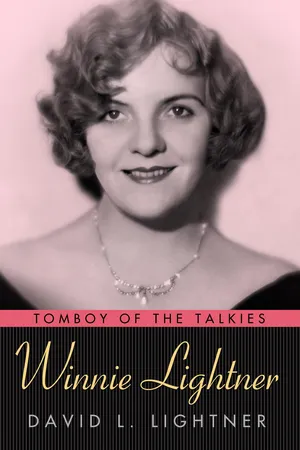
Winnie Lightner (1899–1971) stood out as the first great female comedian of the talkies. Blessed with a superb singing voice and a gift for making wisecracks and rubber faces, she rose to stardom in vaudeville and on Broadway. Then, at the dawn of the sound era, she became the first person in motion picture history to have her spoken words, the lyrics to a song, censored.
In Winnie Lightner: Tomboy of the Talkies, David L. Lightner shows how Winnie Lightner's hilarious performance in the 1929 musical comedy Gold Diggers of Broadway made her an overnight sensation. She went on to star in seven other Warner Bros. features. In the best of them, she was the comic epitome of a strident feminist, dominating men and gleefully spurning conventional gender norms and moral values. So tough was she, the studio billed her as "the tomboy of the talkies."
When the Great Depression rendered moviegoers hostile toward feminism, Warner Bros. tried to craft a new image of her as glamorous and sexy. Executives assigned her contradictory roles in which she was empowered in the workplace but submissive to her male partner at home. The new persona flopped at the box office, and Lightner's stardom ended. In four final movies, she played supporting roles as the loudmouthed roommate and best friend of actresses Loretta Young, Joan Crawford, and Mona Barrie.
Following her retirement in 1934, Lightner faded into obscurity. Many of her films were damaged or even lost entirely. At long last, this biography gives Winnie Lightner the recognition she deserves as a notable figure in film history, in women's history, and in the history of show business.
- 288 pages
- English
- ePUB (mobile friendly)
- Available on iOS & Android
eBook - ePub
About this book
Information
Print ISBN
9781496809834
Subtopic
Film History & CriticismCHAPTER 1
A Tomboy in Pigtails
PEOPLE SCREAMED AND SCATTERED IN TERROR AS A HORSE CAREENED through the heart of town. Astride the beast, clinging on somehow, were four drunken men. They drove the poor animal at full gallop until at last it collapsed, spilling its riders in all directions. As the horse struggled to get up, a local teenager dashed into the street and grabbed its bridle, only to be set upon by one of the drunks. The teenager returned punch for punch and knocked the man down. But the attacker leaped to his feet, pulled out a knife, and rushed at the youth a second time. The youth dodged the blade and again trounced his assailant. The other three drunks then joined the fray. Fortunately for the outnumbered young man, a town constable appeared. Weighing in with his billy club, the constable whacked the skulls of one drunk after another. Soon all four were splayed on the ground, unconscious.
These stirring events took place 2 December 1893 in Greenport, a coastal village on the north fork of Long Island ninety-five miles east of New York City. Greenport usually was a more tranquil place. Most days the loudest noise was the squawking of seagulls, and the biggest nuisance the odor of fish being made into fertilizer at a local plant. The brave youngster who tried to seize control of the horse was Chauncey Reeves, who was just shy of his nineteenth birthday. The constable who arrived in the nick of time was Chauncey’s father. Chauncey would eventually follow in his father’s footsteps and become a policeman. For now, though, he had other ideas. He had already worked in a traveling minstrel company, learning the ropes and developing his talents. Now he sought engagements as a “blackface single” in vaudeville. Chauncey may have been as adept at singing, dancing, and rubbing his face with burnt cork as he was at swinging his fists; nobody knows for sure. The only surviving evidence of his show-business career is a mention in an obituary published after he died at age seventy-three. Apparently he was one of the legions of young men and women who dreamed of climbing the ladder to stardom but never managed to get a firm foothold on the first rung.
Less than a year after his encounter with the drunks and their runaway horse, Chauncey Reeves married. His bride was eighteen-year-old Winifred Touhey, an immigrant from Ireland. Probably the marriage was hastily arranged, for Winifred soon gave birth to the couple’s first child, a boy. They named him Joseph. It may have been that event that persuaded Chauncey to give up his show-business ambitions and settle down in Greenport, where he could support his young family more reliably. Two years later Winifred gave birth to a second son. They named him Frederick. Finally, on 17 September 1899, Winifred bore a third child, this time a girl. What should have been another joyful occasion turned to tragedy, however, for Winifred died in childbirth. Suddenly Chauncey Reeves became a bereaved single parent faced with the daunting responsibility of caring for two little boys and a newborn girl.
Chauncey now made three decisions, each of them harrowing but understandable given his circumstances. First, he named the newborn baby Winifred Josephine Reeves, preserving the memory of the wife he had just lost by giving his newborn daughter the same first name. Second, he moved back into his parents’ home. Third, and most agonizing of all, he entrusted the care of two of his children to others. By moving in with his parents, Chauncey could continue to provide a home for the younger of his two boys: Little Freddie could be looked after by his grandmother while Chauncey went to work on the fishing boats. But rather than burden his mother additionally with the care of the other two children, Chauncey decided to place them with relatives who would raise Joseph and Winifred as their own. Chauncey’s late wife was survived by a brother and a sister. Joseph was given to the brother and his wife. Winifred was entrusted to the sister and her husband. So it came to be that Winifred was, from infancy, brought up by her aunt and uncle.
Winifred would grow up to become Winnie Lightner, star of stage and screen. The name Lightner did not come from her foster parents, however, or from any of the four men Winnie would eventually marry. Just how Winnie became a Lightner will be explained, but not just now, for that development marked the end rather than the beginning of her childhood.
Winnie’s foster parents were Margaret and Andrew Hansen. Both were thirty-four years old when Winnie entered their lives. The Hansens resided on the Upper West Side of Manhattan, where they rented accommodations in a five-story tenement on the south side of Sixty-Sixth Street just west of Broadway. Their building and its neighbors were packed closely together, each occupying a lot one hundred feet long and twenty-five feet wide, with narrow airshafts providing a modicum of light and ventilation to the interior rooms. The immediate neighborhood was decidedly a working-class area, although not as insalubrious as the notorious Hell’s Kitchen, which lay a little way to the south, from Fifty-Ninth Street on down to Thirty-Fourth. Some of the Hansens’ male neighbors were day laborers, but many were skilled craftsmen. They included a carpenter, a cobbler, a barber, a baker, and a candy maker. Most married women did not work outside the home, but the widowed and single were employed as laundresses and cleaners.
Andrew Hansen was a stationary engineer, a tradesman skilled in the operation of heavy equipment like boilers and steam engines. He probably walked to work. Only a block west of his home stood a cluster of big storage tanks operated by the Consolidated Gas Company. Just beyond them sprawled the switching yards of the New York Central Railroad. Then a series of piers poked like the teeth of a comb into the Hudson River. At the piers a procession of steam-powered lighters arrived and departed, ferrying railway freight cars to and from New Jersey and throughout the busy harbor. Such an industrial environment offered many employment prospects for a man with Andrew’s training. Indeed, among the railroad sidings just west of his home stood an engine and boiler house, an ideal workplace for a stationary engineer.
The tragic circumstances of her birth left no mark upon Winnie, whose earliest memories were of the security and stability of life in the Hansen household. She naturally formed her primary emotional connection with her foster parents. It was to Andrew Hansen she turned when in need, as on the occasion when (according to a newspaper account) she broke open a hotel room door, “aided by her foster father and a crowbar,” in order to catch her philandering husband and a chorus girl in flagrante delicto. But we are getting ahead of our story.
The Hansen family lived in modest comfort, and Winnie had a happy childhood. Unlike some of the other performers she would come to know during her years in vaudeville, she never went hungry or suffered abuse. She spent carefree days playing with the other children on her street, joining in their sports and mischief. A favorite sport was “one-old-cat,” a game of stick and ball in which a batter ran to the pitcher’s position and back again. The mischief included such delights as roasting “mickies” (pilfered potatoes) over an open fire. Also, she later recollected, “I used to jump on the back of ice wagons with the boys. I even fought it out with bare fists in an empty lot on Columbus Avenue with a local bully—and won.” Looking back from the perspective of an adult, Winnie realized that she had been a classic example of a little tomboy in pigtails. “I was just as much a member of the gang as any dirty-faced boy in the whole crowd,” she recalled. “I could run from a cop as fast as any other kid.”
Winnie believed that her tomboy childhood served her well. “I have never had trouble with men,” she observed. “The free-and-easy spirit of comradeship developed through playing with the kids some years ago has resulted in the most complete protection a girl could want. . . . Every man appreciates what he calls the ‘regular fellow’ among women. He never tries making undue or improper advances to the girl or woman he knows is a ‘regular fellow.’ Usually she is both pretty and pretty strong, and her care-free manner is her greatest protection.” Winnie liked men and was pleased when they found her attractive, but she was never deferential to them or emotionally dependent on their approval. Confident that she was both pretty and pretty strong, she thought for herself and made her own decisions. In that respect the woman they came to call the tomboy of the talkies had been a tomboy virtually all her life.
Winnie’s childhood world gradually expanded beyond the confines of her immediate neighborhood. Decades later she still remembered the impressive landmarks that ranged eastwards from her home. Almost across the street, she recalled, the Hotel Marie Antoinette stood at the northwest corner of Sixty-Sixth and Broadway, extending along the latter for an entire block northward. The older part of the hotel rose eight stories, while its more northerly addition reached twelve. The building’s vastness impressed little Winnie, who would have been even more impressed had she known that it contained no fewer than five hundred guestrooms and even more impressively (by early twentieth-century norms), three hundred bathrooms. Walking east from the Marie Antoinette, Winnie would pass the Sixty-Sixth Street entrance to the subway line that had opened along Broadway in 1904, touching off a frenzy of real estate development, but not reducing the traffic congestion that plagued the great thoroughfare.
Once she had negotiated her way across the no-man’s-land of carts, carriages, and a few sputtering automobiles that was Broadway, Winnie could continue on along Sixty-Sixth Street. Almost immediately she would pass beneath the massive steel supports for the elevated train that ran up Columbus Avenue, and then she could gaze in wonder through the plate glass windows of Thomas Healy’s lavish restaurant and night club, situated on the northeast corner of Sixty-Sixth and Columbus. The sea of tables, each covered with a crisp white cloth and sparkling place settings, the soaring columns ornamented with elaborate plasterwork, and the lofty ceiling studded with chandeliers were a far cry from the humble kitchen where Winnie and her foster parents ate their meals. Healy’s was popular with the so-called sporting crowd, its airy dining and ballrooms accommodating upwards of a thousand patrons, often including theatrical celebrities and, occasionally, notables such as Theodore Roosevelt and King Albert of Belgium. Private parties wishing to dine more intimately at Healy’s could book the Silver Grill Room, the Log Cabin Room, the African Jungle Room, or the Beefsteak Dungeon.
Winnie probably would have been a tad too young to join in the merriment when a great crowd of rubberneckers gathered in the wee hours of 13 August 1913 to watch a squad of policemen raid Healy’s for violating the city’s curfew law. Tables were overturned and crockery smashed as the officers clubbed, shoved, and dragged outside the several hundred customers who defied an order to exit the premises. Twenty-four hours later, Healy’s was back in business, partly because the district attorney sided with the proprietor, who argued that the curfew required him to shut down only his bar, but mainly because the police commissioner thought better of enforcing the law in the face of public ridicule. When he had enforced the curfew, the commissioner had ignored the well-known fact that Healy’s was frequented by prostitutes. The latter were always elegantly dressed and accompanied by male escorts. So long as both courtesans and clients behaved with discretion, nobody cared.
Next door to Healy’s loomed another impressive landmark, the St. Nicholas Rink. Fronted by a series of eleven neoclassical arches with flagpoles in between, the St. Nicholas was an indoor ice-skating rink, one of the first to be equipped with a mechanically frozen surface. Erected in 1896 by a consortium of investors that included John Jacob Astor and Cornelius Vanderbilt, the building also served as a venue for prizefights. When describing her childhood, Winnie gave no hint that she had ever gone skating at the St. Nicholas, but she did vigorously defend the sport of boxing, suggesting that she and her playmates may have attended some of the prizefights. “It is far healthier for a woman or a young girl to watch a clever exhibition of the art of self defense,” she declared, “than to sit in a stuffy theater watching some vampire-type actress show them a few tricks as to how to use their physical charms on men. It is far safer for a group of girls and boys to sit at ringside watching a clean bout than for a group of girls to gather in the ladies room of a smart hotel and exchange some of the stories such girls usually boast of knowing and telling.”
East of the St. Nicholas Rink stood another remarkable edifice, Durland’s Riding Academy. This complex, which extended through the block to Sixty-Seventh Street, housed a huge arena, stables for hundreds of horses, and an assortment of lounges and clubrooms. People came here to saddle up for canters along the four-mile bridle path in Central Park. Those who wished to enjoy the fresh air in a more sedate manner could hire a carriage as well as a horse. Riding lessons were given in the arena, and every afternoon there was a “music ride” for those who preferred to do their cantering indoors accompanied by forty musicians. Because the arena had a balcony with seats for six hundred, all sorts of other activities took place there, ranging from at least one meeting of suffragettes, to games of “horseketball,” in which young men played an equestrian version of basketball, attempting slam-dunks while keeping a firm grip on the reins. Even if Winnie never got to see any of the wonders inside Durland’s arena, she could at least enjoy the spectacle of the horses and carriages entering and exiting the stables in a steady stream.
Even more memorable than the grand buildings in Winnie’s purview was the leafy paradise that stretched beyond them. Central Park, a vast oasis of greenery only a two-block stroll from Winnie’s home, was an almost entirely artificial creation sprung from the genius of architects Calvert Vaux and Frederick Law Olmsted. But in the eyes of a child like Winnie the park seemed a miraculous vestige of primeval nature within the heart of the metropolis. Here were mysterious rocky outcrops to climb, ponds to splash about in, birds and squirrels to feed, and paths to explore amid labyrinths of flowering shrubs and trees. Winnie remembered especially the great Sheep Meadow due east of Sixty-Sixth Street, where John Conway, the Central Park shepherd, tended his flock. Winnie was among the three generations of children that Conway befriended, allowing them to carefully hold the newborn lambs in their own small arms. It was perhaps from him that Winnie acquired a life-long love of animals, which she would later indulge by keeping a series of pets, beginning with little lapdogs that could be carried about in hotels and Pullman cars, and ending, at her Hollywood mansion, with enormous St. Bernards that could well have carried her.
Besides visiting Conway at his usual outpost in the park, Winnie may have seen him nearer her home. On 18 May 1913, the city of New York held a grand civic pageant in which twelve thousand municipal employees paraded up Broadway as half a million spectators looked on. Clerks, cleaners, gardeners, street sweepers, and policemen were all applauded. The firemen and the mighty draft horses that pulled their engines were greeted with special enthusiasm. Another favorite with the crowd was Winnie’s friend John Conway, clad in a kilt and accompanied by his two faithful collies and a dozen of his prettiest sheep.
While the streets of New York provided an education in themselves, Winnie also received more systematic instruction. When she reached the appropriate age, the Hansens enrolled her at a Catholic parochial school operated by the Church of the Blessed Sacrament on West Seventy-First Street between Broadway and Columbus. Established by the founder of the parish, Matthew A. Taylor, and commonly known as Father Taylor’s School, the institution was opened in 1903 and staffed by the Sisters of Charity of Mount St. Vincent. The school offered classes through the eighth grade, and Winnie completed the whole program. By the standards of the day, she received a good education, one far superior to that of most vaudevillians, many of whom had little or no formal schooling.
Winnie remembered one more important edifice from her childhood. She once told an interviewer that the back of her home had faced the rear wall of a vaudeville theater. Sometimes when the theater was empty and its emergency exit doors propped open for ventilation, she would sneak inside and climb up onto the stage. There she would perform childish stunts and pretend that she was entertaining a vast audience. One day a janitor caught her in the act, gave her a clout on the ear with his dustless mop, and ordered her to leave. “I told him I’d go,” Winnie recalled, “but someday he’d pay admission to see me on that stage. And he did, too.”
If the story is true, then its setting was the Lincoln Square Theater, which was indeed situated so that its rear exits opened just opposite the tenements that lined the south side of Sixty-Sixth Street. The front entrance to the theater was on Sixty-Fifth Street, but it could also be reached from Broadway by walking through an arcade that transected a block-long, six-story building containing a warren of shops, offices, and furnished rooms, the last named being inhabited by a motley collection of starving artists, bohemians, alcoholics, and eccentrics. The Lincoln Square Theater was erected in 1906 on what had been an empty lot. It had seating for sixteen hundred and claimed to be the safest theater in existence, having not just the only steel and asbestos safety curtain in the city, but also the only water curtain in the world (the latter an artificial cascade that would flow from sprinklers above the proscenium in the event of a fire).
At first a stock company put on plays in the new theater, but in September 1908 the prominent theatrical agent and entrepreneur William Morris began using it as a venue for high-class vaudeville. Morris did not prosper in that location, however, and so fourteen months later the theater was taken over by Marcus Loew, who was pioneering a new form of entertainment that combined a multi-reel motion picture with a relatively small number of minor vaudeville acts. Loew repeated his complete program several times daily, in contrast to the “two-a-day” (a matinee and then a single evening performance) that was the norm among the “big-time,” all-vaudeville shows staged by people like William Morris. Because his low costs enabled him to charge exceptionally low admission prices, Loew hit upon a formula that would enable him to build an empire. The Lincoln Square was one of the earliest of what eventually totaled some two hundred Loew’s theaters, peppering New York City but also ranging as far as Chicago and Dallas. Loew’s formula would continue to prosper long after big-time vaudeville had disappeared.
From this little potted history of the Lincoln Square Theater, it can be deduced that Winnie larked about in its empty auditorium during the fourteen months when William Morris was in charge, for then the house routinely stood empty for around three hours each day between matinee and evening shows. Once Marcus Loew took over, there would have been no opportunity for a little girl to sneak inside and play at being a star. Winnie was therefore about nine years old when she first set foot on a vaudeville stage—and was rewarded with a vigorous smack from a mop.
Six years later Winnie again cavorted on a vaudeville stage, but this time she was appearing as a full-fledged professional. She had come out of nowhere right into the big time. That was extraordinary. Many vaudevillians had to toil for years at exhausting, low-paid work in places like dime museums, medicine shows, or carnivals before they managed to gain entry into even small-time vaudeville. Then nearly everybody had to spend a decade or so eking out a living on the lesser vaudeville circuits before they at last succeeded in advancing to the big time, if indeed they ever got there at all.
Winnie’s shortcut to the big time came about because she was taken under the wings of two established performers, both twice her age, who decided to take a chance on a fifteen-year-old unknown. Their names were Newton Alexander and Theodora Lightner. This stroke of luck explains how the girl who had been born Winifred Reeves and then spent her childhood as Winifred Hansen became Winnie Lightner. A vaudeville act named “Newton Alexander, Theo Lightner, and Winnie Hansen” was too big a mouthful. Better to call it “The Lightner Sisters and Newton Alexander,” with Winnie adopting Lightner as her stage name and posing as Theodora’s sibling.
The next two chapters will trace the careers of Winnie’s vaudeville partners ...
Table of contents
- Cover
- Half title
- Title
- Copyright
- Contents
- Introduction
- Chapter One A Tomboy in Pigtails
- Chapter Two The Exposition Four
- Chapter Three Newton and Theo
- Chapter Four A Jolly Trio
- Chapter Five Scandals and Revels
- Chapter Six Movies That Talk and Sing
- Chapter Seven Gold Diggers of Broadway
- Chapter Eight She Couldn’t Say No
- Chapter Nine A Singer Silenced
- Chapter Ten Feminism Restrained
- Chapter Eleven Best Friends Forever
- Chapter Twelve I Never Cared a Hang for Fame
- Acknowledgments
- Stage Career and Filmography
- Notes
- Index
Trusted by 375,005 students
Access to over 1.5 million titles for a fair monthly price.
Study more efficiently using our study tools.
Frequently asked questions
Yes, you can cancel anytime from the Subscription tab in your account settings on the Perlego website. Your subscription will stay active until the end of your current billing period. Learn how to cancel your subscription
No, books cannot be downloaded as external files, such as PDFs, for use outside of Perlego. However, you can download books within the Perlego app for offline reading on mobile or tablet. Learn how to download books offline
Perlego offers two plans: Essential and Complete
- Essential is ideal for learners and professionals who enjoy exploring a wide range of subjects. Access the Essential Library with 800,000+ trusted titles and best-sellers across business, personal growth, and the humanities. Includes unlimited reading time and Standard Read Aloud voice.
- Complete: Perfect for advanced learners and researchers needing full, unrestricted access. Unlock 1.5M+ books across hundreds of subjects, including academic and specialized titles. The Complete Plan also includes advanced features like Premium Read Aloud and Research Assistant.
We are an online textbook subscription service, where you can get access to an entire online library for less than the price of a single book per month. With over 1.5 million books across 990+ topics, we’ve got you covered! Learn about our mission
Look out for the read-aloud symbol on your next book to see if you can listen to it. The read-aloud tool reads text aloud for you, highlighting the text as it is being read. You can pause it, speed it up and slow it down. Learn more about Read Aloud
Yes! You can use the Perlego app on both iOS and Android devices to read anytime, anywhere — even offline. Perfect for commutes or when you’re on the go.
Please note we cannot support devices running on iOS 13 and Android 7 or earlier. Learn more about using the app
Please note we cannot support devices running on iOS 13 and Android 7 or earlier. Learn more about using the app
Yes, you can access Winnie Lightner by David L. Lightner in PDF and/or ePUB format. We have over 1.5 million books available in our catalogue for you to explore.