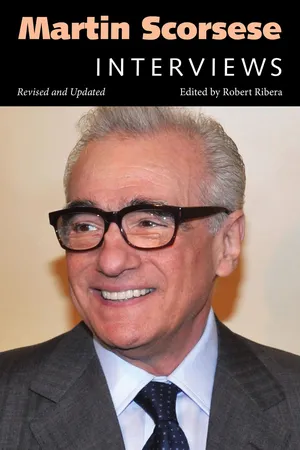
Martin Scorsese (b. 1942) has long been considered one of America's greatest cinematic storytellers. Over the last fifty years he has created some of the most iconic moments in American film, never afraid to confront controversial issues with passion. While few of his films are directly autobiographical, his upbringing in New York's Little Italy, the childhood asthma that kept him from playing sports, and his early desire to enter the priesthood all helped form his sensibilities and later shaped his distinct style. Community, religion, violence—these themes drive a Scorsese picture, and whether he examines the violence that bursts forth in the hand of Travis Bickle or the passion of Jesus Christ, Scorsese's mastery of the history, art, and craft of filmmaking is undeniable.
This collection was originally edited by the late Peter Brunette in 1999 and is now revised and extensively updated by Robert Ribera. It traces Scorsese's evolution from the earliest days of the New American Cinema, his work with Roger Corman, and his days at New York University's film program to his efforts to preserve the legacy of cinema, his documentary work, and his recent string of successes. Among new movies discussed are The Departed, Hugo, and The Wolf of Wall Street, and the documentaries No Direction Home and The Blues. Scorsese stands out as a director, producer, scholar, preservationist, and icon. His work both behind the camera and in the service of its history are a cornerstone of American and world cinemas. In these interviews, Scorsese takes us from Elizabeth Street to the heights of Hollywood and all the journeys in between.
- 320 pages
- English
- ePUB (mobile friendly)
- Available on iOS & Android
eBook - ePub
About this book
Information
Subtopic
Film & VideoDialogue on Film: Martin Scorsese
From a Harold Lloyd Master Seminar with Martin Scorsese, held on February 12, 1975.
©1975 American Film Institute. Reprinted by permission.
©1975 American Film Institute. Reprinted by permission.
James Powers: Okay, ladies and gentlemen, in violation of all fire laws, I welcome you to this crowded seminar. You’ve just finished seeing Mr. Scorsese’s work and I won’t intrude myself any further between you and him. Questions anybody?
Question: Why did you choose to move the camera so much in Alice Doesn’t Live Here Anymore?
Martin Scorsese: There are a lot of reasons for that. First, and it’s really an intellectual reason I’m giving you now—it doesn’t mean anything to you, watching the picture, it’s just something for me, that’s all. The intellectual reason is that I was trying to capture a number of characters who were really very much in a state of confusion and never really settling. So the camera is always kind of shifting around, moving around, slightly sliding. Whenever it seems to stop, it starts all over on the other side again. When it does stop, they are usually in scenes of stability, like in the bathroom scene between Ellen Burstyn and Diane Ladd. And in the scene where she has just made love to Kris Kristofferson—the two of them talking—it’s basically a medium shot on her with Kris in the frame, a medium shot of her with Kris in the foreground, or a medium shot of him with her in the foreground, so the two are together in the frame. The camera only moves twice in that scene—when she gets up to demonstrate what she used to do as a kid, the camera moves this way [motioning] and when she comes back to sit on his lap, the camera moves in, just the way she’s moving in, on him.
Q: In other words, you move the camera essentially because the character moves the camera?
MS: Oh, no, no. It has nothing to do—sometimes the camera moves because the person moves, so you move it. But other than that, in this case, the camera moved when she got up to move. I could have just panned but it was an actual track. It has a different meaning for me. The other thing is I like a moving camera.
Q: You didn’t move the camera much in The Big Shave either. Why was that?
MS: The Big Shave—you couldn’t move too much in that room. That was all clips like a TV commercial. In Mean Streets, it was the same thing, the guys talking at the table, the sliding, sinister feeling to it. In Boxcar Bertha, when Barry Primus was trying to pull a fast one with the cards so he’s kind of smiling sleazily, the camera’s kind of sleazy, sliding against the edge of the table. That’s where it really started, in Boxcar. What I was looking for was to give a kind of psychologically unstable feeling to the audience with those characters at those moments. You just don’t feel quite settled watching those scenes. That sequence in Alice where Ben breaks into the room—now, if you notice, that sequence begins with Alice talking to her young boy, Tommy, and he says, “Are you coming home late again tonight?” That scene could have been shot simple two-shot, close-up to close-up, but I did it hand-held and went around this way, and in that sense it was a premonition of violence because the camera is kind of violent, seemingly for no reason. But if you go back and look at it—and the whole picture is like that—I mean, we did it that way. Sometimes I was in rooms where I couldn’t avoid it; I had to use a hand-held camera. The room was the size of this couch so I had to move the camera by hand, whereas many times I had planned it to be moved by dolly. Like in the scene in Alice where they go pick up the kids in the police station, the whole thing was laid out in dolly, all in one take. It is in one take now, only it’s hand-held. People think I did it hand-held to give it documentary, quote, unquote, feeling, the old phony black-and-white realism, because in the late forties, it was all grainy black-and-white and it gave you the impression of something being realistic. But in this case that was definitely not the reason. The reason was because I had a welfare worker and I had to get rid of the kid. We couldn’t dolly to the point where now we get the measurements here, focus, now you move over here, get the measurements here, they have to hit each mark. This way, we did it hand-held with a 16mm lens on an Arri BL and everything was in focus and I could shoot the scene fast and get the hell out of there. That’s a pain in the neck. I would have liked to have done it with a dolly. This scene was all laid out nicely.
Q: Did you rehearse Alice? How did you rehearse it?
MS: Alice was rehearsed. Alice has more rehearsal and improvisation than Mean Streets had. The reason was—Ellen asked me to do the picture for her. She got the script through David Susskind and Francis Coppola told her to, you know, she was looking for young filmmakers and Francis said, “Take a look at Mean Streets.” Mean Streets hadn’t opened yet and Warner Bros. had just bought it. She looked at it and liked it. Sandy Weintraub read the script for me and she said, “This is one of the few scripts that have any interesting characters in them so you’d better take a look at it.” Because we were getting hit with scripts that dealt with similar worlds to Mean Streets. The reason I’m going all the way back is because it’s very complicated—you can’t just say how much rehearsal we had on that picture because it’s really a crazy thing. Anyway, the point is that what happened with Alice was that we started working when I met Ellen. I wanted to see if Ellen had the same ideas I had about the script. And she did and I had similar ideas to what she had. John Calley wanted us to, you know—Ellen was an Academy Award nominee for The Exorcist and Mean Streets was going to open. They had no idea how good or bad it was going to do financially but we got incredible reviews at the time. So they said, “Let’s put the two of them together and if they agree on certain things, fine.” And that’s what happened. We agreed to do that kind of a film. You could call it, I don’t know what. It’s a picture about emotions and feelings and relationships and people in chaos. Which is something very personal to me and to Ellen at the time. We felt like charting all that and showing the differences and showing people making terrible mistakes ruining their lives and then realizing it and trying to push back when everything is crumbling—without getting into soap opera. We opened ourselves up to a lot of experimentation.
Robert Getchell, who wrote the script, we talked to him and he said, “Yeah, I realize the beginning with the husband is not quite right and the last whole sequence where she meets the farmer is not quite right.” I said, “Okay, let’s take a chance at rewriting that.” So we started to rewrite that stuff and we still weren’t satisfied. I started doing improvisations in New York with Ellen and some other actors in certain scenes. Then, from the improvisations, myself and Sandy Weintraub and Larry Cohen—Larry Cohen was the production executive and actually in the long run wound up producing the picture—we got together and we started writing up scenes and ideas based on the improvisations that Ellen and I did. Those scenes were then shifted over to Robert Getchell—we let him take a rest because he had been doing a year of rewrites on the thing under Susskind—and he looked at it and agreed with most of the things we wanted to do. He added some stuff, he wrote whole new scenes, he came back with new ideas. Certain scenes I still didn’t care for and I said, “We’re going to try working on these scenes. These scenes are good, keep these. I’m still not sure about this.” So what happened eventually was that whenever we did improvise something, we improvised it usually during the rehearsal period, two weeks prior to shooting. The other improvisations were in New York while we were casting because we needed to get the script in shape. And then, two weeks before we started shooting in Tucson, we improvised a little more and then we sent that back to Bob and Bob gave us a few extra lines. Sometimes, you see, his dialogue was important because of colloquialisms and things which I didn’t know in the Southwest. He gave us that sort of thing and we took the best of what he could give us, we gave it our best, and very often you’ll find a scene like Ellen and Kris Kristofferson in the kitchen, which started out as a kind of scene where in the original script it has her saying, “Oh, I remember sitting under the trees thinking about Alice Faye,” and we had already done that, you know. So what could be new? It’s a scene that really reveals each person to the other. Ellen got up and said, “I used to do this when I was working with my brother, my first business in show business.” She actually did it and that’s what’s in the picture. I said, “That’s great.” Then Kris gave us his lines. The only written stuff in the scene is at the end where he says, “Are you sure what you want to do? Do you want to go home? Do you want to sing? You can’t have everything.”
Q: So those were improvised before shooting and transcribed and rewritten?
MS: Oh, yes. Transcribed and rewritten. For a scene like that, though, we improvised it and kept on improvising it and what really happened was that we had it written down the morning of the shooting. Which I didn’t care for very much but we did it anyway and therefore I shot a fifteen-minute scene. This fifteen-minute scene was eventually cut down to about three minutes. But again, that’s another reason for shooting it simply—medium shot, medium shot, two-shot. Same thing with the bathroom scene.
Q: The thing that’s interesting, though, is that you’re really right on the edge all the time between going over to soap opera and yet you don’t and it works. Did you evolve any rehearsal techniques or anything to get the actors to that point?
MS: Well, we were really dealing with our own feelings and our own emotions. A lot of peoples’ lives are soap operas; mine is anyway. Basically I think if you’re in touch with your own feelings—it was almost like analysis for all of us. It’s crazy. It was a madhouse but it was fun. That was the good thing about it because when somebody would come up with a good idea, it was really good. We’d write it down, improvise, terrific. It was a matter of trying to feel what you were feeling at the moment. We kind of—and that’s one of the faults, I feel—we got caught up more with what was happening to us. Maybe it isn’t a fault; I don’t know. But we got caught up more with what was happening to us at the moment, in our own feelings, on the set, in that damned Tucson. I’m a New Yorker and I’m in the desert. Cactus. I got crazy with cactus alone. So I’ve got all those feelings wound up in me and that’s what came out. Because I was feeling like that at the moment. It was unlike Mean Streets because Mean Streets was a picture that went straight down the line.
Q: I got a feeling of improvisation in Mean Streets also.
MS: Yes, there’s some improvisation there. Of course, the scene where Bob De Niro and Harvey Keitel are in the back room arguing over money was totally improvised.
Q: How do you then choose your actors? Particularly for Mean Streets, because they were extraordinary actors with the capacity also to improvise and still maintain character. You had some really good characters. Did you have the characters before the actors or how did you work that?
MS: Mardik Martin and I wrote Mean Streets in 1966. Wrote the outline. I wrote the outline first and then brought it to Mardik, who used to write all my shorts with me at NYU. Mardik and I sat down and Mardik worked out the structure for me and I worked out the characters and the incidents. Then we took the script around for years and we could never get it done. That was the end of that so we put it away. Well, eventually, when we did get it done, I had those characters down. It was originally written for Harvey Keitel to play the lead of Charlie, mainly because when we wrote the first version of Mean Streets, I had just completed a film called Who’s That Knocking at My Door. I should say, the first version of that film, because it took me three years to finish it. So what happened was that, after the first version of Who’s That Knocking at My Door, which was a disaster, I sat down and said, “Now I’m going to write something that, everything I couldn’t get in in Who’s That Knocking, I’m going to get in here.” It turned out to be Mean Streets. Besides it being almost autobiographical, it was easier, in a sense, to make than Alice. Because I had a grasp of the people; I knew the people. De Niro knew the people. He knew the guys from downtown, he lived on 14th Street. Keitel knew them because he knew them from Who’s That Knocking and he came from Brooklyn. Richard Romanus, the guy who played Michael, we found him at the Jon Voight workshop here in LA. but actually, he was a New Yorker. And David Proval is also a New Yorker from Brooklyn but we found him in the Jon Voight workshop also. Amy Robinson is a New Yorker. We found all of these guys and the film kind of lent itself to improvisation. There are only, maybe, three or four scenes that are really improvised. But we also improvised during rehearsal again. Taped and then written from the tape.
Q: There are several moments in Mean Streets where it’s not voiceover in the usual sense but where you almost get inside the character’s head in terms of what he’s thinking. Was that really in the script or did that come later?
MS: We had more of that. We had more in the script and I chopped it out.
Q: It worked almost to the point where it was unnoticeable.
MS: Yes, that’s what I tried to get to. Because what happened was, the first version of the script was steeped very much in the religious conflict. See, the whole idea was to make a story of a modern saint, you know, a saint in his own society but his society happens to be gangsters. It should be interesting to see how a guy does the right thing, that’s the old phrase they use, “the right thing,” in that world. Somebody does something wrong, you’ve got to break his head or you shoot him. It’s as simple as that. He became a character who refused to acknowledge that and eventually did the worst thing he could do which was to put everything off, put all the confrontations off, until everything explodes. It’s the worst thing you can do. It’s the same way in the movie business. You’ve got to go into the room with the producer first thing and say, “Hey, I think this thing sucks. I won’t do it.” That’s what you’ve got to do. Otherwise you can put it off and put it off until, finally, they cut your picture down or whatever—they fire you or you walk off and it’s a disaster. It’s a matter of knowing where your heads are at right away. But this character wants to avoid unpleasantness at all costs. You notice he’s always separating people when they fight. “Come on, we’re all friends,” he says. The voiceover was the whole business of his own relationship with God, his own way of looking at things. And also his guilt. This is a minor thing—it’s not even in the film—but it’s in the film if you’re really Catholic and you look at it closely. He would go to confession but he wanted to deal with things in his own way so he would never really—there’s an old heretical sect that felt they were not worthy of anything. They would go to confession but would not go to communion because they felt th...
Table of contents
- Cover
- Half title
- Title
- Copyright
- Contents
- Introduction
- Chronology
- Filmography
- Martin Scorsese and the American Underground Doris Freedman / 1970
- Dialogue on Film: Martin Scorsese The American Film Institute / 1975
- Taxi Dancer: Martin Scorsese Interviewed Jonathan Kaplan / 1977
- Raging Bull Michael Henry / 1981
- Taxi Driver Paul Schrader / 1982
- Chalk Talk Peter Biskind and Susan Linfield / 1986
- Martin Scorsese: In the Streets Peter Occhiogrosso / 1987
- . . . And Blood Richard Corliss / 1988
- Scorsese: A Bicoastal Story Amy Taubin / 1988
- What the Streets Mean Anthony DeCurtis / 1990
- Martin Scorsese Interviewed Gavin Smith / 1993
- Martin Scorsese’s Testament Ian Christie / 1996
- Everything Is Form Amy Taubin / 1998
- Fresh Air: Director Martin Scorsese Terry Gross / 2003
- 2006 Charles Guggenheim Symposium Honoring Martin Scorsese Jim Jarmusch / 2006
- Martin Scorsese on The Departed Michael Goldman / 2006
- Docufictions: An Interview with Martin Scorsese on Documentary Film Raffaele Donato / 2007
- In Hugo, Scorsese Salutes a Movie Magician Melissa Block / 2011
- The Art of Martin Scorsese Jim Leach / 2013
- DP/30: Scorsese on The Wolf of Wall Street David Poland / 2014
- Index
Trusted by 375,005 students
Access to over 1.5 million titles for a fair monthly price.
Study more efficiently using our study tools.
Frequently asked questions
Yes, you can cancel anytime from the Subscription tab in your account settings on the Perlego website. Your subscription will stay active until the end of your current billing period. Learn how to cancel your subscription
No, books cannot be downloaded as external files, such as PDFs, for use outside of Perlego. However, you can download books within the Perlego app for offline reading on mobile or tablet. Learn how to download books offline
Perlego offers two plans: Essential and Complete
- Essential is ideal for learners and professionals who enjoy exploring a wide range of subjects. Access the Essential Library with 800,000+ trusted titles and best-sellers across business, personal growth, and the humanities. Includes unlimited reading time and Standard Read Aloud voice.
- Complete: Perfect for advanced learners and researchers needing full, unrestricted access. Unlock 1.5M+ books across hundreds of subjects, including academic and specialized titles. The Complete Plan also includes advanced features like Premium Read Aloud and Research Assistant.
We are an online textbook subscription service, where you can get access to an entire online library for less than the price of a single book per month. With over 1.5 million books across 990+ topics, we’ve got you covered! Learn about our mission
Look out for the read-aloud symbol on your next book to see if you can listen to it. The read-aloud tool reads text aloud for you, highlighting the text as it is being read. You can pause it, speed it up and slow it down. Learn more about Read Aloud
Yes! You can use the Perlego app on both iOS and Android devices to read anytime, anywhere — even offline. Perfect for commutes or when you’re on the go.
Please note we cannot support devices running on iOS 13 and Android 7 or earlier. Learn more about using the app
Please note we cannot support devices running on iOS 13 and Android 7 or earlier. Learn more about using the app
Yes, you can access Martin Scorsese by Robert Ribera in PDF and/or ePUB format, as well as other popular books in Media & Performing Arts & Film & Video. We have over 1.5 million books available in our catalogue for you to explore.