Literary scholar Michael A. Chaney examines graphic novels to illustrate that in form and function they inform readers on how they ought to be read. His arguments result in an innovative analysis of the various knowledges that comics produce and the methods artists and writers employ to convey them. Theoretically eclectic, this study attends to the lessons taught by both the form and content of today's most celebrated graphic novels.
Chaney analyzes the embedded lessons in comics and graphic novels through the form's central tropes: the iconic child storyteller and the inherent childishness of comics in American culture; the use of mirrors and masks as ciphers of the unconscious; embedded puzzles and games in otherwise story-driven comic narratives; and the form's self-reflexive propensity for showing its work. Comics reveal the labor that goes into producing them, embedding lessons on how to read the "work" as a whole.
Throughout, Chaney draws from a range of theoretical insights from psychoanalysis and semiotics to theories of reception and production from film studies, art history, and media studies. Some of the major texts examined include Marjane Satrapi's Persepolis; Chris Ware's Jimmy Corrigan: The Smartest Kid on Earth; Joe Sacco's Palestine; David B.'s Epileptic; Kyle Baker's Nat Turner; and many more. As Chaney's examples show, graphic novels teach us even as they create meaning in their infinite relay between words and pictures.
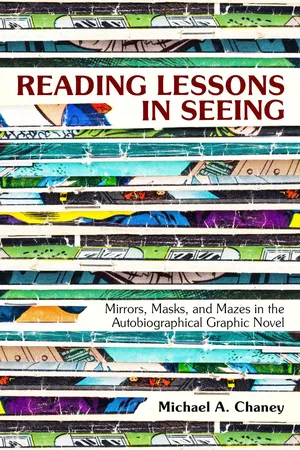
eBook - ePub
Reading Lessons in Seeing
Mirrors, Masks, and Mazes in the Autobiographical Graphic Novel
- 220 pages
- English
- ePUB (mobile friendly)
- Available on iOS & Android
eBook - ePub
Reading Lessons in Seeing
Mirrors, Masks, and Mazes in the Autobiographical Graphic Novel
About this book
Information
Index
Literature1
Mirror, Mask, and Mise en Abyme in Autobiographical Graphic Novels
Civilization’s first gesture is to hold up a mirror to the Object, but the Object is only seemingly reflected therein; in fact, it is the Object itself which is the mirror.
—Jean Baudrillard, The Transparency of Evil (172–73)
Why are there so many mirrors in graphic novels? Characters in comics are constantly playing Narcissus, particularly in the autobiographies. They look at themselves in mirrors ritually. Where actual mirrors do not appear, the gutters impersonate them and take on their properties. In such instances, gutters are neither empty nor simply connective but refractive. They reflect the panels between them while preserving a sovereign space of difference that allows panels to be read sequentially.1 Given their provocative abundance, mirrors both actual and symbolic in comics prod us to wonder about matters of illustration and fidelity, those inevitable departures from the Real that any drawing conveys and which become all the more telling in the case of a supposedly autobiographical text.
Lynda Barry’s One Hundred Demons (2002) opens by wondering the same thing. It begins with a mirror scene of Barry painting herself in a miniature self-portrait. She appears in the little picture exactly as she does in the larger one, the panel. A visual pun is created as a result of this arrangement. The smaller image may be seen as either a painting or a mirror. It is either an approximation or a faithful depiction of the painted world around it. Fortifying the conundrum, the accompanying captions raise questions of mediation and veracity as part of the memoir’s obligatory pact to tell the truth. Philippe Lejeune explains how the truth claims made at the start of any autobiography—what he calls the “autobiographical pact” (3)—help to establish an autobiographer’s authority according to subjective rather than verifiable truths. Although the autobiographical pact usually takes the form of a proposition, it comes as a series of questions in One Hundred Demons. Sitting at her drawing table in the first panel, Barry muses, “Is it autobiography if parts of it are not true?” In the second panel, she inverts the question: “Is it fiction if parts of it are?” (7). Her posture in the second panel mirrors the self-portrait on the table before her and plunges the whole scene into the abyss of the comics’ mirror.
The word “abyss” is apt as this scene exemplifies the classic trope of a reflection within a reflection, or mise en abyme, meaning “to place into the abyss.” For Barry, authorial introspection conjures a space outside of and prior to narrative, in which vexations peculiar to autobiography suspend the story before it officially begins. By calling attention to the same homology of content and structure that Jean Baudrillard’s epigraph describes above, Barry’s figure of the mirror-within-a-mirror seeks to assuage those anxieties of selfconsciousness.2 The very act of holding up a mirror to behold the terrors it reveals about the self is shown to be essential to the game of misdirection played by both psyches and forms of representation like the comics.
In a way, Barry’s outspokenness about the ineluctable fictions of life writing seems intended not solely to confess but also to bypass the paradoxes of her project. As Hillary Chute puts it in Graphic Women, “Barry embraces the discursive and generic fault lines of her work as productive, making that instability […] the basis upon which we approach her work” (109). By bridging the gulf between fact and fiction, Barry implicitly forces her audience to lend credibility even to the most fanciful elements of her paintings, such as the unruly parade of demons in the margins. Moreover, Barry’s collagebased aesthetic and scrapbookish sense of kitsch thicken the reading process, according to Chute, representing memory as a material construct, a “ruffling … [of] the visual surface of the text” (111). Eccentric, colorful, and surprisingly physical, Barry’s pictorial style divulges as it veils.
This familiar paradox of art being the lie—to paraphrase Picasso—“that helps us realize the truth” is not unique to Barry (qtd. in Cummings 98). Tensions between the cartoonish and the cathartic typify autography (or graphic novel memoir), as authorial anxiety compulsively regards itself in mirrors in a range of texts.3 Take, as another example, the climax of Harvey Pekar and Joyce Brabner’s collaborative autobiography, Our Cancer Year (1994). In the devastating wake of chemotherapy, the atrophied protagonist ponders his role as the writer of the long-running autobiographical comic American Splendor (1976–1993). In a triptych drawn by Frank Stack on the last page of Chapter Nine (the text is not paginated), Harvey looks at himself in a mirror wretchedly. The middle panel shows him asking Joyce, “Tell me the truth, am I some guy who writes about himself in a comic book called American Splendor?” A circular inset within that panel encloses his debilitated body like a filmic iris shot as he continues, “Or am I just a character in that book?” Determining where the self as a construct within a public text ends and the pained and private realities of existence begin is prerequisite to Pekar’s overcoming of cancer. Once again, meta-pictorial commentary calls forth doublings. Harvey is not just the character of Our Cancer Year at this moment of utterance, but also the protagonist of American Splendor. Here, Pekar is taking a metaphorical snapshot of himself in Our Cancer Year, suffering the same conflation of self and subject that unfolds slowly and episodically in the American Splendor series. Charles Hatfield diagnoses this conflation as a crisis of self-ownership: “Pekar has succeeded in mythologizing himself, transforming ‘Harvey’ into a property that belongs to him (or he to it?) but which nonetheless exceeds him” (109). And perhaps it is this excess of identity that visual narratives manage so efficiently, while obscuring distinctions between psyche and soma, agent and object—blurring them in the refractory representations of the mise en abyme.
As a final prefatory example, Gene Luen Yang’s semiautobiographical allegory of racial identity crisis, American Born Chinese (2006), includes a scene where Danny, a white teenager, discovers that he is the long-lost relative of Chin-Kee, who is little more than a montage of racist Chinese stereotypes. For much of the story, Danny exists in a state of constant embarrassment over the antics of Chin-Kee. Only near the end do we learn that white-bread Danny is really Jin Wang, a third character who struggles to accept his Asian difference. All is revealed when we witness how Jin awoke to see in a mirror that he had become Danny, the Anglo ideal he had so longed to embody. Simultaneous to these abrupt visual shifts is the demand that reader-viewers amend our understanding of the narrative logics of identity retroactively. Only through belated recognition do we comprehend the graphic novel’s ethnic hyperbole as nothing more than internalized distortions projected as optic truths before the mirror.
All of these uses of the mirror reinforce an iconographic shorthand widespread in pop culture. The trope of the mirror as the screen on which the interior is projected derives from the same cultural clichés that equate happiness to a hearty appetite for looking contentedly at oneself. For evidence of this, we need look no further than pharmaceutical television commercials. How often do they portray people feeling good about themselves (presumably after taking the advertised pill) by showing them catch satisfying glimpses of their reflections, preferably in the rearview mirror of a sports car—and all this despite an obligatory tirade of morbid side effects?
But, in addition to being the barometer of a character’s ego, the mirror in American Born Chinese and other graphic novels resonates with Oscar Wilde’s pronouncement from the poem that opens The Picture of Dorian Gray: “It is the spectator, and not life, that art really mirrors.” For at the end of the graphic novel, Yang grants readers fairy-tale closure through another pop cultural misrepresentation of Asian American identity: Jin Wang and Wei-Chen wearing Yao Ming jumpsuits sing together on a digital video. This single panel of the last page parodies a parody. While its outer shape mirrors that of a YouTube window, the shapes within the panel resemble the two Chinese art students whose YouTube skit of themselves lip-syncing to a Backstreet Boys song went viral in 2005. It is fitting that Yang’s sometimes uncomfortably funny graphic novel of Chinese stereotypes bids readers farewell with one last provocation geared to make us self-conscious about racial spectatorship and laughter. For how many viewers laughed with, instead of at, the Asian performers who seemed to be laughing at their parodic targets—the Backstreet Boys or themselves acting like the Backstreet Boys or both? American Born Chinese ends, therefore, by figuratively putting resolution in scare quotes; it does so through sophisticated citations of racist visual humor that turns, like Wilde’s mirror of art, more on the spectator than the “real” it supposedly reflects.
Mirror Moments and the Real
But why must these epiphanies of characters, interiorities, and spectators play out before the mirror? What do mirror scenes accomplish for pictorial autobiography? Posed in this way, the question assumes the reciprocity of form and content. Following David Carrier’s insight that “the form of comics places very real constraints on its content” (5), this chapter analyzes not simply the form of autobiographical graphic novels but their formal unconscious. Drawing on comics scholarship, autobiography studies, and psychoanalysis, this chapter investigates the significance of mirror scenes of subject formation and fragmentation in Marjane Satrapi’s Persepolis (2003), James Kochalka’s American Elf: The Collected Sketchbook Diaries (1998–2004), David B.’s Epileptic (1996–2003; 2005), and Laurie Sandell’s The Imposter’s Daughter (2009). In frequency and function, all of these mirrorings mark “failed encounters with the real.”4
The real in this formulation is a construct that only becomes legible in partnership with fabular devices like mirrors, exhibiting it sometimes by failing to do so. And yet, the skeptical reader will notice that few of the examples discussed so far can be categorized strictly as mirror moments. They do not all portray characters gazing into mirrors like the queen from Snow White. Expecting them to, however, confirms the enduring power of the mirror in Western storytelling. Enshrined as an archetype, the mirror is never quite sufficient as a metaphor or when hinted at merely. It must be seen and is in itself an iconic mandate of the visual as an organ of self-knowledge.
For the purposes of this chapter, however, the specificity of the mirror is less consequential than what it spawns. As the opening examples show, mirrors make use of the same dualities of revelation and fictionalization that subtend the comics. They X-ray the medium, catching it in the act, as it were, in literal mirrors, panels acting like mirrors, or panels seeming to contain mirrors within them as with the picture-in-picture mechanics of the mise en abyme. Apart from precipitating catharsis for characters, the mirror forces readerviewers to confront assumptions about the text’s capacity to convey reality.
Of course, to wonder if anything in an illustrated story may be said to be “really” happening at all is to pursue the very line of inquiry that the mirror activates. Questions of truth return us to the ground rules we bring to the stories we read, rules we adjust as we go. As the opening chapter of a book about the reading lessons in graphic novels, it makes sense to start with the comic form’s obsessive instruction in mirrors, masks, and the mise en abyme. In these lessons, reader-viewers are trained to exercise a recursive process not unlike the symptomology of OCD, whereby we return again and again to the premise underlying and undermining every image: that it be itself as well as the sign of something else, its counterpart in the real.
As demonstrated by Pekar, the relationship between the real and the masquerade of images approximating it in comics is complicated by the slippery nature of autobiographical authority. The iconic authors of Maus (1986), Blankets (2003), Fun Home (2006), and so many other autobiographical graphic novels function both as symbols of consciousness and as visual figures scarcely different from any other represented object. All perform authorial identity in the third person and do so with two important implications. First, the form creatively invites and depends upon the reader’s ability to playfully detach image from text. Divorced from first-person captions, iconic avatars of author-protagonists—what we shall call I-cons—remain objects of consumption. Reading a drawn life story we cannot so easily objectify a mental picture of the “real” person lurking behind the lexical abstractions of “I” or “me.” Rather, the I-con of visual narrative tells us in a flash that the story is an approximation, its protagonist a caricature never entirely of our own mental creation.5 What Linda Hutcheon ascribes specifically to Maus, that “it always reminds us of the lack of transparency of both its verbal and visual media” (306), may be asserted as a generic principle of the I-con.
Secondly, while these I-cons are the visual equivalent of the narrated “I” of written autobiography, they are always on view, being viewed rather than revealing the view.6 Instead of telling the author’s life story by depicting all that the author may have seen—which need not include the author, of course—these texts always keep the author in the foreground. The nearly universal absence of what film criticism refers to as the camera-I perspective in autobiographical comics has less to do with aesthetic paucity or blind adherence to convention than to the medium-wide investment in the primary conception of the I-con as an actor of memory and of temporality as a fluid construct. Flipping through the pages of some of the most celebrated autobiographical graphic novels, one finds plentiful evidence of the ubiquity of the I-con as an actor of narration. In its most exclusively linguistic form, narration occurs in such texts through first-person captions. These ordinarily create a retrospective temporality, making comments from the present about the past. Never separable from the words around it, the visual I-icon achieves greater complexity when tethered to writing, signifying beyond the spatiotemporalities that attend it as illustration.
One of the most compelling effects of the juxtaposition of writing (e.g., captions, speech balloons) and images for autographers is the I-con’s visual fictionality. By implication, such fictions contemplate how an actor so obviously unreal may index real life.7 When autobiographical protagonists are also comic images, they raise troubling questions, according to Ann Miller and Murray Pratt, “about the possibility of ‘being’ both in comics and in life, of simultaneously occupying ontologies with such divergent ‘rules.’”8 The trope of the mirror underscores these ontological boundary crossings. As Mieke Bal contends, “[t]he mirror is … an icon, an allegory, and a mise en abyme of this invisible boundary, in which culture touches nature” (228).9
The mirror also references ghostly structures of meaning lying beneath the visible surface, which in turn solicits a psychoanalytic approach to comics texts. Although it is outlandish to presuppose psychoanalysis either to be unitary as a body of scholarship or successful in precisely anatomizing the human psyche, as philosophy psychoanalysis is useful for our purposes in theorizing the tangled relationships that bind perceptual phenomenon and meaning to the unconscious. Rather than depending upon observable, ostensible drives and desires, psychoanalysis (along with materialist theories of culture, media, and language) equips us with tools for dealing with the invisible, subjective forces that impact the world subversively in states of latency or fantasy, as when the estranged twin (which all I-cons are) meets its double in the mirror. And as comics assume a flexible hold on such things as visual reality, time, and memory, while making truth claims about them nevertheless, we might avail ourselves of the fund of psychoanalytic interpretive structures that seek to understand, if not the real, then its double in representation: the exaggerated dream-work of human experience.
In what follows, the formal operations of the medium, as well as its formal unconscious, shall concern us as we consider not just the subjects talked about in graphic novels but the models of subjectivity that do the talking. These contradictory models of autobiographical authorship collaborate with the intermedial possibilities of the comics in order to reconcile memory to something we might call the Real. The result is a set of self-reflexive, visual statements uttering life and inner life in brazenly non-realistic tones. And to better articulate...
Table of contents
- Cover
- Title Page
- Copyright
- Contents
- List of Illustrations
- Acknowledgments
- Introduction
- 1. Mirror, Mask, and Mise en Abyme in Autobiographical Graphic Novels
- 2. The Child in and as the Comics
- 3. Picture Games in Story Frames and the Play Spaces of Autography
- 4. The Work Behind the Work of Graphic Künstlerroman
- 5. Visual Pedagogies of Impossible Community in Incognegro and March
- Coda: Richard McGuire’s Here as an Autography of Place
- Notes
- Works Cited
- Index
Trusted by 375,005 students
Access to over 1.5 million titles for a fair monthly price.
Study more efficiently using our study tools.
Frequently asked questions
Yes, you can cancel anytime from the Subscription tab in your account settings on the Perlego website. Your subscription will stay active until the end of your current billing period. Learn how to cancel your subscription
No, books cannot be downloaded as external files, such as PDFs, for use outside of Perlego. However, you can download books within the Perlego app for offline reading on mobile or tablet. Learn how to download books offline
Perlego offers two plans: Essential and Complete
- Essential is ideal for learners and professionals who enjoy exploring a wide range of subjects. Access the Essential Library with 800,000+ trusted titles and best-sellers across business, personal growth, and the humanities. Includes unlimited reading time and Standard Read Aloud voice.
- Complete: Perfect for advanced learners and researchers needing full, unrestricted access. Unlock 1.5M+ books across hundreds of subjects, including academic and specialized titles. The Complete Plan also includes advanced features like Premium Read Aloud and Research Assistant.
We are an online textbook subscription service, where you can get access to an entire online library for less than the price of a single book per month. With over 1.5 million books across 990+ topics, we’ve got you covered! Learn about our mission
Look out for the read-aloud symbol on your next book to see if you can listen to it. The read-aloud tool reads text aloud for you, highlighting the text as it is being read. You can pause it, speed it up and slow it down. Learn more about Read Aloud
Yes! You can use the Perlego app on both iOS and Android devices to read anytime, anywhere — even offline. Perfect for commutes or when you’re on the go.
Please note we cannot support devices running on iOS 13 and Android 7 or earlier. Learn more about using the app
Please note we cannot support devices running on iOS 13 and Android 7 or earlier. Learn more about using the app
Yes, you can access Reading Lessons in Seeing by Michael A. Chaney in PDF and/or ePUB format, as well as other popular books in Literature & Comics & Graphic Novels Literary Criticism. We have over 1.5 million books available in our catalogue for you to explore.