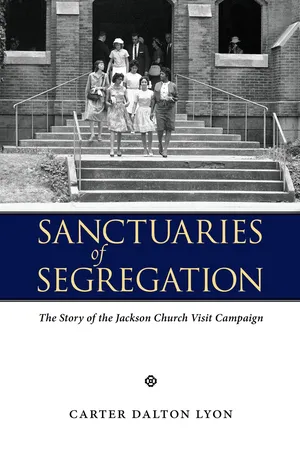
Winner of the 2017 Eudora Welty Prize Sanctuaries of Segregation provides the first comprehensive analysis of the Jackson, Mississippi, church visit campaign of 1963-1964 and the efforts by segregationists to protect one of their last refuges. For ten months, integrated groups of ministers and laypeople attempted to attend Sunday worship services at all-white Protestant and Catholic churches in the state's capital city. While the church visit was a common tactic of activists in the early 1960s, Jackson remained the only city where groups mounted a sustained campaign targeting a wide variety of white churches.Carter Dalton Lyon situates the visits within the context of the Jackson Movement, compares the actions to church visits and kneel-ins in other cities, and places these encounters within controversies already underway over race inside churches and denominations. He then traces the campaign from its inception in early June 1963 through Easter Sunday 1964. He highlights the motivations of the various people and organizations, the interracial dialogue that took place on the church steps, the divisions and turmoil the campaign generated within churches and denominations, the decisions by individual congregations to exclude black visitors, and the efforts by the state and the Citizens' Council to thwart the integration attempts. Sanctuaries of Segregation offers a unique perspective on those tumultuous years. Though most churches blocked African American visitors and police stepped in to make forty arrests during the course of the campaign, Lyon reveals many examples of white ministers and laypeople stepping forward to oppose segregation. Their leadership and the constant pressure from activists seeking entrance into worship services made the churches of Jackson one of the front lines in the national struggle over civil rights.
eBook - ePub
Sanctuaries of Segregation
The Story of the Jackson Church Visit Campaign
- 384 pages
- English
- ePUB (mobile friendly)
- Available on iOS & Android
eBook - ePub
About this book
Information
Subtopic
North American HistoryIndex
History[1]
Introduction

Even after a devastating week, Anne Moody and her classmates were still optimistic that this Sabbath would be different. The Sunday before, they had fanned out across the city to attend worship services at a variety of white Protestant churches for the first time, but because they were black, no churches admitted them. Just days later, Medgar Evers, their leader and one of the adults who had driven them to the churches that Sunday, was murdered in his driveway. Now, a day after his funeral and another confrontation with city police, the students once again presented themselves at the doors of many of the city’s white churches. They remained confident that engagement with white Christians could help bridge the divide in the city, especially given the tumult of the preceding days. On this Sunday, most of the churches continued to reject them, but one let them inside. Ushers at St. Andrew’s Episcopal—a church just steps away from the governor’s mansion, occupied by Ross Barnett—admitted and seated Moody and three others. The young women were uncomfortable and nervous, and a journalist reported a few curious glances in their direction from the congregation, but the group did not encounter any obvious animosity. Exiting the church, they were greeted by its rector, Rev. Christoph Keller, who was pleased to see them and invited them to visit again. Moody later wrote that his words seemed genuine. In a moment captured by a photographer and printed in newspapers around the nation the next day, she descended the stairs with the three others. For the first time in a long while, she “began to have a little hope.”1
In 1963 and 1964, the steps of churches in Jackson, Mississippi, were among the front lines in the national struggle over civil rights. For ten months, integrated groups attempted to attend Sunday worship at twenty-two all-white Protestant and Catholic churches. While civil rights activists utilized church visits or “kneel-ins” as a tactic of nonviolent direct action in various parts of the South, Jackson was the only city where groups mounted a sustained campaign to protest segregation by attempting to worship in white churches that spanned the denominational spectrum. Faculty and students at Tougaloo College, under the direction of their chaplain, Rev. Edwin King, initiated the Jackson church visit campaign in June 1963, after years of controversy within Mississippi churches over the issue of segregation, and in the wake of a boycott and sit-in campaign against Jackson businesses and public accommodations. Rev. King and the other activists aimed to stir the consciences of white Christians, hoping to motivate silent white moderates who could help steer the state toward a peaceful resolution to the burgeoning crisis. Christian principles of love for one’s neighbor, brotherhood, and equality dominated the strategy of the activists and the out-of-state ministers who sometimes accompanied them. They felt that if change were going to come, breaking down barriers of segregation in the Christian church would be a logical place to begin. The Tougaloo groups intended to engage white church people in dialogue and publicly testify to the oneness of mankind, but they also hoped to tug at the hearts of local white ministers, particularly those who had not used their pulpit to denounce racial injustice.
During the course of the campaign, the church visits sparked internal debates within congregations over segregation in their churches. Most of the churches maintained closed-door policies and consistently turned away black visitors. In a few of the churches that refused to admit African Americans, ministers recognized that closed church doors conflicted with their Christian consciences, and they took a stand for open doors. Their convictions cost all of them their jobs; ultimately they either resigned or church members forced them out. Then, starting October 1963, just after the Jackson Citizens’ Council announced a campaign to “save these churches from integration,” police began arresting visitors who were denied entrance. This tactic remained in effect for the next six months. In all, police made forty arrests, mostly of out-of-state ministers who came to Jackson out of solidarity with the Tougaloo activists. Still, not all of the churches in Jackson refused to allow African Americans to join in Sunday worship. A few, such as a Lutheran and two Presbyterian churches, admitted black visitors early in the campaign before segregationists forced the church doors closed. Moreover, the Catholic, Episcopal, and Unitarian churches consistently admitted black visitors. These churches, while in the minority, served as useful counterpoints to a community of otherwise closed churches.
By May 1964, when most of the churches remained closed and it became clear that the Methodist Church would not mandate open doors in all of its churches, Rev. King and the Tougaloo activists halted the campaign and turned their attention to the Mississippi Summer Project. For them, the church visit campaign exposed the failure of the white church to be a relevant force in helping to address the momentous problem facing Mississippi. Rev. King and the students felt that they had given white church people a chance. Now that these congregations had passed on the opportunity, the activists would pursue a more wide-ranging civil rights program, one that included even more non-Mississippian campaigners.
Surviving records of the weekly showdowns on church steps—found in government documents, newspapers, letters, minutes of church meetings, contemporary manuscripts, and interviews with eyewitnesses—illuminate the motivations of the opposing sides. Significantly, the record reveals a few rare opportunities for dialogue between activists and white lay people. For the Tougaloo students and the out-of-state ministers who sometimes accompanied them, opportunities to convey their thinking to ushers or other white church people were even more important than providing a visible witness to their convictions. On some occasions, the police, in actions constituting unprecedented state intervention in the affairs of a local church, stepped in to prevent more dialogue. When police arrested church visitors for trespassing, breach of peace, or disturbing divine worship, they sometimes did so on their own initiative, without being specifically asked to do so by the minister or a layperson. In those instances when an usher had clearly solicited police intervention, the event demonstrated state collusion with a church member, regardless of the wishes of the minister involved or the policies of the denomination.
Despite receiving substantial local and, at times, national and international news coverage, the story of the Jackson church visit campaign is a largely neglected chapter in the history of the civil rights movement. Works about the movement and religion in Mississippi sometimes discuss the Jackson church visits, sometimes called kneel-ins. The seminal analysis of the movement in the state—John Dittmer’s Local People—provides a brief summary of the goals and highlights of the campaign. Charles Marsh, in God’s Long Summer, devotes a chapter to the campaign’s leader, Rev. King, and another chapter to the pastor of a Jackson church targeted by students on a few Sundays. Marsh illuminates some of the focal points of the campaign—namely the Sunday of the first arrests and the barring of two Methodist bishops from Galloway Memorial Methodist Church—and provides a thorough analysis of the theological beliefs and motivations of Rev. King. In Freedom’s Coming, Paul Harvey presents a concise synopsis of the campaign within the context of other efforts by Christians to challenge theological racism. Four historians, Carolyn Dupont in Mississippi Praying, Joseph Crespino in In Search of Another Country, Randy J. Sparks in Religion in Mississippi, and Ellis Ray Branch in Born of Conviction, and, most recently, Joseph Reiff’s Born of Conviction: White Methodists and Mississippi’s Closed Society, discuss the campaign within the framework of the controversy over race in the Mississippi Conference of the Methodist Church during the 1950s and 1960s. Stephen Haynes’s The Last Segregated Hour, which focuses on the impact of a church visitation campaign in Memphis, Tennessee, provides an outline of the Jackson campaign and a comprehensive overview of the tactic of church visits and kneel-ins during the movement. To date, only one published work gives a firsthand account of the events, Agony at Galloway, published in 1980. In it, Rev. W. J. Cunningham chronicles his time as senior pastor at Galloway Memorial Methodist Church during the climax of the turmoil.
On one level, an analysis of the Jackson church visits sheds light on the relationship between congregations and their pastors, and between local churches and their regional or national bodies during one of the major crises in American religious history. The argument that most white church people in the South conformed to the culture during this period is a familiar one, grounded in two works from the era, Kenneth K. Bailey’s 1964 book, Southern White Protestantism in the Twentieth Century, and Samuel S. Hill Jr.’s 1966 analysis, Southern Churches in Crisis. Bailey points to the practical and theological concerns that set denominational leaders and pastors apart from rank-and-file church people. Most white pastors, he emphasized, were seminary trained and detached from the cultural milieu of the South. Those ministers who did speak out against segregation received overwhelmingly negative responses. Hill, on the other hand, sees Southern white ministers and laymen as more of a united front, joined by a theological understanding elevating the conversion experience and changing individual behavior over concern for racial equality.
The nature of the Southern white church response to the civil rights movement continues to receive scholarly attention. Some, like Charles Marsh, see a commitment to a certain theology guiding many segregationist church people’s reactions in the 1950s and 1960s. In God’s Long Summer, Charles Marsh finds the evangelical impulse in the thinking of Rev. Douglas Hudgins, pastor of First Baptist Church in Jackson, Mississippi. Marsh argues that because of his particular theology, Rev. Hudgins spoke out against his denomination’s endorsement of the Brown decision and allowed his ushers to bar African Americans from worshipping in his church in the 1960s. While Rev. Hudgins affirmed the congregationalism inherent in Southern Baptist practice, he believed that political concerns—which for him included the civil rights question—intruded on the purity of the event of salvation. In Getting Right With God: Southern Baptists and Desegregation, 1945–1995, Mark Newman also recognizes the role of theology in justifying segregation among many within the Southern Baptist Convention, though he emphasizes that Southern Baptists historically prized other beliefs and institutions—such as law and order, public schools, and global missionary efforts—that conflicted with the argument to maintain segregation after Brown. These other commitments ultimately helped to guide Baptists toward accepting the end of legalized segregation and disfranchisement. Yet not all historians emphasize what amounted to collusion between segregationists and Southern white ministers and church people. In A Stone of Hope: Prophetic Religion and the Death of Jim Crow, David Chappell sees little religious rationale or biblically based arguments in the discourse of racial conservatives, and remains unconvinced that ministers and church leaders were central or even necessary to the segregationist cause. He argues that after Brown, most segregationists saw their own churches and denominations as their enemies. As a result, Chappell finds that white supremacists lost in their effort in part because they did not have the backing and support of the white church. Paul Harvey, in Freedom’s Coming, demonstrates how this defeat of what he calls theological racism occurred. While those committed to a theology of segregation lost whatever claims to a Bible-based defense once they failed to have the law on their side, Harvey sees a larger process at work, one that helped undermine the Christian segregationist argument. He traces a racial interchange between black and white evangelicals from the cultural exchanges of music and folk traditions to the interracial traditions of holiness and Pentecostal churches, which then gave rise to informal and institutional zones for Christian interracialism. Working together within these spaces, black and white Christians drew inspiration from the evangelical concerns of redemption, salvation, and the omnipotence of God in daily life to foment a social revolution that successfully destabilized theological racism and helped to defeat Jim Crow.
A recent work, Carolyn Dupont’s Mississippi Praying, provides the most thorough and helpful analysis to date on the role of white evangelicals in the fight to sustain segregation in Mississippi in the decades after World War II. Examining local church communities and church people, she challenges Chappell’s findings, seeing white evangelicals as central to the racist cause in the state. Though some white evangelicals labored to ensure fairness and such principles as freedom of the pulpit, most white Baptists, Methodists, and Presbyterians in Mississippi actively defended white supremacy, using their own particular theologies and political philosophies. Churches were not mere captives to a white supremacist culture; churches provided clear institutional support for white supremacy, and church people were as vigorous inside the church doors as they were outside in trying to repel desegregation.
This study enters the discussion on the white church response to the civil rights movement of the early 1960s at an even more acute angle, from the vantage point of a city, the local congregation, and the individual church person. The story of the Jackson church visit campaign reveals a complicated milieu of contested spaces and divergent beliefs. On one side, a fierce localism prevailed among many of the white churches of Jackson—though this localism had to be asserted and won, as its victory was never predetermined. Many churches in Jackson saw themselves as private houses of worship subject to their own racial policies, regardless of whether or not they were connectional bodies affiliated with or chartered by a larger denomination. At a basic level, the fight to open or close the doors of churches was a fight over the meaning of “church” itself and the ideal of connectionalism. When the official boards of local Methodist churches voted to forbid African Americans from attending services, they did so with total disregard for Methodist Church policies and beliefs. Not only did the pastor retain complete authority in admitting or declining to admit individuals to worship, recently adopted statements and creeds from national Methodist Church conferences affirmed the right of all persons to worship, irrespective of color or nationality. Yet on the local level, the people who maintained responsibility for enforcing the policy of the denomination, especially the bishop and the district superintendent, either believed that desegregating the local church would fracture the conference—or worse, they displayed racist behavior. White ministers looking for leadership to help buttress their own efforts in bringing their congregations more in line with Methodist Church values were left unsatisfied in Jackson. As a result, some departed the state, while others struggled to work within the segregationist structure, content to labor on as pastors and shepherds to errant flocks.
This dilemma of the so-called moderate religious leader or pastor, one who opposed racial discrimination but favored a patient, gradualist approach to desegregation, could be seen in communities throughout the South, but was highlighted most distinctly during the Birmingham campaign of 1963. When a number of high-profile white religious leaders in the state denounced the timing and tactics of the movement in the city, Dr. Martin Luther King Jr. replied with his “Letter from a Birmingham Jail,” a cogent defense of religious leaders who argued that segregation was immoral and un-Christian and the response must therefore be immediate, direct, and nonviolent. King reserved particular scorn for white moderate pastors, but some were beginning to reassess their predicament. In Blessed Are the Peacemakers, S. Jonathan Bass provides a comprehensive analysis of the “letter” and the men to whom it was addressed. Upon uncovering the stories of the eight white religious leaders and the pressures that each faced—particularly from segregationists and other extremists—Bass finds the group to be far more sympathetic than King and others appreciated at the time. If King had bothered to seek out the men—or vice versa—he would have found a range of beliefs about the racial crisis. The over-simplified category of “moderate” was not a particularly accurate label for them.
Some white pastors in Jackson fit the designation as moderates, but my analysis of a specific church community reveals many examples of white ministers and church people from a variety of denominations in Jackson denouncing segregation in moral and overtly religious terms. The leadership of some of the pastors was crucial in guiding churches through the turmoil in part created by the church visit campaign. In some cases, the guidance that ministers provided proved not to be assertive enough; in other instances, pastors who denounced compulsory segregation found themselves removed from their congregations. Most of the white ministers in Jackson who took a stand against segregation during the early to mid-1960s were out of their pulpits within a few years. While it may be true, as some scholars assert, that most white ministers were reluctant to confront the immorality of racial discrimination, one must not lose sight of those who did, particularly those whose stories have not yet been told.
The church visit campaign also reveals many instances of moderate and liberal white lay people proclaiming their convictions. A few directly joined the church visit campaign, bringing black guests with them to white churches where they belonged or regularly attended. Some decided they could not remain at a closed church, and announced their views by simply switching membership to an open church. Others recognized that their churches needed their voices, and they chose to fight from within, determined to help steer their churches toward inclusiveness. While some churches remained closed to blacks, at least for the time being, the campaign demonstrated that these closures were not preordained. The actions of moderates and liberals within churches in Jackson, combined with weekly attempts to break the color barrier, ensured that segregationists had to fight to close the churches to African Americans.2
An examination of the Jackson church visit campaign provides a window into understanding the forces advocating and resisting social change on a local and individual church level. While James Silver gave America an inside view on how racial conservatives maintained a monopoly of power in the state in his 1964 book, Mississippi: The Closed Society, my analysis demonstrates how that society operated on a more fundamental level, though I suggest that this society was never as closed as Silver found it to be. Both activists and segregationists understood what was at stake. Civil rights volunteers, many of whom joined the movement because of their Christian convictions, recognized the power of their argument that segregation was not only unconstitutional, it was a sin. They intended to remind white Christians throughout their struggle and their weekly visits to churches, feeling that if positive and non-violent change would ever occur in Mississippi, it would happen because white Christians saw their cause as a moral one. Though segregationists rejected the religious argument the Tougaloo activists made—or instead framed it in sociological or political terms—they understood the value of maintaining closed church doors. Ushers at some white churches routinely blocked integrated groups of students, teachers, and ministers from participating in worship because they knew they could not concede the moral grounds for integration if they wanted their side to prevail in other areas.
Additionally, segregationists recognized that their churches constituted one of the last communal spaces they controlled. The church visit campaign began at a time when segregationists were losing their grip on Jackson and on the state. Though city officials and civic leaders quashed civil rights demonstrations in late May and early June 1963, the mayor began to make a series of concessions that had the effect of gradually eroding white control in the capital city. Moreover, the campaign began just as President Kennedy sent Congress a civil rights bill that would eventually force the desegregation of all public facilities in the city. With Jackson schools beginning to phase in integrated classrooms in the fall of 1964, white church...
Table of contents
- Cover
- Title Page
- Copyright
- Dedication
- Contents
- 1. Introduction
- 2. “When Integration Comes to Mississippi, It Will Enter through the Front Doors of Churches” 1954–60
- 3. Jackson Ministers Proclaiming Their Convictions 1961–63
- 4. “There Can Be No Color Bar in the House of God” Spring 1963
- 5. “I Began to Have a Little Hope” June 1963
- 6. “The Christian Church Is Down the Road” Summer 1963
- 7. “Saving the Churches from Integration” August–October 1963
- 8. “We Knew Strength and We Knew Peace” October 1963
- 9. “Betraying Jackson” Late October–Early November, 1963
- 10. Behind the “Magnolia Curtain” November–December 1963
- 11. “Jackson Has Become a Symbol of Our Common Sin” Winter 1964
- 12. Easter in Jackson March 1964
- 13. “The Nation Needs Our Witness Now” April 1964
- 14. “The Church Needs a Scapegoat” 1964–73
- 15. Afterword “Doing a Little Something to Pave the Way for Others”
- Acknowledgments
- Abbreviations
- Notes
- Bibliography
- Index
Trusted by 375,005 students
Access to over 1.5 million titles for a fair monthly price.
Study more efficiently using our study tools.
Frequently asked questions
Yes, you can cancel anytime from the Subscription tab in your account settings on the Perlego website. Your subscription will stay active until the end of your current billing period. Learn how to cancel your subscription
No, books cannot be downloaded as external files, such as PDFs, for use outside of Perlego. However, you can download books within the Perlego app for offline reading on mobile or tablet. Learn how to download books offline
Perlego offers two plans: Essential and Complete
- Essential is ideal for learners and professionals who enjoy exploring a wide range of subjects. Access the Essential Library with 800,000+ trusted titles and best-sellers across business, personal growth, and the humanities. Includes unlimited reading time and Standard Read Aloud voice.
- Complete: Perfect for advanced learners and researchers needing full, unrestricted access. Unlock 1.5M+ books across hundreds of subjects, including academic and specialized titles. The Complete Plan also includes advanced features like Premium Read Aloud and Research Assistant.
We are an online textbook subscription service, where you can get access to an entire online library for less than the price of a single book per month. With over 1.5 million books across 990+ topics, we’ve got you covered! Learn about our mission
Look out for the read-aloud symbol on your next book to see if you can listen to it. The read-aloud tool reads text aloud for you, highlighting the text as it is being read. You can pause it, speed it up and slow it down. Learn more about Read Aloud
Yes! You can use the Perlego app on both iOS and Android devices to read anytime, anywhere — even offline. Perfect for commutes or when you’re on the go.
Please note we cannot support devices running on iOS 13 and Android 7 or earlier. Learn more about using the app
Please note we cannot support devices running on iOS 13 and Android 7 or earlier. Learn more about using the app
Yes, you can access Sanctuaries of Segregation by Carter Dalton Lyon in PDF and/or ePUB format, as well as other popular books in History & North American History. We have over 1.5 million books available in our catalogue for you to explore.