Contributions by Rosa M. Banda, Lakeyta M. Bonnette-Bailey, Donathan L. Brown, Michael L. Clemons, William H. L. Dorsey, Hannah Firdyiwek, Alonzo M. Flowers III, Helen Taylor Greene, William G. Jones, Athena M. King, Taj'ullah Sky Lark, Jamela M. Martin, Marcus L. Martin, Byron D'Andra Orey, Amardo Rodriguez, Audrey E. Snyder, James L. Taylor, Leslie Walker, and Jason M. WilliamsThis book examines how Martin Luther King's life and work had a profound, if unpredictable, impact on the course of the United States since the civil rights era. A global icon of freedom, justice, and equality, King is recognized worldwide as a beacon in the struggles of peoples seeking to eradicate oppression, entrenched poverty, social deprivation, as well as political and economic disfranchisement. While Dr. King's work and ideas have gained broad traction, some powerful people misappropriate the symbol of King, skewing his legacy.With unique, multidisciplinary works by scholars from around the country, this anthology focuses on contemporary social policies and issues in America. Collectively, these pieces explore wide-ranging issues and contemporary social developments through the lens of Dr. King's perceptions, analysis, and prescriptions. Essayists bring a multidisciplinary and interdisciplinary approach to social policies and current issues in light of his ideals. They strive to glean new approaches and solutions that comport with Dr. King's vision.Organized into three sections, the book focuses on selected issues in contemporary domestic politics and policy, foreign policy and foreign affairs, and social developments that impinge upon African Americans and Americans in general. Essays shed light on Dr. King's perspective related to crime and justice, the right to vote, the hip hop movement, American foreign policy in the Middle East and Africa, healthcare, and other pressing issues. This book infers what Dr. King's response and actions might be on important and problematic contemporary policy and social issues that have arisen in the post–civil rights era.
eBook - ePub
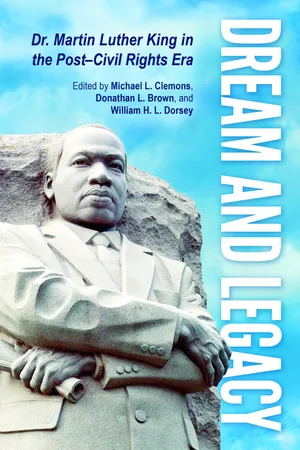
Dream and Legacy
Dr. Martin Luther King in the Post-Civil Rights Era
- 234 pages
- English
- ePUB (mobile friendly)
- Available on iOS & Android
eBook - ePub
Dream and Legacy
Dr. Martin Luther King in the Post-Civil Rights Era
About this book
Information
Subtopic
African American StudiesIndex
Social SciencesPart I
POLITICS AND PUBLIC POLICY
THROUGH THE EYES OF KING
Assessing Contemporary Challenges to Voting Rights
Donathan L. Brown
Ratified on February 3, 1870, as the third and final of the Reconstruction amendments, the Fifteenth Amendment of the US Constitution prohibits the federal and state governments from denying a citizen the right to vote based on that citizen’s “race, color, or previous condition of servitude.” Despite this supposed safeguard, many Southern whites orchestrated discursive maneuvers to continue African American disenfranchisement for many years to come. Even with the passage of five anti–poll tax bills in the House of Representatives from 1942 through 1949, by means of either senatorial filibusters or simply denying this legislation a floor vote, all such measures failed (Santoro, 2008). The passage of the Civil Rights Act of 1957 did little to enfranchise African Americans or increase voter turnout, as the law allowed a jury trial for those accused of denying suffrage. Because the typical all-white jury selected for these and other related trials rarely, if ever, upheld these charges, this provision was nothing more than a mirage.
Growing very impatient with Congress and fatigued by the growing resistance against African American enfranchisement, individual civil rights leaders understood that change was necessary. It became quite clear that white lawmakers and the white public in general did not view civil rights as a cornerstone issue as did African Americans. In reference to public opinion surveys that canvassed the perceived political tensions of the time, “less than 5 percent of the public listed civil rights issues as the nation’s most important problem during the 40’s and most of the 50’s” (Santoro, 2008, p. 1396). Moreover, there were very few, if any, legal protections for African Americans following the tragic slaying of fourteen-year-old Emmett Till in Money, Mississippi, for reportedly flirting with a white woman (Crowe, 2003). As times continued to produce lackluster political outcomes, efforts by civil rights leaders began to gain more attention and momentum.
Hoping to force the federal government to fulfill the promises of the three-year-old Brown v. Board of Education decision, civil rights leaders in conjunction with the Prayer Pilgrimage for Freedom (a nonviolent demonstration for African American equality), called for a rally on the steps of the Lincoln Memorial in Washington DC. Amidst the presence of civil rights activists such as Ella Baker, A. Philip Randolph, Roy Wilkins, Adam Clayton Powell Jr., Fred Shuttlesworth, Mahalia Jackson, and Harry Belafonte, Dr. Martin Luther King Jr. was slated to speak last. Delivered on May 17, 1957, Dr. King gave one of his most memorable speeches, “Give Us the Ballot.” In his address, King argued that voting rights for African Americans would result not only in a positive change for the disenfranchised, but also in the betterment of the nation. Calling for federal leadership from white moderates and liberals to jumpstart a change in political direction, King took to the bully pulpit to stake his claim by means of characterizing the problem, in hopes of eliciting a long overdue solution. As seen through King’s eyes:
All types of conniving methods are still being used to prevent Negroes from becoming registered voters. The denial of this sacred right is a tragic betrayal of the highest mandates of our democratic tradition. And so our most urgent request to the president of the United States and every member of Congress is to give us the right to vote. Give us the ballot, and we will no longer have to worry the federal government about our basic rights. Give us the ballot, and we will no longer plead to the federal government for passage of an anti-lynching law; we will by the power of our vote write the law on the statute books of the South and bring an end to the dastardly acts of the hooded perpetrators of violence. Give us the ballot, and we will transform the salient misdeeds of bloodthirsty mobs into the calculated good deeds of orderly citizens. Give us the ballot, and we will fill our legislative halls with men of goodwill and send to the sacred halls of Congress men who will not sign a “Southern Manifesto” because of their devotion to the manifesto of justice. Give us the ballot and we will place judges on the benches of the South who will do justly and love mercy and we will place at the head of the southern states governors who will, who have felt not only the tang of the human, but the glow of the Divine. Give us the ballot and we will quietly and nonviolently, without rancor or bitterness, implement the Supreme Court’s decision of May seventeenth, 1954. (King, 1957)
As seen here, the political state of affairs that King describes not only belies voting rights for African Americans; it enters a grander conversation of law and order. King’s brilliant message of social transformation sought to articulate the discursive dimensions of everyday life that enfranchisement can empower people with. For instance, with the right to vote, African Americans can deny the “hooded perpetrators of violence” further political influence by means of electing other officials to office. With the right to vote, African Americans can assist their own mission to end Jim Crow and no longer wait on Congress and the president to intervene.
Unfortunately, the Prayer Pilgrimage did not produce any sudden changes in political outcome. As Gilbert Jonas recounts, “the growing violence by itself should have given Congress and the Whitehouse sufficient incentive in 1957 to enact a halfway respectable civil right law. Instead, the lawmakers and executive branch interpreted that massive white resistance, including violence toward African Americans, as the will of the majority white Americans generally” (2005, p. 164). While no strong relief came from either the Eisenhower administration or Southern white segregationists, “Give Us the Ballot” not only served as King’s first address given on the steps of the Lincoln Memorial, but it continues to serve as one of King’s earliest exemplars of his outlook on equal access to the polls.
King often questioned the sincerity and thoroughness of some of his “supporters.” The long journey toward political equality for African Americans often baffled him. Why, asked King, “is equality so assiduously avoided?” (King, 2010, p. 4). King’s dismay with the wavering degrees of concern and participation by some of his “supporters” only caused him to become more involved in his quest for voter equality. He was relentless in expressing his advocacy for voting rights, even knowing the various threats waged against his life and the lives of others. While greatly monumental, the historic 1965 march from Selma to Montgomery, Alabama, which would later be referred to as “Bloody Sunday” (Lee, 2002), serves as one example where King and his supporters knew the threats against their well-being but believed the fight for equality was more important. Born out of continual frustration with white resistance, the Dallas County Voters League (DCVL) and organizers from the Student Nonviolent Coordinating Committee (SNCC) requested the assistance of King and the Southern Christian Leadership Conference (SCLC) to bring prominent civil rights and civic leaders to Selma to assist in their efforts. Civil rights leaders and their supporters knew of the challenges imposed by Alabama’s segregationist governor, George Wallace (who prohibited the fifty-four-mile march from Brown Chapel in Selma, Alabama, to the state capitol in Montgomery) and a denied request for protection by federal marshals and troops.
King, who was in Atlanta, in coordination with his advisors, initially decided to postpone the demonstration; however, supporters, members of the media, and antagonists alike still convened in Selma to march. Led by John Lewis of the SNCC and the Reverend Hosea Williams of the SCLC, the estimated five hundred to six hundred supporters began their march. Earlier that morning, Dallas County sheriff Jim Clark had issued an order for all white males in the county over the age of twenty-one to report to the courthouse to be deputized prior to the march (Thornton, 2002). Law enforcement advanced on the marchers with a combination of tear gas and nightsticks. The footage of police brutality against nonviolent civil rights marchers was televised and later published in newspapers and magazines, this unfortunate episode illustrating the state of white resistance against the forces of sociopolitical equality that King’s speeches and actions sought to capture.
King’s effort toward the establishment of permanent black inclusion into American democracy intensified following Bloody Sunday, forcing President Lyndon Johnson’s hand. With major demonstrations in Chicago, Boston, New York City, Oakland, and across the street from the White House, Johnson became wounded by widespread criticism. With the momentum generated by King and his followers, President Johnson addressed Congress on the state of the nation’s democratic process, namely, voting rights for African Americans. This “destiny for democracy” and the many obstacles therein, must be quickly remedied by meaningful efforts and actions, according to Johnson. In his words,
[S]hould we defeat every enemy, and should we double our wealth and conquer the stars, and still be unequal to this issue, then we will have failed as a people and as a nation … There is no Negro problem. There is no Southern problem. There is no Northern problem. There is only an American problem. And we are met here tonight as Americans, not as Democrats or Republicans, we are met here as Americans to solve that problem. (Johnson, 1965)
Taking obvious rhetorical cues from Dr. King’s experienced dilemmas associated with equal access to the polls, Johnson finally sought to seize the moment in order to rescue his flagging favorability among both Democrats and Republicans.
To otherwise save a sinking presidency, congressional approval, and an awaiting world, Johnson made a calculated decision to unveil what would become one of the most important civil rights advancements since Reconstruction. In President Johnson’s words,
Wednesday I will send to Congress a law designed to eliminate illegal barriers to the right to vote … [T]his bill will strike down restrictions to voting in all elections: Federal, State, and local; which have been used to deny Negroes the right to vote. This bill will establish a simple, uniform standard which cannot be used, however ingenuous the effort, to flout our Constitution. It will provide for citizens to be registered by officials of the United States Government, if the State officials refuse to register them. It will eliminate tedious, unnecessary lawsuits which delay the right to vote. Finally this legislation will ensure that properly registered individuals are not prohibited from voting. (Johnson, 1965)
Again drawing upon King’s rhetorical leadership, Johnson argued, “The real hero of this struggle is the American Negro. His actions and protests, his courage to risk safety and even to risk his life, have awakened the conscience of this nation. His demonstrations have been designed to call attention to injustice, designed to provoke change, designed to stir reform” (Johnson, 1965). Nick Kotz (2005) notes that “never before had the civil rights movement received the breadth of support and the strength of federal endorsement that it had during the eight days beginning with Bloody Sunday and culminating in Johnson’s speech,” as the efforts of King were heard loud and clear through Johnson’s voice (p. 314).
Enacted by the eighty-ninth Congress and signed into law by President Lyndon Johnson, the Voting Rights Act of 1965 (VRA) was designed to eliminate rampant and widespread discriminatory voting practices largely targeted at African Americans. Specifically, the VRA prohibits states from imposing any “voting qualification or prerequisite to voting, or standard, practice, or procedure … to deny or abridge the right of any citizen of the United States to vote on account of race or color.” Section 2 of the act contains a general prohibition on voting discrimination, enforced through federal district court litigation. Congress amended this section in 1982, prohibiting any voting practice or procedure that has a discriminatory result. Section 5 of the VRA prevents any changes in voting procedure for the nine states, and parts of seven others housed under “preclearance” (Griffith, 2008). Those states and jurisdictions in this category, chiefly because of their political history pertaining to voter disenfranchisement, must receive clearance from the Department of Justice (DOJ) in order to enforce changes in voting laws or redistricting until it is proven that the proposed changes do not deny or abridge the right to vote on account of race, color, or membership in a language minority group. Dr. King was heavily involved in early movements aimed at equal access to the polls, especially in the South; however, the political landscape continues to shift, transforming old antagonistic tactics into new policy.
KING’S DREAM DEFERRED: VOTER IDENTIFICATION LAWS
Like much of what Dr. King experienced and articulated, a large-scale shift in our nation’s racial landscape, whether it be a population on the verge of receiving the overdue right to vote or a growing racial demographic (like Latinos in the United States), is often accompanied by massive waves of resistance from those who fear a possible change in the nation’s balance of power. While rarely do we see protests and other forms of civil rights demonstrations that are tantamount to Bloody Sunday, nowadays, voter identification laws continue to gain retrogressive momentum, disenfranchising certain communities from political participation.
To better understand this peculiar movement, its distinct synchronicity, it is best to understand the role that shifting racial and ethnic demographics play within it. For instance, 2003 to some was no different than the years preceding it, yet to others, it marked the beginning of the end. As reported by the US Census Bureau, 2003 was the first year in American history that Latinos overtook African Americans along with all other “minority groups” to become the largest and fastest-growing group/constituency in the nation. At that time nearly one-third of the US population was nonwhite, and some projections suggested that within the next forty to fifty years whites would become a minority; this caused great concern for some. With individuals like Samuel Huntington (1981, 1996, 1997, 2004a, 2004b), Pat Buchanan (2002, 2007, 2011), and Tom Tancredo (2006) sounding the alarm, political attention at the state and local levels began to shift toward such policies as those regulating immigration (Fraga and Segura, 2006), official language legislation (Brown, 2012; Brown, 2013; Schmidt, 2000), housing ordinances (Pham, 2007), and voting rights (Hayduk, 2006). As the nation began to experience population growth across the country, questions began to quickly arise regarding how and in what ways shifting demographics could possibly correlate with a change in political direction. While Latinos are not monolithically liberal, with Cuban Americans more likely to support the Republican Party, David Leal (2007) reminds us that “Latinos are much stronger supporters of the Democratic Party than Anglos in terms of both partisan identification and voting in presidential and congressional elections,” whereas “the Republican Party is worried about a future in which an expanding Latino population augments Democratic political power” (pp. 31–32). The increasingly larger Latino population, especially in the Southern states, and a growing Latino constituency that possesses the ability to shift the balance of power in many Republican stronghold districts and states are the ingredients for a perfect storm.
A cursory glance across the United States reveals disturbing trends in voter identification laws that continue to bespeak equal access to the polls. While Dr. King argued that “the basic elements so vital to Negro advancement can only be achieved by seeking redress from government at local, state and Federal levels. To do this the vote is essential,” quite the retrogression has been underway for the last decade (Schlueter, 2002, p. 71). In 2003, new voter identification laws passed in Alabama, Colorado, Montana, North Dakota, and South Dakota. In 2005, Indiana, New Mexico, and Washington joined the ranks, while Georgia tightened an existing identification law. In 2006, a voter identification law passed in Ohio, while Missouri tightened an existing law, and in 2009 and 2010, Utah, Idaho, and Oklahoma passed such laws. New voter identification laws were passed in 2011 in Kansas, Mississippi, Rhode Island, and Wisconsin, while Alabama, South Carolina, Tennessee, and Texas tightened existing laws (new laws in Texas, Mississippi, and South Carolina were rejected due to DOJ preclearance) (Streb, 20...
Table of contents
- Cover
- Title Page
- Copyright
- Contents
- Acknowledgments
- Introduction
- Part I. Politics and Public Policy
- Through the Eyes of King: Assessing Contemporary Challenges to Voting Rights
- The Ideals and Vision of the Late Dr. Martin Luther King Jr.: Crime and Social Justice
- A Vision for Racial Congruence: Reflecting on the Underrepresentation of Faculty of Color in the Academy
- African American Healthcare: Assessing Progress and Needs through Martin Luther King’s Perspective on Social Justice and Equality
- Part II. Foreign Affairs and Africa
- Toward Foreign Policy Justice?: A Dream Unfulfilled
- Martin Luther King Jr. and Africa: Then and Now
- Part III. Social Developments
- A Dream That Occurred or a Dream Deferred?: Race Relations from Dr. Martin Luther King Jr. to President Barack Hussein Obama
- King the Sellout or Sellin’ Out King?: Hip Hop’s Martin Luther King Jr.
- On Redefining Civil Rights
- Epilogue: King’s Enduring Relevance
- Contributors
- Index
Trusted by 375,005 students
Access to over 1.5 million titles for a fair monthly price.
Study more efficiently using our study tools.
Frequently asked questions
Yes, you can cancel anytime from the Subscription tab in your account settings on the Perlego website. Your subscription will stay active until the end of your current billing period. Learn how to cancel your subscription
No, books cannot be downloaded as external files, such as PDFs, for use outside of Perlego. However, you can download books within the Perlego app for offline reading on mobile or tablet. Learn how to download books offline
Perlego offers two plans: Essential and Complete
- Essential is ideal for learners and professionals who enjoy exploring a wide range of subjects. Access the Essential Library with 800,000+ trusted titles and best-sellers across business, personal growth, and the humanities. Includes unlimited reading time and Standard Read Aloud voice.
- Complete: Perfect for advanced learners and researchers needing full, unrestricted access. Unlock 1.5M+ books across hundreds of subjects, including academic and specialized titles. The Complete Plan also includes advanced features like Premium Read Aloud and Research Assistant.
We are an online textbook subscription service, where you can get access to an entire online library for less than the price of a single book per month. With over 1.5 million books across 990+ topics, we’ve got you covered! Learn about our mission
Look out for the read-aloud symbol on your next book to see if you can listen to it. The read-aloud tool reads text aloud for you, highlighting the text as it is being read. You can pause it, speed it up and slow it down. Learn more about Read Aloud
Yes! You can use the Perlego app on both iOS and Android devices to read anytime, anywhere — even offline. Perfect for commutes or when you’re on the go.
Please note we cannot support devices running on iOS 13 and Android 7 or earlier. Learn more about using the app
Please note we cannot support devices running on iOS 13 and Android 7 or earlier. Learn more about using the app
Yes, you can access Dream and Legacy by Michael L. Clemons,Donathan L. Brown,William H. L. Dorsey in PDF and/or ePUB format, as well as other popular books in Social Sciences & African American Studies. We have over 1.5 million books available in our catalogue for you to explore.