Winner of a 2018 C. L. R. James Award for a Published Book for Academic or General Audiences from the Working-Class Studies Association
Beginning with the Haitian Revolution, Scott Henkel lays out a literary history of direct democracy in the Americas. Much research considers direct democracy as a form of organization fit for worker cooperatives or political movements. Henkel reinterprets it as a type of collective power, based on the massive slave revolt in Haiti. In the representations of slaves, women, and workers, Henkel traces a history of power through the literatures of the Americas during the long nineteenth century.
Thinking about democracy as a type of power presents a challenge to common, often bureaucratic and limited interpretations of the term and opens an alternative archive, which Henkel argues includes C. L. R. James's The Black Jacobins, Walt Whitman's Democratic Vistas, Lucy Parsons's speeches advocating for the eight-hour workday, B. Traven's novels of the Mexican Revolution, and Marie Vieux Chauvet's novella about Haitian dictatorship.
Henkel asserts that each writer recognized this power and represented its physical manifestation as a swarm. This metaphor bears a complicated history, often describing a group, a movement, or a community. Indeed it conveys multiplicity and complexity, a collective power. This metaphor's many uses illustrate Henkel's main concerns, the problems of democracy, slavery, and labor, the dynamics of racial repression and resistance, and the issues of power which run throughout the Americas.
eBook - ePub
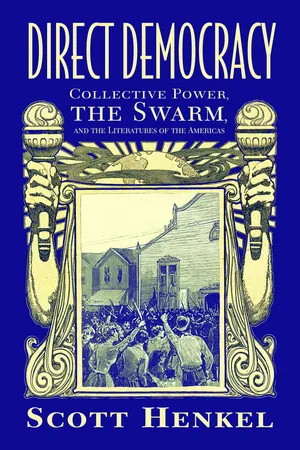
Direct Democracy
Collective Power, the Swarm, and the Literatures of the Americas
- 224 pages
- English
- ePUB (mobile friendly)
- Available on iOS & Android
eBook - ePub
About this book
Information
CHAPTER ONE
“There Are 2,000 Leaders”: The Swarm Metaphor and a Logic of Collective Action in C. L. R. James’s The Black Jacobins
On July 1, 1802, Napoleon Bonaparte wrote to his brother-in-law, Charles Leclerc, the French officer tasked with quelling the Haitian Revolution, that he wanted him to deport “all the Black generals,” because “without this […] we will have done nothing, and an immense and beautiful colony will always remain a volcano, and will inspire no confidence in capitalists, colonists, or commerce.”1 During that summer and fall, the French colonial forces continued to fight the many insurgent groups in the various ways in which they encountered each other, but Bonaparte’s letter conveys the overarching French strategy at this late stage of the Haitian Revolution. The largest achievements of this strategy were undoubtedly the capture and exile of Toussaint Louverture, who was the first among the revolutionary generals, and Leclerc’s manipulation of the remaining black generals into fighting for the French, against the insurgents.2 The strategy was built on the belief that to remove the leaders was to end the revolution. To this line of thinking, the groups of insurgents were merely “motley crowd[s]”3 which would eventually collapse after their big leaders were removed.
Bonaparte and Leclerc’s plan is a common, and often successful, counterrevolutionary strategy.4 It may seem unbelievable, therefore, that the Haitian Revolution not only sustained itself when its leadership structure became unstable but adapted and grew to the point where Leclerc would write that it was not enough to have removed Toussaint, because 2,000 leaders had emerged to take his place.5 Considering how stories and scholarship have traditionally portrayed such events, it is difficult to imagine the American Revolution at any moment without Washington, Jefferson, and Adams; the Mexican Revolution without Villa and Zapata; and the Cuban Revolution without Castro or Che, but mutatis mutandis, in Saint Domingue in 1802, their counterparts were captured, pacified, or killed. This is not to suggest such leadership is trivial—quite the contrary. The importance of Toussaint, Dessalines, Christophe, Moïse, and the other big leaders is considerable. The big leaders’ contributions to the Haitian Revolution make the fact that the 2,000 could operate without them, if not in outright opposition to them, more remarkable, not less.
But although these events are remarkable, they are not inexplicable. As C. L. R. James emphasizes by quoting, twice, a letter from Leclerc written to the French minister of marine, the colonial powers had “a false idea of the country in which [they] fight and the men whom [they] fight against.”6 Put plainly, the insurgents were not irrational, but rather were well prepared for the task, and the fact that the revolution adapted and grew into a general insurrection at this point is proof of the matter. As Nick Nesbitt suggests, the Haitian Revolution was not unthinkable; rather, it shows that the colonial ideology failed to think through the simplest axioms of political philosophy: all people ought to be free, and that when they are made unfree, they will resist to the degree and in the ways available to them.7 It is logical that the Haitian Revolution’s 2,000 leaders emerged out of resistance to the domination of slavery, likewise to expect that the 2,000 would seek out a substantive alternative to that domination. As Carolyn Fick suggests, “every form of enslavement generates in one way or another an opposing struggle for liberation.”8 In this case, the decentralized, networked forms of resistance were quite precisely tailored to defeating the centralized, more hierarchical French colonial forces.
To say that the Haitian Revolution in 1802 was leaderless is not to say that it was being driven by accident or happenstance: it is, rather, to say that the multitude of efforts that sustained it came from the contributions of many people, not just a few people who directed those contributions from above. As Fick writes, the insurgents developed a “network of resistance, whose aim was to proselytize, to gather additional recruits and supporters, to call meetings and assemblies, and to devise plans of action. The whole burden of resistance now lay squarely upon their shoulders, and for resisting they would face firing squads, be hanged, drowned, even gassed to death.”9 It took coordinated efforts over time to build such a network, and when many of its main actors—Toussaint, especially—were removed, the network proved resilient enough to sustain itself and to grow. James’s representation of this situation is multi-faceted: clearly, the presence of Toussaint Louverture towers over The Black Jacobins, but even so, James could have judged that the 2,000 leaders were an anomaly in the Haitian Revolution, a mere ellipsis in the period between when Toussaint was captured and when Dessalines asserted his control over the revolution. He did not, however, and charting the reasons why he did not is one task for this chapter.
How groups like the 2,000 maintain their coherence, aggregate intelligence, and overcome cooperation problems are topics for this book’s subsequent chapters and for further research.10 After generations of experience with slavery and eleven years of coordinated resistance to it, the people who would soon become Haitian citizens did not need to be told to resist—their experiences with struggle gave them practice, and their hatred of slavery gave them motive. On the practice, Cedric D. Robinson writes that what he calls the Black Radical Tradition “was an accretion, over generations, of collective intelligence gathered from struggle. In the daily encounters and petty resistances to domination, slaves had acquired a sense of the calculus of oppression as well as its overt organization and instrumentation. These experiences lent themselves to a means of preparation for more epic resistance movements.”11 On the motive, Fick writes that “the uninstructed mass of slaves, and not their leaders,[…] saw so clearly what was at stake, regardless of the cost. And if the price they were ready to pay was high, it was no greater than the human suffering they had already endured.”12 Therefore, it was not an anomaly that the 2,000 could organize themselves into effective groups when their big leaders were removed; on the contrary, such forms of organization have logic that we can examine, although that logic is different from a hierarchy of leaders and led. One of the debts that contemporary scholars owe to James is that in The Black Jacobins, he recognized what was at issue—an alternative logic of collective action—and rather than dismissing it as an anomaly, he makes it one of the key aspects of his analysis. Even if, in 1938 and 1963, as he is writing and revising The Black Jacobins, or in 1971, as he is delivering his “Lectures on The Black Jacobins,” he does not pursue the topic to as great a degree as he would like, that recognition is not insignificant, especially given the context in which he was writing, an intellectual environment that loudly condemned the Haitian Revolution. So in addition to this practice and motive the 2,000 possessed, as I noted above, it is evident that they possessed a sufficient amount of power to prevail against several of the Atlantic world’s colonial states, supplanting a slavocracy with an independent nation. As I will show here, they also possessed a particular type of collective power, one that James would represent as a swarm, repeatedly and consistently in The Black Jacobins, and which I call direct democracy.
In the “Lectures on The Black Jacobins,” which he gave to the Institute of the Black World in 1971, James stated that if he were to rewrite the book, he would focus to a greater degree on the 2,000 and the profound implications of their example.13 Among James’s concerns is that a rewritten book would, to a far greater degree, draw on primary sources written by the participants in the revolution, rather than sources with a colonial perspective found in the French archives.14 There has been a range of responses to this call for further research—some, like Fick’s book The Making of Haiti: The Saint Domingue Revolution from Below, Laurent Dubois’s Avengers of the New World: The Story of the Haitian Revolution, and Jeremy Popkin’s Facing Racial Revolution: Eyewitness Accounts of the Haitian Revolution, draw upon new archives, and some, like David Scott’s Conscripts of Modernity and Nick Nesbitt’s Universal Emancipation, use new critical perspectives. Much of the critical work on the problems presented by the 2,000 in particular has been framed by what Paul B. Miller, in his book Elusive Origins: The Enlightenment in the Modern Caribbean Historical Imagination, calls the “leader/masses dynamic.”15 This body of work is both substantial and insightful, and it builds from the idioms used by the socialist movements of James’s era, which James both used and developed in his own ways in his writing.
I aim to build upon this work by tracing the trajectory of James’s thinking about the logic of collective action that the 2,000 present and by proposing an alternative framework for understanding that logic. The scholarship on the “leader/masses dynamic” analyzes the situation as a problem with those two variables. This is useful, to a degree. I argue, however, that a framework with multiple variables—that is, a situation in which many people are seen to act, rather than one in which two groups are seen to act—is a better framework through which to view the logic of collective action in The Black Jacobins. From his earliest thinking about the 2,000 leaders, in his research and in the play Toussaint Louverture: The Story of the Only Successful Slave Revolt in History, which was first performed in 1936, through the 1938 edition and then the 1963 edition of The Black Jacobins, and to his 1971 “Lectures on The Black Jacobins,” James comes to see 1802 and the logic of collective action the 2,000 display as the most important parts of the story. One question is: how is James able to recognize their importance? He could have seen the months of late 1802 as an anomaly, but he does not. Another question is, then, how does James represent the 2,000, the masses in revolt? I propose answers to both questions in this chapter.
The power that James shows the 2,000 possess and his use of the swarm metaphor in The Black Jacobins present the best set of examples of this book’s two main claims: that direct democracy can be understood as a type of collective power, and that the swarm metaphor is like a signpost pointing to the presence of that direct democratic power. The moment the 2,000 emerged, and the lessons of the Haitian Revolution more generally, present indispensable material for analyzing the potential and problems of direct democracy. Why the Haitian Revolution did not collapse in 1802 when its leadership structure became unstable has as much to do with who the insurgents were—a demos, even after generations of systematic attempts by the slave trade to dehumanize them—as it does with what they had—a kratos that was sufficiently powerful to end that domination.
In what follows, I will sketch a trajectory of James’s thinking about the 2,000 and their logic of collective action through three sites—the play Toussaint Louverture, the text of The Black Jacobins, and James’s 1971 lectures—to show the plot points in a trajectory of his thinking. His thinking on these topics continued to evolve over his career, as is evident in his writings on topics other than the Haitian Revolution. This body of work shows what I will call James’s ethos of direct democracy—by which I mean a mind-set that prepared him to see why the 2,000 leaders in the Haitian Revolution were so significant. The trajectory I map in this chapter will provide a path to follow through additional examples in this book’s subsequent chapters.
A Trajectory of Thinking about a Logic of Collective Action
From his earliest work on the Haitian Revolution, the 2,000 occupied a prominent place in James’s imagination. In his play Toussaint Louverture: The Story of the Only Successful Slave Revolt in History, which was first performed in 1936 and which was the text that gave shape to The Black Jacobins, James takes the idea of the 2,000 from Leclerc and gives it to Toussaint. When Toussaint is in the French jail, moments away from death, his captors torment him with the idea of slavery reestablished in Saint Domingue. Toussaint replies:
You can defeat an army, but you cannot defeat a people in arms. Do you think an army could drive those hundreds of thousands back into the fields? You have got rid of one leader. But there are two thousand leaders to be got rid of as well, and two thousand more when those are killed.16
In The Black Jacobins, James quotes Pamphile de Lacroix, who states that “no one observed that in the new insurrection of San Domingo, as in all insurrections which attack constituted authority, it was not the avowed chiefs who gave the signals for revolt but obscure creatures for the greater part personal enemies of the colored generals.”17 In his 1971 “Lectures on The Black Jacobins,” James repeated this quote18 and indicated that these are the ideas upon which he would expand if he had the opportunity to rewrite the book. He stated, “I am concerned with the two thousand leaders who were there. That is the book I would write. There are two thousand leaders to be taken away. If I were writing this book again, I would have something to say about those two thousand leaders.”19
Yet James did not rewrite The Black Jacobins along the lines he speculates about in the “Lectures.” That text, as it remained, as David Scott suggests in Conscripts of Modernity, “most of all is the political biography of this enlightened and inspiring leader, Toussaint L’Ouverture.”20 Among his many insightful points, therefore, Scott critiques the use of The Black Jacobins as a mere blueprint for political action in the present—James’s problem space, to use Scott’s terms, differs from ours in such a way to make a simple adoption of James’s framework unwise.21 Scott writes, “Many contemporary readers of C. L. R. James read The Black Jacobins as though it might provide them with answers to present problems, as though, for instance, it might tell them how to conduct oppositional politics today.”22 He suggests that such work should not search for new answers to the same questions James asked about colonialism, for example, but should ask new questions, based on the conditions of a given historical moment.23 Scott suggests that James’s work “directly challenges us to ask ourselves what kind of story might be best for the politicohistorical presents within which we now live and write. It is this that makes The Black Jacobins a work of unending critical value.”24 James’s effort in The Black Jacobins was to look back to an earlier era in order to cull ideas that would be useful in the present: not a simple adoption of ideas and tools, but an adaptation of them fit for his political present.
The issue James faced when writing and rewriting, and then rethinking the Haitian Revolution, was how to construct a narrative about the situation that was both sufficiently complex and sufficiently coherent; his book’s undiminished relevance speaks to the degree to which he was successful. The issue that we now face is how best to understand the logic of collective action that the 2,000 present—both as it is represented in James’s writing and also in the light of the subsequent research about the Haitian Revolution. As I noted above, much of the scholarship on the 2,000 frames their dynamics as a binary between leaders and led. A multivariable framework is, I believe, more consistent with what we know about other similar groups, with what James suggests when he states that he sought to analyze the movement of forces, of masses, of individuals, and their influence on their environment at a fluid moment in history,25 and also more in line with how he represents the actions of the 2,000.
In addition to Scott, who uses the example of the 2,000 in Conscripts of Modernity to reorient the ways in which researchers writing politically engaged scholarship interact with texts written by a previous generation,26 several scholars, in writing about The Black Jacobins or the Haitian Revolution, have keyed in on Leclerc’s comment about 2,000 leaders, and the points James makes about that comment. Carolyn Fick dedicates The Making of Haiti to “Haiti, her people, her obscure leaders, and her future”;27 and the book seeks, from start to finish, to tell the story of those obscure leaders, and does so in impressive detail. In Avengers of the New World, Laurent Dubois makes the 2,000 a key point;28 Susan Buck-Morss refers to the idea in two separate moments in Hegel, Haiti, and Universal History.29 Nick Nesbitt ends Universal Emancipation with a discussion of the 2,000.30
Seen all together, this work suggests that to understand the 2,000 one needs to understand them as people, with all the complexities of their personalities, as participants in groups, and how their interactions fuel the dynamics of those groups. One must also understand the material contexts in which they lived and acted and the ideas that motivated them. In other words, a fuller understanding of the 2,000 comes from archival history and from critical theory, from the content of primar...
Table of contents
- Cover
- Title Page
- Copyright
- Contents
- Acknowledgments
- Prologue
- Introduction
- Chapter One “There Are 2,000 Leaders”: The Swarm Metaphor and a Logic of Collective Action in C. L. R. James’s The Black Jacobins
- Chapter Two Carlyle, Whitman, Parsons: Three Perspectives on Direct Democracy
- Chapter Three Nearly One Hundred Nat Turners: Collective Power in the 1831 Southampton Slave Rebellion
- Chapter Four The Emergence of the Swarm in B. Traven’s Mahogany Novels
- Chapter Five Repression and Cooperation in Marie Vieux Chauvet’s Love
- Epilogue
- Notes
- Bibliography
- Index
Trusted by 375,005 students
Access to over 1.5 million titles for a fair monthly price.
Study more efficiently using our study tools.
Frequently asked questions
Yes, you can cancel anytime from the Subscription tab in your account settings on the Perlego website. Your subscription will stay active until the end of your current billing period. Learn how to cancel your subscription
No, books cannot be downloaded as external files, such as PDFs, for use outside of Perlego. However, you can download books within the Perlego app for offline reading on mobile or tablet. Learn how to download books offline
Perlego offers two plans: Essential and Complete
- Essential is ideal for learners and professionals who enjoy exploring a wide range of subjects. Access the Essential Library with 800,000+ trusted titles and best-sellers across business, personal growth, and the humanities. Includes unlimited reading time and Standard Read Aloud voice.
- Complete: Perfect for advanced learners and researchers needing full, unrestricted access. Unlock 1.5M+ books across hundreds of subjects, including academic and specialized titles. The Complete Plan also includes advanced features like Premium Read Aloud and Research Assistant.
We are an online textbook subscription service, where you can get access to an entire online library for less than the price of a single book per month. With over 1.5 million books across 990+ topics, we’ve got you covered! Learn about our mission
Look out for the read-aloud symbol on your next book to see if you can listen to it. The read-aloud tool reads text aloud for you, highlighting the text as it is being read. You can pause it, speed it up and slow it down. Learn more about Read Aloud
Yes! You can use the Perlego app on both iOS and Android devices to read anytime, anywhere — even offline. Perfect for commutes or when you’re on the go.
Please note we cannot support devices running on iOS 13 and Android 7 or earlier. Learn more about using the app
Please note we cannot support devices running on iOS 13 and Android 7 or earlier. Learn more about using the app
Yes, you can access Direct Democracy by Scott Henkel in PDF and/or ePUB format, as well as other popular books in Literature & Latin American & Caribbean Literary Criticism. We have over 1.5 million books available in our catalogue for you to explore.