Since the earliest days of the nation, US citizenship has been linked to military service. Even though blacks fought and died in all American wars, their own freedom was usually restricted or denied. In many ways, World War II exposed this contradiction.
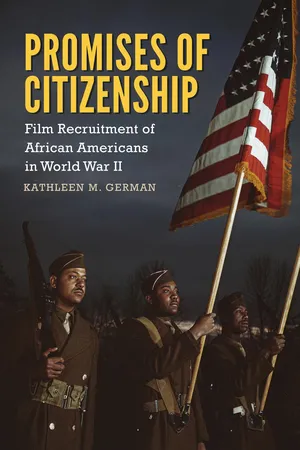
As demand for manpower grew during the war, government officials and military leaders realized that the war could not be won without black support. To generate African American enthusiasm, the federal government turned to mass media. Several government films were produced and distributed, movies that have remained largely unexamined by scholars. Kathleen M. German delves into the dilemma of race and the federal government's attempts to appeal to black patriotism and pride even while postponing demands for equality and integration until victory was achieved.
German's study intersects three disciplines: the history of the African American experience in World War II, the theory of documentary film, and the study of rhetoric. One of the main films of the war era, The Negro Soldier, fractured the long tradition of degrading minstrel caricatures by presenting a more dignified public image of African Americans. Along with other government films, the narrative within The Negro Soldier transformed the black volunteer into an able soldier. It included African Americans in the national mythology by retelling American history to recognize black participation. As German reveals, through this new narrative with more dignified images, The Negro Soldier and other films performed rhetorical work by advancing the agenda of black citizenship.
eBook - ePub
Promises of Citizenship
Film Recruitment of African Americans in World War II
- 278 pages
- English
- ePUB (mobile friendly)
- Available on iOS & Android
eBook - ePub
About this book
Information
Publisher
University Press of MississippiYear
2017Print ISBN
9781496823335
9781496812353
eBook ISBN
9781496812360
CHAPTER ONE
The Dilemma of Racial Identity
We have a wolf by the ears, and we can neither hold him, nor safely let him go. Justice is in one scale, and self-preservation in the other.
—ANDREW JACKSON REFERRING TO THE INSTITUTION OF SLAVERY1
Emergence of the idea of a social structure based on race paralleled European colonial expansion, although it had probably been present in other, earlier cultures. In European eyes, the image of nonwhites was profoundly shaped by Christianity, as Europeans encountered and subdued the darker peoples of Africa. Fascination with apes and baboons coincided with the thought that Africans, perceived to be physically similar to African wildlife, were also bestial.2 European religion provided the framework whereby all things, living and inanimate, were ranked from closest to furthest from God in the great chain of being, a construct that influenced human power relationships for generations.3 To European colonists, both Africans and Native Americans were originally seen as servants of Satan, as savages without souls. Eventually, Native Americans were acknowledged as fit subjects for conversion—unless they resisted. In that case, they were massacred, their deaths justified because their resistance to Christianity proved they were human manifestations of the devil. Not until the eighteenth century were blacks considered fit subjects for Christian proselytizing.
In North America, the system of rigid racial categories that emerged from colonial conquest produced a social order based on the belief that inferior races required patriarchal protection. This paternalistic hierarchy mirrored the cycle of human development from childhood through adulthood. Nineteenth-century scholars used the concept of human growth to describe the varied development of the races. Blacks were considered fetal, Asians infantile, and whites adult. Lack of beards among the inferior races, as well as their uncomplicated natures, supported this purportedly scientific view.4 The peculiar institution of slavery and policies of immigration were shaped according to this template.
The hierarchy of privilege that accompanied this racial orientation permeated most aspects of American life and was reinforced by a complex social, economic, political, and legal infrastructure. In one sense, the American institutions that grew from slavery reflected these roots, if not in name, then in the practice of segregation. Among the cultural institutions that preserved racism, by the twentieth century media had become ubiquitous with the advent of film and radio. Ironically, media simultaneously reinforced racial hierarchies and revealed the fissures of an unraveling system of segregation, as Sambo-like caricatures challenged and were rebuffed by white characters. In the land of the free, freedom did not extend to many inhabitants, including African Americans. That apparent contradiction did not seem inconsistent, largely because those disenfranchised were considered incapable of participation as full-fledged citizens; owing to their inferior nature, they lacked the necessary qualities of citizenship.
Federal definitions of race in the United States have relied on the idea of “blood quantum,” a measure of how one’s heredity can be traced through blood to particular ancestors such as African Americans, Native Americans, Hispanics, and so on. Unlike racial categories that resulted from geographic circumstances, where groups like Asians and Hispanics were protected by strong sovereign territories and governments, Native and African American classifications were “the direct result of conquest and enslavement.”5
The concept of blood quantum was widely applied in order to prevent the dilution of white blood. The original use of blood quantum can be traced to 1705 and Virginia laws that limited the civil rights of Native Americans and persons who were of half or more Native American ancestry. In practice, many people of mixed ancestry, especially those who “looked white,” were blended into the white majority and enjoyed the same privileges as whites—in some places. However, these individuals were restricted by laws like the 1822 Virginia law designating anyone with one African American grandparent as legally “mulatto,” and therefore subject to the same restrictions applied to African Americans.
Following the Nat Turner Rebellion of 1831, many state legislatures increased controls over African Americans, and their rights eroded further in the post-Civil War South. For instance, marriage to whites was prohibited to anyone considered black or racially mixed. In the twentieth century, still more restrictive legal definitions of race were enacted. From 1910 to 1930 racial discrimination reached its zenith with implementation of the rigid Jim Crow system in the South and more lax, but still discriminatory racial segregation, in the North and West. Virginia, for example, adopted the “one-drop rule” in its 1924 Racial Integrity Act, making any African ancestry grounds for exclusion as “colored.” And the Indian Reorganization Act of 1934 condemned the pollution of white blood by mixing with other races, especially African Americans. Such legal definitions often did not differentiate between African Americans, Native Americans, and others, labeled them all “colored.”
The effect of African American blood was so potent that one drop defined a person as black. In application, divisions by race had serious consequences. In 1854, for example, the California Supreme Court in People v. Hall held that blacks, mulattoes, Native Americans, and Chinese were not white and therefore could not testify in court against whites. The result was to sanction violence by whites against nonwhites, because eyewitness evidence of nonwhite victims could not be introduced in court. These laws arbitrarily designated Mexican residents as white, while some European immigrants, notably Irish and Italian, were designated as black unless they could demonstrate they were white persons.6
The one-drop rule coincided with Jim Crow racial segregation laws, the adoption of eugenics theories by some scientists, and ideas of racial purity that disenfranchised most African Americans by restricting their voting rights, controlling their access to public facilities, and limiting their recourse to education. White-dominated institutions such as state and national legislative bodies, as well as the Supreme Court, reinforced racial restrictions through a network of laws and decisions. Plessy v. Ferguson (1896), the most notorious of these decisions, upheld the constitutionality of state laws requiring racial segregation in public facilities under the doctrine of “separate but equal.” This standard preserved Jim Crow segregation until its repudiation in Brown v. Board of Education (1954), which began the slow legal process of dismantling Jim Crow.
Plessy informed the prevailing social practices and legal standards of World War II. While the Court stipulated that there was no implication of the racial inferiority of African Americans because such would violate the Fourteenth Amendment, it did affirm existing public policies separating people by race. Justice Henry B. Brown summarized the majority opinion that racial separation did not stamp African Americans with “a badge of inferiority,” but if inferiority is found, it exists “solely because the colored race chooses to put that construction upon it.”7 Since the court did not find differences in quality between white and black railroad cars in Plessy, it assumed that other public facilities were similarly equal. Justice John Marshall Harlan’s caustic dissent predicted that the decision would become infamous, but Harlan did not foresee the contradictions that World War II would produce when Asians, who in 1896 were allowed to board the same railroad cars as whites, became the focus of discrimination and relocation to internment camps. Plessy v. Ferguson anchored the legal foundation for the separation of races in military institutions; the idea that segregation based on racial classifications remained legal as long as facilities were of equal quality. Ultimately, restrictions based on racial categories informed US military policy during World War II.
The process of racial identification has often been one of reduction, forging a single identity for groups that may be culturally diverse, historically constituted, and ethnically fragmented. Such categorization also dichotomizes societies along a binary scale that classifies as “nonwhite” anyone outside a narrow range, and renders a racial hierarchy of preference for whites at the expense of other racial groups. In practice, the question of race is often complicated by economic and political factors, social interaction, and legal stipulations. And race continues to be debated today, as evident in the 1986 Supreme Court case Doe v. Louisiana and publications such as A Troublesome Inheritance: Genes, Race, and Human History (2014), by Nicholas Wage.
In effect, racial division in the United States has separated any group deemed nonwhite as racially “other.” For much of American history, this practice has protected a narrow group of original settlers, mainly from northern European countries like England, Russia, and Germany, from successive waves of immigration, as well as from the original native inhabitants of the continent. Race, according to Ronald Takaki, “has been a social construction that has historically set apart racial minorities from European immigrant groups.”8 It is not, Takaki argues, equivalent to ethnicity, which derives from the customs and practices of social groups. By contrast, race is the inheritance of immutable physical and psychological characteristics. While the distinction can occasionally be fuzzy, to link race with permanent characteristics justifies racial discrimination because the immutable characteristics that accompany racial groups predetermine their treatment. Hence, the strong prohibition against racial mixing is intended to preserve the innate characteristics of race from dilution. This assumption prompted Mississippi congressman John Rankin to denounce in 1943 the transfusion of black or Japanese blood into white Americans as a communist plot, an attempt to mongrelize America, “to pump Negro or Japanese blood into the veins of our wounded white boys regardless of the dire effect it might have on their children.”9 In essence, racial category dictates social position. For example, this understanding of race explains how Irish immigrants were first classified as nonwhite because they were considered to be pagan and savage, closer to African American slaves than to civilized white men. As a result, the Irish were prohibited from purchasing land, marrying white Europeans, holding office, serving on juries, or testifying in court.10 In contrast to the straight-laced, hard-working puritan ideal of the European colonists, Irish immigrants were stereotyped as wicked, lazy, morally loose, without manners, inept as farmers and orchard keepers, and thieves who had to be watched carefully.
One ramification of establishing binary racial divisions that preclude change is centralization of power. The immutable characteristics of race establish a permanent border between the powerful and outsiders. Racial definitions preserve the site of decision-making and establish yardsticks for inclusion. The earliest colonial stereotypes of Native Americans, Irish immigrants, and African Americans categorize each group as savage and shiftless, as opposed to white colonists, who exhibited the spirituality and industry of civilized people. The first laws restricting citizenship to land ownership reflected this division between white power elites and disadvantaged others.11 Throughout the colonies, suffrage was also originally based on property ownership, which assumed that owners of material goods and land had acquired them through dedicated labor and divine providence favoring the godly. Limited access to land and power resulted in tensions that erupted in 1676 in Bacon’s Rebellion. In ensuing years, the power base moved from land ownership toward class status, which included property owners as well as indentured and slave classes. Laws once hostile to white servants became more liberal, while those laws restricting the rights of African Americans, who were often enslaved, remained intact, creating a political division based more squarely on skin color.12 As the criterion for citizenship shifted to encompass social rank rather than land ownership, racial definitions were reinforced—with curious results. Irish and other immigrants, such as Italians, were considered closer to whites, while “blacks were forced to occupy a racially subordinate and stigmatized status, one below all whites regardless of their class.”13 Such racial discrimination protected whites by restricting access to power and defining other groups as nonwhite. This system provided the justification for segregation and, for Native Americans, for forcible removal to reservations. These collective constraints forged a common denominator of powerlessness for those who were excluded by racial restrictions.
During wartime, although legally ambiguous, the social practices of a segregated society were replicated in military institutions. Dichotomization based on race promotes the construction of “the other,” those who are located outside the structures of power. Such dichotomization often results in the stigmatization of whole categories of people who, as a consequence, become objects of contempt. Stereotypes about those segregated accompany the stigma of segregation, for those who are “other” are presumed to lack the characteristics valued by the dominant culture. They were seen as inherently unsalvageable, stereotyped as lacking self-control and intelligence, and as carriers of disease. Finally, they were depicted as simultaneously childlike and brutishly savage. The physically distinctive attributes ascribed to African Americans confirmed their innate lack of culturally desirable attributes. And these characteristics, such as a simple nature, were not limited to African Americans, but were also ascribed to other outsiders, such as Native Americans. Vestiges of these stereotypes have persisted unabated into the twenty-first century.
During World War II, both the Allies and the Axis powers expressed racial hatred and practiced systems of racial hierarchy. Intolerance of Jews, homosexuals, gypsies, Poles, and Russians in Axis nations is well documented. The Japanese expressed their racial superiority in atrocities committed against the people of China, Manchuria, and Australia. Americans were not exempt from racial hatred, and sometimes violence, usually targeting African Americans, Japanese, and Hispanics. For some white Americans, hatred of nonwhite races did not distinguish Japanese living in imperial Japan from those living as American citizens. Some conflated all racial groups, lumping Asians together with African Americans.14 The Japanese, perceived by white Americans as an inferior race, lacking human feelings although possessing manic determination, were more hated than the Germans or the Italians.15 Racist images were exceedingly graphic and contemptuous, portraying the Japanese as apes, buck-toothed and nearsighted rats, and vermin. Few Americans objected to these depictions.
Such feelings were so commonplace that in 1945 a popular American scientific magazine published an article, “Why Americans Hate Japs more than Nazis” without public protest.16 Two weeks after the attack on Pearl Harbor, Life magazine included diagrams illustrating “How to tell Japs from the Chinese” to help readers distinguish between enemies and allies.17 American soldiers were issued copies of the Pocket Guide to China, a pamphlet illustrated with graphics depicting supposed differences between Asian friends and foes, including skin coloration, eye configuration, and “the wide space between the first and second toes” caused by wooden Japanese sandals.18 Collectively, the Japanese were understood to be primitive, emotionally deficient, and capable of horrifying atrocities, yet superhuman and fanatically devoted to their emperor. In a 1943 Atlantic Monthly article, Virginius Dabney explained the race riots in the United States by blaming African Americans, associating them with the degeneracy of Asians: “Like the natives of Malaysia and Burma the American Negroes are sometimes imbued with the notion that a victory for the yellow race over the white race might also be a victory for them.”19 The link between the Japanese and the African Americans signaled fear that the demands of African Americans for civil rights were somehow associated with the enemy.
Adherence of the Nazis to the doctrine of Aryan superiority provoked a critique of master race arguments, particularly among Western scientists and intellectuals. This examination of theories concerning inherent superior or inferior capabilities of different races began to expose the hypocrisy of racial prejudice in the United States. Anti-Semitism, internment of Japanese American citizens, and demeaning Jim Crow laws were manifestations of American bigotry exposed in the debate over Nazi racism. In the midst of the war, Congress considered revising Oriental exclusion laws, notoriously rooted in attitudes of white racial superiority. As John W. Dower concludes, “In such ways, World War II contributed immeasurably not only to a sharpened awareness of racism within the United States, but also to more radical demands and militant tactics on the part of the victims of discrimination.”20
Intellectual uneasiness regarding racism was more broadly introduced into the public discussion by other challengers. The popular works of Ruth Benedict, Patterns of Culture (1934) and The Races of Mankind (1943), became epicenters of controversy. They were banned by the army and civilian United service organizations, as well as denounced by the Military Affairs Committee of the House of Representatives as communist propaganda because they critiqued racism—in particular, American racial injustice.21 These actions reflected the racial views of many Americans, who were not receptive to reconsidering racial issues or inclusive viewpoints. Their racial attitudes derived from historical precedent and were embedded in public institutions. But the social tensions and severe disruptions introduced by global war necessitated closer inspection of unjust attitudes and practices.
At a time when white Americans overwhelmingly supported segregation, the federal government was obliged to acknowledge positive African American capabilities in order to generate support for African American enlistments, while simultaneously avoiding black demands for expanded civil rights. The most successful federal effort was The Negro Soldier, a film praised by white and black viewers alike. Focusing on the common goal of victory, filmmakers plundered the past, retelling America’s story while highlighting African American contributions. This revised history generated an unmistakably integrationist message for black viewers but reassured whites that victory was the ultimate goal of temporary cooperation.
Prev...
Table of contents
- Cover
- Half title
- Title
- Copyright
- Dedication
- Contents
- Introduction
- Chapter One The Dilemma of Racial Identity
- Chapter Two Military Service and Citizenship
- Chapter Three Mass Media in the Twentieth Century
- Chapter Four The Negro Soldier as Conversion Narrative
- Chapter Five Conflicting Narratives and Images
- Chapter Six Military Conditions during World War II
- Chapter Seven Attitudinal Barriers to Change
- Chapter Eight Social Conditions for Change
- Chapter Nine The Influence of the Black Press
- Chapter Ten The Negotiation of Racial Identity
- Chapter Eleven The Challenge of Change in the Aftermath of World War II
- Notes
- Bibliography
- Index
Trusted by 375,005 students
Access to over 1.5 million titles for a fair monthly price.
Study more efficiently using our study tools.
Frequently asked questions
Yes, you can cancel anytime from the Subscription tab in your account settings on the Perlego website. Your subscription will stay active until the end of your current billing period. Learn how to cancel your subscription
No, books cannot be downloaded as external files, such as PDFs, for use outside of Perlego. However, you can download books within the Perlego app for offline reading on mobile or tablet. Learn how to download books offline
Perlego offers two plans: Essential and Complete
- Essential is ideal for learners and professionals who enjoy exploring a wide range of subjects. Access the Essential Library with 800,000+ trusted titles and best-sellers across business, personal growth, and the humanities. Includes unlimited reading time and Standard Read Aloud voice.
- Complete: Perfect for advanced learners and researchers needing full, unrestricted access. Unlock 1.5M+ books across hundreds of subjects, including academic and specialized titles. The Complete Plan also includes advanced features like Premium Read Aloud and Research Assistant.
We are an online textbook subscription service, where you can get access to an entire online library for less than the price of a single book per month. With over 1.5 million books across 990+ topics, we’ve got you covered! Learn about our mission
Look out for the read-aloud symbol on your next book to see if you can listen to it. The read-aloud tool reads text aloud for you, highlighting the text as it is being read. You can pause it, speed it up and slow it down. Learn more about Read Aloud
Yes! You can use the Perlego app on both iOS and Android devices to read anytime, anywhere — even offline. Perfect for commutes or when you’re on the go.
Please note we cannot support devices running on iOS 13 and Android 7 or earlier. Learn more about using the app
Please note we cannot support devices running on iOS 13 and Android 7 or earlier. Learn more about using the app
Yes, you can access Promises of Citizenship by Kathleen German in PDF and/or ePUB format, as well as other popular books in Social Sciences & World War II. We have over 1.5 million books available in our catalogue for you to explore.