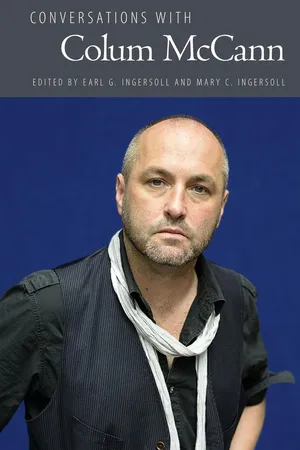
Conversations with Colum McCann brings together eighteen interviews with a world-renowned fiction writer. Ranging from his 1994 literary debut, Fishing the Sloe-Black River, to a previously unpublished interview conducted in 2016, these interviews represent the development as well as the continuation of McCann's interests. The number and length of the later conversations attest to his star-power. Let the Great World Spin earned him the National Book Award and promises to become a major motion picture. His most recent novel, TransAtlantic, has awed readers with its dynamic yoking of the 1845-46 visit of Frederick Douglass to Ireland, the 1919 first nonstop transatlantic flight of Alcock and Brown, and Senator George Mitchell's 1998 efforts to achieve a peace accord in Northern Ireland. An extensive interview by scholar Cécile Maudet is included here, as is an interview by John Cusatis, who wrote Understanding Colum McCann, the first extensive critical analysis of McCann's work. An author who actually enjoys talking about his work, McCann (b. 1965) offers insights into his method of writing, what he hopes to achieve, as well as the challenge of writing each novel to go beyond his accomplishments in the novel before. Readers will note how many of his responses include stories in which he himself is the object of the humor and how often his remarks reveal insights into his character as a man who sees the grittiness of the urban landscape but never loses faith in the strength of ordinary people and their capacity to prevail.
- 224 pages
- English
- ePUB (mobile friendly)
- Available on iOS & Android
eBook - ePub
Conversations with Colum McCann
About this book
Information
Topic
LiteraturaSubtopic
Biografías literariasTwo Interviews with Colum McCann
Originally published in TransAtlantica, January 10, 2014. http://transatlantica.revues.org. Reprinted with permission.
While working on her doctoral degree at Rennes University, Cécile Maudet focused her research on Colum McCann’s fiction following his fall 2008 reading at Rennes. In spring 2013, Cécile interviewed Colum at his home in New York, paving the way for extensive correspondence, leading in turn to her inviting him to Rennes the next year as guest of honor at a conference devoted to his work.
First Interview (April 22, 2013)
Cécile Maudet: You have written mostly novels, but their composition is always fragmented into different stories told by various narrators. Their structures are thus somehow reminiscent of that of collections of short stories. I would like to understand the interest you find in resorting to so many voices within the same novel. What kind of spaces would you say that these condensed stories create for you as opposed to a longer story that would be told by one narrator? And what do you find in the novels that you don’t find in the short stories in terms of writing possibilities—because you’ve gradually left the genre of the short story aside these last few years, right?
Colum McCann: I suppose first of all you write the books that you want to read. That’s the most important thing. People ask you: “Who is your reader?” Well, ultimately your reader should be yourself, twenty years from now. So you hope not to be bored by your stuff, and you hope that it still has the electricity that runs through it. And also, I’m very interested in the kaleidoscopic notion of storytelling and increasingly interested in it as a political idea, especially the notion that it can be an all-embracing sort of democracy, so that if you go to a kaleidoscopic point of view you can see things from several different angles. I have quoted this many times before—I’m sure you’ve seen me quote it—but John Berger says: “Never again will a story be told as if it were the only one.” When I came across that, it was really interesting for me because I was writing. I think the big moment for me was when I was just starting writing Dancer. Do you know the story about how I got to write Dancer?
Maudet: A friend of yours …
McCann: A friend of mine, he was in Dublin, his father came home drunk and he saw Rudolf Nureyev on TV and he sort of fell in love with Rudolf Nureyev. I thought that’s a beautiful story, an absolutely gorgeous story, really powerful. And I started to think: that particular story would never make it as a part of the official biography, the official history of Rudolf Nureyev because it’s a supposedly anonymous story. But if that story captures a life, or a part of a life, it captures not only Jimmy’s life—my friend—but it also captures Rudolf Nureyev’s life, right? It’s also a story about fathers, about cultures, about drink, it’s about Dublin, it’s about Russia, it’s about all these different things coming together. So each individual story has its own sort of kaleidoscopic moment, its own crystal, if you will. You look at it, you shine the light through it and you see it fractured in several different ways. But the accumulation of those things can tell a sort of biography.
I’d just written a very small book called Everything in This Country Must, which was tight. The geography was tight, it was gathered all about Northern Ireland, and I wanted to sort of expand my lungs, but also I wanted to write very much an international novel. And the origin is kind of stupid now when I think about it, but originally I wanted to write a novel that had every country in the world mentioned somehow. But then it became a device. I started it and then I thought: “No, this is a device, this is not good.” And it wasn’t true, even though Rudolf Nureyev would have been the perfect person for that because he was sort of all over the place. So the project started, I suppose, when I started Dancer. And then after Dancer, Zoli was a much more controlled book and much more focused book, and yet it still had different points of view.
Well, maybe it’s because I’m influenced by cinema in certain ways because you have the high angle, and then you have the close up, and then you have the fish-eye lens, and then you have different lenses. If you’re making a film, you never use the same lens all the way along. So there’s something cinematic about it, there’s something to do with politics and democracy, there’s something to do with just the kaleidoscopic nature.
And quite frankly I don’t want to bore myself or bore the reader, and I love shifts in pace. So that’s kind of like music: things become contrapuntal, and they’re moving in and moving out and then they bash up against one another. Sometimes it awakens the sleep in you in certain ways when you can’t write that way. That’s the sort of writing I enjoy reading. So part of it then is just logical, part of it is political, part of it is aesthetic, and part of it is just because that’s the way I want to do, and maybe it’s the only way I know how.
Maudet: You’ve just mentioned the political aspect of your writing. You once said that “[you] don’t know what [the term fiction] means”1 and that “you don’t like the word [fiction] anymore”2 because, for you, stories are windows onto history. Could you elaborate on this a little? With this assertion, would you go as far as saying that your literature is akin to a historical testimony in a way, or archive?
McCann: Well, I don’t say that all fictions should be this way. One of the things that I think is really important to say is that I have my point of view and I will not impose it on anybody else. I don’t want to make any grand sweeping statements about the nature of fiction or anything like that, but I do think that writers, especially when they embrace the anonymous corners, are creating a new history. They become the sort of unacknowledged historians in a certain way. I think it’s really important. Their story has to be told over and over and over again; otherwise it gets distorted and forgotten. The Jewish culture is really interesting in the sense that it has always known that it must tell a story over and over and over again. Otherwise you’ll have people appropriate it outside; they’ll say it’s untrue. Writing about the Holocaust they’ve done the most incredible things. They’ve told it from so many different angles that you can’t really deny its truth. Anybody who tries to deny its truth seems ridiculous. If they hadn’t told their story, like, say, the Romani culture didn’t really tell their story, the truth would have been created for them from the outside. It’s like that Sartrian notion of the stereotypes,3 you know, that society conforms to its own stereotypes. If the truth is formed from the outside, that’s a real problem. The Irish culture forms its own truth much like the Jewish culture because we are storytellers. But there are certain things that we have avoided too like the famine. The Irish famine has been sort of avoided. So, in a certain way, I do find that there’s perhaps even a truer history involved in all this. I wrote an essay about Ulysses. I don’t know if you have had a chance to read it?
Maudet: Yes, I’ve read it. You’re alluding to “But Always Meeting Ourselves,”4 right?
McCann: Right. And in that, I sort of assert that this fiction Ulysses is a more important history to me personally than that of my actual ancestors themselves. So that Leopold Bloom—the fictional character—legislates my Dublin for me, because he’s there on June 16, 1904. My great-grandfather, who I never met—but it pumps through my blood, right?—walked the same streets on June 16, 1904. Why do I know my great-grandfather? I really know him because I know Leopold Bloom. That’s very interesting to me. The imagined is real, if not even more real than reality itself. I think that’s been my project for the past I don’t know how many books since Dancer. This new book, TransAtlantic, is very much like that project too. I think I’ve finished. I’m at the end of that. I’ve pushed it as far as it can go. I don’t know where I want to go next. Maybe off the cliff or out the window or something, I don’t know! But yes, I think we have a responsibility to history, and we also have a responsibility to our characters. Much of the history, I get it right, as for example in TransAtlantic. I get it minutely right and then I insert fictional characters.
Maudet: It’s how you do, isn’t it?
McCann: So I talked with Sasha Hemon—Aleksandar Hemon—about this and he says that in Bosnia, there’s no word for fiction. I think that’s really cool. He says it’s all called storytelling. So there’s no word for fiction or non-fiction; it’s just storytelling. And I think essentially that’s what we are engaged in.
Maudet: Talking about engagement, your political stances are not dissimulated in your press articles, especially concerning the Bush administration and the socio-economic changes that Ireland has gone through during the last decades. You said you wished the voice of today’s writers was more influential, and you deplore the “acute crisis of disengagement”5 from both readers and writers. You’ve also insisted on wanting to give a voice to “the anonymous corners of the world.”6 Such a recurring treatment of balkanized countries, the margins and migration leads me to ask you this: in what way would you say that your literary production is also politically engaged?
McCann: I will have to say that it’s politically engaged right down to its very core. But I’m not interested in telling anybody what sort of politics they should live, nor am I necessarily interested in anybody knowing what my politics happen to be after they finish the book. I think they have a fair idea. But what’s more interesting to me is that you allow a human experience through the function of writing. So tomorrow, for instance, I have possibly the best day of my literary life, the biggest thing that ever happened to me, because I’m going to Newtown, Connecticut, where those twenty-six kids were killed in the shooting last year.7 The high school there used Let the Great World Spin as the text to navigate the grief for the high school children, for the seventeen-and eighteen-year-olds. They’ve been studying Let the Great World Spin for the past two months. They are talking with counselors, they’re talking with themselves, amongst themselves, with their teachers about Let the Great World Spin, but they’re also using it to navigate this horrible thing with their brothers, their sisters, the kids that they babysat for, who were killed. And to me that’s where literature comes in and has this moment of healing. This is where it becomes political because I’m sure that healing is political and engagement is political. And I don’t want to become a politician obviously—it’s so boring to be a politician, right?—but to be somebody who just talks about these human things that [William] Faulkner talks about: the human heart at conflict with itself; love, pride, pity, compassion; these things that he quotes in his 1950 Nobel address.8 In fact, I always think it’s very interesting to look at the writers. When they receive their award, that’s when they become the most optimistic. They can be quite dark in their own work but virtually every writer worth his or her salt believes in the power of literature. And that’s fascinating to me. I mean, there’s no point to do it otherwise. We’d just be solipsistic or sort of onanistic. So, I would say that I would like to think that it is politically engaged but it’s not—hopefully—it’s not didactic.
Maudet: Sure, you don’t want to be didactic. Yet, literature is or has to be for some writers. Frank Norris said that the novel “may be a great force that works together with the pulpit and the universities for the good of the people.”9 Conversely, Richard Ford wrote that short “story writers—more so than novelists—are moralists at heart. The short story enables to kind of show the reader some path to follow.”10 According to these two writers then, it seems that literature—whatever form it takes—has an educative role to play. As it is concise and generally very efficient, I would personally agree with R. Ford to say that the short story could indeed be envisaged as an adequate way to convey a moral message. Would you acknowledge this congruence between literature and morality? And would you agree that literary texts are forms to, if not convey a moral message, at least trigger in the reader a situation of moral questioning?
McCann: For sure, yeah, yeah, yeah. Well, first of all, I don’t see a massive difference between the literary forms, between short stories and novels. I also don’t even see a huge difference between novels and journalism, nor poems and playwriting. I believe that the well-chosen word properly put down upon the page can be as influential in no matter what form it happens to be. I can do short stories and I can do novels. I’ve tried plays and they’re terrible, I’ve tried poems they’re really terrible, they’re unbelievably bad. I don’t want to show them to anybody! It doesn’t really bother me what form it happens to take in all the forms that I love the most, but I think the most expansive form, the biggest form of all, is the novel, because it can contain everything. But in relation to its moral purpose and its moral parameters, I think it’s dangerous to say that the novel must be moral, but I will say the novel must be moral!
Maudet: I am currently working on the concept of rupture in your work. I think it applies thematically first of all. You always envisage historical events from a distance, so rupture is temporal. Would you say that, like historians who think they cannot legitimately investigate the history of the present time—as they think they need hindsight to deal with historical event...
Table of contents
- Cover
- Title Page
- Copyright
- Contents
- Introduction
- Chronology
- Interview with Colum McCann
- Interview with Colum McCann
- This Side of Brightness Interview
- Interview with Colum McCann
- Colum McCann
- Zoli Interview: Q&A with Michael Hayes
- Zoli Interview: Q&A with Laura McCaffrey
- Colum McCann
- 2009 National Book Award Winner Fiction: Interview with Colum McCann
- Colum McCann in Conversation with John Kelly
- “A Country of the Elsewheres”: An Interview with Colum McCann
- “Embracing the World by Inventing the World”: The Literary Journey of Colum McCann
- The Rumpus Interview with Colum McCann
- Two Interviews with Colum McCann
- Do What Is Most Difficult
- Making It Up to Tell the Truth: An Interview with Colum McCann
- “In the End, We Write to Say That We Matter”: A Conversation with Colum McCann
- Index
Trusted by 375,005 students
Access to over 1.5 million titles for a fair monthly price.
Study more efficiently using our study tools.
Frequently asked questions
Yes, you can cancel anytime from the Subscription tab in your account settings on the Perlego website. Your subscription will stay active until the end of your current billing period. Learn how to cancel your subscription
No, books cannot be downloaded as external files, such as PDFs, for use outside of Perlego. However, you can download books within the Perlego app for offline reading on mobile or tablet. Learn how to download books offline
Perlego offers two plans: Essential and Complete
- Essential is ideal for learners and professionals who enjoy exploring a wide range of subjects. Access the Essential Library with 800,000+ trusted titles and best-sellers across business, personal growth, and the humanities. Includes unlimited reading time and Standard Read Aloud voice.
- Complete: Perfect for advanced learners and researchers needing full, unrestricted access. Unlock 1.5M+ books across hundreds of subjects, including academic and specialized titles. The Complete Plan also includes advanced features like Premium Read Aloud and Research Assistant.
We are an online textbook subscription service, where you can get access to an entire online library for less than the price of a single book per month. With over 1.5 million books across 990+ topics, we’ve got you covered! Learn about our mission
Look out for the read-aloud symbol on your next book to see if you can listen to it. The read-aloud tool reads text aloud for you, highlighting the text as it is being read. You can pause it, speed it up and slow it down. Learn more about Read Aloud
Yes! You can use the Perlego app on both iOS and Android devices to read anytime, anywhere — even offline. Perfect for commutes or when you’re on the go.
Please note we cannot support devices running on iOS 13 and Android 7 or earlier. Learn more about using the app
Please note we cannot support devices running on iOS 13 and Android 7 or earlier. Learn more about using the app
Yes, you can access Conversations with Colum McCann by Earl G. Ingersoll, Mary C. Ingersoll in PDF and/or ePUB format, as well as other popular books in Literatura & Biografías literarias. We have over 1.5 million books available in our catalogue for you to explore.