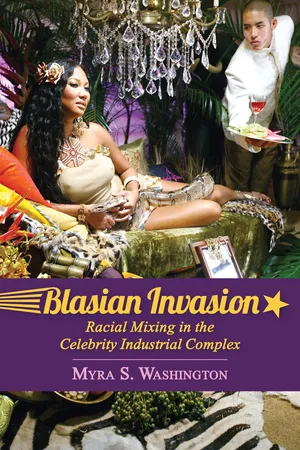
Myra S. Washington probes the social construction of race through the mixed-race identity of Blasians, people of Black and Asian ancestry. She looks at the construction of the identifier Blasian and how this term went from being undefined to forming a significant role in popular media. Today Blasian has emerged as not just an identity Black/Asian mixed-race people can claim, but also a popular brand within the industry and a signifier in the culture at large. Washington tracks the transformation of Blasian from being an unmentioned category to a recognized status applied to other Blasian figures in media.
Blasians have been neglected as a meaningful category of people in research, despite an extensive history of Black and Asian interactions within the United States and abroad. Washington explains that even though Americans have mixed in every way possible, racial mixing is framed in certain ways, which almost always seem to involve Whiteness. Unsurprisingly, media discourses about Blasians mostly conform to usual scripts already created, reproduced, and familiar to audiences about monoracial Blacks and Asians.
In the first book on this subject, Washington regards Blasians as belonging to more than one community, given their multiple histories and experiences. Moving beyond dominant rhetoric, she does not harp on defining or categorizing mixed race, but instead recognizes the multiplicities of Blasians and the process by which they obtain meaning. Washington uses celebrities, including Kimora Lee, Dwayne Johnson, Hines Ward, and Tiger Woods, to highlight how they challenge and destabilize current racial debate, create spaces for themselves, and change the narratives that frame multiracial people. Finally, Washington asserts Blasians as evidence not only for the fluidity of identities, but also for the limitations of reductive racial binaries.
- 192 pages
- English
- ePUB (mobile friendly)
- Available on iOS & Android
eBook - ePub
About this book
Information
CHAPTER ONE
Theorizing Blasians
In March 2015 the Miss Japan beauty pageant created a slew of headlines and think pieces after crowning its newest queen. There were criticisms that the newest Miss Japan was not Japanese “enough.”1 That is because, though Ariana Miyamoto is Japanese through citizenship, parentage, and various cultural practices, she is also Black.2 Not only is Miyamoto Japan’s first obviously multiracial winner, she is also its first Black one.3 Many of the news stories focused on the backlash surrounding the crowning of Miyamoto, centering on Miyamoto’s “non-Japanese” look and the resistance by many in Japan to even acknowledge that she is Japanese. The tenor of the comments proliferating online made claims that she had “too much black blood to be Japanese,”4 or that she did not “even look Japanese,”5 or that the pageant should have crowned a “pure-blooded Japanese”6 woman instead. During CNN’s story on her historic win, the reporter asked a group of high school students on the street their thoughts on the decision to crown Miyamoto as Miss Japan. One student replied, “Half is not 100% Japanese. If someone is chosen as Miss Japan, both her parents should be Japanese.”7 The responses to Miyamoto highlighted the tensions between the perceptual and the performative aspects of racial identities that all of the subjects in this book navigate.
Miyamoto’s response to the critiques around her mixed-race identity attempts to meet both constitutive notions of race: the performative, doing, and the essentialist, being. When asked why she got involved in the pageant, Miyamoto discussed how the death of a mixed-race friend motivated her attempt to “change Japan.”8 Later Miyamoto told reporters about the racism she faced through childhood but asserted, “I’m Japanese through and through, but in Japan if you look ‘foreign’ you are often not accepted as Japanese. But I am Japanese—100 percent.”9 Miyamoto also stresses her Japanese cultural competencies, such as holding a fifth-level expertise in Japanese calligraphy, and donning a kimono for her coming-of-age ceremony. Still, despite her assertion that she is Japanese, nearly every news piece in the weeks following her crowning made sure to mention how Miyamoto spoke either “fluent” or “perfect” Japanese. Which is, of course, only noteworthy if one assumes she is not Japanese and thus might not be able to speak the language.
Not all stories focused on how other Japanese people thought of Miyamoto; there were news stories that focused on how her win might shift (perhaps necessarily) the image of Japan as something other than a country so hostile to outsiders that it thrives on its continued isolation and homogeneity. Miss Japan has won the Miss Universe title only twice, in 1959 and 2007, and both times the competition was held in Japan. Miyamoto represented Japan in the 2016 Miss Universe pageant in Las Vegas, which featured nearly 100 women who are all symbols of national pride for their respective countries. That Miyamoto was the first visibly multiracial representative for Japan is notable because it “expands and contests the idea of whose ideal beauty represents a country.”10 Additionally, as Sarah Banet-Weiser notes, national pageant winners’ bodies are inscribed with narratives “that articulate dominant expectations about who and what [Japanese] women are and should be at the same time as it narrates who and what the nation itself should be through promises of citizenship, fantasies of agency, and tolerant pluralism. Therefore the beauty pageant provides us with a site to witness the gendered construction of national identity.”11 The crowning of Miyamoto, then, becomes a strategic attempt by the organizers of Miss Japan to “remain competitive in the Miss Universe arena”12 by garnering both national and international attention, and appealing to a transnational judging body with their obviously transnational contestant. Though pageant participants and organizers would probably not see these competitions as political arenas, they are, especially in the sense that the “presentation and reinvention of femininity that takes place on the beauty pageant stage produces political subjects.”13 Miyamoto becomes, then, the perfect trope for Japan, as through her the nation comes to embody both modernity and tradition.
This opening vignette about Miyamoto suggests her identity in media is racialized in very particular ways, specifically how narratives about her identity focused on themes of nationalism, beauty, and authenticity. Miyamoto is framed as Black according to a hegemonic understanding of race and racial mixing in the United States, Japanese for the purposes of shifting the national identity of Japan, and Blasian (mixed-race Black and Asian) according to the ways she describes herself and the celebratory rhetoric in various news articles. This book attempts to explain how Blasian, a concept and a term likely still unknown to some today, went from being undefined to taking an identifiable place in popular media culture. Today it is not just an identity that Black and Asian/American14 mixed-race people can claim but also a popular identity with meaning within media and a relevance that works in productive ways. This book explores the transformation and branding of Blasian from being an illegible and unmentioned category to a legible classification that is then applied to other Blasian figures in media. By “legibility” I mean the “ease with which [one] can be recognized.”15 I use branding as a tool to map out the process of conferring meaning, legibility, to Blasians. Importantly, I also use Blasians as an example of what Leslie Bow has described as transracialism because they “enable the formation of alternative concepts of community, of alliances that contest those sedimented by nationality and belief in biological inevitability.”16 This book ultimately reveals that even though Americans have mixed in every way possible, racial mixing is talked about in certain ways (which seems to almost always involve Whiteness) and not others. Importantly, Blasians contest the hegemony of race constructed around the lives of not just Blacks and Asian/Americans, but all members of US society, as we are all embroiled in the illogical (and contradictory) discourses framing our identities. After all, as Stuart Hall notes, “the future belongs to the impure.”17
The Politics of Naming
I contend in this book that, like Ariana Miyamoto, Blasian celebrities are the focus of contested racialized media discourses, and through media coverage of these celebrities the need for alternative narratives for understanding racial identity and multiracial identity arises. Blasian, which first appeared in print in 2001 when high school swimmer and Korean adoptee Zak Heaton used the term to describe his racial mixture,18 broke into mainstream consciousness at the height of the Tiger Woods scandal in 2009. I use the term Blasian to refer to the celebrities and stars in this book because they self-identify with these socially constructed racial/ethnic categories of Black and Asian/American. This is also why stars I would categorize as Blasian, like Bruno Mars, do not appear in this book. Of course, Blasian joins a number of other labels used to describe multiracial individuals, labels like hapa, mulatto/a, métis, half-breed, creole, biracial, hybrid, and colored, among others. I chose Blasian over those terms because the historical meanings and the commonsense understandings of those labels are directly dependent on Whiteness. For example, hapa (haole) carries with it a history of violent White colonization of indigenous Hawaiians.19 Though it has been appropriated since then by mixed-race Asian/Americans to refer to themselves, implied in its use is Asian/American and White racial intermixing. The terms mulatto/a, colored, half-breed, métis, and biracial, common terms in early literature on mixed race, carry similar connotations, but instead of White and Asian/American mixtures, those terms refer to White racial mixing and speak to the history of colonizer violence against indigenous people and slaves. While it is sometimes used in other ways, biracial has primarily come to stand in for those who identify themselves or are identified as Black and White, excluding those of other racial mixtures. There are also biological implications of sterility and superiority tied in with labels like mulatto, half-breed, and hybrid. Mulatto and half-breed have historically circulated the idea that mixing “breeds” will result in a new breed that will be sterile and subsequently unstable because of that sterility.20 Hybrid’s mooring in biology carries with it the idea that (racial) mixing produces a biologically superior end result,21 one that is stronger, more attractive, and all-around better than the individual components.22 Hybrid and half-breed are also problematic considering how often people of color are already compared to animals and objects. Using the term Blasian allows me to talk about a particular subjectivity while acknowledging the work of Blackness but not making it the default racial position, as hypodescent does when terms like mulatto or biracial are used. There are other terms, reflective of the multicultural 1990s, terms like Amerasian, Eurasian, and Austronesian. Amerasian has been used to refer to mixed-race Asians, especially those who came about as a result of US military interventions in Asian countries. I use Blasian partially because it is a term that has acquired and continues to gain public attention and acceptance. Mainly, I use Blasian because it recognizes racial mixing that occurs outside of Whiteness even though Whiteness obviously works to racialize Blasians. Research on mixed-race people highlights the need for racially mixed people to label themselves as a response to being labeled by others. Self-identification is especially important for Blasians, as people of color who are often labeled according to how they are phenoperceived,23 because their self-identification strategies point to the fluidity and multiplicity of racialized identity.
Used interchangeably with the label Blasian is the term mixed race. Mixed race, like some of the other aforementioned labels, can be criticized for giving the impression that multiracial people are “mixed up” or confused and/or unstable because of racial mixing. It has also been criticized as a label for people because it privileges the idea that race must be essentially pure, so mixed race has connotations of racial impurity. However, given that race is socially constructed and does not derive from biology, within this book the terms mixed race, racially mixed, and multiracial are used interchangeably, as they all signify the dynamic nature of racial classification. Additionally, I still find it to be a useful term because mixed-race people use it to describe themselves. Mixed race does not carry with it the racially exclusive connotations that labels and descriptors like biracial, hapa, mestizo/a, colored, Eurasian, or mulatto/a all do. Also, mixed race is a label that allows people who categorize themselves as such to divulge their particular mixtures or not, conferring on multiracial folks a small amount of agency in determining how they identify. Mixed race as a descriptor also enables multiracials who use the label to become part of a larger mixed-race community. So, while all multiracial people do not use mixed race to describe themselves, many do and it is one of the most recognizable terms both inside academia and outside in the multiracial community and in the spaces where those two worlds overlap.
As with the term mixed race, there are some who might find the term Blasian to be problematic, because it stems from superficial color/racial designations, but despite the problematic branding aspects of using the term and the less-than-satisfactory identity-producing dimension of it, I use the term here to signal the need for language that breaks out of old and outdated racial schema. Blasian also allows me, despite criticism to the contrary, to acknowledge that the terms Black and Asian refer to a diverse population of people; yet, despite that diversity, the racial structure of US culture classifies each group according to some socially constructed conventions centered mostly on perceived phenotypical markers or what Spivak terms “chromatism.”24 Additionally, the constructed nature of race and how individuals interpret its meanings are crucial to how we understand race in this country. I do not put quotations around the term race, despite the fact that it is socially constructed and without any real biological moorings, as it has very real power which is deployed unevenly and oppressively and has a very real impact on the lives of people everywhere.25
As people are increasingly embracing terms like mixed race,26 multiracial,27 and Blasian, analyses of racial mixing and identity formation are crucial and make projects such as this one all the more essential. When multiracial political organizations like Project Reclassify All Children Equally (Project RACE) and the Association for MultiEthnic Americans (AMEA) grew in popularity during the 1990s, they employed the same strategies used by ethnic immigrants (e.g., Irish, Italians, Jews) at the turn of the twentieth century to Whiten themselves. These organizations used Blackness as their foil, focusing their ire on hypodescent, which they felt unfairly constrained the identities of mixed-race people by rendering them Black. For example, Maria P. P. Root’s “Bill of Rights for Racially Mixed People”28 rhetorically positioned Blacks as trapping biracial people into Blackness through enforcement of the one-drop rule.29 For these organizations, mixed-race people were almost exclusively Black and White, and all other combinations of racial mixtures were mostly ignored.30 Thus, the movement used racial mixing as a means for escape from Black identity, offering up mixed-race people as exemplars of progress and change.
The groups that made up this early wave of the multiracial movement claimed not to be Whitening themselves, but to be working toward the end of race as a classification category by calling for multiraciality to be recognized as its own category.31 Yet, despite criticisms the movement was anti-Black, those leading these groups appropriated the language of the civil rights movement and its ideologies to argue that the refusal to let mixed-race people identify as they choose, in concert with the use of the one-drop rule to recruit (unwillingly, according to the movement) members to the Black community were violations of the rights of multiracial people. Activists within this first wave of the mixed-race movement and early scholars researching multiracial people argued the one-drop rule was racist because its enforcement maintained racial categories. In order for hypodescent to be applicable, the biologically based nature of race had to exist: Whiteness had to be considered biologically pure, and transitively Blackness had to be biologically impure. Interestingly, those same activists and many early multiracial scholars insisted on framing the discussion of mixed race in terms of a multiracial baby boom/rapid growth in numbers, which, despite their intentions, reinforced those very biological differences they wished to avoid with the application of hypodescent. Meaning, in order to have and count multiracial bodies, “biologically” identifiable monoracial people need to exist (Black, White, Asian, Indigenous, etc.), so that when they mix they can be tracked and counted.
Nevertheless, through legal and political maneuvering based on perceived civil rights violations, the multiracial movement’s mobilization to allow those filling out the US census to check more than one box was successful. This policy approach won out over creating a multiracial category, which some members of the movement claimed would have at least challenged the existing categories. The movement declared changing the census would allow mixed-race people to be counted fairly and finally represented accurately in numbers. In addition to Root’s “Bill of Rights for Racially Mixed People,” Nathan Douglas’s “Declaration of Racial Independence”32 also focused on the “rights” of multiracial people to self-identify. The multiracial movement’s rallying point in having the need and ability to self-identity was validated partially at the state, federal, and cultural levels. The success has varied from state to state, and other than in the census, has yet to be implemented full-scale within the federal government, but the movement has had some success in making it more culturally appropriate to self-identify.
Mixed-Race Studies and Its Discontents
Despite talk of rights and fair representations, many of the criticisms against the multiracial movement focused on its anti-Black orientation and the erasure of other groups of color. Jared Sexton points out that the way “multiracialism operates [is] by way of a historic double standard—endorsed when it does not involve blackness in significant ways, abjured whenever it does.”33 That key organizations within the multiracial movement found support from neoconservatives like Newt Gingrich and Ward Connerly certainly seems to buttress the claims of anti-Blackness. The tensions between critics and supporters of the multiracial movement pre-2000 census centered on how state and federal agencies would disburse resources to communities of color should multiracial become a census category. Racial groups previously represented on the census believed the change in the census would see first their numbers, then subsequently their resources, diminish. In addition to those very possible political and economical implications of the changes proposed by the multiracial movement, supporters made the discursive claims that biracial identity should stop being viewed as a subset of Blackness. Critics pointed out that multiracial would simply become another category added to the racialized hierarchy in the United States, further separating Blacks from Whites and Blackness from Whiteness.
Like many but not all multiracial people, Blasians attempt to trouble the notion of hypodescent in the way they accept being racialized as people of color, who are oftentimes but not always also Black. Blasian is an intentional identity, meaning this is not an identity that is thrust upon people, but rather one tha...
Table of contents
- Cover
- Title Page
- Copyright
- Dedication
- Contents
- Acknowledgments
- Chapter One: Theorizing Blasians
- Chapter Two: Birth of a Blasian
- Chapter Three: Modeling Race: Refashioning Blasianness
- Chapter Four: “Because I’m Blasian”: Tiger Woods, Scandal, and Protecting the Blasian Brand
- Chapter Five: Sporting the Blasian Body
- Conclusion: En-Blasianing the Future
- Notes
- Index
Trusted by 375,005 students
Access to over 1.5 million titles for a fair monthly price.
Study more efficiently using our study tools.
Frequently asked questions
Yes, you can cancel anytime from the Subscription tab in your account settings on the Perlego website. Your subscription will stay active until the end of your current billing period. Learn how to cancel your subscription
No, books cannot be downloaded as external files, such as PDFs, for use outside of Perlego. However, you can download books within the Perlego app for offline reading on mobile or tablet. Learn how to download books offline
Perlego offers two plans: Essential and Complete
- Essential is ideal for learners and professionals who enjoy exploring a wide range of subjects. Access the Essential Library with 800,000+ trusted titles and best-sellers across business, personal growth, and the humanities. Includes unlimited reading time and Standard Read Aloud voice.
- Complete: Perfect for advanced learners and researchers needing full, unrestricted access. Unlock 1.5M+ books across hundreds of subjects, including academic and specialized titles. The Complete Plan also includes advanced features like Premium Read Aloud and Research Assistant.
We are an online textbook subscription service, where you can get access to an entire online library for less than the price of a single book per month. With over 1.5 million books across 990+ topics, we’ve got you covered! Learn about our mission
Look out for the read-aloud symbol on your next book to see if you can listen to it. The read-aloud tool reads text aloud for you, highlighting the text as it is being read. You can pause it, speed it up and slow it down. Learn more about Read Aloud
Yes! You can use the Perlego app on both iOS and Android devices to read anytime, anywhere — even offline. Perfect for commutes or when you’re on the go.
Please note we cannot support devices running on iOS 13 and Android 7 or earlier. Learn more about using the app
Please note we cannot support devices running on iOS 13 and Android 7 or earlier. Learn more about using the app
Yes, you can access Blasian Invasion by Myra S. Washington in PDF and/or ePUB format, as well as other popular books in Social Sciences & African American Studies. We have over 1.5 million books available in our catalogue for you to explore.