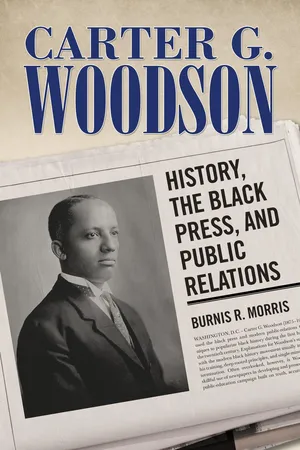
This study reveals how historian Carter G. Woodson (1875-1950) used the black press and modern public relations techniques to popularize black history during the first half of the twentieth century. Explanations for Woodson's success with the modern black history movement usually include his training, deep-rooted principles, and single-minded determination. Often overlooked, however, is Woodson's skillful use of newspapers in developing and executing a public education campaign built on truth, accuracy, fairness, and education. Burnis R. Morris explains how Woodson attracted mostly favorable news coverage for his history movement due to his deep understanding of the newspapers' business and editorial models as well as his public relations skills, which helped him merge the interests of the black press with his cause.
Woodson's publicity tactics, combined with access to the audiences granted him by the press, enabled him to drive the black history movement--particularly observance of Negro History Week and fundraising activities. Morris analyzes Woodson's periodicals, newspaper articles, letters, and other archived documents describing Woodson's partnership with the black press and his role as a publicist. This rarely explored side of Woodson, who was often called the "Father of Black History," reintroduces Woodson's lost image as a leading cultural icon who used his celebrity in multiple roles as an opinion journalist, newsmaker, and publicist of black history to bring veneration to a disrespected subject. During his active professional career, 1915-1950, Woodson merged his interests and the interests of the black newspapers. His cause became their cause.
- 200 pages
- English
- ePUB (mobile friendly)
- Available on iOS & Android
eBook - ePub
About this book
Information
Subtopic
Social Science BiographiesIndex
Social SciencesChapter 1
FINDING HIS BEARINGS
THE NARRATIVE OF DR. CARTER G. WOODSON, HISTORY, THE PRESS, AND public relations begins far from the glittering spotlight of the media and political capitals in which he operated. It begins under humble circumstances, an upbringing through the foundations of life given him by his father, and lessons a young Woodson learned about the press during his apprenticeship in the coal mines of Appalachia.
Carter’s father, James Henry Woodson, a Civil War veteran, was one of several former slaves who helped Collis P. Huntington complete the Chesapeake and Ohio Railroad on the Ohio River, in an area that became Huntington, West Virginia, in 1870. The elder Woodson used his skills as a carpenter in contributing to the building of that city, and in 1874 he moved his family back to Virginia, where his son Carter Godwin Woodson was born on December 19, 1875, in the New Canton area of Buckingham County. As one of nine children, Carter would eventually rise from the poverty of the New Canton area and become the driving force behind an improbable Black History Movement, begun fifty years after the end of the Civil War (Woodson, 1932c, 1932h, 1944a).
When he attended school in Virginia, Woodson was an excellent student who often completed assignments early in class, and with nothing else to do, he sometimes became a cutup in class. On such occasions, he said he received whippings at school, and his father greeted him with additional punishments when he arrived home (“Carter Godwin Woodson,” n.d.).
At age twelve, Woodson said, he read a story in a William McGuffey fifth-grade reader about two boys moving in opposite directions. One boy, Charles Bullard, studied hard, played hard, was well-liked, and achieved great success in college and beyond. The other boy, George Jones, did not study before going out to play, was unpopular with playmates, and was unsuccessful in life. The impact of that story with deep religious and moral overtones influenced Woodson to pursue a college education and follow in the footsteps of the hero of that story. He said he wanted to become Charles Bullard (“Carter Godwin Woodson,” n.d.).
Woodson identified his uneducated father as the person who gave him his bearing in life, the guiding principles by which he lived. Years later, he recalled the scarcity of material-world assets in his childhood upbringing. He said he went to bed early on Saturday nights to allow his mother to wash and iron his one set of clothing to enable him to attend Sunday school in clean clothes (Woodson, 1932h).
Often during the winter and spring, he had so little to eat that he would leave the family’s table and go into the woods in search of persimmons. At other times, he said, he ate “the sour grass that grew early in spring out of the providence of God.” Despite the poverty, Woodson said his father “believed that such a life was more honorable than to serve one as a menial” (Woodson, 1932h).
Woodson said he was incorrectly taught, as were many other Americans, from books that blacks were inferior and should accept the status of inferiority. Many blacks from similar circumstances were thus mis-educated, and they championed the cause of segregation in church and state, he said. But such training never corrupted Woodson’s thinking because of the influence of his father, the former slave. He explained that his had been a difficult path and struggle to overcome, but he preferred his situation to that of his acquaintances in African American communities who prospered financially in jobs that supported segregation (Woodson, 1932h). Appropriately, one of the first schools named in tribute to Woodson’s work while he was alive was the Carter G. Woodson High School in Hopewell, Virginia. After the Virginia schools were desegregated, Woodson High School was the first black school in the state to receive white students (“Virginia Breaks Tradition,” 1963).
Woodson said he had been well-grounded in the fundamentals of education by the teachings of two of his uncles in rural Virginia schools. At an early age, he demonstrated a willingness to share what he learned with others, especially reading. He read newspapers to his illiterate father, a reading exercise repeated in countless African American homes throughout the country, in which the contents of the local newspapers—both mainstream white and black—were transferred to those who could not read (Myrdal, 1944). Woodson continued to perform this newspaper-reading ritual with his father even after he was a high-school principal (Goggin, 1993; Scally, 1985). In providing this service, Woodson developed an understanding of the value of using newspapers to inform and educate (Woodson, 1944a).
The influence of newspapers seemed to run through several generations of Woodson’s family. John Riddle, an uncle identified as his first teacher in the obituary he published of him, was a schoolteacher and editor of a newspaper in Ohio (“Notes,” 1942). Riddle also was a longtime justice of the peace in Buckingham County, and one of the people who came before him was the man who had sent Riddle’s mother and two children, one of them Riddle, to the slave market in 1859 (Woodson, 1946b).
Woodson’s first cousin Carter H. Barnett was an educator and editor of the West Virginia Spokesman, a newspaper published briefly in Huntington. Woodson’s younger sister Bessie Woodson Yancey wrote letters to the editor of the Herald-Advertiserin Huntington that were published in the 1940s and 1950s, many of them topical and columnlike, in tones similar to her brother’s (Morris, 2009).
The foundations for Woodson’s understanding and appreciation of the American press, which he would later enlist as a powerful ally in his history-selling program, were laid in these rural Virginia and West Virginia communities between the years following Reconstruction and the close of the nineteenth century.
Woodson also had railroad and coal-mining experiences that helped him recognize and exploit the value and utility of the press in educating readers and shaping public debate. Woodson said he had a six-year apprenticeship in the coalfields and cited the sway of Oliver Jones, a black Civil War veteran who worked in the West Virginia coal mines and operated a tearoom where black miners could relax and unwind. Jones owned a large collection of books and subscribed to newspapers edited and published by black and white journalists.
Woodson said Jones was well-educated, but illiterate, having learned from others who were educated. Woodson’s use of newspapers expanded through his association with Jones, who asked Woodson to read to the illiterate miners from his library and compensated him with food (Woodson, 1944a).
Calling a man who could neither read nor write well-educated was not a contradiction from Woodson’s perspective. In many of his newspaper columns and especially in his book The Mis-Education of the Negro, Woodson expressed disappointment with blacks who had obtained college degrees and who knew little about African American people. He compared them unfavorably to people without college degrees who had not been incorrectly taught. Woodson’s respect for the illiterate people he met remained high even after he achieved fame. For instance, his account of the first time he heard Booker T. Washington give a speech in 1903 remembered and complimented an “illiterate, but thinking” elderly black man seated high in the gallery who expressed his enthusiasm for Washington’s oratory, even confirming the truthfulness of his assertions about the grim conditions faced by African Americans with the words ‘“hish yer mouf, boy!’” Woodson thought this man understood Washington’s message as well as anyone there, if not more so (Woodson, 1933j). He told that story in a newspaper column thirty years later and used similar experiences to express his belief on other newspaper platforms that many people who never attended college were better educated than those who had degrees.
At Jones’s tearoom, Woodson said he was affected by discussions regarding the works of Murat Halstead, an author and former Civil War correspondent, and several other well-known journalists from the late nineteenth century—Samuel Bowles of the Springfield Republican, Charles A. Dana of the New York Sun, and Whitelaw Reid of the New York Tribune (see Table 1.1). He said he learned much from the newspaper accounts of speeches, lectures, and essays about civil service reform, taxation, free trade, the gold standard, silver coinage, business monopolies, economics, politics, and other issues. Woodson thus used the newspapers to provide intellectual stimulation, and they became part of his educational foundation. These newspapers helped shape his worldview (Woodson, 1944a).
The readings and discussions at the tearoom also contributed to Woodson’s understanding of race issues. He remembered that the discussions often involved the history of African Americans, “and my interest in penetrating the past of my people was deepened and intensified” (Woodson, 1944a).
The Woodson family returned to West Virginia, roughly two decades following their first residence there, on the recommendation of Robert Woodson, Carter’s older brother. Robert had already migrated west. On a return visit with his family back in Virginia, Robert gave such a glowing report of prosperity in West Virginia that all of the Woodson children wanted to return there with him. Their mother, Anne Eliza Woodson, also a former slave, was immediately on board, but their father agreed reluctantly. Woodson did not explain his father’s tentativeness, but the family moved to Huntington in 1893. Carter and Robert wrapped up jobs building the railroad from Thurmond to Loup Creek and working as coal miners at Nuttallburg * in Fayette County, West Virginia (Woodson, 1944a).
Table 1.1: Books and Newspapers Carter G. Woodson Read at Oliver Jones’s Tearoom in the 1890s | |
Books | Authors |
The Black Phalanx: A History of the Negro Soldiers of the Wars of the United States 1775–1812, 1861-’65 | Joseph T. Wilson and Dudley T. Cornish, American Publishing Company, 1888 |
Men of Mark: Eminent, Progressive and Rising | William J. Simmons, George M. Rewell & Co., 1887 |
Black Newspapers | Editors |
The Pioneer (West Virginia) | Christopher Payne: first black delegate in the West Virginia legislature, founder and editor of the West Virginia Enterprise, the Pioneer, and Mountain Eagle; he was born free but was forced to serve in the Confederate Army (Rice, 2015). |
The Richmond Planet (Virginia) | John Mitchell: said to be a “man who would walk into the jaws of death to serve his race” (Planet/John Mitchell Jr., Exhibit). |
White Newspapers | Editors |
Cincinnati Commercial-Gazette | Murat Halstead: author and Civil War correspondent |
Cincinnati Enquirer | John R. McClean: also owner of the Washington Post; Cincinnati Enquirer known for yellow journalism |
New York Sun | Charles A. Dana: editor and anti-slavery journalist |
New York Tribune | Whitelaw Reid: successor to Horace Greeley as editor and owner of the New York Tribune and ambassador to France and Great Britain |
Pittsburgh Telegraph | Not much information available about this newspaper. The Weekly Chronicle Telegraph was published 1884–1927 |
Toledo Blade | Robinson Locke: president and editor and son of David Ross Locke, a well-known copperhead journalist (Robinson Locke, n. d). |
Springfield Republican | Samuel Bowles Jr.: known for fairness and covering all sides (Newspapers, 1775–1860, n. d.) |
Louisville Courier-Journal | Henry Watterson: influential member of Congress, winner of the Pulitzer Prize for editorial writing in 1918 |
Sources: Developed from Carter G. Woodson, “My Recollections of Veterans of the Civil War” (Woodson, 1944a), and other sources cited above. | |
In Huntington, Woodson enrolled in 1895 at Douglass High School. He missed many classes because he was also working. He studied Virgil and Caesar on his own (“Carter Godwin Woodson,” n.d.). The school, all-black, was named in honor of Frederick Douglass, a former slave, diplomat, and journalist. The Douglass School offered a two-year high school program when Woodson was a student, and he completed the course requirements in half the time, graduating in a class with one other student in 1896 (Huntington Advertiser, 1896). The graduation requirement was raised to four years in 1899 (Gould, 1985).
Although it did not hurt him scholastically, Woodson’s sporadic school attendance before (and during his) Douglass School years was not unique among African Americans living in the South before the early twentieth century, especially those residing in farming communities, where educational opportunities were limited. Many states provided insufficient access to schools for black students after the Civil War, and no US Census report until 1920 showed a majority of blacks of school age (53.5 per 100) attending school. School attendance for African Americans living in West Virginia after the war was further suppressed by the fact that the black population was much smaller than that found in most former slaveholding states and the white leadership’s insistence on keeping the races apart, which meant blacks often went without schooling if their numbers did not meet minimum population requirements for designating schools. In a report on the history of education for West Virginia’s black population, written at the behest of the president of the West Virginia Collegiate Institute, Woodson described the school year as four months in West Virginia schools through the 1890s. In some cases, blacks shared school facilities with whites, but the classes were not integrated because white students would attend classes from September to Christmas, after which blacks would occupy the facilities (Woodson, 1922).
Following graduation from Douglass, Woodson pursued his goals for college when ...
Table of contents
- Cover
- Half title
- Title
- Copyright
- Dedication
- Contents
- Acknowledgments
- Preface
- Prologue
- Chapter 1: Finding His Bearings
- Chapter 2: Enlisting the Press
- Chapter 3: Harnessing Press Coverage
- Chapter 4: Making News with Newspaper Columns
- Chapter 5: Managing Public Relations
- Chapter 6: Remembering Woodson (and Forgotten Black Press Contributions to His Legacies)
- Epilogue
- Appendixes
- References
- Index
Trusted by 375,005 students
Access to over 1.5 million titles for a fair monthly price.
Study more efficiently using our study tools.
Frequently asked questions
Yes, you can cancel anytime from the Subscription tab in your account settings on the Perlego website. Your subscription will stay active until the end of your current billing period. Learn how to cancel your subscription
No, books cannot be downloaded as external files, such as PDFs, for use outside of Perlego. However, you can download books within the Perlego app for offline reading on mobile or tablet. Learn how to download books offline
Perlego offers two plans: Essential and Complete
- Essential is ideal for learners and professionals who enjoy exploring a wide range of subjects. Access the Essential Library with 800,000+ trusted titles and best-sellers across business, personal growth, and the humanities. Includes unlimited reading time and Standard Read Aloud voice.
- Complete: Perfect for advanced learners and researchers needing full, unrestricted access. Unlock 1.5M+ books across hundreds of subjects, including academic and specialized titles. The Complete Plan also includes advanced features like Premium Read Aloud and Research Assistant.
We are an online textbook subscription service, where you can get access to an entire online library for less than the price of a single book per month. With over 1.5 million books across 990+ topics, we’ve got you covered! Learn about our mission
Look out for the read-aloud symbol on your next book to see if you can listen to it. The read-aloud tool reads text aloud for you, highlighting the text as it is being read. You can pause it, speed it up and slow it down. Learn more about Read Aloud
Yes! You can use the Perlego app on both iOS and Android devices to read anytime, anywhere — even offline. Perfect for commutes or when you’re on the go.
Please note we cannot support devices running on iOS 13 and Android 7 or earlier. Learn more about using the app
Please note we cannot support devices running on iOS 13 and Android 7 or earlier. Learn more about using the app
Yes, you can access Carter G. Woodson by Burnis R. Morris in PDF and/or ePUB format, as well as other popular books in Social Sciences & Social Science Biographies. We have over 1.5 million books available in our catalogue for you to explore.