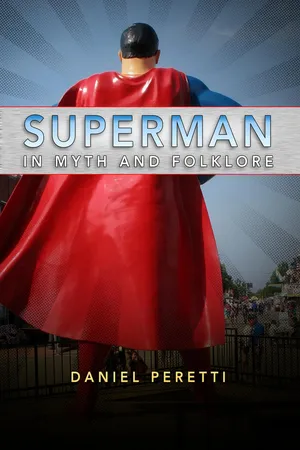
Superman rose from popular culture—comic books, newspaper strips, radio, television, novels, and movies—but people have so embraced the character that he has now become part of folklore. This transition from popular to folk culture signals the importance of Superman to fans and to a larger American populace. Superman's story has become a myth dramatizing identity, morality, and politics. Many studies have examined the ways in which folklore has provided inspiration for other forms of culture, especially literature and cinema. In Superman in Myth and Folklore, Daniel Peretti explores the meaning of folklore inspired by popular culture, focusing not on the Man of Steel's origins but on the culture he has helped create. Superman provides a way to approach fundamental questions of human nature, a means of exploring humanity's relationship with divinity, an exemplar for debate about the type of hero society needs, and an articulation of the tension between the individual and the community. Through examinations of tattoos, humor, costuming, and festivals, Peretti portrays Superman as a corporate-owned intellectual property and a model for behavior, a means for expression and performance of individual identity, and the focal point for disparate members of fan communities. As fans apply Superman stories to their lives, they elevate him to a mythical status. Peretti focuses on the way these fans have internalized various aspects of the character. In doing so, he delves into the meaning of Superman and his place in American culture and demonstrates the character's staying power.
- 208 pages
- English
- ePUB (mobile friendly)
- Available on iOS & Android
eBook - ePub
Superman in Myth and Folklore
About this book
Information
Topic
SozialwissenschaftenSubtopic
Folklore & Mythologie- 1 -
SUPERMAN AND THE FOLKLORISTIC PERSPECTIVE
IT’S LIKE SOMETHING OUT OF A TALL TALE. HOW FAST COULD HE RUN? FASTER than a speeding bullet. How high could he jump? He could leap tall buildings in a single bound. It’s also like something out of heroic myth. Born in amazing circumstances, he is abandoned to the elements, only to be saved and brought up in humble surroundings in a far off land. He discovers that he has miraculous powers, which he uses to protect his adopted home. There are folktale elements: childless parents wishing for a baby, a magical transformation turns an apparently ordinary human being into a fantastical Prince Charming who can rescue any damsel in distress. It’s a science fiction story of alien contact. It’s a fantasy story of a being with great powers that defy the laws of physics. There’s romance, mystery, action, and adventure. Superman has it all.
Superman began in popular culture, but readers embraced the character to the extent that he has become part of folklore. This transition from popular culture to folk culture, from mass media to folklore, signals the importance of the character on the level of the individual and on the level of the larger American populace. Superman’s story has become one with which people work through the vital issues of their lives. It dramatizes questions of identity, morality, and politics. This book will focus on how Superman has become a part of folklore, and how the study of folklore—folkloristics—can contribute to an understanding of the character’s place in people’s lives. Folklorists have long been interested in genres: folktale, myth, legend, folk speech, proverb, riddle, folk song, joke, and a score of others. By examining the ways that Superman has entered several of these genres,1 this book will look for the meanings of the character as he exists outside the official texts (though sometimes within those texts as well).
Superman has become part of a number of folkloric genres, such as jokes, tattoos, festivals, and costuming. Ben Saunders writes that from the very beginning, Superman “had a different kind of intellectual currency from his fellow comic book characters; he stood for things in a way they could not” (2011: 18). Superman is unique.
WHO IS SUPERMAN?
Superman is the name given to a cluster of fictional characters with a relatively stable core set of traits, including his alien origin and journey to Earth, his distinctive costume and insignia, his Midwestern upbringing, and his home in a large city where he uses his superhuman abilities for the protection and betterment of humanity. The cluster that is Superman2 extends beyond the fictional stories to annex both the actors who portray him and his creators. He is an example (by most accounts, the first instance) of a superhero. Superman first appeared in comic books in 1938, and is often credited with contributing to the success of that art form and of the superhero genre.3 His presence soon spread into licensed merchandise and other entertainment media until, by the beginning of the twenty-first century, he had appeared in radio, film, television, video games, novels, short stories, and the internet. Superman usually dresses in a blue, yellow, and red skintight suit accented with a cape and a stylized S on his chest. He wears this in part to differentiate himself from his secret identity, Clark Kent, who dresses in normal, modern American attire and usually works as a journalist. His birth name is Kal-El, the structure of which is typical of people’s names on his home planet, Krypton. This planet exploded when he was an infant. His father, knowing of the impending doom but unable to stop it or to save himself, sent the infant to Earth in a rocket, where his physical resemblance to human beings allowed him to fit in. Differences in environment and physiology give Superman extraordinary abilities.4
I asked the writer and Superman fan Brian Morris how he would describe Superman to someone who had never heard of the character. Brian, who answered in an e-mail, began by noting that it is probably not necessary since everybody’s heard of Superman. He continued, “Anyway, I’d describe Superman to someone, in brief, as a costumed adventurer with unimaginable powers of strength, speed, and flight who uses those abilities to help others in need. If I had to go into detail—and indulge my sense of drama—the best description was the classic from the radio and TV shows:5 ‘Faster than a speeding bullet! More powerful than a locomotive! Able to leap tall buildings in a single bound! Superman! Strange visitor from another planet who came to Earth with powers and abilities far beyond those of mortal men. Superman, who can change the course of mighty rivers, bend steel in his bare hands, and who disguised as Clark Kent, mild-mannered reporter for a great metropolitan newspaper, fights a never-ending battle for Truth, Justice, and the American Way’ . . . No matter how the character changes when it moves to a new medium or even when the comic books change writers or editors, he’s still the infant survivor of the dead planet Krypton who was raised in humble circumstances to become the world’s mightiest hero who does what’s right because it’s the right thing to do. He’s so powerful, he can withstand even the various alterations to his backstory.”6
Brian’s note about change is important. Most of the characteristics covered—everything from the spelling of his given name to the location where he lands on Earth to the nature and explanation of his powers—have been altered over time. This has caused Tom DeHaven to contemplate just exactly what is essential to Superman: “Exploding planet. Rocket ship to earth. Secret identity. Original costume. Lois Lane. What about Lex Luthor? Essential? No, not really, none of the bad guys are. So. Anything else? Then just this, the basic-basic, saved for last: he can fly, and perform marvelous feats of strength, which he chooses to do because it brings him great satisfaction” (2010: 205–206).7 Peter Coogan’s (2006) book-length academic analysis of the superhero genre’s history and development takes into account its literary and critical aspects. He traces its origin to Superman’s initial appearance in the first issue Action Comics, created by Jerry Siegel and Joe Shuster, but proceeds to work backward to find precursors ranging from ancient myth to early twentieth-century fiction. In his final two chapters, Coogan looks closely at some criticisms of the genre that read superhero stories as problematic portrayals of the oppression of late capitalism. Coogan disagrees, finding that the scholars’ analyses do not match that of the majority of readers.
Over the years, the stories of Superman have developed an extensive supporting cast, including the character’s friends, family, and opponents. Prominent among these are his biological parents Jor-El and Lara, his adoptive parents Jonathan and Martha Kent, his foil Lois Lane, his archenemy Lex Luthor, and his friend Jimmy Olsen. His primary concern has always been protecting people, though the types of events that require his intervention have evolved from social injustice and organized crime to megalomaniacs, natural disasters, and alien invasions. He has become integrated into the continuity of a larger fictional cosmos including other superheroes (Reynolds 1992). Superman’s stories are owned by Time-Warner, published by DC Entertainment as comic books and produced by Warner Brothers as films and television shows. Licensed merchandise is too extensive to chronicle, and includes costumes, pajamas and other clothing, lunchboxes, collectible figures, jewelry, and statues. Countless amateurs proficient in using media have made fan films focusing on the character, written their own stories about him and his world, and generally engaged in all of the activities that fan studies has focused on since the 1990s.8 Despite the fact that a corporation owns the character, the public feels a general sense of ownership as well, to the extent that rumors of a new Superman film being put into production inevitably result in fans discussing how it should be made, who should star in it, and what the story should be. This notion of public ownership, of the sustained interest in the character’s development, gives rise to his presence in folklore and his evolution into myth.
An example will help illustrate the extent to which some fans have made Superman a part of their lives. Superman became the subject of national news in 2013 when DC Comics revealed that they were getting ready for publication a Superman story written by novelist Orson Scott Card. Card’s stance against and writings about homosexuality led some readers and comic shop owners to boycott the story long before it would have been released. The argument presented by those boycotting the story was that Card’s viewpoint was in direct opposition to any opinion Superman would hold on the subject. Autumn Sandeen sums up the issue: “Superman may not live in the real world, but I’d like to think that if he were a real being he would be on the side of justice for LGBT community members. With Orson Scott Card writing issue one of a new Superman series, I’m less sure that Superman would, if asked, support marriage equality” (Sandeen 2013). The story was eventually pulled from publication when its artist, Chris Sprouse, left the project. The series in which the story would have appeared was published without it. In the words of Graeme McMillan, “The now non-homophobic Adventures of Superman no. 1 will be launched digitally on April 29” (McMillan 2013). In the outcry and its result—at this writing, the story in question has not been published—the relationship between the public and the corporation responsible for publishing Superman stories is revealed to be complicated. At heart, the Card story, regardless of its actual content, diverged from the morality that readers see at the heart of Superman because of its writer’s views. In other words, Superman’s values matter, as do the values of those who tell his stories, because Superman signifies something beyond his status as an intellectual property owned by a corporation.
THE FOLKLORISTIC PERSPECTIVE
Any superhero can be analyzed from the standpoint of a variety of academic disciplines. I approach Superman through the lens of folkloristics because this discipline can offer a valuable perspective through the use of fieldwork and attention to the character’s situated context. Thus, a few words need to be said about the folkloristic perspective on culture. Folkloristics began as curiosity about various products of human expression, particularly those in oral tradition, with the intention to preserve them in fixed media. The folkloristic method approaches the dynamics of human interaction as people communicate to each other, expressing ideas and solving problems through a number of genres, such as legend, folk tale, proverb, and myth.9 Folklore emerges and can be collected as people interact, so we have to pay attention to both content and context, the latter of which includes the attitude of the performers and audience. The best folkloristic studies take into account the human element: the real, motivated, interested, biased, and creative individuals behind the folklore. Attention to the individual is one great advance of performance studies, which is, as Pravina Shukla puts it, “a paradigm that emphasizes the individual in the social moment of creativity. Creation is understood by attending at once to individuals and their circumstances, looping standards and acts of desire with the forces of consumption and social response. The contrast is with studies that focus on a lone genius floating free of the world, and with studies that see everything as the result of superorganic powers at play. Our [that is, the folklorists’] commitment is to a believable dialectic of people and the world” (2010: 386). Several tensions inform the study of folklore, and we might characterize the first tension as existing between the individual and the group (Glassie 1982).
The study of folklore now begins, when it can, with performance—the manifestation of creativity and competence in human interaction (Bauman 1972).10 Each performance is treated as an emergent event, the result of a process involving numerous potential requirements, leading to what is called a variant—named for the variation that necessarily results from the exigencies of unmediated and repeated performance.11 The variant, which may become reified as a text when recorded, arises in a context that can be broken down into its social, cultural, psychological, environmental, historical, and dialectical components. What sets folkloristics apart is its attention to the creative, human element as it shapes any given variant, particularly in cultural and psychological contexts. Performance studies takes into account the moment of creation, as it manifests itself in an unmediated environment. Some folklorists go so far as to classify folklore itself as a medium, akin to television or magazines or film (de Caro and Jordan 2004: 2–3). Viewed in this way, we can study Superman in folklore just as we study Superman in film or in comic books.
Folklorists have paid particular attention to the performance of folklore since Richard Bauman’s book Verbal Art as Performance galvanized a trend in the early 1970s.12 This is not to say that folklorists limit themselves to performance theory. Gregory Schrempp (1992), to give one example, incorporates a folkloristic attention to variants as he studies the cosmological implications of mythical narratives among the Greeks and Maori in pursuit of the modes of thought-designated myth and philosophy. Schrempp’s focus broadens to culture in general, working with the mythical mode of thought inherent in other genres of folklore and literature (see also Schrempp 2012). The attention to folklore as a dynamic process has crystallized the folkloristic reliance on variation. The variant is understood as the result of the individual reacting to the tensions of the moment of performance. Variation can arise from time constraints, creative whims, economic factors, cultural ideas of appropriateness, and a myriad of other factors.13 The important concept to understand is that variation arises not merely from the reworking of old texts, but from the imprinted pattern that exists in the mind of the performer, making itself manifest during the exigencies of performance. In the study of narrative, folklorists collect as many variants as possible, since in oral tradition no single version of a story can be considered definitive.
A common conception of folklore is that it is old—the survivals of yesteryear—and this is accurate enough as a popular definition. The folklorist, developing technical definitions, is interested in things that persist, but antiquity is not the focus; the focus is the persistent utility of the past in the present. The interest is in tradition (Glassie 1995). People value things that are new and fresh, to some extent, but “while novelty is exciting,” writes Michael Owen Jones, “familiarity is comfortable. These two forces compel much of human behavior” (1989: 244). This is the second tension of folklore—between the new and the old.14
In pursuing the meanings of a performance, folklorists will often elicit what’s known as oral literary criticism (Dundes 1966; Narayan 1995), which refers to the performer’s and audience’s own interpretations of and thoughts about the folklore in question. Folklorists also look for native categories, how performers and audiences classify things, as opposed to the analytical categories developed by scholars (Dundes 1962; Ben-Amos 1972). Much of my method has relied on applying this sort of oral criticism to Superman; determining what the character and stories mean to people who read them and love them.
Superman—indeed, the form of comic books in general—has also been called folklore, or an extension of it (Inge 1990: 141 ff.; Peretti 2015), and exploring how and why is important. The character appears in cultural forms of folklore in the analytical or scholarly sense of the term, but there are plenty of examples of the character being called folklore by people who aren’t folklorists. This usage of the term refers to the character’s place in American culture, placing him on the same level as other folkloric characters such as Bigfoot, Paul Bunyan, and Davy Crockett. M. Thomas Inge writes that Superman “immediately captured the American imagination and became our first twentieth-century folk hero, a perfect mythological figure for an age of technology in which man was methodically to step beyond every limitation on his intellectual and physical abilities and master the universe” (Inge 1990: 141). Scholars have also used the term folklore to refer to the medium in which Superman originally appeared.
Ellen Rhoads (1973), in her structural analysis of Little Orphan Annie comics, begins with a survey of the idea that comics are a quintessential form of American folklore. She is not alone in characterizing comics as folklore. Rolf Brednich engages in a similar type of analysis, beginning with a common rhetorical move by which scholars equate comic books with earlier forms of art, such as those found on “Egyptian tombs, on Greek vases, Roman victory columns, and so forth,” as a means of simultaneously demonstrating the validity of their study and establishing a link to other forms of scholarship (1976: 45). Brednich demonstrates the similarities between superhero comic books and oral folktales: “Like folktales, comics tend to project outwards, to materialize abilities in concrete pictures. The superheroes’ costumes are visualized magic; their wearers are the folktale heroes of our time” (1976: 50). Brednich’s analysis finds many similarities in the content and patterns of folktales and superhero comic books, though he does offer some account of the differences between the commercial comic book and oral tradition, notably, that of mechanism—standardized production, which omits a great deal of attention to the specific audience. Around the same time, Ronald Baker (1975) delved into specific folkloric motifs that can be found in superhero comic book stories, finding that Superman s...
Table of contents
- Cover
- Half title
- Title
- Copyright
- Dedication
- Contents
- Preface: Why Superman?
- 1: Superman and The Folkloristic Perspective
- 2: Three Cases
- 3: Truth Means Many Things
- 4: Celebrating Superman
- 5: Metafolklore and Superman Humor
- 6: Morality
- 7: Mythological Considerations
- Notes
- Bibliography
- Index
Trusted by 375,005 students
Access to over 1.5 million titles for a fair monthly price.
Study more efficiently using our study tools.
Frequently asked questions
Yes, you can cancel anytime from the Subscription tab in your account settings on the Perlego website. Your subscription will stay active until the end of your current billing period. Learn how to cancel your subscription
No, books cannot be downloaded as external files, such as PDFs, for use outside of Perlego. However, you can download books within the Perlego app for offline reading on mobile or tablet. Learn how to download books offline
Perlego offers two plans: Essential and Complete
- Essential is ideal for learners and professionals who enjoy exploring a wide range of subjects. Access the Essential Library with 800,000+ trusted titles and best-sellers across business, personal growth, and the humanities. Includes unlimited reading time and Standard Read Aloud voice.
- Complete: Perfect for advanced learners and researchers needing full, unrestricted access. Unlock 1.5M+ books across hundreds of subjects, including academic and specialized titles. The Complete Plan also includes advanced features like Premium Read Aloud and Research Assistant.
We are an online textbook subscription service, where you can get access to an entire online library for less than the price of a single book per month. With over 1.5 million books across 990+ topics, we’ve got you covered! Learn about our mission
Look out for the read-aloud symbol on your next book to see if you can listen to it. The read-aloud tool reads text aloud for you, highlighting the text as it is being read. You can pause it, speed it up and slow it down. Learn more about Read Aloud
Yes! You can use the Perlego app on both iOS and Android devices to read anytime, anywhere — even offline. Perfect for commutes or when you’re on the go.
Please note we cannot support devices running on iOS 13 and Android 7 or earlier. Learn more about using the app
Please note we cannot support devices running on iOS 13 and Android 7 or earlier. Learn more about using the app
Yes, you can access Superman in Myth and Folklore by Daniel Peretti in PDF and/or ePUB format, as well as other popular books in Sozialwissenschaften & Folklore & Mythologie. We have over 1.5 million books available in our catalogue for you to explore.