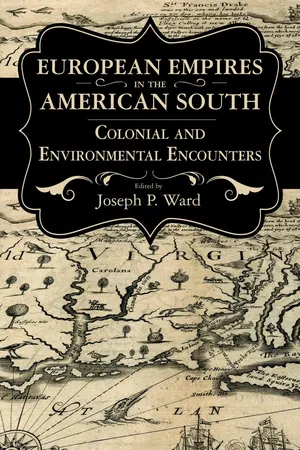
Contributions by Allison Margaret Bigelow, Denise I. Bossy, Alejandra Dubcovsky, Alexandre Dubé, Kathleen DuVal, Jonathan Eacott, Travis Glasson, Christopher Morris, Robert Olwell, Joshua Piker, and Joseph P. Ward European Empires in the American South examines the process of European expansion into a region that has come to be known as the American South. After Europeans began to cross the Atlantic with confidence, they interacted for three hundred years with one another, with the native people of the region, and with enslaved Africans in ways that made the South a significant arena of imperial ambition. As such, it was one of several similarly contested regions around the Atlantic basin. Without claiming that the South was unique during the colonial era, these essays make clear the region's integral importance for anyone seeking to shed new light on the long-term process of global social, cultural, and economic integration. This volume includes essays on all three imperial powers, Spain, Britain, and France, and their imperial projects in the American South. While the consequences of Indian encounters with European invaders have long remained a principal feature of historical research, this volume advances and expands knowledge of Native Americans in the South amid the Atlantic World.
eBook - ePub
European Empires in the American South
Colonial and Environmental Encounters
- 264 pages
- English
- ePUB (mobile friendly)
- Available on iOS & Android
eBook - ePub
About this book
Information
Topic
HistoriaSubtopic
Historia de Norteamérica

COLONIAL INDUSTRY AND THE LANGUAGE OF EMPIRE

Silkworks in the Virginia Colony, 1607–1655
Allison Margaret Bigelow

On November 28, 1653, three years after his failed attempt to sell some two hundred copies of the Eikon basilike to Virginia planters, a beautifully bound but politically precarious celebration of the recently beheaded King Charles I, John Ferrar (c. 1588–1657), former deputy of the Virginia Company, sent to Samuel Hartlib (c. 1600–1662) an account of his daughter Virginia’s silkworm experiments, bookended with three travelers’ reports on Turkish sericulture. If colonial readers were unresponsive to his home-bound book, Ferrar figured that an international community of New World projectors might give greater purchase to a new model of silkwork. Hartlib circle correspondents like the Ferrars sought to rehabilitate the silk colonies in Virginia to establish continuity with the past and open a space for their own midcentury reformations, and they phrased their proposed improvements in explicitly gendered terms that were designed to enable the economic, cultural, and religious remaking of a young virgin colony rich in mulberry trees and already burdened with what Ferrar alliteratively called the “toyl you take about your Tobacco.”*
These midcentury reformers were not the first promoters of colonial silkworks, nor were New World projectors the first to argue that a reformed colonial industry was central to the English pursuits of right Christianity, straight commerce, and true natural knowledge. Richard Hakluyt (1551?–1616), who framed his Principal Navigations (London, 1589–1600) with that tripartite focus, was perhaps one of the earliest English writers to speculate that colonial silkworks could counter the hegemony of Spanish silver in the global economy. In his Discourse Concerning Western Planting (1584), Hakluyt proposed that with the right cultivation of American wealth, “wee may abate and pull down their hygh myndes,” replacing mining and metallurgical models of colonization with agricultural regimes of cultivation, like “plantinge of sugar canes as the Portingales have done in Madeira in maynetenance and increasing of silke wormes for silke, and in dressing the same.”1 Silkworks were eagerly endorsed by the Stuart monarchy, as James VI of Scotland, also known as James I of England, required in 1607 that English landholders plant ten thousand mulberry trees on their estates. The trees, like the order, came from the Crown, which sold them at a rate of “three farthings the plant, or 6 s. the hundred, containing five-score plants.” In the early 1620s royal sericulturalist John Bonoeil recommended that colonial landowners plant no fewer than two or three thousand trees, anything less being “onely for women wantonly to keepe a few Silk-wormes, with a few Mulbery trees, more for pleasure than for profit.” The Virginia assembly never managed to enforce the large-scale program, however, only requiring by midcentury that landowners plant ten mulberry trees for every one hundred acres of their estates.2
Although the trees took root, colonial silkworks failed repeatedly, returning neither pleasure nor profit to the planters. Some writers, like Captain John Smith (c. 1580–1631), blamed these failures not on the effeminate husbandmen that Bonoeil observed, but rather on a shortage of experts. Smith noted that the worms prospered “till the master workeman fell sicke: during which time, they were eaten with rats,” while other projectors, like Dr. Robert Child (1613–1654), pointed to a more general “want of hands” in the labor-poor colony. Although colonial observers like Smith and Hartlib circle correspondents like Child had different ideas about the place of experts and the role of labor in the cultivation of colonial silk, both groups agreed that because humans were partly responsible for the failure of the Virginia silkworks, then they might also play a hand in the solution to the problem and the reformation of this key colonial industry.3
With this idea Virginia Ferrar (1627?–1688), anagrammed by her cousin “F[errar] C[ollett]” as “Rare Fair Virgin” and named by her father after the colony “so that speaking unto her, looking upon her, or hearing others call her by her name he might think upon both at once,” set out to test different feeding methods and silkworm habitats.4 For however rich the Virginia colony was in mulberry trees, the early-seventeenth-century silkworks had failed to thrive without proper food sources and growing spaces for the worms. From her earlier trials, Virginia Ferrar had concluded that mulberry tree leaves were more advantageous than other food sources, namely lettuce; as a follow up to those first experiments, Virginia Ferrar designed a second round of tests to determine the ideal habitat for silkworm cultivation. Controlling for food sources, she fed the same amount of leaves to groups of worms housed in two different locations: indoor worms that she grew in cabinets in her bedroom chamber, and outdoor worms that she cultivated in the family garden. After comparing the sizes and survival rates of the two groups at the end of their forty-five-day cycle, she concluded “in triall and experiment” that outdoor worms produced the best silk outcomes.
The tale of these trials, a story spun as artfully as the homebound books but with wider circulation, formed part of a transatlantic exchange of natural knowledge that belied the more restricted geography of the garden plot and the intimate corners of Virginia Ferrar’s bedroom. It also threw into sharp relief the explicitly feminized program of silk work and colonial labor promoted by mid-seventeenth-century reformers in the hopes of refashioning the English experiment in colonial Virginia. Two years after Hartlib received the report, the Polish émigré appended it to related silkworm letters from Germany, Ireland, and England and published the transcultural assemblage as The Reformed Virginian Silkworm; or, A rare and new discovery of a speedy way, and easy means, found out by a young Lady in England, she having made full proof thereof in May, anno 1652 (London, 1655).
The curious circumstances of English projections for Virginian silk, and their supporting publications, leave us with a few questions about the nature of colonial planting and English imperial designs. Why, at the height of the Protectorate, might an international body of Puritan readers and reformers have endorsed the Stuart monarchy’s silkworks? And why might this colonial scientific community have framed its proposals around the labor of a female sericulturalist and feminized silkworms? What can this history tell us about the gendered nature of English planting in an era of early modern European imperial competition for the Americas? This essay addresses these questions by tracing the linguistic gender of silkworms and scientists in seventeenth-century sericultural treatises, a subset of a rich body of English agricultural literatures that transmitted some of the most important technologies and methods to grow crops known and unknown in the New World, and a textual corpus that provided some of the most formative terms of colonial policy—planting English bodies in America and harvesting new souls.5 I map the shifting male, female, and neuter pronouns of silkworm treatises onto proposed shifts in agroeconomic colonial industries and cultural models of colonization. Reformers hoped that by replacing tobacco with silk they might diversify the colonial economy, and then, that this economic stability would improve relations between and among indigenous practitioners, colonial planters, and the international brotherhood of Protestant projectors committed to the restoration of Adamic empire. As a source of colonial wealth, silk was an undisputed failure—and repeatedly so. But as part of a broader design to reform the political, cultural, and economic relationship between England and its foreign plantations, colonial silkworks contributed an important register to the organizing grammar of settlement. Facts and experiences on the ground could be sanitized by a religioscientific discourse that refashioned spaces of violence into sites of cultivation; the reformed virgin colony would not be an embarrassing exporter of what John Ferrar had called “that contemptible, beggarly Indian weed,” but rather a pure producer of fine, first-rate silk (27).
This model of colonial design emerged during a formative moment in the development of English imperial identity; as such, silk became one of the key industries that Hartlib Circle reformers identified as a source of natural knowledge that could underwrite their imperial projections. By the end of 1655, English soldiers had invaded Jamaica and supplanted Spanish colonists from the island that became the Crown jewel in the imperial economy and the colonial scientific knowledge economy.6 But New World projectors did not know how the story would end when they traded ideas and improvement schemes advancing the small-scale, decentralized production of wines, silks, and honey, explicitly feminized emblems of sensuality and sweetness that signified far different cultural values and imperial images than the industrial-scale regimes of rum, tobacco, and sugar that dominated Atlantic trade. The political, economic, and cultural shifts required to translate imperial aspirations from wine to rum, honey to sugar, and silk to tobacco were registered in agricultural treatises, proposals, and instruction manuals that called for the reformation of these colonial industries. With a better command of the science of sericulture and apiculture, reformers like Virginia and John Ferrar and Hartlib circle projectors argued in texts like the Reformed Virginian Silkworm (London, 1655) and The Reformed Commonwealth of Bees (London, 1655) that feminized modes of colonial labor—human and nonhuman alike—could become commercially viable ways to wealth and the fulfillment of millenarian ends.7
Although literary scholars have focused their studies of gender and seventeenth-century science on single-author texts that fall largely within the purview of natural philosophy, agricultural scientific literatures, and especially sericultural works like the Ferrar epistle, which were equal parts instructional and promotional, represent an important genre whose gender-inclusive, transnational, and commercialized modes of practice and knowledge production puts pressure on some of the longest-held theories of gender and early modern science. This body of literature is not often praised for its literary merit or felicity of expression, and yet literary methods can productively help us to root out the gendered languages of silkworm treatises such that we understand both the complex marking role of linguistic gender within the treatises and the “natural” place of gender within English imperial designs more broadly.8
Agricultural historians, meanwhile, have tended to concentrate more on technical innovations in farming instruments, methods of planting, and species selection, or else on large-scale reengineering projects like enclosure or fenlands drainage.9 While these new crops and technologies are essential parts of English agrarian history—with important biopolitical implications for the movement and management of a population whose scientific advances were shaped by religious institutions, commercial networks, and cultural norms as much as by early modern natural knowledges10—this focus on measurable outcomes has overshadowed a more careful attention to the language in which agricultural writers explained and justified their novel designs. Because most of the ideas proposed by writers like Sir Hugh Platt (1552–c.1611), Gervas Markham (1568–1637), and Walter Blith (c. 1605–1654) were not practiceable, their language is an important vehicle for understanding seventeenth-century ideas about technologies and improvements rather than actual technologies or improvements.
When the conditions of agricultural labor changed, so too did these writers modify the pronouns that they used to describe soils, seeds, and silkworms in practical manuals and philosophical discourses alike. For example, Sir Hugh Platt famously complained that unschooled English husbandmen (“al these simple sots”) spoiled the fertility of their lands by too zealously plowing into unprepared soil, such that “the hungry seede intime will drinke vp all of the salt of the earth, whereby the earth being robd of her salt, can bring forth no more fruit, vntill it bee dunged againe, or suffered to lie fallow a certaine time.” Thus, when Platt described fecund land that needed little labor, it was a she (“robd of her salt”), but when he referred to barren soil that required heavy husbanding, it was an it (“vntill it bee dunged again”).
The marking pronouns of Platt’s late sixteenth-century book were echoed by mid-seventeenth century writers like Gervas Markham, for whom a “barren, dry, and dejected earth” required that the greatest labor “be bestowed upon it, both in manuring digging, and in trenching,” while “the more rich it is, lesse cost of such labour, and more curiosity in weeding, proyning, and trimming the earth, for, as the first is too slow, so the later [sic] is too swift, both in her increase and multiplication.” This second group of rich earths were marked as feminine spaces (“her increase and multiplication”) because of the interaction of art and nature that they demanded; like Platt’s explanation, Markham’s neuter pronouns mark the spaces that require the greatest degrees of human care, while feminine pronouns index more “curious” husbanding of naturally fertile soils.11
Some scholars see the shifting gender pronouns of seventeenth-century agricultural scientific discourse as signs of an animistic view of nature that would ultimately be replaced with the mechanical philosophies of institutional bodies like the Royal Society of London.12 But even late century natural philosophers like John Evelyn (1620–1706), whose presentation to the Royal Society in 1675 was published the following year as A Philosophical Discourse of Earth, shifted between neuter and feminine pronouns to signal important changes in the nature of soils and human responses to them. In a passage that extolled the universally fertile properties of nitrous salt, “which renders AEgypt so luxuriously fruitful after the inundations of Nile; and the Nitrous grounds of Jamaica, and other places,” Evelyn intermixed neuter and feminine pronouns to describe the interactions of plant and planter vis-à-vis the salt that “resuscitates the dead and mortifi’d Earth, when languishing and spent by our indulgence to her verdant Offspring, her vigour seems to be quite exhausted, as appears by the rains and showers which gently melt into her bosome what we apply to it, and for which cause all our Composts are so studiously made of substances which most ingender or attract it.” When the husbandman intervened too eagerly into the earth, he spoiled the virtue of explicitly feminized soil (“her verdant Offspring,” “her vigor,”), but when he remedied her worn-out “bosome” with “studiously made” salts, he restored both the earth and the broader concept of agricultural fertility to a gender-neutral “it” (“what we apply to it,” “which most ingender or attract it”).13 For Platt and Markham, as with many colonial promoters, nature’s unspoiled fertility was feminine, while human intervention shifted the soil into a gender-neutral position. For Evelyn, however, feminine earths were those that had been excessively fertilized by humans, whether in Egypt or the New World, and neuter lands were those properly balanced by well-informed practices and principles of husbandry. Although they defined feminine and neuter lands in different terms, and thus with opposite relationships to human agency, all three writers used shifting gender pronouns to signal the intervention of planters who plotted their work with good and bad practices and right and wrong knowledges. The point here is not that cosmological bodies like soils were consistently gendered as male, female, or neuter, but rather that these gendered ascriptions shifted in accordance with changes in, on, and under the ground, and that these pronominal changes indexed different forms of labor, embodied practices, and stewardship.
We might expect to find similarly shifting gender pronouns in silkworm treatises, a literary corpus dedicated to an insect (Bombyx mori) whose “shifts,” “sicknesses,” and “strange and mystical transmigrations,” as early modern writers called them, index their movement through a four-part life cycle of infancy, adulthood, and emergence as caterpillars that spin cocoons of silk thread for humans to unwind.14 But instead of registering silkworm shifts through shifting gender pronouns, a different gendered pattern emerges in the circum-Atlantic archive. The silkworms tended by male growers begin with masculine pronouns that shift into feminine referents when the worms reach their reproductive maturity, while silkworms grown by women are glossed with feminine pronouns throughout the entirety of the life cycle. The gendered pronouns in the treatises thus serve as linguistic markers of the women and men whose different ideas and methods influenced the “natural” models of what Karen Kupperman has called “colonial design.”15 By tracing those pronouns through multiple editions of collaboratively authored texts, we can appreciate the ways in which gendered model...
Table of contents
- Cover
- Title Page
- Copyright
- Contents
- Acknowledgments
- Introduction
- 1 Colonial Industry and the Language of Empire: Silkworks in the Virginia Colony, 1607–1655
- 2 “The Confines and Boundaries of the Land”: The Struggle for Fort King George and the Southern Frontiers, 1721–1725
- 3 Negotiating Slavery and Empire: Yamasee Indians in the Early Southeast
- 4 The Seller King: Revisiting Control and Authority in French Louisiana
- 5 “A Well Grounded Christian Commonwealth”: Nicholas Trott of South Carolina and Britain’s Atlantic Empire
- 6 The Empire, the Emperor, and the Empress: The Interesting Case of Mrs. Mary Bosomworth
- 7 The American South in the French Empire: Les Étés Longs et Chauds
- 8 Incidental Imperialist: John Bartram’s Florida Travels, 1765–1766
- 9 Urbanity and the Endurance of Global Empire: Charleston and Calcutta before and after the American Revolution
- Afterword
- About the Contributors
- Index
Trusted by 375,005 students
Access to over 1.5 million titles for a fair monthly price.
Study more efficiently using our study tools.
Frequently asked questions
Yes, you can cancel anytime from the Subscription tab in your account settings on the Perlego website. Your subscription will stay active until the end of your current billing period. Learn how to cancel your subscription
No, books cannot be downloaded as external files, such as PDFs, for use outside of Perlego. However, you can download books within the Perlego app for offline reading on mobile or tablet. Learn how to download books offline
Perlego offers two plans: Essential and Complete
- Essential is ideal for learners and professionals who enjoy exploring a wide range of subjects. Access the Essential Library with 800,000+ trusted titles and best-sellers across business, personal growth, and the humanities. Includes unlimited reading time and Standard Read Aloud voice.
- Complete: Perfect for advanced learners and researchers needing full, unrestricted access. Unlock 1.5M+ books across hundreds of subjects, including academic and specialized titles. The Complete Plan also includes advanced features like Premium Read Aloud and Research Assistant.
We are an online textbook subscription service, where you can get access to an entire online library for less than the price of a single book per month. With over 1.5 million books across 990+ topics, we’ve got you covered! Learn about our mission
Look out for the read-aloud symbol on your next book to see if you can listen to it. The read-aloud tool reads text aloud for you, highlighting the text as it is being read. You can pause it, speed it up and slow it down. Learn more about Read Aloud
Yes! You can use the Perlego app on both iOS and Android devices to read anytime, anywhere — even offline. Perfect for commutes or when you’re on the go.
Please note we cannot support devices running on iOS 13 and Android 7 or earlier. Learn more about using the app
Please note we cannot support devices running on iOS 13 and Android 7 or earlier. Learn more about using the app
Yes, you can access European Empires in the American South by Joseph P. Ward in PDF and/or ePUB format, as well as other popular books in Historia & Historia de Norteamérica. We have over 1.5 million books available in our catalogue for you to explore.