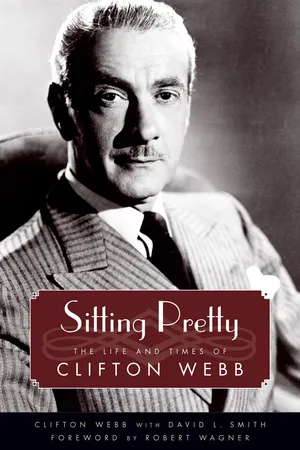
More than any other male movie star, the refined Clifton Webb (1889-1966) caused the moviegoing public to change its image of a leading man. In a day when leading men were supposed to be strong, virile, and brave, Clifton Webb projected an image of flip, acerbic arrogance. He was able to play everything from a decadent columnist ( Laura ) to a fertile father ( Cheaper by the Dozen and The Remarkable Mr. Pennypacker ), delivering lines in an urbanely clipped, acidly dry manner with impeccable timing. Long before his film career began, Webb was a child actor and later a suavely effete song-and-dance man in numerous Broadway musicals and revues. The turning point in his career came in 1941 when his good friend Noël Coward cast him in Blithe Spirit. Director Otto Preminger saw Webb's performance and cast him in Laura in 1944. Webb began to write his autobiography, but he said that he eventually had gotten "bogged down" in the process. However, he did complete six chapters and left a hefty collection of notes that he intended to use in the proposed book. His writing is as witty and sophisticated as his onscreen persona. Those six chapters, information and voluminous notes, and personal research by coauthor David L. Smith provide an intimate view of an amazingly talented man's life and times.
- 256 pages
- English
- ePUB (mobile friendly)
- Available on iOS & Android
eBook - ePub
About this book
Information
Subtopic
Film History & CriticismCHAPTER 1
The Noses Have It
According to all accounts, which I have no reason to disbelieve, I was a disgustingly fat baby. I was an out-sized Hoosier with no perceptible neck and such thick rolls of fat dispersed about my person that I had to be probed clean. Other than that, I was blonde, curly haired, and hazeleyed like my mother, and the nose budding between my fatuous cheeks began immediately to turn up towards my forehead.
Of the facts I have set down above, only the last is of great consequence. Although time has worked upon the others, the nose has remained. If I were even slightly whimsical, I would insist that the course of my life has been determined by Mabelle Parmelee’s nose. I am Mabelle Parmelee’s son, and within the normal limits of genes and chromosomes her nose is my nose. It is not something to be worn lightly.
Once upon a time, for example, I was smuggled into a wicked Parisian party. It was the annual Bal des Quat’z Arts, and I was smuggled because nobody but French artists and models was supposed to be there.

The Bal des Quat’z Arts, the art students’ ball, took place in the spring. The theme was changed every year: Incas, Aztecs, Phoenicians, Egyptians, Gauls, and Babylonians. The costumes were almost always non-existent and there wasn’t much historical authenticity. Everyone, male and female, was covered with vivid colored paint: red, bronze, gold, and silver. Even great painters like Henri Matisse attended this Roman Saturnalia, where every license was permitted.
Having been told that the evening’s motif was Babylonian, I attired myself in a ratty toga and a great deal of brown makeup, which an old dressing-room crone lathered on me with a sponge. At that, I turned out to be overdressed. Some of the artists wore nothing but blue paint and a small tin cup, while there was one model costumed exclusively in a bunch of cherries hung at the most obvious spot. Along about midnight she astonished everybody by launching into a routine of bumps and grinds, extremely professionally executed, as a man in a long black beard pranced about on all fours, snapping at her costume with his teeth.
Without warning, some hour and bottles of champagne later, she climbed a ladder to the box where I was sitting. Before I could move she was in my lap. “Tiens! Quell nez extraordinaire!” she exclaimed, and, seizing my nose between her thumb and forefinger, she gave it a dreadful wrench. The only point of the incident is that at the height of a bacchanal, surrounded by a horde of pickled Babylonians, the first thing that lady noticed was my nose.
As far as design goes, Mabelle’s nose is not a headliner. Cyrano de Bergerac would have ignored it completely. It is merely a nice, functional feature, constructed for blowing, sniffing, and the occasional dramatic snort. There is nothing flamboyant about our nose. The essential factor is its tilt. Although I have never applied a protractor, I am certain that the angle described by the tip of Mabelle’s nose and her brief upper lip is considerably greater than 135 degrees.
Since one’s birth is a purely involuntary part of one’s life, and since the root of everything that happens in this world is imbedded in the past, I must digress for a while to the period when I was merely a coming event.
Mabelle was sixteen and thoroughly saturated with Southern charm when her parents moved from Lexington, Kentucky, to Indianapolis in 1885. The indirect result was their daughter’s romance and my advent.
The 1880 census shows Mabelle and her family living in Indianapolis. In 1870 they were living in Coles County, Illinois. Mabelle had two brothers; Marvin was six years younger and Edwin was older. Webb never mentions them. The family moved to Indianapolis when Mabelle was about eleven years old. The Indianapolis Evening News noted Mabelle’s early theatrical career with articles on her performances (April 18, 1882, and May 30, 1882) at the St. Nichol’s Hotel in Indianapolis. She gave readings of “Painter of Seville,” “Mrs. Candle’s Lecture,” and “Order for a Picture.” A reporter stated, “All the recitations were well delivered but those of Miss Mabel Parmelee deserve special attention.” This means Mabelle was living in Indianapolis from age eleven to at least age thirteen. Apparently, there was a move to Lexington, Kentucky, and then back to Indianapolis when Mabelle was sixteen.
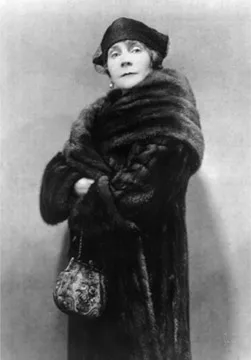
1.3. Mabelle Parmelee. The John and Betsy Neylon Collection.
Mabelle’s early romping in the blue grass had provided her with a tantalizing lisp, a habit of fluttering her eyelids, and various other accessories of blooming belledom, none of which sat well with Grandfather Parmelee. He was the son of a Presbyterian minister and the victim of chillingly Calvinistic convictions, and I am told that Mabelle’s conduct made him spend many hours reflecting on the integrity of his wife’s supposedly Quaker forebears.
In Indianapolis, where she was queen of a front-porch court, Mabelle exercised the lisp and flutter with devastating effect. She had the local swains delicately balanced between hope and despair when it began to be rumored behind fans at taffy-pulls that a tall, dark, and handsome stranger had hit town. To add to the intriguing possibilities of the situation, it was whispered that “he had something to do with railroads.” Just why railroads had such a powerful grip on the girlish imagination is not clear to me, but the fact is indisputable. A little later, against the background of an eminently fashionable dance, one Mr. Jake Grant Hollenbeck was presented to Miss Mabelle Parmelee. He looked at her dance card, saw it was full, and frowned with disappointment. She tossed the card elegantly over her left shoulder and made a silent wish. Then Mr. Hollenbeck smiled and Miss Parmelee smiled. Such portents were of incalculable significance.
Nobody need be surprised that Mabelle’s nose eventually carried the day. After a year of informing her parents in the delightful diction of the day, “I’ll marry Jake Hollenbeck … or die!” Mabelle found it unnecessary to die.
The house in Indianapolis where I was born, and which I dimly remember as enormous, high-ceilinged, with dark closets to strike terror into a child, had a long, curved, black-walnut staircase and banister. The last was more than young Mrs. Hollenbeck, despite her interesting condition, could resist. She landed in a limp heap in the lower hall one afternoon, and the family doctor was hastily summoned. What weighed with Mabelle when he arrived was not his tart comment on the advisability of sliding down banisters while pregnant, but what the spiteful girl across the street might say. Mabelle envisioned her counting on her fingers and gloating cheerfully: “Of course, she says it’s premature … but … I guess this will bring that damn nose down a peg!”
Mabelle accordingly allowed herself to be carried up the long staircase to bed, and there she obdurately remained—one eye on the calendar, determinedly holding up my entrance—until precisely ten months from her wedding day. On that day she produced Webb Parmelee Hollenbeck, an infant endowed with the revolting physical characteristics which I have already described.
Since Webb does not describe how he got to New York from Indianapolis, the following information is provided. After Webb’s birth, Mabelle continued to see as many plays as possible in Indianapolis. Her husband never accompanied her. He cared nothing for the theatre and worried that his wife’s love for the stage might be transferred to their son. Jacob had cause to worry. When Jacob was away at work, Mabelle impetuously boarded a train for New York with her child in tow. Upon their arrival, she immediately enrolled him in dancing, acting, and music schools. Eventually, Jacob found his wayward family. He did not, however, force their return to Indianapolis. Instead, he allowed Mabelle and Webb to stay in New York for what he thought would be a brief adventure for the pair.
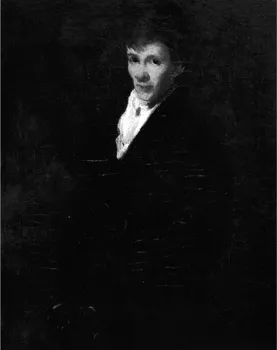
1.4. George Bellows’s portrait of Clifton Webb. Courtesy of richard Zanuck.
Mabelle had other ideas; she wanted to remain in New York, where she could vicariously participate in the theatre through her son. It became apparent to Jacob Hollenbeck that his wife would never return to Indianapolis. He had no desire to move to New York. Mabelle and Jacob finally divorced sometime prior to 1897, when Mabelle remarried.
Webb talks of his public school education. However, most of his schooling was through private tutors. When he was accepted into the Children’s Theatre, teachers were provided for the children.
My nose continued turning up, and at an alarmingly early age began casting its shadow on my future. When I was at Public School No. 87 in New York, between the ages of eleven and thirteen, my classmates used to insist that I was stuck up. Highly incensed, I would shout back: “I’m not! Only my nose is!” They naturally did not believe me, a recollection which I still find painful today. I am not a snob. Mabelle is a snob, but I am not. No one who knows and enjoys so many different kinds of people as do I, who has waded in so many pools and touched so many shores, could possibly be a snob. The carriage of one’s nose is irrelevant.
At the Chase School of Art, where I studied for two years after departing P.S. 87, George Bellows nicknamed me Robin Red Nose and painted a portrait which he said emphasized my “expectant, early morning, worm-hunting look.”
George Bellows became a realist painter known for his bold depictions of urban life in New York City. He has been called “the most acclaimed American artist of his generation.” Today his paintings sell for millions of dollars. His painting of a teenage Webb apparently was done in art school or shortly thereafter. Richard Zanuck told the author he was “willed that painting” by Webb and it is hanging in his home.
The most a nose may do is provide an actor a cue from which he can build a stage personality to match. It is the motion picture camera, however, which allows a nose really to assert itself. The nasal possibilities of the screen are virtually unlimited. As Eliot Templeton in The Razor’s Edge, I was able to convey a large part of that gentleman’s snobbishness solely with my nose. It practically directed Mr. Belvedere in Sitting Pretty and Mr. Belvedere Goes to College.
To that extent, Mabelle has had her nose in my affairs since the day I was born.
Apart from the shared experience of parturition, Mabelle does not bear the slightest resemblance to Mr. Whistler’s notorious mother. My mother is short, plump, blonde, dimpled, with what the Viennese fondly term gemutlichyn. It is immensely to her credit that she survived a Kentucky childhood without melting, like so many ladies of that time and place, into a mass of giggling affectations the color and consistency of butter. Mabelle is an astute person with a superb gift for sizing up characters and situations, traits which she has inherited undiluted from the Philadelphia lawyers and merchants who were her Eno and Saville ancestors. Occasionally, a gentleman of the old school finds Mabelle’s Gay Nineties curves an irresistible temptation, but I venture to say that no gentleman of any school has ever pinched her more than once. Mabelle offers that expensive combination of a soubrette exterior and grande dame standards of behavior.
She has always been completely spoiled. The only one of my grandparents’ four children to withstand the hazards of childhood, they denied her nothing but the one thing on which her mind and heart were set. That was a career on stage.
This ambition filled them with horror. “A girl’s place is at home with her mother,” they informed her unendingly. “Later with her husband.” “Fiddlesticks!” replied Mabelle. Ultimately, they yielded to the extent of permitting dancing lessons, providing that pirouettes and high kicks were practiced only behind the locked door of her bedroom. She was given piano lessons as a matter of course, for that was then considered an essential facet of feminine accomplishment. At fourteen she outraged the professor in Lexington by denouncing “The Maiden’s Prayer” as “silly,” and declaring, “I want to play real music.” Real music has figured largely in Mabelle’s life, and she saw to it that it did in mine during my impressionable years.
Having established a beachhead, Mabelle proceeded to consolidate it. She won Grandfather Parmelee’s consent to take lessons in elocution from a lady of local repute who favored guests at evening parties and church entertainments with recitations by her pupils. Mabelle promptly became her star, and there are still those who recall with wonder my mother’s exquisitely gulping and sobbing rendition of Curfew Shall Not Ring Tonight at the Sayre Institute. I am happy to recommend it professionally to anybody whose taste turns toward dramatic recitation, a neglected art today.
To the growing assortment of handsomely bound, gold-tooled albums and keepsakes won for dancing and excellence at the pianoforte, Mabelle began to add prizes for elocution. And people began to say, with the proper reluctance, “Mercy! She’s really almost an actress!”
If Mabelle was under the impression that the charming bounder she had married was going to be sympathetically inclined to theatrical ambition, she came in for an unpleasant jolt. Alas! The Dutch in Mr. Hollenbeck was inalterably opposed to any female pursuit which might carry a woman beyond the bedroom circuit. He saw to it that Mabelle returned from her honeymoon pregnant.
This did not depress her noticeably, but her husband’s and parents’ program for confinement did. They righteously felt that this period should be devoted to whipping up a Center-Door-Fancy and the cultivation of pure thoughts. When she yowled to be taken to see Modjeska, who happened to be playing a one-night stand at the Indianapolis Opera House, they pushed her firmly back onto the sofa and fed her a nourishing diet of Ella Wheeler Wilcox’s Poems. After that she didn’t ask. She found it a great deal simpler to sneak out the back door after bribing the cook to reply to all inquiries that she had gone for a spiritual stroll.
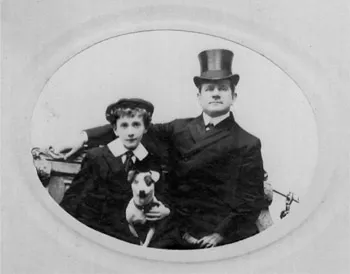
1.5. Clifton Webb and Jacob Hollenbeck, circa 1895. The John and Betsy Neylon Collection.
As Mabelle had often been heard to remark that feet were made for dancing, not walking, this subterfuge should have deceived nobody. Such was the gullibility of the age, however, so great the disinclination to believe that anybody of gentle birth might take the stage seriously, that it did deceive everybody. Everything was fine until that injudicious slide down the banister put her in purdah. Mabelle has always sworn that the first sign of life I evidenced was a good hard kick when she was in the act of applauding the eminent Francis Wilson, and she floated home convinced that she was to be the mother of a great actor. Nobody to this day...
Table of contents
- Cover Page
- Title Page
- Copyright Page
- Dedication
- Contents
- Foreword
- Preface
- Acknowledgments
- Introduction
- Chapter 1. The Noses Have It
- Chapter 2. First Vision of a Name in Lights
- Chapter 3. Art and Opera
- Chapter 4. Making Progress and Moving Up
- Chapter 5. Dancing into Xanadu
- Chapter 6. To Europe in Search of Adventure
- Chapter 7. In Love with Jeanne Eagels
- Chapter 8. Great Plays, Then the Great War
- Chapter 9. The War Starts, Blithe Spirit Leads to Laura
- Chapter 10. More Movies, More Parties, and Garbo
- Chapter 11. A Top Box-Office Draw
- Chapter 12. Stars and Stripes Forever
- Chapter 13. Clifton and Mabelle, Together Forever
- Stage Appearances
- Filmography
- Bibliography
- Index
Trusted by 375,005 students
Access to over 1.5 million titles for a fair monthly price.
Study more efficiently using our study tools.
Frequently asked questions
Yes, you can cancel anytime from the Subscription tab in your account settings on the Perlego website. Your subscription will stay active until the end of your current billing period. Learn how to cancel your subscription
No, books cannot be downloaded as external files, such as PDFs, for use outside of Perlego. However, you can download books within the Perlego app for offline reading on mobile or tablet. Learn how to download books offline
Perlego offers two plans: Essential and Complete
- Essential is ideal for learners and professionals who enjoy exploring a wide range of subjects. Access the Essential Library with 800,000+ trusted titles and best-sellers across business, personal growth, and the humanities. Includes unlimited reading time and Standard Read Aloud voice.
- Complete: Perfect for advanced learners and researchers needing full, unrestricted access. Unlock 1.5M+ books across hundreds of subjects, including academic and specialized titles. The Complete Plan also includes advanced features like Premium Read Aloud and Research Assistant.
We are an online textbook subscription service, where you can get access to an entire online library for less than the price of a single book per month. With over 1.5 million books across 990+ topics, we’ve got you covered! Learn about our mission
Look out for the read-aloud symbol on your next book to see if you can listen to it. The read-aloud tool reads text aloud for you, highlighting the text as it is being read. You can pause it, speed it up and slow it down. Learn more about Read Aloud
Yes! You can use the Perlego app on both iOS and Android devices to read anytime, anywhere — even offline. Perfect for commutes or when you’re on the go.
Please note we cannot support devices running on iOS 13 and Android 7 or earlier. Learn more about using the app
Please note we cannot support devices running on iOS 13 and Android 7 or earlier. Learn more about using the app
Yes, you can access Sitting Pretty by Clifton Webb,David L. Smith in PDF and/or ePUB format, as well as other popular books in Media & Performing Arts & Film History & Criticism. We have over 1.5 million books available in our catalogue for you to explore.