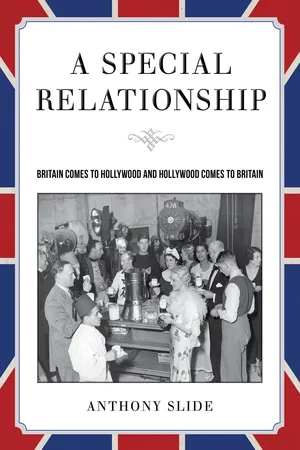
A Special Relationship provides not only a historical overview of the British in Hollywood, but also a detailed study of the contributions made by American individuals and companies to British cinema from the beginning of the twentieth century onwards. The story begins with Ohio-born Charles Urban who came to London in 1898 and deserves credit for major involvement in the creation of a British film industry. While Ireland was still a part of Britain, the New York-based Kalem Company made films there from 1910 to 1913. British producers realized the importance of American stars, and many actors, beginning with Florence Turner (who was arguably also the first American star), made numerous British films. In the 1920s, such Hollywood stars as Mae Marsh, Betty Blythe, and Dorothy Gish remained active in Britain. In the 1930s, as their careers came to a halt, more than one hundred former American stars made the trip to England, partly as a vacation and partly in the hope of reenergizing their careers.
Chapters discuss American cinematographers at work in Britain in the 1920s and 1930s and the introduction of Technicolor to British films. Diversity is represented by African American performers (most notably Paul Robeson), the Chinese American star Anna May Wong, along with female filmmakers from Hollywood. With Britain's declaration of war on Germany, there were Americans who stayed, such as Bebe Daniels and Ben Lyon, contributing to the war effort. America became actively involved in British cinema after World War II, with many Hollywood studios producing films there. As the years progressed, the British film industry became an international film industry. The book concludes with the Harry Potter and James Bond series, indicative of a new international cinema, with financing and behind-the-camera talent coming from the United States, but with British locales and British stars.
eBook - ePub
A Special Relationship
Britain Comes to Hollywood and Hollywood Comes to Britain
- 322 pages
- English
- ePUB (mobile friendly)
- Available on iOS & Android
eBook - ePub
About this book
Information
CHAPTER ONE
British Pioneers in America and an American Pioneer in Britain

DESPITE THE ARGUMENTS PUT FORWARD FOR BIRT ACRES, WORDSWORTH Donisthorpe, Louis Aimé Augustin Le Prince, or William Friese-Greene (celebrated in the personage of Robert Donat in the 1951 biographical film The Magic Box), Britain does not have a legitimate claim to the invention of the cinema. (Pace, I say to those academics, obsessed with the minutiae and triviality of the origins of the motion picture, all of whom will disagree with me.) However, the British can take substantial credit for America’s assertion to have invented the motion picture thanks to two individuals, Eadweard Muybridge and W. K. L. Dickson. Indeed, the British might go even further and point out that a countryman was responsible for the invention of the material that gave the cinema its very raison d’être, celluloid—invented as “Parkesine” by Alexander Parkes, working in Birmingham, England, in 1855. To Parkes goes the credit but it was an American company, the Celluloid Manufacturing Company of Albany, New York, which gave the new substance the name by which it is commonly known.
Almost on a par with Alexander Parkes’s work, and similarly ignored is the contribution of two brothers from Leicester, Thomas and William Taylor, who first experimented with camera lenses in the 1860s, and with a partner, W. S. H. Hobson, formed Taylor, Taylor & Hobson, Ltd. In the 1890s, H. Dennis Taylor (no relation) of T. Cooke & Sons of York brought to the Taylors’ attention his Cooke triplet lens (patented in 1893), which was developed into the finest lens available. In the early 1930s, Arthur Warmisham, who had joined the company in 1911, developed a special lens for use with Technicolor cameras. By 1935, Metro-Goldwyn-Mayer reported that all of its productions were shot with Taylor-Hobson Cooke lenses, and so it was throughout the industry throughout the world, with the company claiming in 1939 that 80 percent of all lenses used at film studios were produced by them. The company has changed names and ownership through the years, and in 2013, at the eighty-fifth presentation, as Cooke Optics, Ltd., it was awarded an award of merit from the Academy of Motion Picture Arts and Sciences “for their continuing innovation in the design, development and manufacture of advanced camera lenses that have helped define the look of motion pictures over the last century.”
First in the chronology of pioneers is Eadweard Muybridge (1830–1904), born with the very English last name of Muggeridge, in the Surrey town of Kingston upon Thames. Muybridge was very much the eccentric Englishman, sporting a long white beard and a broad-brimmed hat, and must have appeared so to Americans once he had immigrated here in 1851. He first gained the attention of the press in 1872, when he was sponsored by Central Pacific Railroad president Leland Stanford in an effort to photograph a trotting horse and prove that it might have all four hooves off the ground at the same time, thus winning a wager for Stanford. This was successfully done, if in somewhat primitive fashion. Three years later, Muybridge gained even more prominent attention when he murdered his wife after discovering she was pregnant by another man. He was acquitted by a jury on the grounds of justifiable homicide. After making the wise decision to take an extended trip to South America, Muybridge returned to the United States, and in 1877 he was again working under Stanford’s sponsorship, using a series of cameras to show animal and human “locomotion.” Using his Zoopraxiniscope projector, Muybridge began to show his photographs in front of a wide audience, attracted no doubt by the fact that, aside from the animals, Muybridge photographed nude or semi-nude female and male students from the University of Pennsylvania performing various acts which, aside from the lack of clothing, might be described as quite innocent. Many of these photographs, particularly those of naked young men wrestling together in a quite amused, not to mention very intimate, fashion can today only be considered homoerotic. Never one to shun the limelight, Muybridge was quite happy to strip down and photograph himself in all his substantial naked glory; with his penis proudly flopping, he walks, ascends steps, and uses a shovel and a pick in front of his cameras. Experiments involving betting, nudity, and sexual crime—on the whole one gets the impression that Eadweard Muybridge must have been a fun character to know. Certainly, Muybridge does not in any way exemplify the stereotypically reserved, quiet, and well-behaved Englishman.

William Kennedy Laurie Dickson.
Muybridge returned to his native land in 1894, publishing two famous volumes, Animals in Motion (1899) and the far more titillating The Human Figure in Motion (1901). His work is generally considered a precursor to the invention of the motion picture as we know it today.
Compared to Muybridge, William Kennedy Laurie Dickson (1860–1935) is not an entertaining personality, and yet his role is crucial in the invention of the motion picture. His parents were British, but Dickson was born in France, for which we will forgive him. He immigrated to the United States in 1879 and began working for Thomas Edison in 1883. Five years later, under Edison’s vague supervision, Dickson became involved in the motion picture. He designed the famous Black Maria studio in 1893, followed by the Kinetoscope, introduced to the world the following year. Unfortunately for Dickson, his ego allowed him to usurp Edison’s power and influence and he found himself pushed out of the organization. He subsequently began to work for others, most notably the American Mutoscope and Biograph Company. In 1897, Dickson came to London and set up the British Mutoscope and Biograph Company, one of the largest British production companies until 1907, and the first to film a Shakespearian play: four scenes from King John, starring Sir Herbert Beerbohm Tree, in 1899. Dickson’s last major achievement was to journey to South Africa in 1899 and shoot what might be described as news-reels of the Boer War, work which he describes in his 1901 book, The Biograph in Battle: Its Story in the South African War. It is not Dickson’s only published work; with his sister, Antonia, he had produced two earlier volumes, The Life and Inventions of Thomas Alva Edison (1894) and History of the Kinetograph, Kinetoscope and Kinetophonograph (1895).
Dickson’s contributions to Edison’s “invention” of the motion picture are still being discussed and analyzed by academics. Whatever the outcome, certainly he is deserving of a prominent place as the only Britisher directly involved in making the motion picture a reality.
Apropos the French connection, it is perhaps worthy of record that Alice Guy, the first female filmmaker and, equally, a pioneering filmmaker alongside her employer, Léon Gaumont, married—in 1907—the British-born Herbert Blaché-Bolton. He took his wife to the United States, dropped the “Bolton” from his name, and ran Gaumont’s US operation, while his wife founded the Solax Company. Herbert Blaché directed a number of prominent American features during the silent era, including the Nazimova vehicles, The Brat (1919) and Stronger Than Death (1920), Buster Keaton’s The Saphead (1920), and Ethel Barrymore’s The Divorcée (1919). He continued as a director through 1929.
There has never been acknowledgment that Britain was there at the birth of film exhibition in the United States. The first public showing of films before a paying audience took place on April 24, 1896, at Koster and Bial’s Music Hall in New York, and one of the “actualities” presented was Rough Sea at Dover, the work of pioneering British cinematographer Birt Acres. The piece is less than a minute in length and had already been screened in London, at the Royal Photographic Society, in January 1896. Thus, at its beginning, film was truly not only an international language but a transatlantic language.
While none of the major studios from Hollywood’s so-called “golden era” can claim a British connection in their creation, one of the most important of the earliest pioneering American film companies was founded not by one, but by two Englishmen. The organization was the Vitagraph Company of America, and its founders were J. Stuart Blackton and Albert E. Smith. Both men were farsighted and intelligent, each in his own way. Blackton was obviously the creative genius behind the partnership, whereas Smith was the businessman. One was a dreamer, whose life was illustrative of his mindset; the other had his feet firmly planted on the ground and, equally, proved until his death that he knew the importance of money over much else. James Stuart Blackton was born in Sheffield on January 4, 1875, and was brought at the age of ten to the United States by his parents. In later years, he was to dismiss his humble working-class background and claim to have been educated at Eton. (In reality, actor John Loder would later point out that he was the only Englishman working in Hollywood who could legitimately claim to be an old Etonian.) Albert Edward Smith was born in the Kentish town of Faversham on June 4, 1875, the son of a market gardener. His entire family immigrated to the United States some thirteen years later.

J. Stuart Blackton (left) and Albert E. Smith, co-founders of the Vitagraph Company of America.
The two men may perhaps have met while apprenticed to a New York carpenter. Whatever the circumstances of their meeting, both had ambitions to be entertainers. A third Englishman, Ronald A. Reader, convinced the two to join with him in forming an act which featured Smith’s magic tricks and Blackton’s expertise as a cartoonist; it was called The Royal Entertainers. The act was not a success, but the crafts of magic and cartooning led to Smith and Blackton, initially minus Reader, acquiring a camera/projector from Thomas Edison and forming their own production company in the spring of 1897.1
Vitagraph, like its fellow pioneering film companies, had humble beginnings, but Smith and Blackton persevered, and their first “major” success owes its origins not only to the couple’s backgrounds as entertainers, but also their desire to show their American patriotism. Using primitive miniatures, a water tank, and smoke provided by Blackton’s cigar, they made The Battle of Manila Bay in May 1898, a celebration of Admiral Dewey’s defeat of the Spanish fleet in the Philippines. Blackton became one of the screen’s first recognizable characters, portraying “The Happy Hooligan” in a series of short subjects beginning in 1900. Trick films and animated subjects followed. A major studio was opened in the Flatbush area of Brooklyn in 1906, a Paris office to handle European distribution in 1908, and a Hollywood studio in the mid-1910s (which still survives today under the ownership of ABC Television). Blackton left the company in 1917, but it continued in operation through 1925, when it was acquired by Warner Bros.
Vitagraph has many British links. Two of its first stars, Florence Turner and John Bunny made films in England, as did J. Stuart Blackton. In its early years, Vitagraph made good use of Shakespearian (and public-domain) plays as the bases for many of its early one-reel productions. One of the company’s last major films, released in 1921, was Black Beauty, based on the classic British novel by Anna Sewell, and starring Smith’s wife, Jean Paige. Among those associated with Vitagraph, and British-born, are John Bunny’s leading lady, Flora Finch, plump character actress Kate Price (born in Ireland), pioneering actor William Shea, and director Wilfred North.
The most important of links between Vitagraph and Britain is the company’s production in 1915 of the feature-length The Battle Cry of Peace, which argued against American isolationism and its entry on the side of Britain into World War I. The production, now “lost,” was aggressive in its attack on American pacifists and isolationists and depicts the country’s invasion by an army which appears suspiciously Germanic in appearance and attire. Based on Hudson’s Maxim’s book, Defenseless America, the film was supported by Theodore Roosevelt, Cornelius Vanderbilt, and Admiral Dewey. There were claims that The Battle Cry of Peace had been at the least influenced and possibly financed by the British Embassy in Washington, D.C., and to counter some of the accusations of its pro-British stance, Blackton announced concomitant with the film’s premiere that he had become an American citizen. As his daughter Marian recalled,
Born an Englishman, imbued with the love of country so stubbornly characteristic of the British, my father was nevertheless profoundly grateful for the blessings of a way of life that made possible his fabulous leap from poverty to riches. Duly, if a shade belatedly, he embraced United States citizenship.2
A second Vitagraph production, Womanhood, the Glory of a Nation, released in the spring of 1917, carried much the same message. Blackton completed his pro-British trilogy, if such it may be described, with Whom the Gods Destroy (1918), a thinly veiled account of the Easter Rebellion in Ireland and the hanging of Irish patriot, Sir Roger Casement. While Whom the Gods Destroy (also no longer extant) might appear on the surface to be pro-Irish, one trade paper, Exhibitor’s Trade Review (December 16, 1916), explained, “Vitagraph has chosen a neutral path in presenting this story by taking the attitude that while the freedom of Ireland from English sovereignty might be a good thing, it is best accomplished by other means than violence at a time when Britain is facing a great crisis.”
The production of these three films was very much Blackton’s project, and after he had left the company, Albert E. Smith explained to Motography (September 1, 1917),
Vitagraph, I think, has partially done its duty toward awakening the nation to a sense of its obligation to itself and civilization. Now, I feel, the policy of Vitagraph and of every motion picture manufacturer should be to make pictures than will take the minds of the people off the war and their troubles, make them laugh, and in that way, make them happy. That is to be our policy.
J. Stuart Blackton was married multiple times and also had his share of mistresses. By the mid-1910s, he owned a large mansion in Brooklyn, an estate in fashionable Oyster Bay, with Teddy Roosevelt and Louis Tiffany as his neighbors, and promoted himself as a commodore of the Atlantic Yacht Club. In 1931, he filed for bankruptcy, and ten years later, either by accident or design, he was hit by a car and died within a couple of days in Los Angeles. Blackton was in many regards a sentimental fool, but Smith had little time for personal feeling. He was a businessman who presided over Vitagraph until its sale to Warner Bros., and had no compunction in firing longtime employees when they had ceased to be saleable commodities. After his “retirement” from Vitagraph, he became a successful real estate investor, owning, among other properties, the Chateau Marmont in West Hollywood.
Of the early and original American film producing entities, only one, Lubin, was founded by a Jewish entrepreneur. The remainder was all Gentile-owned and operated, and, perhaps, nothing could be more Aryan than Vitagraph with its two English founders, who, like their colleagues, were decidedly anti-Semitic and resentful of the Jewish element that by the mid-1910s was quickly taking over the industry.
It was another Englishman to whom credit is due for establishing the film industry on a permanent footing in Hollywood, and that is David Horsley, who was born in the coal mining village of West Stanle...
Table of contents
- Cover
- Half title
- Title
- Copyright
- Contents
- Acknowledgments
- A Note on Style
- Introduction
- Chapter One British Pioneers in America and an American Pioneer in Britain
- Chapter Two The O’Kalems
- Chapter Three The American-Anglo-Irish
- Chapter Four American Silent Stars to the Rescue of British Cinema in the 1910s and 1920s
- Chapter Five American Cinematographers of the 1920s and 1930s in Britain
- Chapter Six The 1930s and the Golden Age of the Hollywood Has-beens
- Chapter Seven Hollywood Producers and British Film Production in the 1930s
- Chapter Eight Diversity—Female Filmmakers, African American Performers, and Others
- Chapter Nine Technicolor Comes to Britain
- Chapter Ten A Golden Age for the British in Hollywood
- Chapter Eleven British Cinema at War
- Chapter Twelve The Postwar Renaissance
- Chapter Thirteen The New International Cinema
- Notes
- Bibliography
- Index
Trusted by 375,005 students
Access to over 1.5 million titles for a fair monthly price.
Study more efficiently using our study tools.
Frequently asked questions
Yes, you can cancel anytime from the Subscription tab in your account settings on the Perlego website. Your subscription will stay active until the end of your current billing period. Learn how to cancel your subscription
No, books cannot be downloaded as external files, such as PDFs, for use outside of Perlego. However, you can download books within the Perlego app for offline reading on mobile or tablet. Learn how to download books offline
Perlego offers two plans: Essential and Complete
- Essential is ideal for learners and professionals who enjoy exploring a wide range of subjects. Access the Essential Library with 800,000+ trusted titles and best-sellers across business, personal growth, and the humanities. Includes unlimited reading time and Standard Read Aloud voice.
- Complete: Perfect for advanced learners and researchers needing full, unrestricted access. Unlock 1.5M+ books across hundreds of subjects, including academic and specialized titles. The Complete Plan also includes advanced features like Premium Read Aloud and Research Assistant.
We are an online textbook subscription service, where you can get access to an entire online library for less than the price of a single book per month. With over 1.5 million books across 990+ topics, we’ve got you covered! Learn about our mission
Look out for the read-aloud symbol on your next book to see if you can listen to it. The read-aloud tool reads text aloud for you, highlighting the text as it is being read. You can pause it, speed it up and slow it down. Learn more about Read Aloud
Yes! You can use the Perlego app on both iOS and Android devices to read anytime, anywhere — even offline. Perfect for commutes or when you’re on the go.
Please note we cannot support devices running on iOS 13 and Android 7 or earlier. Learn more about using the app
Please note we cannot support devices running on iOS 13 and Android 7 or earlier. Learn more about using the app
Yes, you can access A Special Relationship by Anthony Slide in PDF and/or ePUB format, as well as other popular books in Mezzi di comunicazione e arti performative & Storia del XX secolo. We have over 1.5 million books available in our catalogue for you to explore.