Simplifying Cause Analysis
eBook - ePub

Simplifying Cause Analysis

A Structured Approach

  1. 236 pages
  2. English
  3. ePUB (mobile friendly)
  4. Available on iOS & Android
eBook - ePub

Simplifying Cause Analysis

A Structured Approach

About this book

When the challenge is to get to the heart of a problem, you need a simple and efficient cause investigation methodology. And what would make a real difference would be an interactive map to lead you to the answer every time. Chester Rowe's Simplifying Cause Analysis: A Structured Approach is your instruction book combined with the included downloadable Interactive Cause Analysis Tool you have been looking for.

The author intends this book for professionals like you, who have some familiarity with cause analysis projects and are looking for a simple and efficient cause investigation methodology –is a more effective and insightful way of asking "why?"

Introducing his multi-function event investigation tool, Chester Rowe says, "There are already many scientific tools to help us understand the physical causes for machine failures; the challenge now is to find a way of investigating human performance failure modes…humans are often a major source of slips, lapses, and mistakes."

Supporting his instructions with diagrams, charts, and real-world examples from companies like yours, the author takes you step-by-step through planning, completing, and documenting your investigation:

  • Chapter 1 gives you a process to determine the level of effort that your investigation should encompass, assess the level of effort needed, and determine the rigor needed. Your investigation needs to be as risk-informed as possible.
  • Chapters 2 through 5 presents a new and innovative structure –rigorous yet intuitively easy to remember – to identify the underlying causes for the event (Cause Road Maps) and conduct the investigation.
  • Chapter 6 introduces conceptual human performance models and tells you how to begin focusing on the human behaviors involved.
  • Chapters 7 and 8 present you with methods, tools, and techniques for carefully interviewing personnel.
  • Chapters 9 through 13 "put the pieces together," showing you how to analyze and model the event, determine corrective action, and document the investigations and findings.

Chester Rowe developed the Cause Road Map over many years to provide a comprehensive taxonomy for every cause investigation. However, fully implementing the Cause Road Map requires the use of other tools to organize, analyze, and present the final results of your investigation. To get you started, Rowe includes his downloadable Interactive Cause Analysis Tool – an easy-to-use tool in familiar spreadsheet format – free with your verified purchase of the book.

Frequently asked questions

Yes, you can cancel anytime from the Subscription tab in your account settings on the Perlego website. Your subscription will stay active until the end of your current billing period. Learn how to cancel your subscription.
No, books cannot be downloaded as external files, such as PDFs, for use outside of Perlego. However, you can download books within the Perlego app for offline reading on mobile or tablet. Learn more here.
Perlego offers two plans: Essential and Complete
  • Essential is ideal for learners and professionals who enjoy exploring a wide range of subjects. Access the Essential Library with 800,000+ trusted titles and best-sellers across business, personal growth, and the humanities. Includes unlimited reading time and Standard Read Aloud voice.
  • Complete: Perfect for advanced learners and researchers needing full, unrestricted access. Unlock 1.4M+ books across hundreds of subjects, including academic and specialized titles. The Complete Plan also includes advanced features like Premium Read Aloud and Research Assistant.
Both plans are available with monthly, semester, or annual billing cycles.
We are an online textbook subscription service, where you can get access to an entire online library for less than the price of a single book per month. With over 1 million books across 1000+ topics, we’ve got you covered! Learn more here.
Look out for the read-aloud symbol on your next book to see if you can listen to it. The read-aloud tool reads text aloud for you, highlighting the text as it is being read. You can pause it, speed it up and slow it down. Learn more here.
Yes! You can use the Perlego app on both iOS or Android devices to read anytime, anywhere — even offline. Perfect for commutes or when you’re on the go.
Please note we cannot support devices running on iOS 13 and Android 7 or earlier. Learn more about using the app.
Yes, you can access Simplifying Cause Analysis by Chester D. Rowe, Kristen Noakes-Fry in PDF and/or ePUB format, as well as other popular books in Business & Assicurazioni. We have over one million books available in our catalogue for you to explore.

Information

image
Chapter 1
Getting Started
Your organization has just experienced an event. Now you should decide how to go about conducting an investigation that will determine the cause(s) for the event and determine what corrective actions are needed. Before you begin, you need to ask:
• What level of effort (people, money, and other resources) do you need to dedicate to the investigation?
• Is this a small event with minor consequences?
• Is it a catastrophic event with major equipment damage, or is it a precursor event that could have had significant consequences?
• What level of management involvement is needed?
• Is an investigation team needed? If so, who should lead it?
• How big should the investigation team be?
• Does this problem have widespread implications? What are some of them?
1.1 Two Tools to Begin the Investigation
This chapter introduces two tools to help your investigation get started in an orderly fashion.
• Investigation Effort and Rigor Assessment Tool:
The purpose of the first tool is to:
image
Determine the level of effort to devote to the investigation.
image
Help minimize the possibility of emotions dictating the level of investigation.
image
Recommend the level of investigative effort needed based upon consequences, risks, and uncertainties of the cause.
• Checklist Tool:
The second tool is a checklist to help you and your investigation team organize your investigation effort. The checklist serves as a tickler to remind you of the things that should be considered for a successful investigation.
What type of event investigation tools should you use to help identify the cause(s) for the event? Investigation tools are not effective in certain situations.
Beginning with the Investigation Effort and Rigor Assessment Tool, before conducting any cause investigation or analysis, you will need to assess the level of effort needed and determine the rigor needed. To avoid ā€œemotionalā€ reactions (i.e., unwarranted levels of effort), as well as missed opportunities (i.e., not enough effort), the investigation needs to be as risk-informed as possible.
1.1.1 Investigation Effort and Rigor Assessment Tool
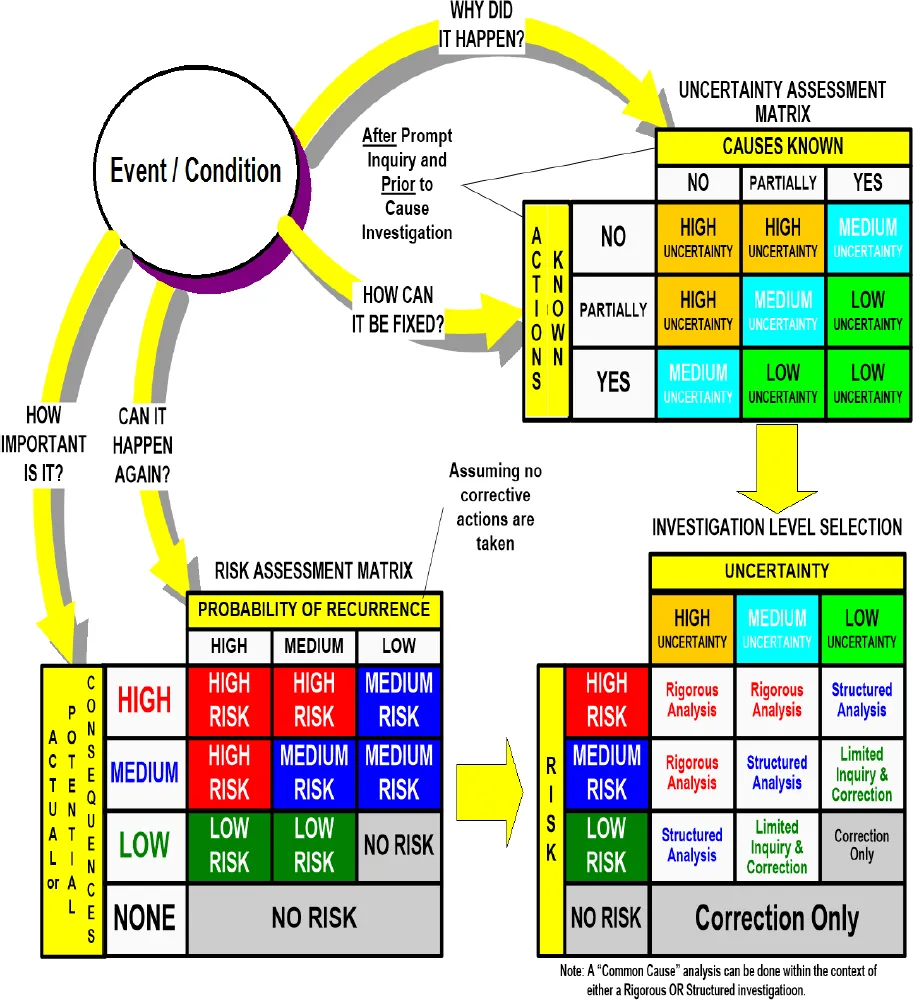
The Investigation Rigor Selection Tool (Figure 1-1) provides you with the framework for a risk-informed decision by first assessing the actual or potential consequences or attributes.
• Actual or Potential Consequences.
The Actual or Potential consequences of the event or condition under consideration (measured as High, Medium, Low, or None):
image
The probability or likelihood of recurrence for this event or condition, assuming that no corrective actions are taken (Measured as High, Medium or Low).
image
The level to which corrective and preventative actions are Already Known or can be quickly determined without a cause investigation (Measured as Yes, No or Partial).
image
The level to which the cause or causes of the event or condition are Already Known or can be quickly determined without a cause investigation (Measured as Yes, No, or Partial).
Note: As the consequences associated with different types of events and conditions differ among various industries and companies, this attribute will require you to develop a set of facility-specific examples for High, Medium, Low and No Consequence events or conditions.
Once you have completed the level of risk matrix and uncertainty matrix, you will be ready to select the level of investigation.
image
Figure 1-1. Investigation Effort and Rigor Assessment Tool
• Level of Effort Output from Rigor Selection Tool
The output (Level of Effort) from this Investigation Rigor Selection Tool is one of the following:
Common Terms
Root Cause:
Among the many definitions of this term I’ve seen, I prefer the following:
ā€œThe fundamental cause (or causes) of a chain of events which leads to an outcome or effect of interest.ā€
The investigative effort to discover the root causes of an event is generally referred to as a Root Cause Analysis (RCA).
Apparent Cause:
In my presentation at the 2007 IEEE/HPRCT joint conference (Apparent Cause Evaluation Myths by Stephen M. Davis and Chester D. Rowe Ā© 2007, The Excellence Engine LLC) I listed 11 different definitions for this term. Since this presentation I’ve identified many more. The only commonality between many of these definitions is use of the phrase ā€œthe most probable causeā€. The problem is that a ā€œprobable causeā€ is not a ā€œlearned causeā€. A ā€œprobable causeā€ is basically a ā€œbest guessā€ cause. Therefore, I reject all existing definitions in favor of...

Table of contents

  1. Cover
  2. Title Page
  3. Copyright
  4. Dedication
  5. Acknowledgments
  6. Table of Contents
  7. Introduction
  8. Chapter 1: Getting Started
  9. Chapter 2: The Cause Road Map Taxonomy
  10. Chapter 3: Human Performance Related Maps
  11. Chapter 4: Machine/Material/Hardware Failure Maps
  12. Chapter 5: Using the Cause Road Map
  13. Chapter 6: Human Performance Basics
  14. Chapter 7: Effective Interviewing
  15. Chapter 8: Analysis Tools and Techniques
  16. Chapter 9: Event Modeling and Analysis Tools
  17. Chapter 10: Event Modeling and Analysis Tools
  18. Chapter 11: Extent of Condition and Extent of Cause
  19. Chapter 12: Corrective Actions
  20. Chapter 13: Documentation and Reporting
  21. Chapter 14: Final Thoughts
  22. About the Author
  23. Credits
  24. How to Get Your Free Download