Kawakami's July 2004 book on extramarital affairs (Tsuma no Koi, Japanese only, ISBN4-901203-4-X) has sold nearly 5,000 copies and is readying for a second run. Kawakami is increasingly being called by Japanese media to comment on extramarital affairs, a hot topic in Japan these days. Goodbye Madame Butterfly includes sections of Kawakami's first book, but it also includes much original writing. Despite her success in Japan, she chose to publish this book in English first because she felt Japan's publishers wouldn't be ready for what she has to say. The book was written in Japanese and translated by Chin Music Press.
eBook - ePub
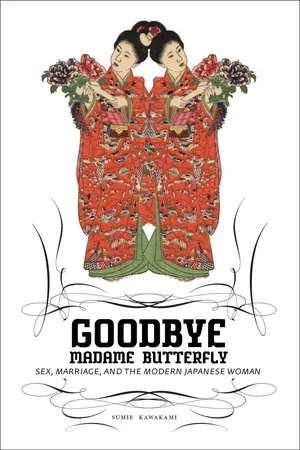
Goodbye Madame Butterfly
Sex, Marriage and the Modern Japanese Woman
- 260 pages
- English
- ePUB (mobile friendly)
- Available on iOS & Android
eBook - ePub
About this book
Information
RED CIRCLES
Misa Kobori, Housewife, 36

MISA’S DAY begins at five in the morning when she draws a bath for her husband, Naoki. She makes sure that the bath temperature is just right when he wakes up. She also puts out clean underwear, socks, a shirt, a necktie and a suit for him. She selects a pair of shoes that match his suit, polishes them and leaves them by the front door. This is her morning ritual; she has been doing it every day for almost a decade.
Misa remembers watching as a child as her mother helped her father with his necktie. She believes that it’s her duty as a housewife to help her husband get ready for work even though friends tell her that no housewife does that anymore. “Aren’t you spoiling him?” her friends ask. Maybe, but why change now, after nearly ten years of marriage?
Misa has two children — a nine-year-old and a six-year-old. The older daughter is in a K-twelve school that is connected to a state university. Misa didn’t really plan it this way. She has always been skeptical of some of the extreme measures taken to get young children into good schools. While some mothers talked about sending their eighteen-month-old children to prep schools so they can do well on kindergarten entrance exams, Misa’s eldest daughter was getting dirty in parks, being wild, playing.
Misa remembers applying for the school in a light-hearted sort of way. She learned that the mothers who hung out at her local park with their children were applying to this one school, so she thought to herself, “Well, why not?” The school was popular and only accepted a few students. In the initial screening process, applications were randomly selected, so for Misa it was like buying a lottery ticket — a winning lottery ticket, that is. The Koboris were the only family in the neighborhood to make it into the initial selection, and that drew jealous comments from the mothers whose children didn’t make the cut. “You got lucky with the initial selection, but you can’t rely on luck for the interview,” one of them said to her.
Naoki seemed confident about the interview, saying, “She’s smart like me, so she might actually make it.” But Misa thought her daughter was ill prepared for any entrance exam. To complicate matters, the week before the interview, Misa, who was pregnant with their second child, had to be hospitalized because of a potential miscarriage. Naoki had to accompany his daughter to the exam. The daughter, who tended to cling to her mother, was calm, seemingly resigned to circumstances beyond her control. She carried herself in a relaxed manner, fearing nothing. When the good news came, Naoki appeared prouder than Misa.
The daughter, now in fourth grade, loves school and says she wants to stay right where she is through middle school. Misa is proud of her. But their second daughter was a different story. Twice, for kindergarten and grade school, they sent in applications for the school, with no success. She took entrance exams for several other private schools, but those attempts also failed. The second daughter was born with a weak heart and had to undergo surgery at the age of two. Naoki took pity on her and told Misa not to push their fragile daughter too hard, but Misa thought otherwise. She wanted to take care of her daughter’s education issues now so that she wouldn’t have to go through examination hell later.
Nonetheless, now that the option of sending her to a private school is gone, Misa has come to feel that a local public school may not be such a bad idea. Her experience with the local community has been positive so far. She has become friends with the mothers and established a sort of solidarity with them. Misa knows that she can depend on any of them if something happens. Sometimes she finds her kindergarten-centric life stifling, but she has learned to get along with everyone while maintaining a comfortable distance. Once her youngest begins grade school, she will have a little more time to herself — something she looks forward to.
Her husband is two years her senior and works in the sales department of a securities company. Like many other Japanese couples, Misa calls her husband “Papa” and Naoki calls her “Mama.” Once a year, they take a family trip to a resort in Hawaii or Guam. They also take a trip to a hot springs resort with Naoki’s mother, Kazue. At first Misa was somewhat uncomfortable with the presence of her mother-in-law during these trips, but she has learned to deal with Kazue from a comfortable distance. The children love Papa and he loves spoiling them. The three-bedroom condo Naoki’s company has helped lease is not extravagant, but it is big enough and near the train station and the girls’ schools. They live a comfortable life with no financial worries.
Misa is from Miyagi Prefecture. Her father left the corporate world to run a convenience store. Her older sister, Sae, never married and still lives at home. She used to work at a car dealership, but now she helps around the house and leads a relatively easy life. Every so often, when the urge strikes, she wanders off to Tokyo. Misa talks to Sae a few times a week on the phone. They don’t talk about anything specific but sometimes they end up chatting for hours. Misa takes a long break during summer and winter vacation to go back to her parents’ home with the children. At her parents’ place, her mother and sister take care of her children so Misa can go out drinking with friends and go to the beauty salon. It’s like being on holiday, though a modest one. To be honest, it hasn’t been easy being far away from home, raising the children by herself while Naoki puts in long hours at work. When she doesn’t feel well, she pines for the comfort of home. There were times when she felt envious of friends who had parents living nearby. Partly because of that, she felt entitled to enjoy herself a little whenever she returned home to her parents’ place.
Misa arrived in Tokyo eighteen years ago. It took her awhile to overcome a dislike for Tokyo that Sae had helped instill. Her mother’s hometown was Saitama Prefecture, which neighbors Tokyo, and Sae made frequent trips to the capital. But when it came time to decide on a school, Sae said, “Tokyo is great for having fun, but I don’t want to live there. The air is unclean and the water tastes horrible.” She enrolled in a school closer to home. “When you walk around Tokyo, the insides of your nose turn black and your nose hairs grow longer,” Sae used to say. That must have rubbed off a little on Misa, who thought, without much conviction, that she would go to a local university also.
It was around then that a relative recommended a university in Tokyo where he worked. She took an exam for the Buddhism department and got accepted. Misa was not really an ardent student of Buddhism, but she was surrounded by relatives who were in one way or another connected with a temple. She was also vaguely attracted to the notion of majoring in something unique. Her father, having lived in Tokyo during his youth, encouraged her to continue her studies there. Her interest in Tokyo began to grow.
Misa believed that each destination of her life was determined by her connections, not arrived at by some strong conviction on her part. She felt that the choices she made were not necessarily made by her but for her, as if someone had gently pushed her from behind and there she was, all settled in.

WHEN MISA was a senior at university, she considered becoming a nun. After all, she had spent the last few years of her higher education concentrating on Buddhist studies. But to go into training, she would have to shave off her long hair. That was one thing she was never going to do.
As she contemplated her future, she was referred by a relative to a bank that had just completed a merger, and before she knew it, she was working there. Misa left her aunt’s house and began living alone in the city. At the bank, she worked as a teller and processed a lot of paperwork. The work was busy, but the days rolled by relatively peacefully.
It was winter during her first year at the bank and Misa was twenty-three when she met Akira. Misa and some colleagues went to a bar in Roppongi that was frequented by foreigners. It was a trendy spot at the time. Her friends talked her into going, she says, and when they arrived, they realized they were very overdressed for this casual bar. They had come from a French restaurant and were still in their business attire, but everybody in the bar wore jeans or other rough attire. Smokers threw their butts on the ground. As soon as she walked in and had a look around, she thought, “I don’t like this. I want to go home.” But her friends darted deep into the bar. She settled down at the counter and managed to order a drink for herself, feeling awkward.
Right then, a man asked her, “What’s wrong? Are you bored?”
“No, I’m not dressed properly for this place,” Misa mumbled.
Akira was tall and fresh-faced — Misa’s type. But she was uncomfortable at this bar. Roppongi was known for its pickup joints, and being hit on in one of these bars was not Misa’s idea of romance. Their conversation soon petered out.
Eventually, her friends came back and they began talking about leaving. As they were ready to leave, Akira turned to her: “I can take you home.”
“Sorry. I’ve gotta go. Bye.”
“Can I have your phone number?”
Misa blurted out a fake number.
“What? What was the number again?” Akira asked.
Misa was caught off guard. She couldn’t remember the fake number, so she ended up giving him her real number.
Akira didn’t have anything to write on, so he kept asking her to repeat it. She relented and repeated her real phone number several times. That evening, he called her.
AKIRA WAS two years younger than Misa. He studied at a university in the US but returned to Japan without completing his studies. He took up a part-time job in Tokyo and has stayed there since. Akira was kind and fun to be with. Perhaps because she was a little older than him, he took her opinions seriously. Mostly, she enjoyed his friendship. When it came time to talk about the future, however, Akira had practically no vision. Akira’s father was an entrepreneur with a hand in a wide variety of businesses. Akira himself was not interested in sponging off of his parents, so he didn’t want to help out his father’s business. She asked him, “Well then, what do you want to do?” His response was, “I just want to live life like a nomad. If I had to work, I’d run either a bar or a cafe, I guess.”
“What you want to do with your life is up to you, but if you’re serious about doing something, shouldn’t you be preparing for that now?” To her, Akira was too much of a dreamer. Misa felt anxious about being in a relationship that held no promising future, especially after watching many of her friends get married. A part of her, however, felt empowered by the situation. She felt as if she had to stand on her two feet for both of them. After many frank conversations, Akira decided to go back to school and graduate. With Akira back in the US, Misa was in Tokyo by herself. It felt lonely, but she preferred that to his goofing around, particularly if marriage was somewhere in the picture.
Misa met her future husband Naoki around this time. She met him one day when her cousin took pity on lonely Misa and invited her for drinks with a group of friends. The group got along well and met regularly. Misa’s apartment was in the middle of Tokyo, so many a drunken friend who missed the last train home used Misa’s place to sleep until the morning. Naoki was one of these overnight guests. He was there as part of the group, though, and never alone with Misa.
One day, without any warning, Naoki showed up at Misa’s place with a suitcase. Seeing the hesitation on Misa’s face, all Naoki said was, “Oh come on. Let me stay.”
“What? No, you can’t do that,” Misa replied.
But Naoki was persistent, and Misa finally gave in. Ever since then, Naoki spent most of the week at Misa’s place.
“He worked in the city, but the company’s apartment was in Saitama Prefecture,” Misa recalled. “I believe he began coming to my place because I was simply closer to his office.”
Naoki knew all about Misa’s boyfriend in the US, but it was just a matter of time before Naoki and Misa became more than roommates. Misa said they went out drinking one night, then one thing led to another.
Soon after they began going out, Naoki asked Misa to break up with Akira. Naoki promised Misa he would “make her happy.” Although Misa wasn’t ready to dump Akira for Naoki, the proposition was flattering.
“I know this sounds petty,” Misa said. “But I was comparing the two. Akira was still a student, so if we were really splurging, we would go to a family restaurant. We often ate at home to save money. Naoki, on the other hand, took me to the top floor of the Hyatt Hotel. We drank cocktails as we watched the Tokyo city lights glowing before us. That was such a strong pull for me. I’ve gone out drinking at such places with other older men from work, but this was something new and fresh to me. The romance, with the sparkling city lights in the background, had my head spinning. At the time, my friends were all getting married. I began to think that I wanted to get married, too. So I weighed one against the other: A man with an uncertain future against a gainfully employed Naoki.”
Time passed and Akira was still unaware of Naoki’s presence. Akira even returned to Japan a few times during this period. Misa would send Naoki home to his company apartment during those times. Akira never seemed to notice that Misa was living with another man. Whenever Akira went back to the US, Naoki returned to Misa’s place. One day, an impatient Naoki asked Misa to break up with Akira.
“Well, I can’t do that,” Misa said. “You knew I had a boyfriend from the start.” Misa didn’t dislike Naoki; she si...
Table of contents
- Cover Page
- Content
- Title Page
- Copyright
- Dedication
- Preface
- Washoi!
- Joint Venture
- Red Circles
- Yin Yang Master
- Purgatory
- Sex Volunteer
- The Fix
- Synchronicity
- The Mannequin
- Shinto Priest’s Wife
- Long Distance Love
- Acknowledgements
Trusted by 375,005 students
Access to over 1.5 million titles for a fair monthly price.
Study more efficiently using our study tools.
Frequently asked questions
Yes, you can cancel anytime from the Subscription tab in your account settings on the Perlego website. Your subscription will stay active until the end of your current billing period. Learn how to cancel your subscription
No, books cannot be downloaded as external files, such as PDFs, for use outside of Perlego. However, you can download books within the Perlego app for offline reading on mobile or tablet. Learn how to download books offline
Perlego offers two plans: Essential and Complete
- Essential is ideal for learners and professionals who enjoy exploring a wide range of subjects. Access the Essential Library with 800,000+ trusted titles and best-sellers across business, personal growth, and the humanities. Includes unlimited reading time and Standard Read Aloud voice.
- Complete: Perfect for advanced learners and researchers needing full, unrestricted access. Unlock 1.5M+ books across hundreds of subjects, including academic and specialized titles. The Complete Plan also includes advanced features like Premium Read Aloud and Research Assistant.
We are an online textbook subscription service, where you can get access to an entire online library for less than the price of a single book per month. With over 1.5 million books across 990+ topics, we’ve got you covered! Learn about our mission
Look out for the read-aloud symbol on your next book to see if you can listen to it. The read-aloud tool reads text aloud for you, highlighting the text as it is being read. You can pause it, speed it up and slow it down. Learn more about Read Aloud
Yes! You can use the Perlego app on both iOS and Android devices to read anytime, anywhere — even offline. Perfect for commutes or when you’re on the go.
Please note we cannot support devices running on iOS 13 and Android 7 or earlier. Learn more about using the app
Please note we cannot support devices running on iOS 13 and Android 7 or earlier. Learn more about using the app
Yes, you can access Goodbye Madame Butterfly by Sumie Kawakami, Yuko Enomoto in PDF and/or ePUB format, as well as other popular books in History & Asian History. We have over 1.5 million books available in our catalogue for you to explore.