![]()
PART ONE
![]()
1
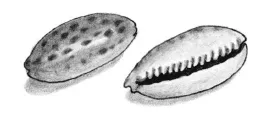
In one of the drawers of the bookcase in my study that contains bric-à-brac, I have long kept a small box. Made of corkwood and with peony-design paper strips pasted at each of the wood joins, it appears to have originally contained tobacco imported from the West. There’s nothing especially beautiful about it, but for the subdued tone and soft touch of the wood, and the warm puffy sound it makes as the lid is shut, it is still one of my favorite things. It is packed with a cowry shell,1 camellia seeds, and other bits and pieces that were my playthings when I was a child, but I have never forgotten that among them is a curiously shaped silver spoon. It has a round bowl about half an inch wide and a short handle that is slightly curved. It is thick, so if held at the end of the handle, it feels unexpectedly heavy. From time to time I take it out of the box, carefully wipe off the tarnish, and gaze at it without ever growing bored. Looking back now, it was a very long time ago that I happened to find this small silver spoon.
From the beginning our house has had a cupboard. When I grew tall enough to reach its upper part on tiptoe, I would open its doors and pull out its drawers just for their different gives and squeaks. One of the two miniature drawers, side by side with tortoiseshell handles, was warped and hard for a child to open, but that only increased my curiosity until one day, after a struggle, I finally forced it out. My heart pounding with excitement, I tipped its contents onto the tatami and found, among weights for scrolls and netsuke, the silver spoon. For some reason I wanted it and immediately took it to my mother.
“May I have this?”
Mother, who was in the dining room working with her glasses on, looked a little surprised. “You must take good care of it,” she said.
Such prompt permission was unusual, and I was at once happy and somewhat let down. The drawer had been broken when we moved from Kanda to the Yamanote and even mother had forgotten about the silver spoon and its peculiar history. This she told me while continuing to sew.
KOYASUGAI: COWRIES
2
When I was born, my mother had a particularly difficult labor. Even the old midwife who was renowned at the time gave up, so they had to call in a doctor of Chinese medicine named Mr. Tōkei. Yet his decoctions just didn’t seem to help my delivery at all, and my father, losing his temper, started to snap at him. So Mr. Tōkei, totally at a loss, read out this or that passage from his book of medicine, trying to prove that he’d made no mistake in his prescription, while desperately waiting for the tides to turn. After giving mother such trouble, I was finally born. But the way Mr. Tōkei, driven to distress, moistened his finger with saliva to turn the pages of his book one by one as he scooped various medicines from his medicine case remained in the realistic mimicry of the clownish aunt who brought me up, and for a long time afterward it afforded a never-failing source of laughter in my family.
Not only was I weak when born, but soon after birth I developed a terrible rash that covered my head and face, making me look “like a pine cone,” according to mother. As a result I had to continue being cared for by Mr. Tōkei. To prevent the rash from affecting me internally, he made me take coal-black electuary and powdered rhinoceros horn every day. Since an ordinary spoon was awkward for scooping medicine into a child’s small mouth, my aunt found this spoon somewhere and gave me the medicine with it throughout my illness. When I heard the story, though unaware of any of it until then, I developed something akin to a fond memory of the spoon and decided never to let it go.
Because I hardly slept night or day for the itchiness of the rash all over me, mother and aunt took turns tapping the scabs with a small rice-bran bag containing adzuki beans. When they did this, I looked happy, twitching my little nose, I was told. I remained weak and hypersensitive until I was quite a bit older and had headaches as often as every three days. So my family would tell visitors that I’d suffered brain damage because they’d tapped my head with a rice-bran bag. I caused a lot of trouble coming into this world. And partly because my mother didn’t fully recover from childbirth and partly because there was then no other help available, it was decided that my aunt, who was living with us at that time, would take care of me, apart from when my mother breastfed me.
3
My aunt’s spouse was called Sōemon and in their province was a samurai, though of low rank. But both husband and wife were such good-natured, good-for-nothing people that with the coming of the Meiji Restoration they fell on hard times. Subsequently, after Sōemon died during the cholera epidemic in a certain year of Meiji,2 it became even more difficult to keep the household going, and in the end my aunt had to place herself in the care of my family. Back in their own province, not only those who were hard-pressed but also those who were not would take advantage of my aunt and her husband’s good nature and borrow money from them, and the two of them would make a loan even when they had hardly a thing to eat themselves. As a result, they were soon almost bankrupt. At which point, those who had borrowed money didn’t hesitate to laugh at them behind their backs.
OFUKUSAMA: MR. AND MRS. GOOD LUCK
“They’re just too good-natured for words, aren’t they,” they’d sneer.
It wasn’t that the couple, once they became really hard up, didn’t go to those who might have been compliant and ask for a repayment of their loan. But they’d then get all teary-eyed at the least pitiful story the borrowers told them and would come home again repeating, “What a pity, what a pity!”
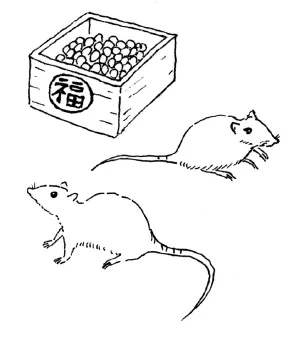
Also, they were terribly superstitious. Once, they bought a pair of white mice somewhere, saying they were the messengers of the Lord Daikoku,3 and bred them with extreme care, calling them Mr. and Mrs. Luck.4 The mice multiplied, as you’d expect mice to do. Finally, swarms of them were scurrying about the house. This the couple regarded as a great blessing, and on any commemorative day they would cook rice with adzuki beans or pile roasted beans high in a square wooden measure and offer them to the mice. And so, when people had borrowed what little money they had and the carriers of good luck had eaten all the rice they kept in their rice casket, my aunt and uncle, with no possessions beyond the clothes they were wearing, and now counting on my family, came to us all the way from their own province—we having moved here to accompany our lord. Soon afterward, Sōemon died of cholera, leaving my aunt an utterly indigent widow. Speaking of that time, my aunt explained that korori—“dropping dead”—raged in Japan because Christians in a foreign country had sent an evil fox over the waters to kill off the Japanese, and that that had happened twice, “the one korori” and “the three korori.”5 Sōemon came down with “the one korori” and was taken to a quarantine ward where they just let the patients, who had turned black with the korori fever, die, without even allowing them to drink water. All the patients died with their intestines burned, she said.
For my aunt, bringing me up was the only pleasure she had in life. Indeed, it may well have been because she had no house, no child, was old, and had nothing to look forward to, but there was another, mysterious reason she cared for me to such a superstitious degree. When my brother, who’d be just a year ahead of me if he were still alive today, died of epilepsy soon after birth, my aunt grieved as if her own child had died, weeping aloud and wailing, “Be born again, be born again!”
So, when I was born the following year, she believed that with the grace of the Lord Buddha the deceased child had been reborn and decided to take inordinately good care of me. Indeed, how happy and moved she must have been to think that this child, covered with dirty scabs though he was, had not forgotten her prayers and had abandoned his house on the Lotus of Paradise just for her! Accordingly, after I turned four or five, when she gave offerings to the Buddhist altar—the happy role of my devout aunt every morning—she would from time to time take me to the altar and try to make me, a child still unable to read the first letter of the Japanese syllabary, memorize my brother’s Buddhist name, Ikkan Soku’ō Dōji, or The Boy Who Responded to a Single Call, which was, according to her thinking, nothing less than my own name while I was in Paradise.
4
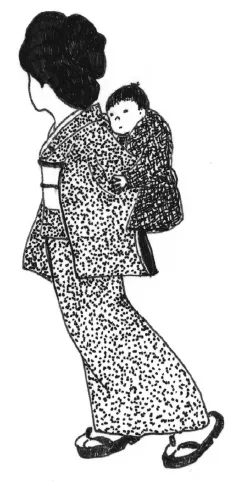
Perhaps not inside the house, but every time I went out of it, even by a single step, I would cling to my aunt’s back. But my aunt must also have been reluctant to let me go, even while moaning that her hip hurt or that her arms were going numb. I probably did not step on the ground until about five, and when I was put down to do things like adjusting my sash, I felt as if the earth was swaying and had to hold on for dear life to the hem of her sleeve. In those days I had a pale green sash tied high on my chest with a small bell and a Mount Narita6 amulet hanging from it. That was my aunt’s idea. The amulet, of course, was so I wouldn’t be injured, wouldn’t fall into a ditch or a river. And the bell was so she might hear it if I was separated from her and got lost, so she could come to find me. Her eyes were hazy and couldn’t see far. But for the child who never left her back all year long both the bell and the amulet were utterly pointless.
Because I was sickly, my intellect was slow to develop. Also, I was prone to extreme depressions and seldom showed a smile, except to my aunt. I hardly spoke and barely responded even when a family member talked to me, merely giving a silent nod and then only when I was in the best of my moods. I was such a weakling and so shy that just the sight of a stranger’s face would prompt me to hide my face on my aunt’s back and weep. I was so thin that my ribs showed, and the only big thing about me was my head. And because my eyes were so deep in their sockets, everyone in my family called me Octopus Boy, Octopus Boy. For myself, I corrupted Kanbō and called myself Kanpon.7
AUNT CARRY KANSUKE
5
I was born in the most Kanda-esque part, as it were, of Kanda, where fires, fights, drunks, and burglars were daily fare. The houses in the neighborhood that left an imprint on my sickly brain were those on the other side of the street—the rice shop and candy shop, then the tofu shop, the public bathhouse, the lumber yard, and the like. Above all, the black fence of the physician’s house further away and the gate to our lord’s estate on which we lived were especially conspicuous.
On fine days my aunt would go outdoors with me clinging to her back like a monster from the Arabian Nights and visit as many places as she thought I might like or her old legs could manage. At the end of the lane right behind us was a house where Hōrai beans8 were made: men with Kurikara9 tattoos wearing only loincloths would pop the beans, singing, headbands gallantly tied around their heads. But I didn’t like it there because I was afraid of those demonic men and the rattling noise they made got on my nerves. Whenever I was taken to an unpleasant place like that I would immediately start to snivel, squirming on her back and, without saying a word, would point in the direction I wanted to go. My aunt, who understood her little monster very well, would then never fail to take me to the place I had in mind.
I liked best the...