Setting the Stage
“The trade of the United States with Japan must pass through the Golden Gate, and San Francisco will be the American depot of all importations from the Japanese empire.”
—The Sacramento Daily, January 27, 1867
The rainy season was about to begin in San Francisco, but the weather was still mild and the skies clear. On November 19, 1866, for readers hungry for news from the far-away East Coast and the larger world, the local Daily Alta California highlighted articles about President Andrew Johnson’s troubles, Negro suffrage, and soon-to-be deposed Emperor Maximilian I in Mexico. Entertainment was always a big topic in the city, so for front page local news there was an article about the awful fall the previous day of a popular tightrope walker. And in the “Amusements” column, there was a cryptic announcement:
Three days later a full advertisement appeared, providing more detail. “the greatest novelty yet,” it dramatically announced, would arrive imminently and consist of “The First Japanese Artistes Who Have Left Their Native Land.” They would be both male and female performers, “acrobats, balancers, top-spinners, etc., etc., etc.” and they would perform tricks only found in the Japanese Empire. It was all possible, according to the ad, because Professor Risley had gone to “infinite trouble” and “prodigious expense” to get the Japanese government to allow them to leave Japan “after a prohibition of three hundred years.” It stressed that they had already appeared before numerous of the elite of Japan and various foreign dignitaries in the foreign settlement of Yokohama. Scheduled to leave Japan “on or about” November 1 on the Archibald, they would appear before the citizens of San Francisco in their native costume, “in their own manner,” accompanied by “competent interpreters,” just in time for the holidays.2
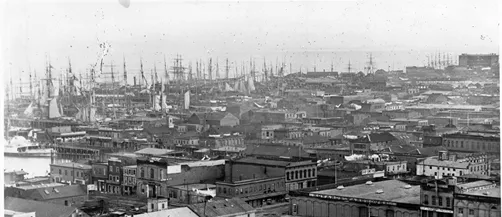
View of San Francisco and its waterfront, from Vallejo and Battery, circa 1867. san francisco history center, san francisco public library.
This was a remarkable advertisement in 1866, even for a city as cosmopolitan as San Francisco. Mentions of Professor Risley also elicited extra interest because he was world-famous in his own right and well-known in the city, as both an acrobat and a showman. The same ad appeared not only in the Alta, but in several of the young city’s already-numerous papers, and would continue to do so throughout most of December.
On December 1, the Alta announced that Risley and his troupe had arrived in San Francisco on a British bark from Yokohama, the Alert. In reality, however, that ship carried an entirely different troupe of Japanese performers, and four days later the Alta was forced to print a retraction. It said that yet another letter had subsequently been received from Risley, still in Yokohama, dated October 28. He had reportedly chartered a ship—not the Alert, but the British Archibald—expressly to convey his troupe to America, and he would sail the following week. The last sentence hinted at Risley’s painful awareness of his situation and his competition, for it specifically stated that he “desired it to be understood by the public that the company under his management is the only legitimate one, having the endorsement of British and American Ministers, and of the foreign officers in Yokohama, and permits of their government to undertake the journey.”3
Where Is Risley?
In an era before any trans-Pacific telegraph, radios, telephones, and instant messaging, it could take weeks, if not months, to receive news from overseas, and people were used to a certain fuzziness in their information. But if the citizens of San Francisco were extra confused this time, they had every right to be. On December 6 an advertisement appeared in local newspapers for the Japanese entertainers who had arrived on the Alert. Placed there by Tom Maguire—known locally as the “Napoleon of the Stage” for his ability as a theatrical manager and impresario—it trumpeted in typically showman fashion that on December 10 twelve Japanese jugglers, brought from Japan “at enormous expense,” would perform “the most marvelous feats of legerdemain ever witnessed in the civilized world, together with the most startling and exciting acrobatic performances.” Just like Risley’s group, these Japanese were the only troupe “ever allowed to leave their native country,” and they would be appearing for “a few nights only.”4 Also like Risley’s group, they were on their way to an international exhibition in Paris, and San Francisco was merely one stop along the way.
As if symbolizing the interest suddenly building in Japanese acrobats, a parody show opened elsewhere in the city two days later titled “Catching a Japanese,” with local white actors imitating Japanese. In what was clearly a subtle dig at the still-yet-to-arrive Professor Risley and troupe, the show featured a “Professor Ichaboo,” who performed his wonderful “Japanese Tricks, accompanied by the TOM-TOM and JAPANESE FIDDLE (‘Cremona Japanica’).”5
On the tenth, after a brief press preview two nights earlier, real, live Japanese acrobats and jugglers from the Alert opened to acclaim at Maguire’s own Opera House in San Francisco. They followed, on the same program, a burletta by Lady Don of “The Water Witches.” They faced considerable competition elsewhere in the city; that same night a young Mark Twain was nearby giving a popular lecture on the Sandwich Islands, as Hawaii was then known, after his recent trip there. Nonetheless, the Opera House was jammed with excited locals assembled to watch the Japanese perform a variety of feats and tricks, and the event was covered by local reporters who wrote about it in glowing terms. As the Daily Evening Bulletin described it:
The acrobatic feats, the reporter continued, were “among the most wonderful we have ever seen.” They consisted, among other things, of a man lying on his back, balancing a twenty-foot-long bamboo pole on his feet, while a small boy climbed to the top and performed various maneuvers; a similar act that involved balancing a large tub with the feet and having the boy perform in it; and two men tossing a large keg back and forth, also with their feet. Some of the acts required more space, so it was announced that the following night the show would reopen in the nearby Academy of Music, which had a proscenium that was twenty feet higher and would allow for even more spectacular feats. Like the Opera House, it was owned by Tom Maguire, the highly successful owner-manager of the city’s best entertainment venues.
San Francisco that year was buffeted by unusually harsh winter storms, dense fogs, and—on December 19—even a mild earthquake. Yet save for a few shows that were rained out, the citizens kept going to see the Japanese acrobats and jugglers from the Alert. Advertisements for them continued to appear regularly in the newspapers, along with those of the still-absent Risley group,...