Watching Anime, Reading Manga
eBook - ePub

Watching Anime, Reading Manga

25 Years of Essays and Reviews

  1. 360 pages
  2. English
  3. ePUB (mobile friendly)
  4. Available on iOS & Android
eBook - ePub

Watching Anime, Reading Manga

25 Years of Essays and Reviews

About this book

The first book-length collection by the most respected writer on anime and manga today.

Anime’s influence can be found in every corner of American media, from film and television to games and graphic arts. And Fred Patten is largely responsible. He was reading manga and watching anime before most of the current generation of fans was born. In fact, it was his active participation in fan clubs and his prolific magazine writing that helped create a market and build American anime fandom into the vibrant community it is today.

Watching Anime, Reading Manga gathers together a quarter-century of Patten’s lucid observations on the business of anime, fandom, artists, Japanese society and the most influential titles.

Illustrated with original fanzine covers and archival photos. Foreword by Carl Macek ( Robotech ).


Frequently asked questions

Yes, you can cancel anytime from the Subscription tab in your account settings on the Perlego website. Your subscription will stay active until the end of your current billing period. Learn how to cancel your subscription.
No, books cannot be downloaded as external files, such as PDFs, for use outside of Perlego. However, you can download books within the Perlego app for offline reading on mobile or tablet. Learn more here.
Perlego offers two plans: Essential and Complete
  • Essential is ideal for learners and professionals who enjoy exploring a wide range of subjects. Access the Essential Library with 800,000+ trusted titles and best-sellers across business, personal growth, and the humanities. Includes unlimited reading time and Standard Read Aloud voice.
  • Complete: Perfect for advanced learners and researchers needing full, unrestricted access. Unlock 1.4M+ books across hundreds of subjects, including academic and specialized titles. The Complete Plan also includes advanced features like Premium Read Aloud and Research Assistant.
Both plans are available with monthly, semester, or annual billing cycles.
We are an online textbook subscription service, where you can get access to an entire online library for less than the price of a single book per month. With over 1 million books across 1000+ topics, we’ve got you covered! Learn more here.
Look out for the read-aloud symbol on your next book to see if you can listen to it. The read-aloud tool reads text aloud for you, highlighting the text as it is being read. You can pause it, speed it up and slow it down. Learn more here.
Yes! You can use the Perlego app on both iOS or Android devices to read anytime, anywhere — even offline. Perfect for commutes or when you’re on the go.
Please note we cannot support devices running on iOS 13 and Android 7 or earlier. Learn more about using the app.
Yes, you can access Watching Anime, Reading Manga by Fred Patten in PDF and/or ePUB format, as well as other popular books in Social Sciences & Film & Video. We have over one million books available in our catalogue for you to explore.

Information

Part I • Anime Fandom

America’s First Manga Advertisements

Graphic Story World no. 8, December 1972–Wonderworld no. 10, November 1973.

01wonderworld003.tif
Cover of Wonderworld no. 10, November 1973
02wonderworld004.tif
Early manga ad in Wonderworld no. 10, November 1973
Richard Kyle and I created Graphic Story Bookshop in 1972 to make the best international comic books available in the United States, as advertised through Graphic Story World magazine. We changed their names to Wonderworld Books and Wonderworld magazine, respectively, in 1973. Kyle edited and published the magazine and I wrote the book reviews. I wrote the advertisements for the bookshop, which Kyle laid out and published in the magazine. I contacted comic book publishers throughout Europe and Japan to import their bandes dessinĆ©es, their fumetti, and their manga, which I sold to American fans via mail order. After a year, the mail-order bookshop, which I operated from my home in Culver City, evolved into a real comic book specialty store in Long Beach where Kyle lived, and he took over all operations. Running a regular comic book shop was a full-time job, so we soon transitioned away from importing foreign comics and selling via mail order, and the magazine was discontinued. But from late 1972 through 1975, Graphic Story Bookshop/Wonderworld Books imported and sold Japanese manga, the first American comics shop to do so. The first illustrated advertisements for manga appeared in the Bookshop’s ads in Graphic Story World no. 8, December 1972; and Wonderworld no. 10, November 1973.
All of the French, Spanish, Italian, and Dutch publishers we contacted were eager to do business with us, but only one Japanese publisher, Akita Shoten, answered my business letters. We later learned that we only got a reply from Akita Shoten because one employee there wanted to practice his English through his business correspondence with me.

Friends Overseas: Fans in America, by Animedia Staff

Animedia no. 15, September 1982.

Here’s a report on anime fans in America for Japanese anime fans just like you!
American anime fans here means fans of ā€œJapanese-made animation.ā€ As many of you may remember, a little while ago anime shows like Grandizer and Candy, Candy have become very popular in France. Well, there are many dedicated anime fans in America, too.
They are centered in Los Angeles and get together for organized screenings of Japanese animation several times a year. They gather in front of a screen around a big video projector. Some of them come to the gathering from the far suburbs, driving more than one hour. Sometimes more than 100 people show up. Of course not many people can understand Japanese, but they enjoy watching the screen all day long.
These fans are not satisfied by just watching anime. They often visit L.A.’s Japantown and subscribe to Japanese anime magazines. Animedia costs as much as $56/year. (According to a letter written to the editorial staff from a subscriber in L.A., one magazine costs Ā„1,000).
It is delightful to know that there are many people who are so interested in anime that they are willing to pay such a high price.
Caption: Fred Patten is an expert on anime in America. He has published introductory articles about Japanese anime in quarterly magazines. He writes many articles with titles like ā€œJapanese TV Animationā€ on shows like Tetsuwan Atomu, [Space Pirate Captain] Harlock, [Galaxy Express] 999, and Gatchaman.
This was the earliest sign of public awareness in Japan of the development in America of a fandom for anime. This article in the September 1982 Animedia was a delightful surprise for the early American fans who bought anime magazines just to look at the pictures. The fans in the Cartoon/Fantasy Organization were tickled pink that three issues of the club’s fanzine were shown.
About all that any of us could read of this was the names of Robin Leyden and myself in katakana. Two years earlier, Leyden and I had served as the American assistants to a tour group of Japanese cartoonists who attended the 1980 San Diego Comic-Con (see the next essay for more details). We decided that this must have been why Animedia singled us out for praise. It was a treat to see my name in katakana in one of the major anime magazines.
Animedia got a couple of details wrong. Leyden worked as a lighting technician on the Star Trek: The Motion Picture feature, not the original TV series. Fanta’s Zine was the title of the Cartoon/Fantasy Organization’s fanzine, not the name of the club.
amigoA.tif
Original Japanese-language article in Animedia no. 15, September 1982
Robin Leyden is a former special effects technician. He was in charge of special effects lighting on Star Trek which opened to the public in 1979. He became independent and now runs his own office where he sets up a video projector and enjoys watching Japanese anime. He is a big anime fan.
Caption: Fanta’s Zine is active in L.A. and its leaders are Fred Patten and Robin Leyden. Both are SF anime fans. Robin is an especially big fan of Osamu Tezuka’s Tetsuwan Atomu and he has a large circle of acquaintances in Japan. Membership magazines are starting to cover Japanese-made anime and information from overseas, as well.
04tezuka005.tif
Comic-Con 1980, Tezuka meeting fans
Courtesy of Jackie Estrada and Comic-Con International.

Remembrance of Cons Past

San Diego Comic-Con Souvenir Program Book, June/July 1984.

Many people say that the best location the Comic-Con ever had was the El Cortez Hotel. That may be true in terms of general convention layout, but the spot that I found most congenial was the University of California, San Diego campus at La Jolla, where the second Comic-Con met in 1971. It was a spacious, beautiful campus with attractive grounds between the dorms where the attendees stayed and the auditoriums where the events were held. I remember having to shade my eyes as I walked because the sun was so bright, but the breeze off the Pacific kept everything pleasantly cool. College was adjourned for the summer and we had the campus all to ourselves. Everything seemed bright, fresh, and exciting. The dorms were new and clean, and staying in them gave us more of a feeling of camaraderie than being in a hotel.
Today’s multitude of comics and media conventions hadn’t yet developed, and it was a thrill to meet such notables as Kirk Alyn for the first time and to see classic movie cartoons in a proper theatrical screening rather than chopped up on TV. The dealers’ room was much cozier. You could even strike up conversations with most dealers and leaf through their comics and discuss favorite stories together—a far cry from today when almost everything in the dealers’ room is a sealed-in-plastic investment. The general attendees, the con committee, and the guests all mixed much more freely as fans together. It’s nice that the Comic-Con has grown and matured, but it’s too bad that much of the old atmosphere of ā€œfamily togetherā€ has been lost.
My most vivid memories are of the 1980 Comic-Con, when the ā€œJapanese invasionā€ took place. This is partly because I didn’t just watch this as a spectator. A Japanese cartoonist (Monkey Punch, creator of the Lupin III strip) had visited the 1979 Comic-Con and had spread favorable word about it back home. As a result, about thirty Japanese cartoonists, animators, and business agents decided to come to the 1980 Comic-Con to investigate the potential American market for Japanese cartoons. A group tour was arranged, and I and another Japanimation fan, Robin Leyden, were asked to help reserve their hotel rooms, get dealers’ tables, and even set up a cocktail reception where they could meet their fellow American artists. It was an honor to handle this liaison work, and it was gratifying to watch their top expectations surpassed.
The 1984 Comic-Con celebrated its fifteenth anniversary. Many SF and comic book celebrities who were regular attendees were invited to contribute to that year’s Souvenir Program Book a brief remembrance of their most notable memories of the past fifteen Comic-Cons.
Fans crowded around Osamu Tezuka, as if he was Neal Adams or Carl Barks, to get original sketches of Astro Boy and Kimba. Tezuka’s animated SF theatrical feature Phoenix 2772 was so popular that publ...
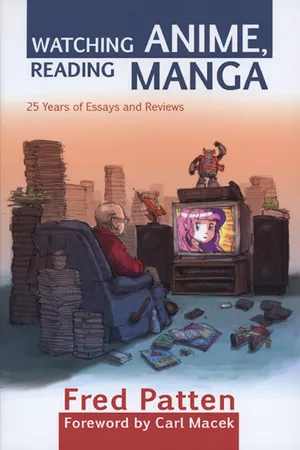
Table of contents

  1. Foreword by Carl Macek
  2. Preface
  3. Part I • Anime Fandom
  4. Part II • The Business of Anime
  5. Part III • Artists
  6. Part IV • Japanese Culture in Anime
  7. Part V • Titles