The Seed and the Soil explores the power of the Bible that brings about God's transforming and liberating purposes, as well as its power as an often oppressively misused text. Characterised by a wide variety of storytelling, this book is accessible to all that read it.Electronic Kindle version available from AmazonWhat People are saying about the book!Reading Pauline Hoggarth's book, one is aware that everything she writes is deeply rooted in her own life of engagement with Scripture and in her wide experience of the Bible's impact in many different cultural contexts. She is refreshingly open about both the difficulties many people have in engaging with Scripture and the difficulties Scripture itself presents. Richard Bauckham Emeritus Professor of New Testament Studies, University of St AndrewsMy shelves are full of books about reading the Bible, but Pauline's new book is outstanding. It is fresh and thoughtful, grounded in personal reality and clearly the fruit of a lifetime of international ministry and friendship, and deep engagement with God's Word. To those beginning with the Bible, Pauline passes on a wealth of practical insights, and more seasoned readers will be challenged to think more widely and more wisely. Revd Jenny Petersen Faith at QMUL[This] is a more than worthy addition to our bulging library. However, this isn't a comfortable, intellectually stimulating book about the background to the Bible or some arcane aspect of biblical theology; it is a challenging book about engaging with Scripture... If someone were to ask me to recommend books to help them with reading the Bible, I would have no hesitation in suggesting How to Read the Bible for All Its Worth for help in understanding the text of the Bible and The Seed and the Soil: Engaging with the Word of God as a help in letting the Bible get under your skin and transform your thinking and actions. Eddie Arthur Kouya.netSpeaking with a depth of pastoral sensitivity and cultural insight, this immensely powerful book is grounded with an understanding of the difficulties encountered by many Christians reading the Bible today. The writer's passion to help others identify and overcome their own challenges includes questions for personal reflection. Amy Roche CMS Mission Partner and Research Student at Durham University
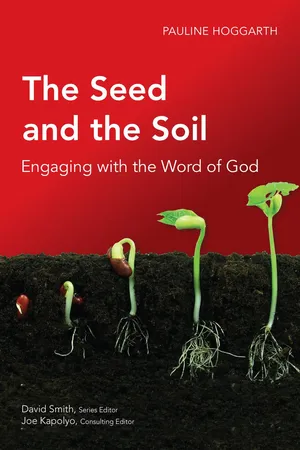
eBook - ePub
The Seed and the Soil
Engaging with the Word of God
- 170 pages
- English
- ePUB (mobile friendly)
- Available on iOS & Android
eBook - ePub
The Seed and the Soil
Engaging with the Word of God
About this book
Information
Topic
Theologie & ReligionSubtopic
Biblische Studien1: Transforming Word
Indeed, the word of God is living and active
— Hebrews 4:12
‘What’s wrong with my heart? My heart is hurting. What’s wrong?’ Among Quechua-speaking communities in Bolivia, this has been the consistent response of men and women as they listen together to chapter 5 of Mark’s Gospel recorded in their mother tongue.1 They cry out as they hear Jesus ask, ‘Who touched my clothes?’ (Mark 5:30). They weep at his tender welcome of the outcast woman: ‘Daughter, your faith has made you well; go in peace, and be healed of your disease’ (Mark 5:34). In this Bible story above all others, these despised people rediscover themselves as they meet Jesus. Since the Spanish Conquest in the sixteenth century, their oppressors have dismissed the Quechua as worthless, primitive and unclean. Now they hear Jesus’ welcome, see him pause and stand still, his attention focused fully on a woman who in significant ways shares their experience of exclusion. The living word of Scripture touches – even ‘hurts’ – their hearts and opens the way for them to have courage also to reach out to Jesus and trust his welcome.
Some two thousand years earlier, on the desert road between Jerusalem and Gaza, a man who was in many ways excluded like the Quechua also encountered Scripture’s power to prompt urgent questions (Acts 8:26–39). Reading aloud to himself from the scroll of Isaiah, a senior civil servant at the Ethiopian court who was also a eunuch2 suddenly found a man called Philip running alongside his chariot. Mysteriously impelled to this encounter by God’s Holy Spirit, Philip had been listening to the man reading and was concerned to know if he needed help to understand. ‘Yes, I do. Who is the prophet talking about?’ The conversation that followed moved outwards, Luke tells us, from Isaiah’s vision to all ‘the good news about Jesus’. Philip was able to help this man discover how in Jesus the prophet’s revelations were fulfilled, especially in their depiction of the ‘God of the whole earth’ (Isa. 54:5), who lovingly and generously summons all the nations (Isa. 55:3–5) and welcomes anxious foreigners and despised eunuchs (Isa. 56:3–8). Like the Bolivian Quechua, this man ‘went on his way rejoicing’, the first African to come to faith in Jesus and identify with him in baptism.
Not far from the eunuch’s home country, and many centuries later, a woman called Nurat encountered the power of God’s word to cut to the heart of human experience and bring about transformation. She was a Muslim, listening to Scripture broadcast over the sound system of the local church. The thin bamboo walls allowed the recordings to be heard in most of the village. Nurat already knew about Jesus from the Qur’an’s account of him as God’s messenger. Now she kept hearing about Jesus’ miracles and healings and wondered how she might truly find him. In her heart she felt the urge to bring one problem to him to see what he would do. Her marriage was a constant struggle. She would become angry with her husband and refuse to talk to him. He behaved violently towards her and insulted her family and friends. Eventually she decided to bring the problem of her marriage to the Lord. Soon after this, listening again to the audio Scriptures, she heard words from one of Paul’s letters that touched her deeply. They described many of the things that characterized her life: ‘Now the works of the flesh are obvious … idolatry, sorcery … strife … anger, quarrels … those who do such things will not inherit the kingdom of God’ (Gal. 5:19–21). Responding to Paul’s words as if they were addressed to her personally, Nurat stopped going to consult her father who was a sorcerer and did her best to be less angry towards her husband. He began to notice the change in her, started to listen himself to the Bible recordings, and eventually became a follower of Jesus alongside his wife.
Engaging with God’s word as a call to action can be painful and demand courageous choices. In an East Asian country whose powerful elites are notorious for breaking the laws that protect the forests and those who live in them, a Christian doctor has chosen to leave the calm waters of his successful medical practice and sail out into the stormy seas of politics. He says: ‘I read in Scripture of the sovereign rule of God in this world, of his love of justice and his concern for powerless people. Behind the Bible text I see the faces of villagers I know who have lost their land to logging companies. If these people are to put their trust in God, then his sovereignty and love of justice have to be more than a matter of words on a page for them; they must become reality in their lives. This is why I entered politics.’3 Many of his fellow-Christians do not share this man’s understanding of Scripture’s call to action. They believe that politics is a murky business in which Christians should not be involved. There has been, at least initially, little encouragement or prayer support for his response to God’s word.
From Europe comes evidence of the power of Scripture to change an entire worldview. This is David’s story:
I am a Protestant from Northern Ireland. My unhappiness at describing myself in such terms today is because of the impact of two things: the murder of my friend, and the Bible. I became a Christian in 1975 when the ‘Troubles’ were at their height. In Northern Ireland the ‘Troubles’ means the civil conflict that raged since the formation in 1922 of Northern Ireland as a compromise political solution to the wider Irish problem that had been rumbling on for centuries. My childhood was a privileged, middle-class, Protestant experience in which I was largely protected from the harsh realities of life on the streets of Belfast or Derry. At boarding school I grew up in my sheltered circle to believe not very much about anything. In Northern Ireland terms I was a ‘passive bigot’. I had no Catholic friends; I lived, socialised, learned and played in an entirely Protestant environment. School led seamlessly to university in Belfast where at the age of eighteen I came to faith in Christ – and became an active bigot. Through teaching received in those first years of my Christian life I came to believe that the Pope was the antichrist and that Roman Catholicism was a Satan-inspired plot to undermine the true faith of the Bible. I became completely unable to relate normally to Catholic people, even on a superficial level. I tried to justify this disturbing problem (and I did find it disturbing) by saying that I loved individual Catholics but couldn’t accept Roman Catholicism as a system. In truth I was a bigot who did not want to relate to anyone outside my tribe.
John Donaldson was one of my circle at school. We did our undergraduate studies together, he in law and I in social studies. Through the Christian Union, we became close friends. We graduated on the same day and John began to work with a law firm in Belfast, while I went to Scotland to start my studies in theology. When I heard on 12 October 1979 that there had been another shooting in Belfast, I hardly gave it a thought. Killings in Belfast were commonplace. But something caught my attention in a later news bulletin and I phoned home to discover that John had been shot dead while delivering legal papers to a police station in west Belfast. One of the Irish Republican terrorist factions had mistaken him for an undercover agent for the British security forces.
I was devastated and outraged by John’s death. I wanted God to consume his killers with fire and I explained what had happened by adding another strand to the partnership of evil already established in my mind. Not only was Roman Catholicism a Satan-inspired plot, so was Irish Republicanism. Like many of my fellow citizens, I came to believe that the aims of the Roman Catholic Church and the violent terrorist organisations made up of its members were the same – to destroy the Protestant, unionist people of Northern Ireland. The task of Christian mission was therefore to resist Irish republicanism and Roman Catholicism by all and every means.
At the time of my friend’s murder I was studying theology in preparation for ordination in the Presbyterian Church. Christ’s College, Aberdeen seemed a world away from Belfast. Among others, Professor James Torrance offered me deep understanding and pastoral compassion as I worked through the impossibility of loving John’s killers. ‘Christ died for them, David,’ was his repeated response in my anguish. I began to read the New Testament again, as I had never read it before. If Christ died for John’s killers, then he must indeed have loved them – much as he loved Samaritans and Romans in his own day. And if he loved them, then so must I. Furthermore, if Jesus-the-Jew loved Gentiles, then I had no basis for excluding a person from the scope of God’s grace on the basis of ethnic origin or political beliefs – something Paul demonstrated with extraordinary courage by going to share Jesus with the Gentiles he had been nurtured to despise. Acts 22 changed my life. Piece by piece, over a period of two years, my theology of bigotry was dismantled. I have come to see that the Bible is a handbook of anti-sectarianism, a narrative that will not permit us to believe in a God who is other than the God of all peoples.
A Protestant from Northern Ireland? Today I would rather be described as a follower of Jesus living in Ireland, because I want the door to my home and my heart to be open to a relationship with the people who killed my friend.4
David’s rediscovery and new understanding of familiar Scripture in the midst of personal crisis has many parallels in the account in Luke 24 of the meeting on the Emmaus road between the risen Jesus and Cleopas and his companion. Like David, these disciples were familiar with Scripture and read it with the certainties and prejudices of their national context. In David’s case his understandings, shaped by his social and theological milieu, provided justification for bigotry and sectarianism. In the case of the two on the Emmaus road, their understanding of Scripture added up to a political Messiah ‘mighty in deed and word before God and all the people’ who would liberate their nation (Luke 24:19, 21). The death of David’s friend John left him utterly disarmed, able only to pray for a fiery end for the killers. The execution on a Roman cross of Jesus, friend of these two disciples, left them bereft and despairing. David’s patient and compassionate teacher helped him to re-examine his rage and grief; his perspective (‘Christ died for them, David’) provoked his student to a radically new reading and understanding of the Bible. On the Emmaus road, Jesus himself walked with the disciples and unfolded to them an entirely different way of hearing the evidence of Scripture about himself, one that turned them round in their tracks: ‘Were not our hearts burning within us … while he was opening the scriptures to us?’ (Luke 24:32).
News of the impact of Scripture sometimes reaches us – perhaps most surprisingly and encouragingly – through the secular media. In an Observer article in October 1999, political commentator Will Hutton wrote,
So who said religion was dead and there was no God? … The Jubilee 2000 campaign has proved to be one of the most effective ever mounted by any pressure group; it may secure an end that four years ago seemed a pipedream – the cancellation of the unpayable debt owed by the world’s poorest countries.
But it owes its success and inspiration to the Bible. I doubt many readers know the Old Testament books of Leviticus, Exodus and Deuteronomy any more than I do, but without them there would be no Jubilee 2000, no debt campaign and no international public pressure. At the end of an increasingly secular century, it has been the biblical proof and moral imagination of religion that have torched the principles of the hitherto unassailable citadels of international finance – and opened the way to a radicalism about capitalism whose ramifications are not yet fully understood.
Just glance at the blessing the Pope gave to the Jubilee campaigners before the IMF / World Bank meetings this year. The Catholic Church, he said, has always taught there was a ‘social mortgage’ on all private property. ‘The law of profit alone cannot be applied to that which is essential for the fight against hunger, disease and poverty.’ … The Pope, like the Church of England, is simply following the injunction of the Bible, and in particular Leviticus Chapter 25, a passage that makes Das Kapital look tame. Leviticus tells its readers that God designed the world to be in harmony, and that every seven years creditors should offer debtors a remission – or repayment holiday. But every seven times seven years … there should be a Sabbath’s Sabbath; a complete dismantling of the structures of social and economic inequality. Debts should be forgiven completely, slaves freed and land forfeited for non-payment of debt returned to its original owners, a principle endorsed both by Exodus and Deuteronomy. The Bible is unambiguous … The Left of Centre should take note; it is no longer Morris, Keynes and Beveridge who inspire and change the world – it’s Leviticus.5
Andrew Rugasira, a Christian businessman from Uganda, would endorse this understanding of the radical nature of the Bible and its power to bring about change. He features in a newspaper article that describes what he has done to enable coffee growers in the Rwenzori Mountains of northern Uganda to sell their produce directly to supermarkets in the UK and elsewhere. Rugasira’s Good Africa Coffee Company shares profits with these farmers on a revolutionary 50:50 basis; the company’s slogan is ‘Trade not Aid’. The article tells an inspiring story of community transformation taking place among people who for years have been terrorized by the soldiers of Obote, Amin and most recently Congolese rebels. The journalist who wrote the article reports several times that he noticed Rugasira reading his Bible as he went about his work. Clearly the journalist had made some kind of connection between Rugasira’s Bible reading and the activities in which he was involved.6 I wanted to hear from Andrew Rugasira how he understood that connection, so I wrote to him via his company’s website. He wrote back immediately:
My link between Bible engagement and community transformation is in the value system of the Word. The more we engage and internalize the word of God, submit to its authority, truth and guidance, the more community transformation becomes a critical element of our life’s mission here on earth. But one has to make a choice: take the Bible as a call to action or treat it as an ideal too remote to be acted upon.7
Community transformation is at the heart of two Old Testament narratives that describe the rediscovery of God’s word by his people, and its impact on them. Six centuries before Christ, Josiah was a reforming king in Judah. At the age of sixteen, despite being son and grandson of Amon and Manasseh, two of Judah’s most corrupt rulers, Josiah ‘began to seek the God of his ancestor David’ (2 Chr. 34:3). Four years later, perhaps encouraged by the prophet Jeremiah, he began to rid the land of everything to do with the decadent Assyrian religious cults. But it was when he was twenty-six that Josiah’s reforms took on new energy. The impulse came through the discovery in the temple by Hilkiah the high priest of ‘the book of the law’ (possibly a version of the book of Deuteronomy). The king’s secretary Shaphan reads the scroll aloud to the king, whose response is immediate and dramatic. He rips his clothes in consternation, ‘for great is the wrath of the Lord that is kindled against us, because our ancestors did not obey the words of this book, to do according to all that is written concerning us’ (2 Kgs 22:13). The prophetess Huldah confirms that Josiah is right in his response to God’s rediscovered word: his people do indeed stand under God’s judgment (2 Kgs. 22:14–20). There follows the account of Josiah’s root and branch reforms that start with the public reading of Scripture:
The king went up to the house of the Lord, and with him went all the people … both small and great; he read in their hearing all the words of the book of the covenant that had been found in the house of the Lord. The king stood by the pillar and made a covenant before the Lord, to follow the Lord … to perform the words of this covenant that were written in this book. All the people joined in the covenant (2 Kgs. 23:2, 3).
But with few exceptions the people of Judah did not, in Andrew Rugasira’s words, ‘engage and internalize the word of God’ other than superficially and sporadically. So God allowed the Babylonian empire to be the instrument of judgment on Judah’s failure to demonstrate to the peoples around them the beauty, integrity and justice of his ways. Some two centuries after Josiah we find some of them living under Persian rule in a burned out and ruined Jerusalem, their only ...
Table of contents
- SERIES PREFACE
- PREFACE
- 1: Transforming Word
- 2: Resisted Word
- 3: God’s Word
- 4: Interpreted Word
- 5: Offensive Word
- 6: Unique Word
- 7: Young Word
- 8: Church’s Word
- 9: Living Word
- Appendix 1: Additional Resources
- Appendix 2: Statement of Hermeneutical Principles207
- Notes
Trusted by 375,005 students
Access to over 1.5 million titles for a fair monthly price.
Study more efficiently using our study tools.
Frequently asked questions
Yes, you can cancel anytime from the Subscription tab in your account settings on the Perlego website. Your subscription will stay active until the end of your current billing period. Learn how to cancel your subscription
No, books cannot be downloaded as external files, such as PDFs, for use outside of Perlego. However, you can download books within the Perlego app for offline reading on mobile or tablet. Learn how to download books offline
Perlego offers two plans: Essential and Complete
- Essential is ideal for learners and professionals who enjoy exploring a wide range of subjects. Access the Essential Library with 800,000+ trusted titles and best-sellers across business, personal growth, and the humanities. Includes unlimited reading time and Standard Read Aloud voice.
- Complete: Perfect for advanced learners and researchers needing full, unrestricted access. Unlock 1.5M+ books across hundreds of subjects, including academic and specialized titles. The Complete Plan also includes advanced features like Premium Read Aloud and Research Assistant.
We are an online textbook subscription service, where you can get access to an entire online library for less than the price of a single book per month. With over 1.5 million books across 990+ topics, we’ve got you covered! Learn about our mission
Look out for the read-aloud symbol on your next book to see if you can listen to it. The read-aloud tool reads text aloud for you, highlighting the text as it is being read. You can pause it, speed it up and slow it down. Learn more about Read Aloud
Yes! You can use the Perlego app on both iOS and Android devices to read anytime, anywhere — even offline. Perfect for commutes or when you’re on the go.
Please note we cannot support devices running on iOS 13 and Android 7 or earlier. Learn more about using the app
Please note we cannot support devices running on iOS 13 and Android 7 or earlier. Learn more about using the app
Yes, you can access The Seed and the Soil by Pauline Hoggarth, David W. Smith, Joe M. Kapolyo, Samuel Escobar in PDF and/or ePUB format, as well as other popular books in Theologie & Religion & Biblische Studien. We have over 1.5 million books available in our catalogue for you to explore.