Wry, generous, lucid poems from one of contemporary poetry’s living masters.
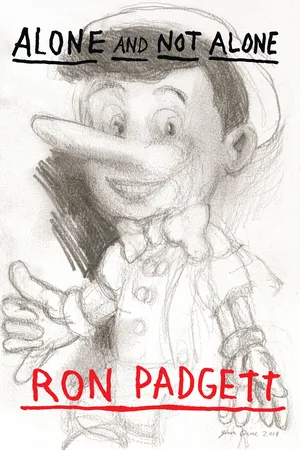
Following Pulitzer Prize finalist Ron Padgett's 2013's Collected Poems (winner of the Los Angeles Times Book Prize and the William Carlos Williams Prize), Alone and Not Alone offers new poems that see the world in a clear and generous light.
- 84 pages
- English
- ePUB (mobile friendly)
- Available on iOS & Android
eBook - ePub
Alone and Not Alone
About this book
Information
It All Depends
Que reste-t-il de nos amours?
—CHARLES TRENET
Et nos amours, faut-il qu’il m’en souvienne?
—APOLLINAIRE
But it is not love that I would speak of
for as you see, I am of
the nineteenth century, when love was
. . . well, it all depends,
and I can’t get out of it,
whatever this love is.
I will die in it and I hope
of it, it is the preamble
to walking in and sitting
down and saying “Hi”
before anything else has a chance
to happen. And then
of course nothing does,
which is why you keep saying it—
you can’t get out
of saying it. So you may as well
take off your hat and stay a while,
which is what you always planned on anyway.
The nineteenth century,
what a tremendous thing
to be in love in!
Cottages go by
and music piles up
like excited dead people.
They stop but don’t,
like sleeping people who are alive,
but it’s not that easy,
the century is more complicated
than one had expected
now that everyone has a pot and a pan
but not a love of the pot and the pan.
Still, look at those sailing ships
on the wide main and the stairways
that spiral into heaven
and that bird with a long red beard
sticking straight up!
It’s our chance to separate ourselves
into numerous pieces and have them
go in different directions,
reassembling what time had dispersed
in the form of granules and mist.
Or was it even really there?
A nightingale warbled
the tune it was supposed to
so the world would calm down.
There’s nothing wrong with resting
alongside this shady rill and taking medications
as if they were piles of stones placed at intervals
by people who must have had a meaning
in mind but with no thought of telling you
what it was, for they didn’t know that you
would exist. Therefore, lie down and rest.
The afternoon is mild and your love
is not driving you crazy, temporarily.
A rest might give you the strength
to look love straight in the eye
and not fade into granules and mist.
Reverdy said
“One must try to live”—
the statement of a man
who didn’t love
or wasn’t loved
enough. A small rectangle
of light lay on his floor
and his shoe
flashed as it went by.
His wife was hidden
in the kitchen, his girlfriend
hidden in celebrity,
his God just hidden.
Pierre opened the kitchen door,
the trap door of fame,
and the side of the cathedral,
but there was nothing there,
and when he opened his heart
he found only a rectangle
of sunlight on the floor.
But it was enough.
Perhaps his wife was hiding
her love in the kitchen,
the dark kitchen in Solesmes,
where I saw her walking
briskly down the street
at the age of 97 or 98,
the same street
a few years later
she would move slowly up
and down the way
to lie down in the tomb
next to Pierre, her Pierre.
By then the girlfriend
had twirled into Eternity,
and God had hidden so deeply
in Pierre’s poems
Pierre didn’t know
He was there—
He had gone back and disappeared
beneath the period
that ended Pierre’s first book,
like a dark glint.
But God too was trying to live.
He hasn’t been around lately,
which is perhaps why
the landscape is so cheerful—
it gets to be just itself,
brutally wonderfully so, and birds
veer and chirp and lift
their wings to see what’s there.
It’s air.
And so singing.
“But that’s what I did,”
says Pierre
out of nowhere.
“And you can’t tell
if the singing made the air
or the other way around—
or both, which is most likely.”
And then, like a Frenchman,
he left, before I had a chance
to throw him around the room,
but with respect,
affection, and mountains,
the kind they had in the century
he was born in, mountains as black
as his tomb, which I am unable
to throw around now
that his wife’s in there too.
Henriette: her name.
(Henri: his real first name.)
(Her name a little feminine version of h...
Table of contents
- Cover
- Title Page
- Copyright
- Acknowledgments
- Dedication
- Contents
- What Poem
- The Roman Numerals
- Butterfly
- Reality
- The Chinese Girl
- Smudges
- It Takes Two
- The First Time
- Circles
- Grandpa Brushed His Teeth
- Coffee Man
- Where Is My Head?
- Survivor Guilt
- The Young Cougar
- Radio in the Distance
- Face Value
- The Plank and the Screw
- 102 Today
- The Pounding Rabbit
- Mountains and Songs
- It All Depends
- The Elevation of Ideals
- Birgitte Hohlenberg
- Pep Talk
- Preface to Philosophy
- You Know What
- A Bit about Bishop Berkeley
- The Step Theory
- My ’75 Chevy
- For A.
- Art Lessons
- A Few Ideas about Rabbits
- The Value of Discipline
- Pea Jacket
- The Ukrainian Museum
- The 1870s
- One Thing Led to Another
- The Rabbi with a Puzzle Voice
- Syntactical Structures
- The World of Us
- Curtain
- Homage to Meister Eckhart
- The Incoherent Behavior of Most Lawn Furniture
- This Schoolhouse Look
- The Street
- Paris Again
- London, 1815
- Of Copse and Coppice
- Manifestation and Mustache
- Shipwreck in General
- French Art in the 1950s
- Three Poems in Honor of Willem de Kooning
- Alone and Not Alone
- Funder Acknowledgments
- The Publisher’s Circle of Coffee House Press
- About the Author
Trusted by 375,005 students
Access to over 1.5 million titles for a fair monthly price.
Study more efficiently using our study tools.
Frequently asked questions
Yes, you can cancel anytime from the Subscription tab in your account settings on the Perlego website. Your subscription will stay active until the end of your current billing period. Learn how to cancel your subscription
No, books cannot be downloaded as external files, such as PDFs, for use outside of Perlego. However, you can download books within the Perlego app for offline reading on mobile or tablet. Learn how to download books offline
Perlego offers two plans: Essential and Complete
- Essential is ideal for learners and professionals who enjoy exploring a wide range of subjects. Access the Essential Library with 800,000+ trusted titles and best-sellers across business, personal growth, and the humanities. Includes unlimited reading time and Standard Read Aloud voice.
- Complete: Perfect for advanced learners and researchers needing full, unrestricted access. Unlock 1.5M+ books across hundreds of subjects, including academic and specialized titles. The Complete Plan also includes advanced features like Premium Read Aloud and Research Assistant.
We are an online textbook subscription service, where you can get access to an entire online library for less than the price of a single book per month. With over 1.5 million books across 990+ topics, we’ve got you covered! Learn about our mission
Look out for the read-aloud symbol on your next book to see if you can listen to it. The read-aloud tool reads text aloud for you, highlighting the text as it is being read. You can pause it, speed it up and slow it down. Learn more about Read Aloud
Yes! You can use the Perlego app on both iOS and Android devices to read anytime, anywhere — even offline. Perfect for commutes or when you’re on the go.
Please note we cannot support devices running on iOS 13 and Android 7 or earlier. Learn more about using the app
Please note we cannot support devices running on iOS 13 and Android 7 or earlier. Learn more about using the app
Yes, you can access Alone and Not Alone by Ron Padgett in PDF and/or ePUB format, as well as other popular books in Literature & American Poetry. We have over 1.5 million books available in our catalogue for you to explore.