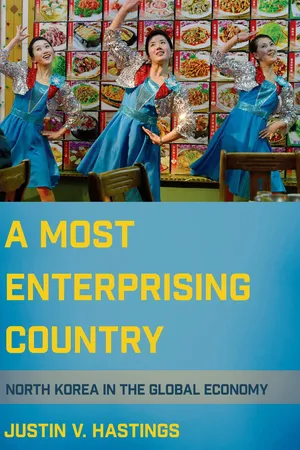
North Korea has survived the end of the Cold War, massive famine, numerous regional crises, punishing sanctions, and international stigma. In A Most Enterprising Country, Justin V. Hastings explores the puzzle of how the most politically isolated state in the world nonetheless sustains itself in large part by international trade and integration into the global economy. The world's last Stalinist state is also one of the most enterprising, as Hastings shows through in-depth examinations of North Korea's import and export efforts, with a particular focus on restaurants, the weapons trade, and drug trafficking. Tracing the development of trade networks inside and outside North Korea through the famine of the 1990s and the onset of sanctions in the mid-2000s, Hastings argues that the North Korean state and North Korean citizens have proved pragmatic and adaptable, exploiting market niches and making creative use of brokers and commercial methods to access the global economy.North Korean trade networks—which include private citizens as well as the Kim family and high-ranking elites—accept high levels of risk and have become experts at operating in the blurred zones between licit and illicit, state and nonstate, and formal and informal trade. This entrepreneurialism has allowed North Korea to survive; but it has also caused problems for foreign firms investing in the country, emboldens the North Korean state in its pursuit of nuclear weapons, and may continue to shape the economy in the future.
- 240 pages
- English
- ePUB (mobile friendly)
- Available on iOS & Android
eBook - ePub
About this book
Information
1
Surviving the Arduous March through Enterprise
The story of the Arduous March and its effect on North Korea’s political economy has been recounted in great detail elsewhere,1 and it is not my intention to repeat the able work done by previous writers. This chapter instead traces the origin and development of North Korean entrepreneurialism, and the underlying trading networks, from North Korea’s fumbling attempts at survival during the Cold War through to the collapse of trade and the economy at the end of the Cold War, the famine that followed, the desperate responses of the state and the people of North Korea, and finally to the eve of North Korea’s attempted retrenchment in 2005 and the international sanctions in the wake of the 2006 nuclear test.
Survival has always been a priority (and perhaps even the central preoccupation) of the North Korean state and, once they realized that the state would no longer take care of their needs, the North Korean population. How to survive is a separate question, and one that has not always been adequately answered by either the state or its citizens. The survival imperative has led to a glimmer of pragmatism in actual North Korean economic behavior, regardless of the rhetoric emanating from official propaganda outlets or even stated policies on the ground within the country. This flexibility in reality, if not in ideology, has not always been successful in keeping the North Korean state strong or much of the population alive (especially during the darkest years of the Arduous March), but it has been apparent in North Korean trade for decades.
The survival mechanisms adopted during the Arduous March did not spring fully formed, as if from the forehead of Zeus, after the Cold War. Both top-down and bottom-up trading networks had origins in the Cold War itself; the end of the Cold War drastically increased the scope and importance of those networks, but they were not wholly new. In turn, the ecosystem of state, nonstate, and hybrid trading networks that have enmeshed North Korea in the global economy (however unwillingly) since the international sanctions regime began in 2006 are outgrowths of the top-down and bottom-up coping mechanisms that began to mature and become semi-institutionalized during the relatively “liberal” years of the Arduous March itself and those that followed. This chapter thus provides the background to how North Korea became the surprisingly enterprising country that it is today.
The business environment that North Korean state enterprises faced in the immediate aftermath of the Cold War was harsh, unforgiving, and (with the collapse of the Soviet Union) something of an uncomfortable surprise, but it was not unfriendly specifically to North Korean trade. North Korean companies faced few major international sanctions, and isolation from global economic networks was an artifact of North Korea’s self-imposed hermit status, its terrible credit rating, and a lack of things to sell to the rest of the world. Private trading networks, while officially banned, also faced a relatively benign operating environment, inasmuch as the famine impaired the state’s ability to crack down on citizens doing whatever it took to survive. At the same time, both top-down and bottom-up trading networks had to navigate environments that were not entirely friendly: what North Korean state enterprises did sell was often illicit in other countries, such that the trade networks moved from state supported to “criminal” simply by crossing international borders, while nonstate networks had to operate, both inside and outside North Korea, in an environment that was almost entirely informal, politically changeable, and individually capricious.
State entities and private citizens alike eventually responded to such conditions with trading networks that were adaptable and flexible in where and how they operated, but not infinitely so. Their spread depended to a large degree on access and territorial proximity to logistical infrastructure and networks that were themselves integrated with the outside world. Outside of Northeast Asia, North Korean trade network nodes clustered around diplomatic and commercial outposts of the North Korean state, leading to networks that were extensive in territorial scope but not particularly dense. Within Northeast Asia, both top-down and bottom-up trade networks preferred to access outside markets, both for purchasing goods and obtaining capital, through networks of ethnic Korean businesspeople around the region. In practice, this funneled the activities of North Korean trade networks without access to state outposts (and even some with such access) through informal networks in northeastern China, Japan, and to a much lesser extent South Korea.
With its own economic survival of paramount importance (to itself), the North Korean central state attempted to extract as much value as it could from state-centered trading networks. In practice, this meant the central state maintained in-house control over the nodes in the chains stretching from North Korea, and reverted to dealing with outside businesspeople only when extending control further down the chain was untenable (notably when North Koreans were either not allowed to trade in specific goods or in particular locations, or when North Korean state traders did not have their own suppliers or buyers). The brokers at the edge of central state control themselves often preferred to deal with firms with which they had nonmarket (often ethnic) ties, but showed themselves capable of delving into global markets when necessary.
The private citizens who went into business during the Arduous March did not have many of the advantages of state-centered networks, particularly access to state resources and, given that what they were doing was technically illegal, political cover. The trade ties of private networks were in some sense the inverse of those of state-centered networks: private traders used markets to sell their goods, but if they imported goods from outside North Korea, they often relied on family and ethnic ties across the border in China or in Japan. To make up for a lack of dependable access to infrastructure or political cover, private (and hybrid) networks also built up ties with state officials, who themselves were often desperate for ways to survive. It was these networks that would be normalized and even semi-institutionalized by the time the central state attempted to crack down in 2005.
In the sections that follow, I find the origins of both state and nonstate North Korean trade networks in pragmatic strategies adopted by the North Korean state and citizens during the Cold War. After a discussion of the collapse of the North Korean economy and the famine that followed the end of the Cold War, I move on to coping mechanisms taken by different segments of North Korean society as they faced economic collapse and starvation, looking first at top-down coping mechanisms of state trading networks, and then at those adopted by private citizens and networks that operated on the boundary between state and nonstate. The chapter concludes with the end of North Korea’s “liberal” period in 2005 and 2006 as the central state began cracking down on wayward enterprise, and as the United States and the international community began to take steps to curb North Korea’s international trade.
The Cold War
Among communist leaders during the Cold War, Kim Il-sung was perhaps the keenest student of Joseph Stalin. North Korea not only did not follow along with the Soviet Union’s de-Stalinization in the late 1950s, it pressed forward with versions of Stalinist political and economic policies that were, if anything, even more extreme than those advocated by Stalin himself. The cult of personality built for Kim Il-sung was perhaps the most notable example, but economic policies were also highly Stalinist: fertilizer-intensive collectivized agriculture, rapid industrialization, a centralized command economy, and a distribution system that provided nearly all the food for the entire North Korean population continued through the end of the Cold War.2 Yet, as Stalinist as North Korea was, and as opposed to foreign infiltration as its elites were, even during the Cold War, North Korea was remarkably nimble in its foreign trade. The manner in which it engaged with the global economy (however tentatively) betrayed many of the trading methods that North Korean firms would use after the end of the Cold War. Despite the sharp divide between the relatively comfortable isolation of North Korea before the collapse of the Soviet Union and the disasters of the Arduous March, North Korea’s trade behavior was not totally new.
As North Korea fell behind the South beginning in the 1960s, the North began pursuing alternative strategies for supporting itself financially and acquiring the goods it wanted from the outside world. These strategies followed two tracks: one in which North Korea extracted concessions from its allies to support its economy, and a second, hedging, strategy in which North Korea began to build trading networks that could bring in income and goods apart from what it could obtain from China and the Soviet Union.
On the first track, North Korea signed friendship treaties in 1961 with both China and the Soviet Union within weeks of each other, in the midst of the Sino-Soviet split. Thereafter, it played China and the USSR off each other in order to maximize financial benefits, one-sided trade, and technical aid.3 It was a game that China and the USSR played willingly. North Korea benefited from the willingness of its Communist Bloc allies to provide subsidies as a means of propping up a fellow socialist economy for strategic reasons.4 Up to the end of the Cold War, in a bid to compete with China for influence, the Soviet Union served as North Korea’s primary benefactor, sending technical advisors who helped to keep its power generation and industry functioning, providing fertilizer for North Korea’s agricultural sector, and accepting barter payment for exports to North Korea at concessionary rates. In this, the North Korean state displayed the same penchant for walking diplomatic tightropes as it would later display in confrontations with the United States and other adversaries.5
North Korea also pursued an economic hedging strategy that was designed to establish trading networks outside Soviet or Chinese control, and to provide income and goods directly to North Korea on its own terms. One of the critical aspects of the strategy was the dual political and economic use of North Korean outposts around the world. In the early 1970s, the North Korean central government began treating its embassies and consulates as revenue centers. Rather than receiving operating funds from the state, diplomatic outposts were required not only to provide for their own costs but also to meet quotas for revenue on a yearly basis and transfer it back to Pyongyang. It was here that many of the characteristics that would distinguish North Korean trade networks in later decades emerged. How North Korean officials met these quotas seems to have been left up to the individual diplomats (or rather the outposts), leaving room for a certain desperate creativity. Not all of the trade conducted by North Korean diplomats was illicit, although enough of it was that North Korea became associated with illicit trading. The diplomats were indifferent to the legality of the goods they were trading in the countries in which they were operating—it was not uncommon for both gray market and black market goods (or the proceeds from their sales) to pass through the same outposts. The year 1976, for instance, saw a spate of North Korean diplomats caught smuggling various contraband. In May, North Korean diplomats were caught by Egyptian authorities while trying to smuggle hashish, but were released on account of their diplomatic status. In October the same year, Danish police expelled the entire North Korean diplomatic staff (four people) after they were caught handing off 147 kilograms of hashish to local drug dealers. They had previously been spotted passing suspicious bags into a shady jewelry store from their official embassy Mercedes. Later that month, Swedish, Norwegian, and Finnish police all broke up North Korean diplomatic smuggling rings. The North Koreans had taken advantage of the price differential of liquor and cigarettes between the Soviet Union and Scandinavian countries to bring in large quantities of goods—four thousand bottles of liquor in Norway, for instance—in their diplomatic luggage for resale.6
Interestingly, the drug and liquor smuggling incidents, among others, were cases where North Korean diplomats essentially served as brokers, connecting buyers and sellers, both of whom were outside of North Korea. This had several implications for how North Korea was hooked into the global economy. First, by serving as brokers, North Koreans did not actually need to ship anything out of (or into) North Korea itself, allowing the home country to continue to isolate itself from the global economy even as they used the same economy as a source of income. Second, and paradoxically, because they were connecting other nodes within an often illicit trade network and presumably minimizing risk and search costs for other parties, North Korean “businessmen” of the Cold War both needed relatively extensive prior contacts and built new contacts with the outside world as a result of doing business. The manner in which North Koreans did business, in other words, actually required them to become more integrated into global trade networks than simple trade into and out of North Korea would have.
Beginning in the early 1970s, North Korea also established a number of central state–owned trading companies in Europe and Asia. Zokwang Trading Company was set up in Macau in 1974, and Golden Star Bank, an apparent subsidiary of Daesong Bank in Pyongyang, was established in Austria in 1982. Zokwang and Golden Star did in fact do what they were theoretically supposed to do: serve as a trading outpost and a bank, respectively. Zokwang seems to have served as the main hub outside of North Korea for buying and selling goods around East Asia. Regular Air Koryo flights between Macau and Pyongyang primarily worked to move cargo into and out of North Korea. Golden Star Bank seems to have served as a hub in Europe for North Korea’s financial dealings, making deals for goods to be shipped to North Korea, serving as a broker for business deals taking place entirely outside of North Korea, and managing North Korean financial accounts.7 But North Korean trading entities were also used for political ends: Kim Hyun-hee, one of the North Korean intelligence operatives who bombed Korean Airlines flight 858 in 1987, claimed to have trained for several months in Zokwang’s offices in Macau.8
North Korea’s nuclear weapons program, not coincidentally, also intensified in the 1970s.9 While all of the usual security and political motivations of the program were clear—North Korea’s desire for an effective deterrent against the United States and South Korea, lack of trust in Soviet and Chinese security guarantees, domestic prestige, and the like—what often goes unremarked was the trade connections North Korea had to make outside the Communist ...
Table of contents
- List of Figures
- Preface
- Acknowledgments
- Introduction: The Enterprising Country
- 1. Surviving the Arduous March through Enterprise
- 2. State Trading Networks versus the World
- 3. Entrepreneurialism, North Korea–Style
- 4. A Terrible, Horrible, No Good, Very Bad Investment Environment
- Conclusion: The Future
- Notes
- Index
Trusted by 375,005 students
Access to over 1.5 million titles for a fair monthly price.
Study more efficiently using our study tools.
Frequently asked questions
Yes, you can cancel anytime from the Subscription tab in your account settings on the Perlego website. Your subscription will stay active until the end of your current billing period. Learn how to cancel your subscription
No, books cannot be downloaded as external files, such as PDFs, for use outside of Perlego. However, you can download books within the Perlego app for offline reading on mobile or tablet. Learn how to download books offline
Perlego offers two plans: Essential and Complete
- Essential is ideal for learners and professionals who enjoy exploring a wide range of subjects. Access the Essential Library with 800,000+ trusted titles and best-sellers across business, personal growth, and the humanities. Includes unlimited reading time and Standard Read Aloud voice.
- Complete: Perfect for advanced learners and researchers needing full, unrestricted access. Unlock 1.5M+ books across hundreds of subjects, including academic and specialized titles. The Complete Plan also includes advanced features like Premium Read Aloud and Research Assistant.
We are an online textbook subscription service, where you can get access to an entire online library for less than the price of a single book per month. With over 1.5 million books across 990+ topics, we’ve got you covered! Learn about our mission
Look out for the read-aloud symbol on your next book to see if you can listen to it. The read-aloud tool reads text aloud for you, highlighting the text as it is being read. You can pause it, speed it up and slow it down. Learn more about Read Aloud
Yes! You can use the Perlego app on both iOS and Android devices to read anytime, anywhere — even offline. Perfect for commutes or when you’re on the go.
Please note we cannot support devices running on iOS 13 and Android 7 or earlier. Learn more about using the app
Please note we cannot support devices running on iOS 13 and Android 7 or earlier. Learn more about using the app
Yes, you can access A Most Enterprising Country by Justin V. Hastings in PDF and/or ePUB format, as well as other popular books in Economics & Korean History. We have over 1.5 million books available in our catalogue for you to explore.