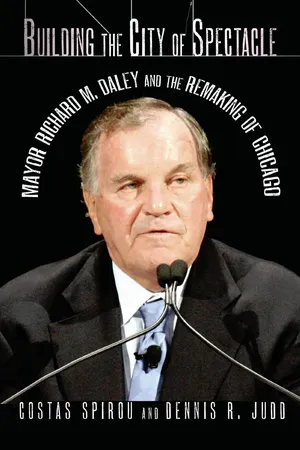
By the time he left office on May 16, 2011, Mayor Richard M. Daley had served six terms and more than twenty-two years at the helm of Chicago's City Hall, making him the longest serving mayor in the city's history. Richard M. Daley was the son of the legendary machine boss, Mayor Richard J. Daley, who had presided over the city during the post–World War II urban crisis. Richard M. Daley led a period of economic restructuring after that difficult era by building a vibrant tourist economy. Costas Spirou and Dennis R. Judd focus on Richard M. Daley's role in transforming Chicago's economy and urban culture.The construction of the "city of spectacle" required that Daley deploy leadership and vision to remake Chicago's image and physical infrastructure. He gained the resources and political power necessary for supporting an aggressive program of construction that focused on signature projects along the city's lakefront, including especially Millennium Park, Navy Pier, the Museum Campus, Northerly Island, Soldier Field, and two major expansions of McCormick Place, the city's convention center. During this period Daley also presided over major residential construction in the Loop and in the surrounding neighborhoods, devoted millions of dollars to beautification efforts across the city, and increased the number of summer festivals and events across Grant Park. As a result of all these initiatives, the number of tourists visiting Chicago skyrocketed during the Daley years.Daley has been harshly criticized in some quarters for building a tourist-oriented economy and infrastructure at the expense of other priorities. Daley left his successor, Rahm Emanuel, with serious issues involving a long-standing pattern of police malfeasance, underfunded and uneven schools, inadequate housing opportunities, and intractable budgetary crises. Nevertheless, Spirou and Judd conclude, because Daley helped transform Chicago into a leading global city with an exceptional urban culture, he also left a positive imprint on the city that will endure for decades to come.
eBook - ePub
Building the City of Spectacle
Mayor Richard M. Daley and the Remaking of Chicago
- 264 pages
- English
- ePUB (mobile friendly)
- Available on iOS & Android
eBook - ePub
Building the City of Spectacle
Mayor Richard M. Daley and the Remaking of Chicago
About this book
Information
Subtopic
Political BiographiesIndex
Social Sciences1
The Founding City
Chicago is the founding City of Spectacle. To this day, much of its identity and collective memory revolves around Daniel Hudson Burnham and the 1893 World’s Columbian Exposition. The dazzling centerpiece of the fair, the White City, morphed into the Emerald City of L. Frank Baum and William Wallace Denslow’s children’s novel, The Wonderful Wizard of Oz (published just seven years after the closing of the fair). Burnham’s conception of what the White City represented was only slightly less fanciful than the one portrayed in the land of Oz. The fair had barely closed its gates when Burnham began promoting the White City, with its cluster of classicist Beaux-Arts structures, fountains, and manicured grounds, as the model for what soon became known as the City Beautiful. The idea that parks, open space, and beautification might serve as the much-needed antidotes to the social disorder and chaos of the industrial city quickly gained an enthusiastic following, and in the 1890s a movement devoted to the ideals of the City Beautiful swept the country. The philosophical premises and design features of the City Beautiful informed the 1909 Plan of Chicago and the plans adopted by many other cities in the coming decades.
The fair’s Midway Plaisance exerted an equally enduring, though less often acknowledged, influence on twentieth-century city development. In stark contrast to the formal and ordered ambience of the White City, the displays at the mile-long Midway were titillating, garish, and risqué. Fairgoers strolling along the Midway encountered the entertainments typically available in today’s theme parks, plus many that revealed a prurient fascination with exotic cultures and social customs (African villagers and dancing girls were especially popular). Within a decade of the closing of the fair, the several features of the Midway were resurrected in several themed areas of Luna Park on Coney Island (such as the “Eskimo Village”); in the next few years movie palaces and other venues offering carnival delights began to spread elsewhere.1 Walt Disney (whose father worked as a carpenter at the World’s Fair) incorporated the contradictory elements of the White City and the Midway into the nation’s first theme park, Disneyland, which opened on July 17, 1955.2
Two decades later, some echoes of the Disney formula made a much-heralded appearance in downtown Boston, when, on August 26, 1976, the developer James Rouse (who said he was inspired by Disney) opened the renovated Quincy Market. Defying expectations, crushing crowds filled the aisles, boutique shops, and restaurants of the three renovated buildings of the long-abandoned 150-year-old market. It was “a gigantic, four-day party” with people “dancing into the night,” a celebration of “the day the urban renaissance began.”3 The national press seemed utterly awestruck; overnight, it seemed, Boston’s downtown had been transformed into a “Disney World with class,” “a glittering rebuke to the notion that inner cities could not attract tourists and shoppers with their cameras, their appetites, and their money.”4
Noting Boston’s success, over the next decade a generation of “messiah mayors” campaigned on promises that they would lead similar urban revivals in their own cities.5 Festival marketplaces, renovated waterfronts, new sports stadiums, convention centers, and luxury hotels began popping up all over the place, literally from coast to coast. Renaissance mayors became media superstars, with William Donald Schaefer receiving top billing. In his four terms as the mayor of Baltimore, Schaefer presided over the construction of Harborplace, a project that transformed the city’s harbor from a collection of derelict docks to a water-front complex anchored by a Rouse mall, the National Aquarium (with its glassed-over Amazon rain forest), and acres of plazas and open space. In 1984 he was hailed as the “Best Mayor in America” and rode the wave of positive press all the way into the governor’s office. Success stories like this became infectious. Even sober and pessimistic scholars came to believe that the worst of the urban crisis had passed, prompting a professional journal to publish three articles in 1985 asking, “Where Has the Urban Crisis Gone?,” “Whatever Happened to the Urban Crisis?,” and “What Urban Crisis?”6
While other cities basked in the breathless prose employed by journalists to announce the renaissance of America’s inner cities, Chicago was receiving a less than favorable press. The racially charged invective that preceded and followed the election of the city’s first African American mayor in 1983 supplied a reliable stream of juicy media stories about Chicago’s bitter racial divisions. Year after year Chicago managed to produce plenty of spectacle, but it was not the kind that seemed likely to raise the city out of its economic malaise. It came as an unexpected surprise to almost everyone when Daley managed to calm the political waters while also placing Chicago at the center of the late-twentieth-century national narrative of urban recovery and transformation. To do so, he relied on a template fashioned in Chicago a century before.
Fashioning the Original Template
On the eve of the 1893 Columbian Exposition, Chicago was led by an energetic group of entrepreneurs and aristocrats eager to counter any impression that the city and its residents were, in a phrase used by A. G. Stephens, “a hustling horde of pig-killers.”7 Rudyard Kipling wrote that Chicagoans were always in a “blind hurry” that gave rise to “their grand ignorance of things beyond their immediate interests.”8 Confident that such wrongheaded perceptions endangered their own prospects, the city’s business and civic establishment cast about for ways to change Chicago’s image, and the chance to host a world’s fair presented a perfect opportunity. In previous decades London, Paris, New York City, Dublin, Philadelphia, and several other cities had hosted international exhibitions. Local boosters regarded the fairs as opportunities to project a sense of modernity and progress and improve future commercial opportunities. The people who attended them were looking for entertainment and cultural enlightenment; in this respect fairs and exhibitions may be regarded as precursors to modern tourism.9
The London World’s Fair of 1851 established a model for the several fairs that opened over the next half century. Named the Crystal Palace Exhibition, after the main building that was constructed of nine hundred thousand square feet of glass held up by thirty-three hundred cast-iron columns, this international gathering was heralded as the “Exhibition of the Works of All Nations.” The Crystal Palace and surrounding grounds contained fifteen thousand exhibits, sixty-five hundred of them from outside Great Britain, and it covered almost twenty-six acres. The six million visitors who attended the London fair gawked at displays featuring inventions such as the telegraph, the steam locomotive, and the electric clock. Other exhibits showcased the world’s largest organ and the first life-size reproductions of prehistoric dinosaurs. The Crystal Palace Exhibition included public art and new design forms in furniture. The five-shilling admission fee guaranteed that attendance would mainly be restricted to the more prosperous classes, which had the effect of highlighting the class divide that was becoming a defining feature of the industrial age. In the words of Karl Marx, it was a “Pantheon in which the bourgeoisie worship their gods.”10
Only two years later New York City held the “Exhibition of the Industry of All Nations,” and in 1855 Paris hosted the “Exposition Universelle.” International expositions followed in London (1862), Paris (1867), Vienna (1873), and Philadelphia. Philadelphia’s Centennial Exposition of 1876 sprawled over 450 acres in Fairmount Park, with close to forty thousand exhibitors scattered through 199 buildings and 250 pavilions. Referenced as the “International Exhibition of Arts, Manufactures and Products of the Soil and Mine,” its displays featured motors, pneumatic and hydraulic equipment, railway engines, forest products, and educational and scientific exhibits. The exposition introduced Alexander Graham Bell’s telephone and the first typewriter (Remington) and bottle of ketchup (Heinz).11
London’s Crystal Palace Exposition celebrated England’s industrial might and expanding empire, and the Exposition Universelle de Paris in 1855 came at a time when Napoleon III’s Second Empire was undertaking a massive physical reconstruction of the French capital. New York’s and Philadelphia’s expositions were, in essence, rejoinders, conveying the message that the United States was now an industrial power equal to any European nation. It is within this historical context that the people involved in planning the Columbian Exposition worked. In the late 1880s Chicago’s entrepreneurial elite seized on the idea that Chicago should enter the competition to host the Columbian Exposition, a prize plum being dangled by Congress to mark the four hundredth anniversary of Columbus’s discovery of America.12 In 1889, Mayor DeWitt C. Cregier assembled the city’s civic leaders to begin the process of raising money. When Chicago won the competition, the fair’s organizing committee selected Daniel Hudson Burnham, who had already made celebrated contributions to the Loop’s development, as the fair’s chief planner.
What made the Columbian Exhibition different from its predecessors was the seamless merger between Burnham’s noble ideals of civic life and the crassest expressions of a rapidly emerging mass culture of consumption. In Burnham’s White City, the nightly illumination of the elaborately ornamented neoclassical buildings created an unforgettable impression. Sepia photos from the period only faintly convey the magical realm of the White City. Visitors who had never experienced electricity were dazzled by the nightly drama of the floodlit buildings lining the Court of Honor, with rows of statues flanking both sides of the Grand Basin, thirteen hundred feet long and three hundred feet wide (roughly the size of eight football fields). At the basin’s center, the Statue of the Republic, resplendently gilded, projected a perfect symbol of strength and wealth. The Columbian Fountain lofted its waters within the image of a boat oared by eight figures representing the arts and industry. Figures representing music, architecture, sculpture, and painting rowed on one side of the boat; agriculture, science, industry, and commerce lifted their oars on the other. It was an imagined marriage of knowledge, progress, and prosperity. Visitors sometimes strolled for hours, barely able to take their eyes from this extraordinary ensemble.

FIGURE 1.1
Grant Park, with the towering buildings of the Loop looming up in the background, has emerged as the centerpiece of Chicago’s contemporary quest for fantasy and spectacle. Concerts, festivals, celebrations, and various other events bring large crowds to the lakefront. Courtesy of user marchello74, Shutterstock Images.
Grant Park, with the towering buildings of the Loop looming up in the background, has emerged as the centerpiece of Chicago’s contemporary quest for fantasy and spectacle. Concerts, festivals, celebrations, and various other events bring large crowds to the lakefront. Courtesy of user marchello74, Shutterstock Images.
Inside the White City’s monumental structures an equally mesmerizing but very different kind of spectacle was put on display. The exhibits within the Manufactures Building, the Electricity Building, the Mines and Mining Building, the Machinery Hall, and the Agriculture Building, which were clustered around the Grand Basin, artfully melded utopian ideals, technological invention, and a rising consumer culture. Between 1870 and 1910, the number of clerical workers, salespersons, government employees, technicians, and salaried professionals in the United States multiplied 7.5 times, from 756,000 to 5.6 million.13 The members of this burgeoning middle class provided a ready market for mass-produced industrial goods, and the exhibits in the White City spoke directly to their aspirations. In the Electricity Building, fairgoers got their first glimpse into the power of electricity: lightbulbs, lamps, carpet sweepers, electric doorbells, electric clocks, fans, stoves, irons, laundry machines, fire alarms, sewing machines, elevators, and much more. Visitors stared in amazement, disbelief, and expectant desire. Electric generators, phonographs, motion picture viewing stations, a model house filled with electric appliances—these and other astonishing wonders drew them from one display to the next. Sales representatives roved about, providing information on how to purchase the products the eager crowd now coveted.
Just to the north of this ensemble a short walk took strollers into an idyllic sanctuary, where a cluster of Beaux-Arts buildings surrounded Wooded Island. Included in this assemblage was the Transportation Building, filled with exhibits ranging from horse-drawn carriages to bicycles to steam-powered locomotive trains; the Fisheries Building, which displayed lighted aquariums containing sea mammals and other ocean specimens; the Horticulture Building, with its elaborate collection of exotic plants from the world over; the Fine Arts Palace—the fair’s only permanent structure—which exhibited thousands of paintings of national and international acclaim. In addition, the Woman’s Building highlighted the accomplishments and advancements of women; and several state and foreign buildings showcased products from around the world.
The White City’s combination of soaring architecture and frenetic commerce may have conveyed a mixed message, but visitors to the mile-long, six-hundred-foot-wide Midway Plaisance encountered no such contradictions. At first the members of the fair’s committee followed their instinct for solemn purpose by hiring a Harvard anthropology professor to design a “Street of All Nations” aimed at educating the visitor, but Chicago’s mayor, Carter Harrison Jr., soon prevailed upon them to instead retain one of his confidants, Sol Bloom. Bloom, the founder of a music store, was known for his predilection for loud, profane, and even lewd entertainment. Under his guidance the Midway evolved into “a jumble of side shows, eateries, thrill rides, and ‘villagers’ and ‘living museums’ of exotic people from around the world … a carnival of consumption and commercial cosmopolitanism.”14 Placed at the center of the Midway was the giant (and newly invented and named) Ferris wheel, a spectacle that towered over everything else (figure 1.2). Visitors boarded the thirty-six luxury cars, each capable of carrying sixty people, ...
Table of contents
- Preface
- Acknowledgments
- Introduction: Building a City of Spectacle
- 1 The Founding City
- 2 Arresting Chicago’s Long Slide
- 3 Master Builder
- 4 Power Broker
- 5 Richard M. Daley’s Ambiguous Legacy
- Epilogue: A City of Bread and Circuses?
- Notes
- Index
Trusted by 375,005 students
Access to over 1.5 million titles for a fair monthly price.
Study more efficiently using our study tools.
Frequently asked questions
Yes, you can cancel anytime from the Subscription tab in your account settings on the Perlego website. Your subscription will stay active until the end of your current billing period. Learn how to cancel your subscription
No, books cannot be downloaded as external files, such as PDFs, for use outside of Perlego. However, you can download books within the Perlego app for offline reading on mobile or tablet. Learn how to download books offline
Perlego offers two plans: Essential and Complete
- Essential is ideal for learners and professionals who enjoy exploring a wide range of subjects. Access the Essential Library with 800,000+ trusted titles and best-sellers across business, personal growth, and the humanities. Includes unlimited reading time and Standard Read Aloud voice.
- Complete: Perfect for advanced learners and researchers needing full, unrestricted access. Unlock 1.5M+ books across hundreds of subjects, including academic and specialized titles. The Complete Plan also includes advanced features like Premium Read Aloud and Research Assistant.
We are an online textbook subscription service, where you can get access to an entire online library for less than the price of a single book per month. With over 1.5 million books across 990+ topics, we’ve got you covered! Learn about our mission
Look out for the read-aloud symbol on your next book to see if you can listen to it. The read-aloud tool reads text aloud for you, highlighting the text as it is being read. You can pause it, speed it up and slow it down. Learn more about Read Aloud
Yes! You can use the Perlego app on both iOS and Android devices to read anytime, anywhere — even offline. Perfect for commutes or when you’re on the go.
Please note we cannot support devices running on iOS 13 and Android 7 or earlier. Learn more about using the app
Please note we cannot support devices running on iOS 13 and Android 7 or earlier. Learn more about using the app
Yes, you can access Building the City of Spectacle by Costas Spirou,Dennis R. Judd in PDF and/or ePUB format, as well as other popular books in Social Sciences & Political Biographies. We have over 1.5 million books available in our catalogue for you to explore.