- English
- ePUB (mobile friendly)
- Available on iOS & Android
eBook - ePub
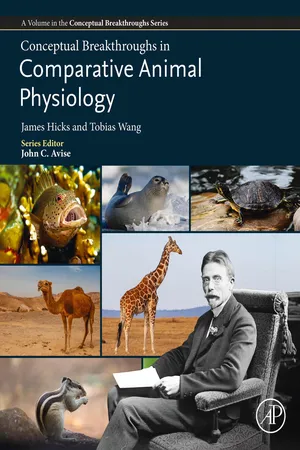
Conceptual Breakthroughs in Comparative Animal Physiology
About this book
Conceptual Breakthroughs in Comparative Animal Physiology tells a story of innate human curiosity about the natural world, and a deeply creative discipline, shaped by varied environments, unusual organisms, elegant experiments, and the persistent effort to understand how animals work and why they work the way they do—along the way discovering "adaptations and mechanisms of the most surprising character".Written by two leading experts in the field, each chapter reflects on the origins of ideas and the approach of turning natural diversity into experimental design. From deserts to oceans, from the anoxia-tolerant animals to endothermic insects, from deep-diving mammals to the integration of "omics," each chapter follows the discoveries and people who were compelled to modify their view of "what life can do." The chapters also highlight the long-term influence of key conceptual breakthroughs, demonstrating how insights from comparative physiology have shaped not only the field itself but also, ecology, evolution, and engineering.As scientists strive to understand the complexity of living systems, the book underscores the inherent integrative nature of comparative physiology, revealing a process that strives to connect genes to organisms and organisms to environments, and providing a framework for understanding the diversity of life. This is an essential resource for undergraduates, graduate students and researchers interested in physiology with its comprehensive synopsis on the field's foundational history and significant advances.
- Provides a single-source, historical overview of the field of comparative animal physiology
- Examines more than 70 significant achievements in the history of comparative animal physiology
- Written in a comprehensive and easy-to-read format
Information
Subtopic
EcologyIndex
Biological SciencesTable of contents
- Title of Book
- Chapter 1 1878: Claude Bernard and la fixité du milieu intérieur
- Chapter 2 1910–1961: From reflexes to rhythms—The discovery of central pattern generators
- Chapter 3 1914–1948: The concept of critical oxygen tension (PcritO2) and the limits of aerobic metabolism
- Chapter 4 1929: Homeostasis and The Wisdom of the Body
- Chapter 5 1929: The progress of physiology—August Krogh at the 1929 Congress
- Chapter 6 1930–1935: Physiology of the estivating lungfish—Ecological and evolutionary insights
- Chapter 7 1930–1938: The foundations of osmoregulation in aquatic vertebrates—Early discoveries in teleost fish and elasmobranchs
- Chapter 8 1877–1963: The history of oxygen secretion in the fish swim bladder
- Chapter 9 1932: From mouse to elephant—How Kleiber transformed our understanding of metabolism
- Chapter 10 1933: James Gray and the foundations of animal movement
- Chapter 11 1935–1949: Krogh and Ussing—The early use of isotopes in biology
- Chapter 12 1936–1961: Cryoprotectants in comparative physiology—Convergent strategies for life below zero
- Chapter 13 1939–1942: The master switch of life
- Chapter 14 1940–1963: Pioneers of desert physiology—The early comparative studies of water economy in mammals
- Chapter 15 1941: Myogenic endothermy in insects—The mechanism of flight preparation
- Chapter 16 1944: The desert laboratory—Discovering reptile thermoregulation in the Coachella Valley
- Chapter 17 1944–1950s: Breathing in bursts—Discontinuous gas exchange in insects
- Chapter 18 1947: The Fry paradigm—A framework for animal activity
- Chapter 19 1948: Hibernation—Connection between metabolism and body temperature
- Chapter 20 1949: Beyond one spike, one twitch—The discovery of asynchronous muscle
- Chapter 21 1950: Coulson and Hernandez and the alkaline tide—Acid–base physiology in postprandial vertebrates
- Chapter 22 1950: Thermal adaptations in Arctic and tropical mammals and birds
- Chapter 23 1954: Oxygen without red blood cells, life without freezing—The polar fish experiment
- Chapter 24 1955–1957: Irving, Scholander, and the Arctic lesson—How vessels conserve heat
- Chapter 25 1955–1975: The doubly labeled water technique—Measuring field energetics
- Chapter 26 1958: Beyond the kidney—The salt glands of marine birds and reptiles
- Chapter 27 1963: Homeostasis in the field—The water economy of birds
- Chapter 28 1963: Ignition point—How arousal from hibernation unveiled a thermogenic organ
- Chapter 29 1963–1993: The Big Four in comparative locomotion, inverted pendulums and running springs, elastic energy storage, and dynamic similarity
- Chapter 30 1966–1967: The role of the hypothalamus in thermoregulation—Contributions from comparative physiology
- Chapter 31 1966: Low arterial PCO2—The signature physiology of water breathers
- Chapter 32 1966: How regional and facultative endothermy transformed the study of ectothermic physiology
- Chapter 33 1966: Cardiac shunts—Mechanisms and functional significance
- Chapter 34 1966–1972: Cooling the brain—Countercurrent exchange and the carotid rete
- Chapter 35 1966: From whalers’ lines to time-depth recorders—Tracing the limits of marine mammal diving
- Chapter 36 1968–1972: Anaerobic scope and anaerobic capacity in ectotherms
- Chapter 37 1968–1974: The mystery of exercise hyperpnea and the role of intrapulmonary chemoreceptors
- Chapter 38 1966–1968: Life without oxygen—Metabolic depression and the anoxic turtle
- Chapter 39 1970-1975: Comparative respiratory physiology and the Göttingen models
- Chapter 40 1972: Fish gills under competing demands—Oxygen uptake vs. ionic balance
- Chapter 41 1970–1972: The cost of transport—A unifying measure for animal locomotion
- Chapter 42 1972: The Buffalo curve and the alpha-stat hypothesis
- Chapter 43 1971–1972: Avian gas exchange—Countercurrent vs. Crosscurrent mechanisms in bird lungs
- Chapter 44 1973: Torkel Weis-Fogh—Discovering the clap-and-fling mechanism
- Chapter 45 1973–2002: Biochemical adaptation—A serendipitous collaboration that shaped a discipline
- Chapter 46 1974–1985: Keeping membranes fluid—The discovery of homeoviscous adaptations to temperature and pressure
- Chapter 47 1975: Behavioral fever and survival
- Chapter 48 1977–1983: The worms that changed our view of life—Chemoautotrophy at hydrothermal vents
- Chapter 49 1979: Maximum metabolic rate and endothermy—The aerobic capacity hypothesis
- Chapter 50 1980: Breath-hold boundaries—Defining the aerobic dive limit
- Chapter 51 1980: “Drunken” goldfish—EtOH production during anoxia
- Chapter 52 1981–1994: The rediscovery of safety factors as a principle of form and function
- Chapter 53 1981: Strong ion difference—Rethinking acid–base balance beyond bicarbonate
- Chapter 54 1981: Symmorphosis—Economy of design in the oxygen transport cascade
- Chapter 55 1982: Norbert Heisler—Preferential regulation of intracellular pH
- Chapter 56 1982: Discovering adrenergic control of red blood cells—The Na+/H+ exchange mechanism
- Chapter 57 1985: Turning down the heat—Comparative patterns of hypoxia-induced anapyrexia
- Chapter 58 1985: A new way to see muscle work—Josephson’s work-loop insight
- Chapter 59 1986: Cold limits, oxygen limits—Channel arrest as a unifying strategy
- Chapter 60 1987: Charting a new course—New Directions in Ecological Physiology
- Chapter 61 1987: Solvent drag and sugar flow—The paracellular pathway for glucose
- Chapter 62 2000: The rediscovery of evolutionary physiology
- Chapter 63 1990: Why animals don’t burn out—The hidden boundaries of sustained metabolism
- Chapter 64 1985–1994: Beyond just-so stories—Phylogenies and the comparative method
- Chapter 65 1994–1998: The dynamic cost of eating—Specific dynamic action and the rise of the “dynamic gut” in comparative physiology
- Chapter 66 1997–2003: Beyond plasticity—The dynamics of phenotypic flexibility
- Chapter 67 2001: Gene expression profiling in nonmodel organisms—The introduction of “omics” to comparative physiology
- Chapter 68 2001–2008: Limits to life and the ongoing debate on oxygen, temperature, and tolerance
- Chapter 69 2006: From physiological ecology to conservation physiology—Mechanisms with a mission
- Chapter 70 2010: Beyond birds—Unidirectional airflow in the reptilian lung
- Epilogue: The future of comparative physiology—A Kroghian framework for the 21st century
- Index
Trusted by 375,005 students
Access to over 1.5 million titles for a fair monthly price.
Study more efficiently using our study tools.
Frequently asked questions
Yes, you can cancel anytime from the Subscription tab in your account settings on the Perlego website. Your subscription will stay active until the end of your current billing period. Learn how to cancel your subscription
No, books cannot be downloaded as external files, such as PDFs, for use outside of Perlego. However, you can download books within the Perlego app for offline reading on mobile or tablet. Learn how to download books offline
Perlego offers two plans: Essential and Complete
- Essential is ideal for learners and professionals who enjoy exploring a wide range of subjects. Access the Essential Library with 800,000+ trusted titles and best-sellers across business, personal growth, and the humanities. Includes unlimited reading time and Standard Read Aloud voice.
- Complete: Perfect for advanced learners and researchers needing full, unrestricted access. Unlock 1.5M+ books across hundreds of subjects, including academic and specialized titles. The Complete Plan also includes advanced features like Premium Read Aloud and Research Assistant.
We are an online textbook subscription service, where you can get access to an entire online library for less than the price of a single book per month. With over 1.5 million books across 990+ topics, we’ve got you covered! Learn about our mission
Look out for the read-aloud symbol on your next book to see if you can listen to it. The read-aloud tool reads text aloud for you, highlighting the text as it is being read. You can pause it, speed it up and slow it down. Learn more about Read Aloud
Yes! You can use the Perlego app on both iOS and Android devices to read anytime, anywhere — even offline. Perfect for commutes or when you’re on the go.
Please note we cannot support devices running on iOS 13 and Android 7 or earlier. Learn more about using the app
Please note we cannot support devices running on iOS 13 and Android 7 or earlier. Learn more about using the app
Yes, you can access Conceptual Breakthroughs in Comparative Animal Physiology by James Hicks,Tobias Wang in PDF and/or ePUB format, as well as other popular books in Biological Sciences & Ecology. We have over 1.5 million books available in our catalogue for you to explore.