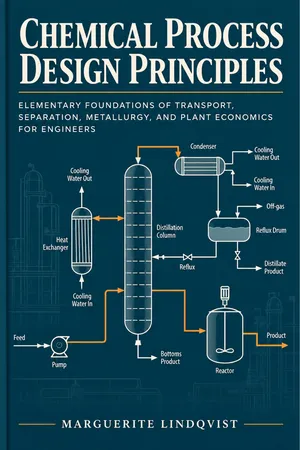
Chemical Process Design Principles
eBook - ePub

Chemical Process Design Principles

Elementary Foundations of Transport, Separation, Metallurgy, and Plant Economics for Engineers

  1. English
  2. ePUB (mobile friendly)
  3. Available on iOS & Android
eBook - ePub

Chemical Process Design Principles

Elementary Foundations of Transport, Separation, Metallurgy, and Plant Economics for Engineers

About this book

You can pass a transport course and still freeze in front of a blank flowsheet. This book closes that gap.

Chemical engineering fundamentals are often taught as separate subjects—fluid mechanics here, heat transfer there, thermodynamics somewhere else—leaving students and early-career engineers without a clear path from theory to a working process design. Chemical Process Design Principles bridges that gap by walking through the elementary foundations of transport, separation, metallurgy, and plant economics in one coherent sequence. You will set up material balances with recycle and purge, carry energy balances through reacting systems, size pipe and pumps with real friction and suction-head limits, and design a shell-and-tube exchanger from an overall coefficient and a corrected log mean temperature difference.

Distillation is built from equilibrium to McCabe-Thiele stages, minimum reflux, and column hydraulics, then extended to absorption, extraction, evaporation, and drying. Reactor sizing, a metallurgy chapter on phase diagrams, reduction thermodynamics, and corrosion-resistant alloy choice, and a closing block on flowsheets, capital cost estimation, cash flow, and hazard review complete the design picture. Each chapter connects directly to the next, so you finish with a working understanding of how unit operations fit into a complete process rather than a collection of isolated equations.

What you will learn:

• Apply dimensional analysis and consistent units to process variables and design calculations
• Set up material balances on non-reacting and reacting systems, including recycle and purge streams
• Carry energy balances and thermochemistry through reacting and non-reacting processes
• Use phase equilibrium and physical property data to support separation and reactor design
• Size pipe, pumps, and fluid movers with real friction and suction-head limits
• Design shell-and-tube heat exchangers using overall coefficients and corrected LMTD
• Build distillation designs from equilibrium stages to McCabe-Thiele, minimum reflux, and column hydraulics
• Extend mass transfer fundamentals to absorption, stripping, extraction, leaching, evaporation, drying, crystallisation, and mechanical separation
• Size reactors and select materials using phase diagrams, reduction thermodynamics, and corrosion-resistant alloy choice
• Read and create flowsheets, estimate capital costs, evaluate cash flow, and apply hazard review

Written for chemical and process engineering students and early-career plant engineers, this book is for anyone who needs to move from passing exams to producing defensible process designs. If you are preparing for a design course, starting a plant assignment, or returning to fundamentals after time in the field, the chapters here give you the elementary foundations and the confidence to fill in that blank flowsheet.

Table of contents

  1. Foreword
  2. Preface
  3. About This Book
  4. Important Safety Notice
  5. Chapter 1: Process Variables, Units and Dimensional Analysis
  6. Chapter 2: Material Balances on Non-Reacting Systems
  7. Chapter 3: Material Balances with Reaction
  8. Chapter 4: Energy Balances and Thermochemistry
  9. Chapter 5: Phase Equilibrium and Physical Properties
  10. Chapter 6: Fluid Flow and Fluid Movers
  11. Chapter 7: Heat Transfer and Exchanger Design
  12. Chapter 8: Mass Transfer Fundamentals
  13. Chapter 9: Distillation
  14. Chapter 10: Absorption, Stripping, Extraction and Leaching
  15. Chapter 11: Evaporation, Drying, Crystallisation and Mechanical Separation
  16. Chapter 12: Reaction Engineering and Reactor Sizing
  17. Chapter 13: Metallurgy and Materials Selection
  18. Chapter 14: Flowsheets, Costing and Process Safety
  19. Conclusion
  20. Acknowledgements
  21. Glossary
  22. Sources and Further Reading
  23. About the Author
  24. A Request from the Author

Trusted by 375,005 students

Access to over 1.5 million titles for a fair monthly price.

Study more efficiently using our study tools.

Frequently asked questions

Yes, you can cancel anytime from the Subscription tab in your account settings on the Perlego website. Your subscription will stay active until the end of your current billing period. Learn how to cancel your subscription
No, books cannot be downloaded as external files, such as PDFs, for use outside of Perlego. However, you can download books within the Perlego app for offline reading on mobile or tablet. Learn how to download books offline
Perlego offers two plans: Essential and Complete
  • Essential is ideal for learners and professionals who enjoy exploring a wide range of subjects. Access the Essential Library with 800,000+ trusted titles and best-sellers across business, personal growth, and the humanities. Includes unlimited reading time and Standard Read Aloud voice.
  • Complete: Perfect for advanced learners and researchers needing full, unrestricted access. Unlock 1.5M+ books across hundreds of subjects, including academic and specialized titles. The Complete Plan also includes advanced features like Premium Read Aloud and Research Assistant.
Both plans are available with monthly, semester, or annual billing cycles.
We are an online textbook subscription service, where you can get access to an entire online library for less than the price of a single book per month. With over 1.5 million books across 990+ topics, we’ve got you covered! Learn about our mission
Look out for the read-aloud symbol on your next book to see if you can listen to it. The read-aloud tool reads text aloud for you, highlighting the text as it is being read. You can pause it, speed it up and slow it down. Learn more about Read Aloud
Yes! You can use the Perlego app on both iOS and Android devices to read anytime, anywhere — even offline. Perfect for commutes or when you’re on the go.
Please note we cannot support devices running on iOS 13 and Android 7 or earlier. Learn more about using the app
Yes, you can access Chemical Process Design Principles by Marguerite Lindqvist, Artificial intelligence in PDF and/or ePUB format, as well as other popular books in Technology & Engineering & Industrial & Technical Chemistry. We have over 1.5 million books available in our catalogue for you to explore.