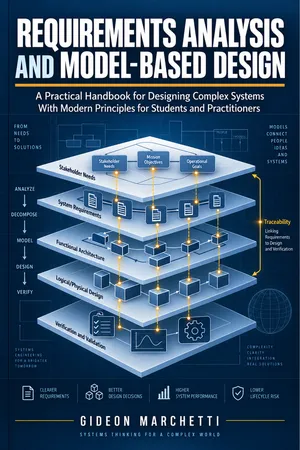
Most systems fail at their seams, not their parts. This handbook teaches the discipline that holds the seams together.
Requirements Analysis and Model-Based Design is a practical handbook for designing complex systems using modern principles. It walks you from stakeholder needs and an operational concept through verifiable requirements, traceability, functional analysis, interface control, and architecture allocation. You then move into a full model-based treatment: block definition, internal block, activity, state machine, and parametric diagrams assembled into one coherent model instead of a shelf of documents that disagree.
Trade study chapters give you weighted decision analysis, and risk chapters give you registers and technical performance measures that track margin honestly. Verification chapters cover inspection, analysis, demonstration, and test, along with integration sequencing and review gates. One communications system runs through every chapter, so each method is shown in context rather than as an isolated technique. The result is a repeatable path from needs to a verified, integrated system.
What you will learn:
• Apply systems thinking across the full system life cycle
• Capture stakeholder needs and write a concept of operations
• Elicit and write requirements that can actually be verified
• Manage requirements, traceability, and baselines across a multi-year program
• Perform functional analysis and behavioural modelling
• Define architecture and synthesize design through allocation
• Control interfaces, boundary documents, and system seams
• Build SysML models: block definition, internal block, activity, state machine, and parametric diagrams
• Use parametric models, simulation, and the digital thread
• Run trade studies and weighted decision analysis
• Manage risk, opportunity, and technical performance measures
• Plan verification, validation, and test, including inspection, analysis, demonstration, and test
• Sequence integration, technical reviews, and configuration management
• Address reliability, specialty engineering, and life-cycle support
For engineering students and practitioners new to systems roles, this handbook provides a coherent method you can apply immediately. If you are moving from a component-focused role into systems engineering, or studying systems engineering and want a practical reference that connects requirements, architecture, and models, this book is for you.