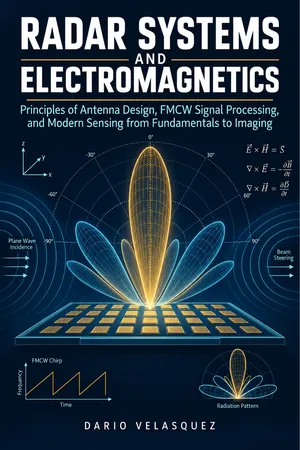
Radar is not two subjects. It is one continuous path from field physics to detected target.
Most books treat antennas and signal processing as separate disciplines. This book connects them. You start with electromagnetic propagation and the radar range equation, then build aperture and phased-array design directly from radiation integrals. From there, you move into waveform choice, matched filtering, and the complete FMCW chirp chain—from sweep parameters to the range-Doppler map. The result is a single, coherent framework that shows how physics constrains algorithms and how algorithms exploit physics.
Later chapters extend the path to CFAR detection, monopulse and MIMO angle estimation, Kalman tracking, and SAR image formation. Every concept is reinforced with worked numbers you can check against your own designs. Whether you are optimizing an automotive radar sensor or simulating a synthetic aperture system, you will find the equations, block diagrams, and practical trade-offs needed to move from theory to implementation.
What you will learn:
• Apply electromagnetic foundations and the radar range equation to predict system performance
• Design aperture and array antennas using radiation integrals and pattern synthesis
• Implement phased-array beamforming and understand grating lobes, tapering, and scan loss
• Analyze radar cross section and scattering for target and clutter modeling
• Select waveforms using the ambiguity function and apply matched filtering for pulse compression
• Build the complete FMCW chirp chain, from sweep linearity to range-Doppler processing
• Mitigate clutter with Doppler processing and MTI filters
• Detect targets with CFAR and estimate angle using monopulse and MIMO techniques
• Track targets with Kalman filters and form SAR images for high-resolution sensing
Who this book is for: RF and DSP engineers, graduate students, and automotive sensing teams who need the physics and the algorithms in the same volume. If you work with radar hardware, write signal processing code, or study remote sensing, this book gives you the end-to-end understanding to design, simulate, and debug modern radar systems.