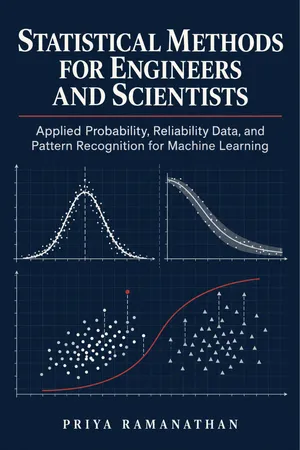
Stop forcing clean textbook data onto messy engineering reality.
Real engineering data arrives censored, correlated, and far from normal. Inspection records stop at the detection limit. Failure times are truncated by test schedules. Measurements carry uncertainty that propagates through every downstream calculation. Statistical Methods for Engineers and Scientists teaches inference on the data you actually have, not the idealized samples in a classroom example.
Priya Ramanathan builds each method from an engineering problem, then shows the mathematics that makes it work. You will construct probability models from inspection and failure data, fit Weibull and lognormal distributions by probability plotting and maximum likelihood, and propagate measurement uncertainty through a tolerance stack. The book treats interval estimation, sample size, and power as design decisions rather than afterthoughts, and it insists on residual diagnostics instead of an R-squared value alone.
Later chapters move into the methods that quality, reliability, and machine learning work depend on: control charts and capability indices, life data analysis with censoring and accelerated testing, system reliability, and the classification, cross-validation, and mixture-model ideas behind pattern recognition. Each topic connects to the one before it, so the book reads as a single argument about how to reason from data under engineering constraints.
What you will learn:
• Build probability models from inspection and failure problems, including conditioning and Bayes' theorem
• Fit Weibull and lognormal distributions by probability plotting and maximum likelihood
• Propagate measurement uncertainty through a tolerance stack using joint distributions
• Construct confidence, prediction, and tolerance intervals, and choose a sample size that gives real power
• Run analysis of variance and factorial experiments, then check regression models with residual diagnostics
• Apply statistical process control, capability indices, and measurement systems analysis
• Analyze life data with censoring and accelerated testing, and compute system reliability
• Use classification, cross-validation, and mixture models as pattern recognition tools
• Connect classical inference to modern machine learning without skipping the assumptions
Who it is for: Engineering students who need a statistics text grounded in practice, quality and reliability engineers who work with censored and non-normal data, and applied scientists who want the probabilistic foundations behind machine learning methods. If your data never matches the textbook example, this book is written for you.