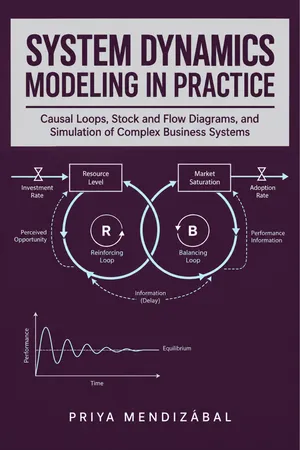
You already know your organisation behaves in ways nobody intended. This book gives you the tools to show why.
System dynamics is not a software feature or a diagramming habit. It is a disciplined way of representing how accumulation, feedback, and delay produce the behaviour you observe—and of testing whether your explanation survives contact with data. This book teaches that discipline from the ground up, using the conventions and pitfalls that separate a model you can defend from a sketch that merely looks plausible.
You begin by drawing reference modes and framing a dynamic hypothesis, then learn causal loop diagrams properly, with polarity and naming rules that keep a diagram readable a month later. From there you convert structure to stocks, flows and equations, choose an integration step that does not fabricate behaviour, and model material and information delays. You build growth, oscillation and overshoot structures, calibrate nonlinear relationships, test models with extreme-condition and dimensional checks, and run sensitivity sweeps. Four complete models, from inventory and workforce to an energy transition, are developed end to end.
What you will learn:
• Frame a dynamic hypothesis and draw reference modes that define what a model must explain
• Build causal loop diagrams with correct polarity, loop naming, and readable layout
• Translate feedback structure into stocks, flows, and equations without losing meaning
• Select integration steps and time constants that do not manufacture oscillation or overshoot
• Represent material and information delays, including pipeline and perceptual delays
• Construct and diagnose growth, oscillation, and overshoot structures
• Calibrate nonlinear table functions and avoid common curve-fitting errors
• Validate models with extreme-condition, dimensional, and sensitivity tests
• Develop four complete models: inventory, workforce, and an energy transition
For analysts, operations managers and engineers who must model complex systems before deciding, this book is a practical bridge from whiteboard to simulation. If your decisions depend on how stocks accumulate, how feedback loops interact, and how delays surprise you, the methods here will change both what you build and what you trust.