Production engineering is a chain of measurements, and a weak link anywhere shows up as a bad forecast.
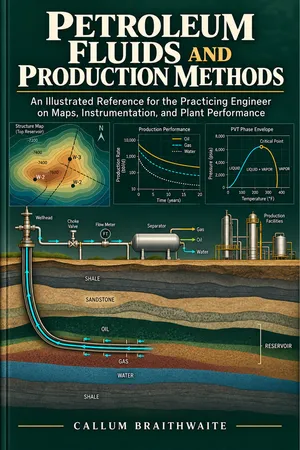
This illustrated reference follows that chain from the reservoir fluid to the plant outlet. It is written for the practicing engineer who needs to move between a phase envelope, a laboratory PVT report, a structure contour map, a pressure buildup test and a nodal analysis without losing the thread that connects them. Each chapter is built around the measurements and calculations that decide whether a well, a lift system or a facility performs as predicted.
You will classify a reservoir fluid from its phase envelope, read the laboratory report that produces formation volume factor and solution gas-oil ratio, and use rock properties and relative permeability to explain what a well will actually give up. Mapping chapters turn raw logs into structure contours, isopachs and correlated cross sections. Flow chapters build radial Darcy performance, skin and inflow curves, then interpret a pressure buildup test. Lift chapters compare rod pumps, electrical submersible pumps and gas lift through nodal analysis. Facility chapters cover separation, treating, metering and the instrumentation that reveals plant performance, before flow assurance and enhanced recovery.
What you will learn:
• Classify reservoir fluids and interpret phase behaviour from phase envelopes and laboratory data
• Read PVT reports and apply correlations for formation volume factor, solution gas-oil ratio and viscosity
• Use porosity, permeability and saturation to describe storage and flow capacity
• Apply capillary pressure, wettability and relative permeability to production behaviour
• Convert well logs into structure contours, isopachs and correlated cross sections
• Estimate volumetrics and material balance and identify drive mechanisms
• Build radial Darcy inflow performance, quantify skin and interpret pressure transient tests
• Compare rod pump, electrical submersible pump and gas lift performance through nodal analysis
• Evaluate separation, treating, metering and plant instrumentation, then address flow assurance and enhanced recovery
For practicing petroleum engineers, production technologists and students who want a single illustrated reference that connects reservoir fluids, maps, instrumentation and plant performance across the production chain.