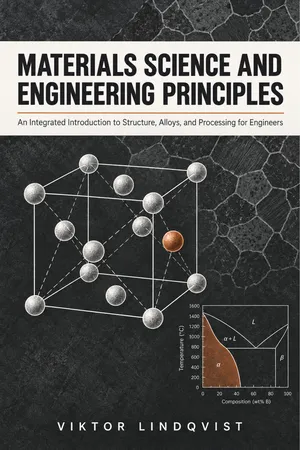
Materials Science and Engineering Principles
eBook - ePub

Materials Science and Engineering Principles

An Integrated Introduction to Structure, Alloys, and Processing for Engineers

  1. English
  2. ePUB (mobile friendly)
  3. Available on iOS & Android
eBook - ePub

Materials Science and Engineering Principles

An Integrated Introduction to Structure, Alloys, and Processing for Engineers

About this book

Structure decides everything. This book keeps that connection in view from the first bond to the final material selection.

Why does quenched steel crack, and annealed copper bend forever? Because the arrangement of atoms, defects, and phases controls every property an engineer can measure. Materials Science and Engineering Principles builds that understanding as one continuous argument rather than a catalogue of facts. You begin with atomic bonding, crystal structures, and crystallography, then examine imperfections and diffusion before using dislocations to explain yielding, work hardening, and every strengthening mechanism in real use.

The middle of the book turns theory into practice. You read phase diagrams with the lever rule, take the iron-carbon system through transformation curves into practical heat treatment, and follow the same logic into cast irons, aluminium alloys, ceramics, glasses, polymers, and composites. Failure chapters cover fracture toughness, fatigue crack growth, and creep, while the closing chapters address corrosion mechanisms, protection methods, and a structured procedure for choosing a material and its process together. Worked numbers appear throughout, from diffusion depths to laminate stiffness, so the equations stay tied to components you can picture.

What you will learn

• How atomic bonding and crystal structure set the stage for every later property
• How point, line, and planar defects control real material behaviour
• How diffusion drives processes from carburising to sintering
• How dislocations explain yielding, work hardening, and strengthening mechanisms
• How to read phase diagrams and apply the lever rule with confidence
• How iron-carbon transformation curves translate into practical heat treatment
• How fracture toughness, fatigue crack growth, and creep lead to failure
• How ceramics, glasses, polymers, and composites differ in structure and processing
• How to select a material and its manufacturing process as one integrated decision

Written for engineering undergraduates and design engineers specifying materials, this book assumes only introductory chemistry and mechanics. Each chapter connects structure to processing to performance, giving you the reasoning to predict behaviour instead of memorising tables. Whether you are preparing for a materials course, supporting a design project, or returning to the subject from industry, the integrated approach helps you choose alloys, treatments, and processes with evidence rather than habit.

Information

Table of contents

  1. Foreword
  2. Preface
  3. About This Book
  4. Chapter 1: Atomic Bonding and the Structure of Solids
  5. Chapter 2: Crystal Structures and Crystallography
  6. Chapter 3: Imperfections in Solids
  7. Chapter 4: Diffusion
  8. Chapter 5: Mechanical Properties
  9. Chapter 6: Strengthening Mechanisms
  10. Chapter 7: Failure
  11. Chapter 8: Phase Diagrams
  12. Chapter 9: Phase Transformations and Heat Treatment
  13. Chapter 10: Metal Alloys and Manufacturing Routes
  14. Chapter 11: Ceramics and Glasses
  15. Chapter 12: Polymers
  16. Chapter 13: Composites
  17. Chapter 14: Degradation and Materials Selection
  18. Conclusion
  19. Acknowledgements
  20. Glossary
  21. Sources and Further Reading
  22. About the Author
  23. A Request from the Author

Trusted by 375,005 students

Access to over 1.5 million titles for a fair monthly price.

Study more efficiently using our study tools.

Frequently asked questions

Yes, you can cancel anytime from the Subscription tab in your account settings on the Perlego website. Your subscription will stay active until the end of your current billing period. Learn how to cancel your subscription
No, books cannot be downloaded as external files, such as PDFs, for use outside of Perlego. However, you can download books within the Perlego app for offline reading on mobile or tablet. Learn how to download books offline
Perlego offers two plans: Essential and Complete
  • Essential is ideal for learners and professionals who enjoy exploring a wide range of subjects. Access the Essential Library with 800,000+ trusted titles and best-sellers across business, personal growth, and the humanities. Includes unlimited reading time and Standard Read Aloud voice.
  • Complete: Perfect for advanced learners and researchers needing full, unrestricted access. Unlock 1.5M+ books across hundreds of subjects, including academic and specialized titles. The Complete Plan also includes advanced features like Premium Read Aloud and Research Assistant.
Both plans are available with monthly, semester, or annual billing cycles.
We are an online textbook subscription service, where you can get access to an entire online library for less than the price of a single book per month. With over 1.5 million books across 990+ topics, we’ve got you covered! Learn about our mission
Look out for the read-aloud symbol on your next book to see if you can listen to it. The read-aloud tool reads text aloud for you, highlighting the text as it is being read. You can pause it, speed it up and slow it down. Learn more about Read Aloud
Yes! You can use the Perlego app on both iOS and Android devices to read anytime, anywhere — even offline. Perfect for commutes or when you’re on the go.
Please note we cannot support devices running on iOS 13 and Android 7 or earlier. Learn more about using the app
Yes, you can access Materials Science and Engineering Principles by Viktor Lindqvist, Artificial intelligence in PDF and/or ePUB format, as well as other popular books in Technology & Engineering & Materials Science. We have over 1.5 million books available in our catalogue for you to explore.