![]()
CHAPTER 1
Understanding Maxine Hong Kingston
Maxine Hong Kingston once stated that her contribution to literature was showing “how to get from the oral to the written.”1 Her career has been defined by her attempts to write down the “huge inheritance of talk story” that her ancestors have passed down from one family member to the next, from one generation to another, over the years.2 Committing these stories to the page has been no easy task, for as she reveals in her works, these talk-stories change—sometimes subtly, sometimes dramatically—with each retelling, and Kingston’s own memory of these stories and her re-imagining of them impact the form the textual versions take. And yet, she is deeply attentive to keeping alive in her own text the dissent between the oral versions: the contradictions, inconsistencies, and idiosyncrasies that make it impossible to authenticate the stories or impose a unified logic to them. This is what Kingston means when she talks of getting “from the oral to the written”—the process of writing for her is not about codifying any one version of a story so much as acknowledging the multiplicity of stories that make up the history of her family’s experiences.
The story of Maxine Hong Kingston’s own life will sound familiar to those who have read The Woman Warrior, China Men, or her other works, for she revisits scenes from her past frequently in her writing. Her childhood in Stockton, her complicated relationship with her parents, the Chinatown in which she grew up, and the histories—both national and familial—that brought her parents as well as thousands of others from China to Chinatown proved to be fertile ground for generating the narratives that form the backbone of her literary career. After the publication of China Men in 1980, Kingston claimed that she had “told all my childhood stories,” and at first glance, this statement seems to be an accurate one, since her subsequent works do not seem to mine her own childhood for source materials in the same way that The Woman Warrior and China Men do. And yet, the experiences of her family and the Chinese American community—its politics, histories, losses, and triumphs—are a deeply essential part of all of Kingston’s writing, even as she has experimented with genres, forms, and language.
Life and Career
Maxine Ting Ting Hong was born in Stockton, California, on October 27, 1940. Her parents were Tom and Ying Lan Hong. Before coming to the United States, Kingston’s father was a teacher and scholar in his home village of Sun Woi (New Society Village) in Guangzhou. Like thousands of other Chinese men before him, he left his home and young family in 1924 in order to seek out the wealth and prosperity that Gold Mountain promised. In China Men, the narrator suggests that her father left China for the United States as much out of boredom and disappointment with teaching as for the financial incentives working in the United States offered. Kingston’s father would have had plenty of advice on how to travel to the United States as a paper son, since he was from a family in which the men often went abroad to work before returning to China. Kingston’s own grandfather, father, great-uncles, and uncles, often journeyed to the United States in search of employment. Much later in her life, Kingston’s mother told her that Tom attempted to enter the United States three times via Cuba; the first two times he was caught and shipped back before he ultimately succeeded on his third attempt. Perhaps this explains why Tom never attempted to return to China once he made it into America—the chances of being turned away again were simply too high. Thus, while most of his family members traveled back and forth between Sun Woi and Gold Mountain, Tom did not.
Once in the United States, Tom Hong worked multiple jobs in order to survive: washing windows, waiting tables, and working at a laundry. These activities did not stop him from enjoying himself and all the opportunities that his new home had to offer: he socialized with other Chinese men, danced at nightclubs, flirted with white women, and toured New York like a tourist, sending back to his wife pictures of himself in his sharp and stylish Western clothes. After a number of years, he invested in a laundry with three other Chinese immigrants. At that point, Tom sent for his wife Ying Lan in China, and she joined him in 1939.
Like her husband, Ying Lan Chew, Kington’s mother, was a well-educated professional in China. She and Tom had had two children in China before he decided to give up his scholarly career and try his luck on Gold Mountain. These two children—a boy and a girl—passed away some time after his departure.3 Casting about for something to do, Ying Lan decided to follow her husband’s suggestion to learn a vocation; using the money he sent her every month, she enrolled at the To Keung School of Midwifery in Canton to train to be a doctor and midwife. She worked for a number of years in this capacity before leaving for the United States to rejoin her husband. She arrived in the United States via Angel Island in California and then traveled by train across the country to meet her husband in New York City. (Kingston only learned that her mother entered the United States via Angel Island well after the publication of both The Woman Warrior and China Men.4 In an interview with Paul Mandelbaum, Kingston states that for most of her life, she had “always thought [my mother] came through Ellis Island because all her stories about America start with New York.”5) When Ying Lan arrived in New York she was forty-five, and she and her husband had been separated for fifteen years.
After being cheated by his fellow business partners out of the laundry that they had all started, Tom and Ying Lan moved to California and settled in Stockton. It was here in 1940 that Maxine was born, the first of six American-born children. While Tom ran a gambling house for a much wealthier Chinese man, Ying Lan worked many odd jobs to help support the growing family: she cooked and cleaned, picked crops in the field, and worked in a cannery. Just after World War II ended, the family were finally able to achieve a level of financial independence by opening their own business in Stockton: the New Port Laundry. As with many immigrant families, the children were expected to work at the laundry, and many of Kingston’s memories of her childhood revolved around the hours before and after school spent working there. While the labor was backbreaking and the hours were long (starting at dawn and ending well past midnight), the Hongs were able to use the proceeds from their business to purchase their own home, complete with a space in the back for a garden. Along with their work in the laundry and their academic responsibilities, the children attended Chinese school in the afternoons.
Like the Hongs, the Chinese who lived in Stockton during this period hailed mostly from Sun Woi and surrounding villages.6 Although many readers and critics have sometimes erroneously assumed that Kingston grew up in the more famous Chinatown of San Francisco, Kingston herself has always averred that the Chinese community of Stockton was very different from the Chinatown inhabitants of larger California metropolitan centers like San Francisco or Los Angeles, and her narratives of growing up in Chinatown are firmly rooted in the history and spaces of Stockton. According to Kingston, the Stockton Chinatown of her childhood was relatively small and less sharply defined geographically. It was also racially integrated. Along with Chinese, Kingston and her family lived among Mexicans and African Americans as well as Caucasians. In China Men, the narrator proclaims, “We lived on a special spot of the earth, Stockton, the only city on the Pacific with three railroads—the Santa Fe, Southern Pacific, and Western Pacific.”7 Stockton’s position within a rail network made it a crossroads and gathering place for all kinds of people, especially those who had been uprooted, not unlike her own family. So many of Kingston’s relatives lived and died in Stockton after emigrating from China that many in her family called the city “ancestral ground,” a home to replace the one that they had left and then lost in China. In recreating the Chinatown of her childhood, Kingston created “a territory as convincing and as American as William Faulkner’s Yoknapatawpha County, or closer to Kingston’s home, John Steinbeck’s California.”8
Kingston’s images of a Stockton before urban renewal tore down the section of town where her parents lived and worked are particularly evocative of a space filled with obstreperous bodies in constant motion. The homeless meandering through the streets while the Hong children walked home from school; Kingston’s mother picking for edible or medicinal greens and weeds in empty lots; the family going through the trash cans of businesses and neighbors to see if they could find anything of use or value for the home or to sell; the children dragging home railway ties to use in their play at home. The places of Kingston’s childhood were paved over in the 1970s, expanded, or knocked down in order to make way for shopping malls, parking lots, or other more desirable, business-friendly public spaces where the homeless, transients, and people of color were often unwelcome and excluded. But these spaces live on in Kingston’s narratives.
Living in Stockton’s Chinatown and surrounded by a community that hailed from the same place in China as her parents and ancestors had a formative impact on Kingston as a child and then as a woman. In The Woman Warrior, Kingston vividly describes the pressures of growing up under the sharp eyes of these Chinese neighbors. These “villagers” are described as being officious, oppressive, and sexist, constantly denigrating the narrator as a child because of her gender and criticizing her when she misbehaved. In other writings, Kingston takes a more mellow view of growing up in Chinatown. Despite all of these economic, educational, and cultural pressures, Kingston also remembered a childhood filled with a sense of community and neighborly activities. There were “shows to raise money for China Relief. And parades with a red flag … and operas, live and on film. And American films on Saturday afternoons and Hong Kong films on Sundays. Talk-stories and letters that came from China were often about what happened at the theater, how the theater became Communist, how the theaters went dark…. America is our country not just for work but for play.”9 While her family was enthralled by the theater and films (in The Woman Warrior, the narrator describes an incident in which her grandmother insists that everyone goes to the theater, even though the family knows that they will be robbed that night by a marauding band of thieves), Kingston found an outlet for her own sense of identity in writing. “I Am an American Girl” was published when she was fifteen years old, and Kingston has said that its purpose was “to assert myself as an American.”10 Her love of writing lead to a journalism scholarship at the University of California, Berkeley, where she matriculated in 1958. In an interview with the New York Times’s Nan Robertson, Kingston recalls that her entrance into college life was a “terrible culture shock.” “The reason … was that for the first time she did not have her big, vital, ‘exhilarating’ family close around her, no matter what bad times there had been.”11
Although the struggles of her family mirrored the experiences of many Chinese American families, Kingston has always been careful to emphasize the individual personalities of her parents and to note the ways in which her family was atypical from other Chinese immigrants. This awareness stems from the tendency of readers of ethnic memoir or fiction to normalize such texts as paradigmatic of that ethnic group’s history and experience. Highlighting the fact that her family often didn’t fit in within the Chinatown community also deflected the charges of exoticism leveled by Kingston’s Chinese American critics. After the publication of The Woman Warrior, Kingston’s most controversial work, Kingston asked her sister “On a range of 1 to 10, how odd do you think we were? How odd was our upbringing?” Kingston’s sister responds that the oddness of the family registered as an eight in her opinion, which to Kingston “means [the family was] pretty odd, which is saying that we are not very representative.”12 By emphasizing her family’s “oddness,” Kingston responds to white readers who might be tempted to read The Woman Warrior as an ethnographic tract as well as to Chinese American charges that the book represents Chinese Americans in the most stereotypical way possible. Kingston rejects the notion that her work is representative or stereotypical.
While at Berkeley, Kingston became active in the antiwar movement, protesting American involvement in Vietnam. Kingston’s commitment to peace activism would only intensify as she grew older. (Kingston was also opposed to the US invasion of Iraq and was arrested in 2003 along with Alice Walker for crossing a police cordon at the White House.13) She graduated from Berkeley in 1962 with a degree in English and in November of that year married Earll Kingston, an aspiring actor who had also attended Berkeley. For the next few years, Kingston worked as a teacher in the Oakland area and participated in antiwar marches. The urgency of this work was no doubt deepened by the fact that two of her brothers and a brother-in-law were drafted; another brother departed the United States for Canada to avoid the draft (Guardian). Firmly believing that the war in Vietnam was “a war against Asians,” Kingston’s antiwar activism and efforts to promote peace have been a constant throughout her adult life, something that she has talked about in countless interviews and which she has incorporated in various guises in all of her published works. As she has gotten older, in fact, her antiwar work has occupied an increasingly visible place within her literary output and efforts.14
By 1967, both she and Earll were feeling suffocated by Berkeley, discouraged by the despair that pervaded the antiwar movement, and alarmed by the increasing reliance of their friends and fellow protestors on drugs. Feeling the need to get out of the Berkeley bubble, Kingston, Earll, and their young son Joseph moved to Hawai'i. Hawai'i had not been the Kingstons’ original destination. Initially, they had planned to relocate to the Far East and stopped in Honolulu only for a visit.15 Any thought that they had escaped the anxieties of the war by retreating to Honolulu was quickly dashed; the unmistakable presence of the American military on the Hawaiian Islands reminded them constantly of the war that was being fought. Kingston’s antiwar work continued—made even more necessary by the fact that Hawai'i was a seat of military operations—and she established herself as an English and writing teacher at various educational institutes and schools in the Honolulu area.
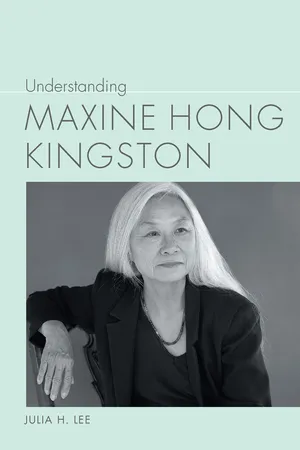
It was while living in Hawai'i that Kingston took her first steps toward publishing her writing. According to her timeline, Kingston started work on what would become The Woman Warrior in approximately 1974. (She actually wrote the final chapter of China Men first.) She sent the manuscript to several agents, one of whom, John Shaffner, accepted it almost immediately. Editors at Alfred A. Knopf showed interest in the book but had misgivings regarding how to market it. After deciding to categorize the book as a memoir/nonfiction rather than as a novel, Knopf published The Woman Warrior to almost instant acclaim in 1976. John Leonard, the influential book reviewer for the New York Times, was an early champion of The Woman Warrior, famously rhapsodizing in his review that it was “one of the best I’ve read in years…. As an account of growing up female and Chinese-American in California, in a laundry of course, it is antinostalgic. It burns the fat right out of the mind. As a dream—of the ‘female avenger’—it is dizzying, elemental, a poem turned into a sword.”16 Leonard’s glowing review ratcheted the public’s interest in the book; the fact that Kingston had come out of nowhere to publish one of the best reviewed books of the year also piqued readers and critics alike. In his review, Leonard seemed as intrigued by Kingston’s anonymity as he was by her writing, querying wonderingly at the end of his review: “Who is Maxine Hong Kingston? Nobody at Knopf seems to know. They have never laid eyes on her.” That mystery wouldn’t last for long, as Kingston’s tiny four feet nine inch frame (according to her mother, she stopped growing at age twelve after a bout of rheumatic fever) and prematurely whitened hair soon became a familiar presence at awards c...