"Does an admirable job of examining Capote as a writer whose work reflects America of the late 1940s and 1950s more deeply than previously thought." —Ralph F. Voss, author of
Truman Capote and the Legacy of "In Cold Blood"
Truman Capote—and his most famous works,
In Cold Blood and
Breakfast at Tiffany's—continue to have a powerful hold over the American popular imagination, along with his glamorous lifestyle, which included hobnobbing with the rich and famous and frequenting the most elite nightclubs in Manhattan. In
Understanding Truman Capote, Thomas Fahy offers a way to reconsider the author's place in literary criticism, the canon, and the classroom.
By reading Capote's work in its historical context, Fahy reveals the politics shaping his writing and refutes any notion of Capote as disconnected from the political. Instead this study positions him as a writer deeply engaged with the social anxieties of the postwar years. It also applies a highly interdisciplinary framework to the author's writing that includes discussions of McCarthyism, the Lavender Scare, automobile culture, juvenile delinquency, suburbia, Beat culture, the early civil rights movement, female sexuality as embodied by celebrities such as Marilyn Monroe, and atomic age anxieties. This new approach to studying Capote will be of interest in the fields of literature, history, film, suburban studies, sociology, gender/sexuality studies, African American literary studies, and American and cultural studies.
Capote's writing captures the isolation, marginalization, and persecution of those who deviated from or failed to achieve white middle-class ideals and highlights the artificiality of mainstream idealizations about American culture. His work reveals the deleterious consequences of nostalgia, the insidious impact of suppression, the dangers of Cold War propaganda, and the importance of equal rights. Ultimately, Capote's writing reflects a critical engagement with American culture that challenges us to rethink our understanding of the 1940s and 1950s.
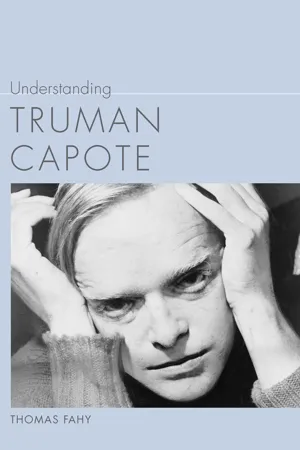
- 186 pages
- English
- ePUB (mobile friendly)
- Available on iOS & Android
eBook - ePub
Understanding Truman Capote
About this book
Information
CHAPTER 1
Understanding Truman Capote
Lillie Mae Faulk desperately wanted an abortion. Within a few weeks of her marriage to Archulus (“Arch”) Persons in 1923, she realized she had made a terrible mistake. At first Arch seemed like her ticket out of small-town America. A natural salesman with a charming personality, Arch came from a well-respected Alabama family, and his talk of money-making schemes dazzled the sixteen-year-old girl, who dreamed of going to the big city. She would finally escape Monroeville, a town with no paved streets and a population of just over one thousand people . . . or so she thought. She soon discovered that her new husband was not what he appeared to be. Arch ran out of money on their honeymoon along the Gulf Coast, and after deciding to stay in New Orleans to find work, he scraped together enough cash to buy his wife a return ticket to Alabama. Lillie Mae felt duped. She was right back where she started, living with her three spinster cousins and their bachelor brother in the family house. She was not going to let these circumstances dim her aspirations, though. She enrolled in business school with plans of making it on her own, but a few weeks later she realized she was pregnant. The thought of having a permanent connection with Arch chilled her, but it was difficult to get an abortion in the 1920s—particularly in the South. As a result Truman Streckfus Persons (whose name would later be changed to Truman Capote after his mother’s second marriage) was born on September 30, 1924.
Neither Arch nor Lillie Mae had much interest in parenthood. Arch, who possessed P. T. Barnum’s hunger for get-rich-quick schemes but lacked the showman’s acumen, spent much of his life moving from one fruitless enterprise to another. One of his more curious ventures involved managing the Great Pasha, a sideshow performer who could survive being buried alive for nearly five hours. (Capote would later resurrect this figure in his haunting short story “A Tree of Night.”) As Arch’s entrepreneurial efforts became less scrupulous (particularly through his habit of writing bad checks), he would find himself in legal trouble and behind bars numerous times throughout his life. Truman’s mother was preoccupied with her own affairs—literally. She began seeing other men a few months after Truman’s birth, and her young son witnessed a number of these dalliances firsthand. In short, Truman was a neglected child who, not surprisingly, developed a profound fear of abandonment—a fear his parents did little to assuage. When the family traveled together, for instance, Arch and Lillie Mae had no scruples about locking Truman in their hotel room (sometimes in a dark closet) and leaving him for the evening. They simply told the hotel staff to ignore the boy if he started screaming, which was often the case. His parents came back on those nights, but in the summer of 1930, with Arch away to pursue yet another scheme, Lillie Mae left Truman with her relatives in Monroeville indefinitely. She decided to follow her own dreams in New York City.
The three Faulk sisters, Jennie, Callie, and Nanny Rumbly (“Sook”), became Truman’s family for the next two years, and they would inspire the central characters in a number of his works, including The Grass Harp and “A Christmas Memory.” Jennie, the most authoritarian member of the family, owned a successful hat shop that sold a variety of women’s goods. Her volatile temper helped fuel a contentious relationship with her youngest sister, the proper and sanctimonious Callie. Though she had been a schoolteacher, Callie eventually managed the finances of Jennie’s store. Sook possessed a childlike spirit and rarely left the property. Only twice a year did she walk to the nearby forest to scavenge ingredients for her dropsy cure and Christmas fruitcakes. Two African American women, “Aunt” Liza and Anna Stabler, also spent a great deal of time at the Faulk house, and as hired help they did much of the cooking and cleaning. The cantankerous Anna, who would become Catherine in The Grass Harp, lived in a shed behind the house, had no teeth, played a mean accordion, and argued fearlessly with whites. She also denied having any black blood.
Truman spent most of his time with Sook, who played games with him in the attic, and Nelle Harper Lee—a neighbor and the future author of To Kill a Mockingbird (1960). The three of them shared a sense of separateness. Sook was largely isolated at the house before Truman arrived, and Nelle, who could whup most boys her age, did not behave like a conventional girl. She also felt estranged from her sickly mother. Truman’s effeminate behavior, soft features, affectionate nature, and small frame (he never grew taller than 5'3") ostracized him, making him an easy target for verbal and physical abuse. Nelle protected him from bullies on a number of occasions, and both children frequently took refuge in the chinaberry tree in her backyard—a space where they hid from peers, shared dreams, and read their favorite books. This tree would become the setting for Capote’s The Grass Harp, and Nelle would provide the model for Idabel, the tomboy in Other Voices, Other Rooms. Truman’s experiences in Monroeville also inspired his engagement with social issues. On one occasion he hosted a Halloween party that included the participation of an African American servant who had once killed several people with a revolver. This enraged the local chapter of the Ku Klux Klan, but their planned march was thwarted, which Capote viewed as a personal victory: “Nobody will back them. We saw the Ku Klux Klan commit suicide” (quoted in Schultz 27). Perhaps it is not entirely surprising that Capote felt his calling to be a writer while living in this town: “When I was nine or ten, I was walking along the road, kicking stones, and I realized that I wanted to be a writer, an artist. How did it happen? . . . I don’t believe in possession, but something took over inside me, some little demon that made me a writer” (quoted in Clarke 48–49).
Lillie Mae eventually sent for her son in September 1932, but his arrival in New York was not the homecoming Truman had hoped for. His mother, who had remarried and changed her name to Nina Capote (just as Lulamae would rename herself Holly Golightly in Breakfast at Tiffany’s), was preoccupied with the active society life that her husband’s (Joseph Garcia Capote’s) income as a Wall Street broker enabled.1 She also lavished most of her affection on Joe Capote. Not only was she in love with her husband, but she was also ashamed of and repelled by Truman’s effeminacy. In fact she would terminate two pregnancies with Joe in large part because she refused to have another child like Truman. Mostly Nina feared that her son was becoming a homosexual, and she tried desperately to prevent this. She took him to numerous psychiatrists and then sent him to a military academy in the fall of 1936 (just before his twelfth birthday). After a disastrous year of being verbally and sexually abused by other cadets,2 he returned to the city and resumed his studies at Trinity—an elite private school on the Upper West Side. Nina, however, remained vigilant in her disapproval of Truman. She ridiculed him publically and privately, calling him a “fairy,” a “pansy,” and a “monster.” She even set up an appointment with a doctor to give her son male-hormone shots.3 These humiliations and torments intensified when she drank, which was increasingly the case after the Capotes moved to an exclusive suburb in Greenwich, Connecticut, in 1939. It is no wonder that Capote later described her as “the single worst person in my life” (quoted in Clarke 41).
When he entered Greenwich High School as a tenth-grader, Capote continued his horrendous career as a student—failing various subjects, ditching classes, and refusing to participate in any athletic activities. Despite all of this, his English teacher Catherine Wood began to mentor him, inviting him for dinner, speaking to Nina about his talent, and encouraging his writing. He also developed an important friendship with Phoebe Pierce during this period. On Sunday evenings they would train into Manhattan to explore numerous jazz clubs and spend time at either the Stork Club or El Morocco. Truman’s grades, however, prevented him from graduating with his classmates in 1942. That summer the Capotes moved to an apartment on Park Avenue, and Truman entered Franklin School to retake his senior year. During this year (from 1942 through 1943) he became close friends with Carol Marcus, Oona O’Neill (daughter of the playwright Eugene O’Neill and future wife of Charlie Chaplin), and the heiress Gloria Vanderbilt—all of whom achieved celebrity status at an early age. This foursome frequented the club scene as well, and these experiences solidified Capote’s lifelong passion for the glamorous nightlife of New York City. Each of these women would subsequently claim to be the model for Capote’s Holly Golightly in Breakfast at Tiffany’s.
After a brief and thankless job as a copyboy at the New Yorker, Capote returned to Monroeville to work on Summer Crossing—a novel about a wealthy seventeen-year-old debutant who rebels against her parents by marrying a Jewish parking lot attendant. Being back in Alabama changed Capote’s focus, however. He set aside Summer Crossing to begin Other Voices, Other Rooms, mining his childhood for material and returning to his interest in the problem of southern racism. More specifically, recent news about the gang rape of an African American woman in Alabama inspired Capote to include a similar incident in this new novel. In 1945 Capote returned to New York with his manuscript well under way and several completed short stories in hand. His career as a fiction writer was about to take off. Mademoiselle accepted “Miriam” for its June issue, and Harper’s Bazaar published “A Tree of Night” a few months later.
During these months he befriended several important figures in New York’s literary and social scene, including Carson McCullers. McCullers felt an immediate connection with Capote (both were southern writers interested in issues of alienation and loneliness), and she took the young writer under her wing. She found him an agent and sent a letter on his behalf to the senior editor at Random House. On October 22, 1945, Capote signed a contract with the press for Other Voices, Other Rooms. McCullers then used her influence to secure him a spot at Yaddo, the artists’ colony in Saratoga Springs. This retreat would give him enough time—and quiet—to finish his book. This fast and intense friendship would characterize Capote’s relationships throughout his life. He learned at an early age that he charmed people. His wit, emotional generosity, flamboyant behavior, and startling willingness to share deeply personal information drew people to him. After working with Capote on the film set of John Huston’s Beat the Devil, for example, Hollywood tough guy Humphrey Bogart said, “At first you can’t believe him, he’s so odd, and then you want to carry him around with you always in your pocket” (quoted in Clarke 222).
Other Voices, Other Rooms, published in 1948, leaped onto the New York Times best-seller list and sold over twenty-six thousand copies in just nine weeks.4 Not surprisingly, a novel about a young boy’s struggles to come to terms with and accept his homosexuality caused a stir. Many critics railed against the protagonist’s acquiescence to an older man’s sexual advances at the end of the book. The publication of Alfred Kinsey’s Sexual Behavior in the Human Male (1948) was startling many with its statistics about male sexuality as well. Based on over five thousand interviews, Kinsey and his team reported that 37 percent of men had reached orgasm through homosexual contact.5 Such a report played into pervasive fears about masculinity and homosexuality at the time, and Capote, who consciously tapped into these social issues, added fuel to the fire with this novel, as did the jacket photograph of the precocious novelist lounging suggestively on a Victorian couch.
Shortly after the novel’s publication, Capote traveled to England and Europe with his lover Jack Dunphy. As did many Jazz Age expatriates, Capote often wrote his best works about American life while living overseas, and he spent considerable time abroad throughout the next fifteen years. He may have been thousands of miles away from his beloved New York, which he once referred to as a “diamond iceberg,” but he never lost touch with the happenings at home. He corresponded daily with friends and read several U.S. newspapers every afternoon. His travels also inspired him to work as a journalist. In addition to his exploration of the anxieties characterizing 1940s American life in A Tree of Night and Other Stories (1949), his first collection of short fiction, he compiled some recent travel writing for a book titled Local Color (1950). Whether through the profile of a New Orleans jazz musician named Shotgun, a piece about the stigma of being a Brooklynite, or his recollections about overreacting to the sound of gunfire while traveling on a Spanish train, the essays in Local Color demonstrated an early interest in bringing together the directness of journalism with the techniques of fiction.
Capote was eager to get back to his new novel, but his struggles with Summer Crossing continued. He put aside the manuscript again and turned to his experiences in Alabama for inspiration. The result was his 1951 novella, The Grass Harp. This fable recalls the teenage years of Collin Fenwick, a boy sent to live with his father’s spinster sisters and a toothless African American housekeeper. As with Other Voices, Other Rooms, Capote modeled the protagonist on himself; he also based several characters on the Faulk family and their servants. This elegant, comic novel not only is a coming-of-age story but also celebrates the collective efforts of several misfits who reject social conformity and American materialism by living in a tree house. In many ways Capote’s nostalgic impulse to return to his childhood—instead of writing about contemporary American life—can be seen as a reaction against the cultural climate of the Cold War. Furthermore the maniacal efforts of McCarthyism included a highly publicized attack on homosexuality, and these attitudes were undoubtedly an affront to Capote’s identity. In all likelihood, they reminded him of his own mother’s aggressive disapproval and persecution
Over the next few years Capote took a hiatus from serious fiction writing to pursue other projects. The success of The Grass Harp inspired a Broadway producer to approach Capote about writing a theatrical adaptation. The play, which premiered on March 27, 1952, was a critical and popular failure, as was Capote’s second attempt at writing for the stage—a musical adaptation of his short story “House of Flowers.” Capote also dabbled with screenwriting, penning Beat the Devil (1953) and cowriting The Innocents (1961). His work as a journalist continued as well. The Muses Are Heard, his firsthand account of Everyman Opera Company’s performances of Porgy and Bess in the Soviet Union, was released in 1956. Its portrait of Russian culture and racial integration challenged Cold War prejudices, reflecting Capote’s ongoing interest in the political issues of the period. The following year he published a controversial profile of Marlon Brando (“The Duke and His Domain”) in the New Yorker. Capote’s technique as an interviewer here would be crucial to his later success with In Cold Blood. He tended to disclose personal information to disarm his subjects, to encourage them to speak frankly. Furthermore he committed his interviews to memory (he never took notes or used a tape recorder), making people feel less inhibited. Brando was no exception. In their interview, which lasted over five hours, Brando spoke frankly about his contempt for acting, his mother’s alcoholism, and his own need to dominate those around him. After reading the publication, the actor told a friend, “I’ll kill him!” (quoted in Clarke 303).
With Breakfast at Tiffany’s (1958) Capote returned to fiction writing, and his subject matter was once again controversial. The novella revolves around the adventures of a young woman who thoroughly enjoys her sexual and social freedom. Holly Golightly does exactly as her name implies: she goes lightly from one man to another and from one self-constructed identity to another. Having abandoned her life as a country girl and her fleeting career in movies, she has become an unabashed gold digger who charges men for her company and seeks a wealthy husband. She sums up her philosophy to the narrator: “I’d steal two bits off a dead man’s eyes if I thought it would contribute to the day’s enjoyment. . . . Be anything but a coward, pretender and emotional crook, a whore. I’d rather have cancer than a dishonest heart” (83). Harper’s Bazaar had originally agreed to publish the book but opted out after reading it. The editors found Holly’s lifestyle (as a woman who earns a living through her romantic/sexual relationships) and the use of profanity offensive. The response by Harper’s can largely be understood as a reflection of contemporary anxieties about female sexuality in the late 1950s (though the text is set in the immediate aftermath of World War II). The success of Playboy magazine, the popularity of Marilyn Monroe, and the shocking findings of Kinsey’s report on female sexuality undermined the popular images of white womanhood on television shows such as Father Knows Best and Leave It to Beaver. Instead Kinsey’s study revealed that 50 percent of women had engaged in premarital sex, 26 percent had been unfaithful to their husbands, and over 20 percent had gotten abortions.6 Holly’s sexual proclivities reflected the kinds of behaviors that Kinsey reported and that mainstream America wanted to suppress. Perhaps it is not surprising that the film adaptation of the novel, which was released in 1961 and starred Audrey Hepburn, presented a much more palatable version for public consumption. The screenplay transforms the book into a romantic comedy in which the narrator and Holly fall in love at the end—“saving” her from her dissolute lifestyle.
Though Capote was disappointed with the film, he was already embroiled in his next project, which would make him one of the most celebrated writers of the twentieth century. Capote was reading the New York Times on November 16, 1959, when he came across a story about four brutal murders in Holcomb, Kansas. Four weeks later Capote arrived in the town of Holcomb with Nelle Harper Lee, who helped him with his initial research and interviews.Six years after the execution of the killers, he completed In Cold Blood: A True Account of a Multiple Murder...
Table of contents
- Cover
- Half title
- Title
- Copyright
- Dedication
- Contents
- Series Editor’s Preface
- Acknowledgments
- Chapter 1 Understanding Truman Capote
- Chapter 2 A Tree of Night and Other Stories
- Chapter 3 Other Voices, Other Rooms
- Chapter 4 The Grass Harp
- Chapter 5 The Muses Are Heard
- Chapter 6 Breakfast at Tiffany’s
- Chapter 7 In Cold Blood
- Chapter 8 Three Stories, Answered Prayers, and Capote in the Twenty-First Century
- Notes
- Bibliography
- Index
Trusted by 375,005 students
Access to over 1.5 million titles for a fair monthly price.
Study more efficiently using our study tools.
Frequently asked questions
Yes, you can cancel anytime from the Subscription tab in your account settings on the Perlego website. Your subscription will stay active until the end of your current billing period. Learn how to cancel your subscription
No, books cannot be downloaded as external files, such as PDFs, for use outside of Perlego. However, you can download books within the Perlego app for offline reading on mobile or tablet. Learn how to download books offline
Perlego offers two plans: Essential and Complete
- Essential is ideal for learners and professionals who enjoy exploring a wide range of subjects. Access the Essential Library with 800,000+ trusted titles and best-sellers across business, personal growth, and the humanities. Includes unlimited reading time and Standard Read Aloud voice.
- Complete: Perfect for advanced learners and researchers needing full, unrestricted access. Unlock 1.5M+ books across hundreds of subjects, including academic and specialized titles. The Complete Plan also includes advanced features like Premium Read Aloud and Research Assistant.
We are an online textbook subscription service, where you can get access to an entire online library for less than the price of a single book per month. With over 1.5 million books across 990+ topics, we’ve got you covered! Learn about our mission
Look out for the read-aloud symbol on your next book to see if you can listen to it. The read-aloud tool reads text aloud for you, highlighting the text as it is being read. You can pause it, speed it up and slow it down. Learn more about Read Aloud
Yes! You can use the Perlego app on both iOS and Android devices to read anytime, anywhere — even offline. Perfect for commutes or when you’re on the go.
Please note we cannot support devices running on iOS 13 and Android 7 or earlier. Learn more about using the app
Please note we cannot support devices running on iOS 13 and Android 7 or earlier. Learn more about using the app
Yes, you can access Understanding Truman Capote by Thomas Fahy, Linda Wagner-Martin in PDF and/or ePUB format, as well as other popular books in Literature & Literary Biographies. We have over 1.5 million books available in our catalogue for you to explore.