eBook - PDF
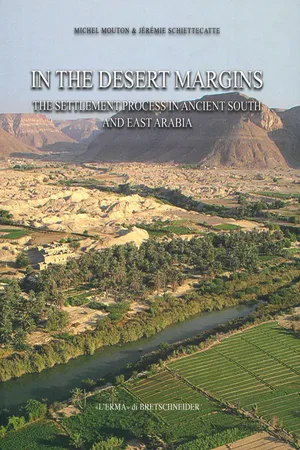
In the Desert Margins the Settlement Process in an Ancient South and East Arabia
- 337 pages
- English
- PDF
- Available on iOS & Android
eBook - PDF
In the Desert Margins the Settlement Process in an Ancient South and East Arabia
About this book
Ancient Arabia has promptly been pictured as a vast empty desert. Yet, for the last 40 years, by digging out of the sand buried cities, archaeological researches deeply renewed this image. From the second half of the 1st millennium BC to the eve of Islam in East Arabia, and as early as the 8th century BC in South Arabia, the settlement process evolved into urban societies. This study aims at reviewing this process in South and East Arabia, highlighting the environmental constraints, the geographical disparities and the responses of the human communities to ensure their subsistence and to provide for their needs. Evolution was endogenous, far from the main corridors of migrations and invasions. Influences from the periphery did not cause any prominent change in the remarkably stable communities of inner Arabia in antiquity. The settlement process and the way of life was primarily dictated by access to water sources and to the elaboration of ever-spreading irrigation systems. Beyond common traits, two models characterise the ancient settlement pattern on the arid margins of eastern and southern Arabia. In South Arabia, the settlement model for the lowland valleys and highland plateaus results from a long-term evolution of communities whose territorial roots go back to the Bronze Age. It grew out of major communal works to harness water. Into a territory of irrigated farmland, the south- Arabian town appeared as a central place. Settlements constituted networks spread across the valleys and the plateaus. Each network was dominated by a main town, the centre of a sedentary tribe, the capital of a kingdom. In East Arabia, the settlement pattern followed a different model which emerged in the last centuries BC along the routes crossing the empty spaces of the steppe, in a nomadic environment. Each community spread over no more than one, two or three settlements. These settlements never grew very large and the region was not urbanised to the same degree as in the southwest of the Arabian Peninsula. Permanent settlements were places for exchanges and meetings, for craft productions, for worship, where the political elites resided, where the wealth from long-distance trading was gathered, and where surplus from the regional economy was held. Each town was isolated, like an island in an empty space. Dr Hdr Michel Mouton Archaeologist at the French National Centre for Scientific Research (CNR S), Michel Mouton has been director of the French archaeological expedition in Sharjah from 1991 to 1997 (excavations at Mleiha and al-Madam); director of the French archaeological expedition in the Jawf-Hadramawt from 1995 to 2006 (excavations at Qan', Makaynn, and surveys of the Yemen territory) and head of the project "Early Petra" from the National Agency for Research (2008-2012). From 2000 to 2002, he has been general secretary of the French Institute in the Near-East (IFPO, Damascus / Beirut / Amman), and deputy director in 2003. At the present time, he is director of the French Research Centre for Archaeology and Social Sciences in the Arabian Peninsula (CEFAS, Jeddah / Sanaa). Dr Jérémie Schiettecatte Archaeologist and researcher at the French National Centre for Scientific Research (CNR S), in Paris, Jérémie Schiettecatte holds a PhD in Near-Eastern archaeology from the Sorbonne University. He focuses on the study of the settlement process in arid lands. His current interests lay in the analysis of the evolution of settlement patterns in the Arabian Peninsula from the Bronze Age to the Islamic period. Since 2000, he has been working in Bahrain, United Arab Emirates, Yemen and Saudi Arabia. After having directed the archaeological mission in Hasi, Yemen (2008-2011), he is heading since 2011, together with A. al-Ghazzi, the French Saudi Archaeological Project in al-Kharj (Riyadh Province, Saudi Arabia).
Information
Subtopic
Ancient HistoryIndex
HistoryTable of contents
Trusted by 375,005 students
Access to over 1.5 million titles for a fair monthly price.
Study more efficiently using our study tools.
Frequently asked questions
Yes, you can cancel anytime from the Subscription tab in your account settings on the Perlego website. Your subscription will stay active until the end of your current billing period. Learn how to cancel your subscription
No, books cannot be downloaded as external files, such as PDFs, for use outside of Perlego. However, you can download books within the Perlego app for offline reading on mobile or tablet. Learn how to download books offline
We are an online textbook subscription service, where you can get access to an entire online library for less than the price of a single book per month. With over 1.5 million books across 990+ topics, we’ve got you covered! Learn about our mission
Look out for the read-aloud symbol on your next book to see if you can listen to it. The read-aloud tool reads text aloud for you, highlighting the text as it is being read. You can pause it, speed it up and slow it down. Learn more about Read Aloud
Yes! You can use the Perlego app on both iOS and Android devices to read anytime, anywhere — even offline. Perfect for commutes or when you’re on the go.
Please note we cannot support devices running on iOS 13 and Android 7 or earlier. Learn more about using the app
Please note we cannot support devices running on iOS 13 and Android 7 or earlier. Learn more about using the app
Yes, you can access In the Desert Margins the Settlement Process in an Ancient South and East Arabia by Michel Mouton,Jeremie Schiettecatte in PDF and/or ePUB format, as well as other popular books in History & Ancient History. We have over 1.5 million books available in our catalogue for you to explore.