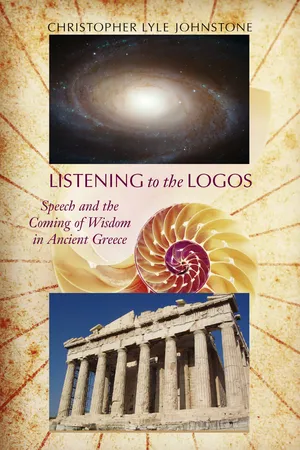
Listening to the Logos
eBook - ePub

Listening to the Logos

Speech and the Coming of Wisdom in Ancient Greece

  1. 312 pages
  2. English
  3. ePUB (mobile friendly)
  4. Available on iOS & Android
eBook - ePub

Listening to the Logos

Speech and the Coming of Wisdom in Ancient Greece

About this book

An exploration of the role of language arts in forming and expressing wisdom from Homer to Aristotle

In Listening to the Logos, Christopher Lyle Johnstone provides an unprecedented comprehensive account of the relationship between speech and wisdom across almost four centuries of evolving ancient Greek thought and teachings—from the mythopoetic tradition of Homer and Hesiod to Aristotle's treatises.

Johnstone grounds his study in the cultural, conceptual, and linguistic milieu of archaic and classical Greece, which nurtured new ways of thinking about and investigating the world. He focuses on accounts of logos and wisdom in the surviving writings and teachings of Homer and Hesiod, the Presocratics, the Sophists and Socrates, Isocrates and Plato, and Aristotle. Specifically Johnstone highlights the importance of language arts in both speculative inquiry and practical judgment, a nexus that presages connections between philosophy and rhetoric that persist still. His study investigates concepts and concerns key to the speaker's art from the outset: wisdom, truth, knowledge, belief, prudence, justice, and reason. From these investigations certain points of coherence emerge about the nature of wisdom—that wisdom includes knowledge of eternal principles, both divine and natural; that it embraces practical, moral knowledge; that it centers on apprehending and applying a cosmic principle of proportion and balance; that it allows its possessor to forecast the future; and that the oral use of language figures centrally in obtaining and practicing it.

Johnstone's interdisciplinary account ably demonstrates that in the ancient world it was both the content and form of speech that most directly inspired, awakened, and deepened the insights comprehended under the notion of wisdom.

Frequently asked questions

Yes, you can cancel anytime from the Subscription tab in your account settings on the Perlego website. Your subscription will stay active until the end of your current billing period. Learn how to cancel your subscription.
At the moment all of our mobile-responsive ePub books are available to download via the app. Most of our PDFs are also available to download and we're working on making the final remaining ones downloadable now. Learn more here.
Perlego offers two plans: Essential and Complete
  • Essential is ideal for learners and professionals who enjoy exploring a wide range of subjects. Access the Essential Library with 800,000+ trusted titles and best-sellers across business, personal growth, and the humanities. Includes unlimited reading time and Standard Read Aloud voice.
  • Complete: Perfect for advanced learners and researchers needing full, unrestricted access. Unlock 1.4M+ books across hundreds of subjects, including academic and specialized titles. The Complete Plan also includes advanced features like Premium Read Aloud and Research Assistant.
Both plans are available with monthly, semester, or annual billing cycles.
We are an online textbook subscription service, where you can get access to an entire online library for less than the price of a single book per month. With over 1 million books across 1000+ topics, we’ve got you covered! Learn more here.
Look out for the read-aloud symbol on your next book to see if you can listen to it. The read-aloud tool reads text aloud for you, highlighting the text as it is being read. You can pause it, speed it up and slow it down. Learn more here.
Yes! You can use the Perlego app on both iOS or Android devices to read anytime, anywhere — even offline. Perfect for commutes or when you’re on the go.
Please note we cannot support devices running on iOS 13 and Android 7 or earlier. Learn more about using the app.
Yes, you can access Listening to the Logos by Christopher Lyle Johnstone in PDF and/or ePUB format, as well as other popular books in Languages & Linguistics & Communication Studies. We have over one million books available in our catalogue for you to explore.
Index
Academy, 148, 151, 163, 189–90
Achilles, 19–20, 28, 32
aêr, 51, 72, 75, 235n32
Against the Schoolmasters (Sextus), 98
Against the Sophists (Isocrates), 153
Agamemnon, 19–20, 28, 32, 40–41
Agathon, 175–76
agôn, 41–42, 83–84, 90, 99, 115, 137, 145, 221. See also elenchos; eristic
aidôs, 93, 245n14
aitia, 194, 197, 200–201, 206
akrasia, 135, 256–57n90
Alcibiades, 127, 141, 149, 179, 258nn3–4
Alexander the Great, 190–91, 231n39, 264n5
Anaxagoras, 71–72
and nous, 72–74
Anaximander, 46–51, 233n21, 233n23, 234n27, 235n30
DK 12 A9, 149
Anaximenes, 51, 235nn31–32
Andronicus, 264–65n6
Antidosis (Isocrates), 146, 154, 157, 259–60n13, 260n15
Antiphon, 95–97, 144, 245n13, 246n19, 247n23
apeiron, 47–51, 234n25, 234n27, 235n32
Aphrodite, 19–21, 174
Apollo, 19, 28, 32, 64, 89
priestess of Pythian Apollo at Delphi, 128, 230n33
Apologia (Xenophon), 125
Apology (Plato), 86, 127–28, 132–33, 135
aporia, 128, 138, 165, 182, 208
archai, 83, 186, 194, 196–98, 200–201, 205–6, 213
archê, 7, 34, 73, 84–85, 232n15
and Anaximander, 46–50, 72, 234n25
and Anaximenes, 51, 235n32
and Aristotle, 201, 204
and Diogenes, 75, 242n87
and Thales, 42–46
Archelaus, 74, 86, 127
archên, 42, 47
Archidamus (Isocrates), 154
A...

Table of contents

  1. Cover
  2. Half title
  3. Title
  4. Copyright
  5. Dedication
  6. Contents
  7. Series Editor’s Preface
  8. Acknowledgments
  9. Prologue
  10. One The Greek Stones Speak: Toward an Archaeology of Consciousness
  11. Two Singing the Muses’ Song: Myth, Wisdom, and Speech
  12. Three Physis, Kosmos, Logos: Presocratic Thought and the Emergence of Nature-Consciousness
  13. Four Sophistical Wisdom, Socratic Wisdom, and the Political Life
  14. Five Civic Wisdom, Divine Wisdom: Isocrates, Plato, and Two Visions for the Athenian Citizen
  15. Six Speculative Wisdom, Practical Wisdom: Aristotle and the Culmination of Hellenic Thought
  16. Epilogue
  17. Notes
  18. Bibliography
  19. Index