eBook - ePub
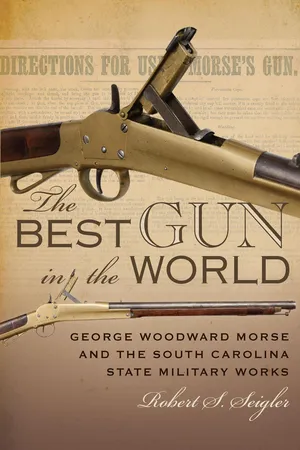
The Best Gun in the World
George Woodward Morse and the South Carolina State Military Works
- 296 pages
- English
- ePUB (mobile friendly)
- Available on iOS & Android
eBook - ePub
The Best Gun in the World
George Woodward Morse and the South Carolina State Military Works
About this book
A thoroughly researched account of weapons innovation and industrialization in South Carolina during the Civil War and the man who made it happen.
A year after seceding from the Union, South Carolina and the Confederate States government faced the daunting challenge of equipping soldiers with weapons, ammunition, and other military implements during the American Civil War. In The Best Gun in the World, Robert S. Seigler explains how South Carolina created its own armory and then enlisted the help of a weapons technology inventor to meet the demand. Seigler mined state and federal factory records, national and state archives, and US patents for detailed information on weapons production, the salaries and status of free and enslaved employees, and other financial records to reveal an interesting, distinctive story of technological innovation and industrialization in South Carolina.
George Woodward Morse, originally from New Hampshire, was a machinist and firearms innovator, who settled in Louisiana in the 1840s. He invented a reliable breechloading firearm in the mid-1850s to replace muzzleloaders that were ubiquitous throughout the world. Essential to the successful operation of any breechloader was its ammunition, and Morse perfected the first metallic, center-fire, pre-primed cartridge, his most notable contribution to the development of modern firearms.
The US War Department tested Morse rifles and cartridges prior to the beginning of the Civil War and contracted with the inventor to produce the weapons at Harpers Ferry Armory. However, when the war began, Morse, a slave-holding plantation owner, determined that he could sell more of his guns in the South. The South Carolina State Military Works originally designed to cast cannon, produced Morse's carbine and modified muskets, brass cartridges, cartridge boxes, and other military accoutrements. The armory ultimately produced only about 1,350 Morse firearms. For the next twenty years, Morse sought to regain his legacy as the inventor of the center-fire brass cartridges that are today standard ammunition for military and sporting firearms.
"Does justice to one of the greatest stories in American firearms history. If George Woodward Morse had not sided with the Confederacy, his name might be as famous today as Colt or Winchester." —Gordon L. Jones, Atlanta History Center
"Excellent and well-researched." —Patrick McCawley, South Carolina Department of Archives and History
"For connoisseurs and scholars of military history (especially Civil War), history of technology, or Southern/South Carolina history, this is a must-read and reference volume pertaining to a previously little-known aspect of the nineteenth century that had a far-reaching impact in the manner wars would be fought by soldiers decades later." —Barry L. Stiefel, College of Charleston
Trusted by 375,005 students
Access to over 1.5 million titles for a fair monthly price.
Study more efficiently using our study tools.
Information
CHAPTER 1

George Woodward Morse

George Woodward Morse ca. 1846–1847. Courtesy of Atlanta History Center.
George Woodward Morse was an eighth-generation American of English descent. The American patriarch of the family was Anthony Morse, who immigrated to New England in 1635. Stephen Morse, George’s grandfather, was among the first settlers of Haverhill, New Hampshire, where George was born.1 Bryan Morse, George’s father, was a blacksmith, cabinetmaker, staunch abolitionist, and preacher in the Methodist Episcopal Church in Haverhill. He married twice. With his first wife, Susannah Stevens, he had six children, including George, and with his second wife, Eliza D. Torr Repill, there were three offspring.2 We know very little about the relationship between Bryan and his children, but the four who moved to Louisiana in the 1830s held views of slavery that were diametrically opposed to Bryan’s. Reflecting the division within the family concerning slavery, the New Hampshire Gazette printed in 1850 that George’s older brother, Peabody, had emigrated many years ago to New Orleans, “where he forgot all his father’s counsels, who was an early and zealous abolitionist.”3 Though George became a strong advocate for both the personal and public ownership of slaves, he maintained a relationship with his father until the late 1850s and with his brother, Isaac, until well after the end of the Civil War.

Haverhill Academy, Haverhill, New Hampshire, where George W. Morse was educated. By permission of Haverhill Historical Society.

Reverend Bryan Morse (1781–1863), George’s father. He was a blacksmith, cabinetmaker, Methodist Episcopal preacher, and zealous abolitionist. Four of his children spent most of their adult lives as slaveholders in Louisiana. Courtesy of Atlanta History Center.
Many writers incorrectly claim a close relationship between George W. Morse and Samuel Finley Breese Morse, coinventor of the Morse code. The error originated in George’s obituary and was perpetuated in a variety of journals and publications.4 One of George’s attorneys, James A. Skilton, wrote in 1872 that George was the namesake and relative of S. F. B. Morse, who had died that April. Skilton was probably embellishing the relationship between the two men so that the U.S. Congress would look favorably upon Morse’s current appeals for extension of his patents.5 George, himself, never claimed a close relationship. In all likelihood, the two men’s common ancestor was Anthony Morse, George’s great-great-great-great-grandfather.
George and his five full siblings, Horace Bassett, Peabody Atkinson, Priscilla Peabody, Isaac Stevens, and Rebecca Carleton, were born in Haverhill. All but Horace played a role in George’s adult life. His three half-siblings—Joseph, Mary, and Virginia—were the children of Bryan and Eliza; they were all born in Haverhill and all died at a young age in the 1820s.
The oldest, Horace Bassett, was born in 1804. He was graduated from Dartmouth in 1823 and was the principal of Portsmouth Academy when he died in a drowning accident in Portsmouth Harbor in 1825 at the age of twenty-one.6 The family was soon divided. George’s father; his brother, Isaac; and probably his sisters moved to Lowell, Massachusetts, in 1833. George’s father later moved to Groveland, Massachusetts, where he died in 1863.7 Also in the early 1830s, Peabody began what would become a family migration to Louisiana, and eventually Priscilla, Rebecca, and George joined him in a settled lifestyle there by 1840.
Though the fifth-born sibling, Isaac Steven, remained in Massachusetts, he played a significant role in George’s later life. He attended Dartmouth College and Cambridge Law School, was admitted to the bar in 1840, practiced law in Lowell and Cambridge, Massachusetts, and was district attorney for Middlesex County from 1855 to 1871.8 Highly respected in his profession, Isaac maintained contact with George well into the 1870s, assisting him in his postwar lawsuits against the federal government.
Peabody Atkinson Morse was the second-born and was seven years older than George. His major influence on the family was that he led three of his siblings, including George, to a life in Louisiana. Peabody was born in 1805 in Haverhill and was graduated from Dartmouth College in the class of 1830.9 From 1830 to 1833 he lived in Fredericksburg, Virginia, where he studied law under Virginia Court of Appeals justice Francis Taliaferro Brooke.10 Peabody established a law practice in Natchitoches, Louisiana, about 1833.11 He married Virginia Sompayrac in 1837 and established the nearby town of Ninock the same year. Peabody served in the Louisiana House of Representatives and rose to the rank of major general in the Louisiana Militia.12 About 1849, Peabody moved to San Francisco, California, where he served as chief justice of the Superior Court of San Francisco in 1850 and 1851.13 By August 1855 Peabody moved back to Louisiana, where he remained active in politics and in managing his wife’s large estates until his death in 1878.14 George’s two younger sisters, Priscilla and Rebecca, followed Peabody to Natchitoches in the 1830s and, in 1840, both married Virginia Sompayrac’s brothers, deepening the Morse family roots in northwest Louisiana. Priscilla, born in 1814, married Adolphe Sompayrac, and Rebecca, born in 1820, married Paul Victor Sompayrac. George soon joined his siblings in Louisiana.

Peabody Atkinson Morse (1805–1878), George’s brother, photograph taken ca. 1858–59. Peabody was a Louisiana attorney, chief justice of the Superior Court of San Francisco, and major general in the Louisiana militia. Courtesy of Atlanta History Center.
George was born in Haverhill, New Hampshire, on May 10, 1812, the third-born child.15 He was named for his father’s good friend and prominent Haverhill attorney and banker, George Woodward (August 20, 1776–December 5, 1836).16 George Morse was educated at the Haverhill Academy, the extent of his formal education. He displayed mechanical and inventive skills at an early age. His personal letters and professional reports from the 1840s through the 1870s reflect a man of intelligence, education, and creativity. Morse’s grammar, vocabulary, and mastery of the complex technical aspects of the disciplines of surveying and civil engineering seem to reflect a college education, though he had none.
Various family traditions and undocumented claims state incorrectly that George moved to Louisiana in the early 1830s when, in fact, he was living in Boston and England until very late in the decade.17 The correct version of events comes from an affidavit written in 1870 by George’s brother and Boston-area attorney, Isaac, and a deposition given by George in 1872.18 George testified that he worked with Captain Eliphalet Smith in Quincy Point, Massachusetts, in 1829 or 1830, when he was seventeen or eighteen years old. In 1830 or 1831, George moved to Boston to work with Otis Tufts, a machinist who invented a steam pile driver. After only fifteen months of employment, Morse was foreman of Tufts’s machine shop making steam engines, printing presses, and running gear for railroad cars. Morse even lived in Tufts’s home in 1834 and 1835.19
It was during his years spent with Tufts that Morse began to acquire experience with mechanical processes. His obituary states, “as a boy [he] identified with labor-saving inventions and manufactures in Boston.”20 Morse assisted Tufts in the development of a simplified printing press that could print eighteen sheets per minute. When they added steam power to the new machine, it became the first steam-powered printing press in the United States. Tufts introduced the new machine to the public, and Morse set it up in various Boston offices and even learned to print books on it.21 Because the new press was so promising, a group of capitalists planned to apply for patents in England and delegated Morse as their representative.22 Accompanying the new invention, Morse sailed for London about 1835 on a two-year journey that exposed him to high-ranking British officials and engineers who would later play a role in the development of his firearms. The printing press proved to be such a labor-saving machine that some workmen intentionally damaged it to prevent its coming into general use. Morse repaired it and subsequently printed three novels by the Irish author Marguerite Gardiner, Countess of Blessington, and a popular annual she edited in 1837 called the Keepsake. Building on his success in England, Morse made a contract with noted engineer brothers George and Sir John Rennie of Blackfriars Road, London, to manufacture one hundred presses. While still in London, Morse worked on a new steam engine, which brought him into contact with a noted American inventor, Jacob Perkins; a Scottish diplomat, Lord Napier; and another famous English engineer, I. K. Brunel. During that time the Rennies offered Morse an annual salary of five hundred pounds if he would remain as superintendent of their machine works, but he declined the offer.23
Between 1830 and 1837, Morse developed from an eighteen-year-old machinist’s apprentice into a twenty-five-year-old young man who had helped develop a new invention with worldwide practical applications and had accompanied the device across the ocean as its sole representative. His contact with Tufts provided him with two critical experiences. First, it allowed him to acquire practical skills and knowledge of manufacturing processes which led to his later inventions.24 Second, it fostered his inventive spirit and allowed him to participate in a highly successful invention from concept to market. His sojourn in England provided him with invaluable experience in explaining innovative, complicated technology to skeptics, and in becoming comfortable around men of wealth, power, and professional stature. These experiences paid off in the late 1850s when he was trying to get the U.S. government to see the remarkable features of his new breechloader and its accompanying metallic, center-fire cartridge.
After a two-year stay in London, Morse arrived in New York onboard the packet ship St. James on December 27, 1837.25 He soon joined Peabody, Priscilla, and Rebecca in Natchitoches. A gap in our knowledge of Morse’s exact whereabouts exists for the years 1838 and 1839, but he was likely living in Louisiana at that time. Isaac recalled after the Civil War that George returned to the United States about 1839 and soon moved to Louisiana.26 It is possible that George made a second trip to England in 1838 or 1839, but more likely Isaac remembered the date incorrectly. A search of city directories from England between 1836 and 1840 did not reveal Morse’s name. We know that George was livi...
Table of contents
- Cover
- Title Page
- Copyright
- Contents
- Acknowledgments
- Introduction
- Chapter 1. George Woodward Morse
- Chapter 2. Morse’s Early Patents
- Chapter 3. Nathan M. Muzzy
- Chapter 4. War Department Evaluations, 1857–1858
- Chapter 5. Springfield Armory
- Chapter 6. Morse’s New Carbine, 1860
- Chapter 7. Morse in Late 1860 and Early 1861
- Chapter 8. Harpers Ferry, Nashville, and Atlanta
- Chapter 9. South Carolina State Military Works and David Lopez Jr.
- Chapter 10. 1862
- Chapter 11. Morse Comes to South Carolina
- Chapter 12. Labor
- Chapter 13. 1863
- Chapter 14. Lopez’s Resignation and Successor
- Chapter 15. Morse’s Brass-frame Carbine
- Chapter 16. Sale of the State Works
- Chapter 17. Late 1863 and 1864
- Chapter 18. 1865
- Chapter 19. State Military Works and Lopez, Postwar
- Chapter 20. Morse’s Postwar Patent Petitions and Lawsuits
- Chapter 21. Morse’s Final Productivity
- Conclusion
- Appendix 1. Inventory of Machinery, Tools, and Stock of Tennessee Armory, Atlanta, March 1862
- Appendix 2. Surviving Morse Firearms Listed by Serial Number
- Appendix 3. List of Slave Workers
- Appendix 4. List of White Employees
- Appendix5. Total Production of Morse’s Firearms
- Notes
- Bibliography
- Index
Frequently asked questions
Yes, you can cancel anytime from the Subscription tab in your account settings on the Perlego website. Your subscription will stay active until the end of your current billing period. Learn how to cancel your subscription
No, books cannot be downloaded as external files, such as PDFs, for use outside of Perlego. However, you can download books within the Perlego app for offline reading on mobile or tablet. Learn how to download books offline
Perlego offers two plans: Essential and Complete
- Essential is ideal for learners and professionals who enjoy exploring a wide range of subjects. Access the Essential Library with 800,000+ trusted titles and best-sellers across business, personal growth, and the humanities. Includes unlimited reading time and Standard Read Aloud voice.
- Complete: Perfect for advanced learners and researchers needing full, unrestricted access. Unlock 1.5M+ books across hundreds of subjects, including academic and specialized titles. The Complete Plan also includes advanced features like Premium Read Aloud and Research Assistant.
We are an online textbook subscription service, where you can get access to an entire online library for less than the price of a single book per month. With over 1.5 million books across 990+ topics, we’ve got you covered! Learn about our mission
Look out for the read-aloud symbol on your next book to see if you can listen to it. The read-aloud tool reads text aloud for you, highlighting the text as it is being read. You can pause it, speed it up and slow it down. Learn more about Read Aloud
Yes! You can use the Perlego app on both iOS and Android devices to read anytime, anywhere — even offline. Perfect for commutes or when you’re on the go.
Please note we cannot support devices running on iOS 13 and Android 7 or earlier. Learn more about using the app
Please note we cannot support devices running on iOS 13 and Android 7 or earlier. Learn more about using the app
Yes, you can access The Best Gun in the World by Robert S. Seigler in PDF and/or ePUB format, as well as other popular books in History & American Civil War History. We have over 1.5 million books available in our catalogue for you to explore.