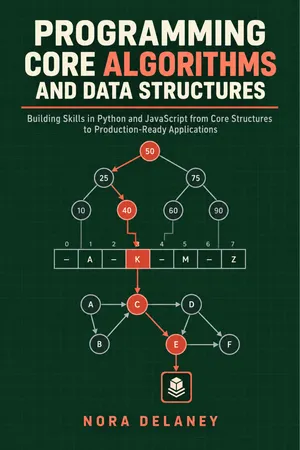
Programming Core Algorithms and Data Structures
eBook - ePub

Programming Core Algorithms and Data Structures

Building Skills in Python and JavaScript from Core Structures to Production-Ready Applications

  1. English
  2. ePUB (mobile friendly)
  3. Available on iOS & Android
eBook - ePub

Programming Core Algorithms and Data Structures

Building Skills in Python and JavaScript from Core Structures to Production-Ready Applications

About this book

Most algorithm books prove things. This one shows you what each choice costs in code you can run.

You will count operations before trusting a benchmark, then build dynamic arrays, hash tables, linked lists, stacks, queues and heaps in both Python and JavaScript and watch where each one falls over. You will write merge sort, quicksort and heapsort, get binary search boundaries right, balance a search tree, build a trie for prefix search, and traverse graphs with breadth-first and depth-first search before moving to Dijkstra, minimum spanning trees and union-find. Closing chapters cover greedy reasoning, memoisation and tabulation, and how to choose a structure for a real service under memory and latency budgets.

Written for self-taught developers, bootcamp graduates and interview candidates, this book bridges the gap between theoretical computer science and the practical decisions you make every day. Instead of abstract proofs, you will measure, compare, and implement. Each chapter pairs conceptual explanation with runnable code in two languages, so you can see exactly how the same algorithm behaves differently in Python and JavaScript. You will learn to reason about time and space complexity not as a notation exercise but as a tool for predicting performance before you ship.

What you will learn:

• Count operations and interpret benchmarks to compare algorithms fairly
• Build dynamic arrays, hash tables, linked lists, stacks, queues and heaps in Python and JavaScript
• Implement elementary and divide-and-conquer sorting, including merge sort, quicksort and heapsort
• Get binary search boundaries right and work effectively with sorted data
• Balance a binary search tree and understand the trade-offs of different balancing strategies
• Build a trie for prefix search and apply it to text processing tasks
• Traverse graphs with breadth-first and depth-first search, then move to Dijkstra, minimum spanning trees and union-find
• Apply greedy reasoning, memoisation and tabulation to optimisation problems
• Choose the right data structure for a production service under memory and latency budgets

If you are a self-taught developer, a bootcamp graduate, or an interview candidate who wants to move beyond memorising solutions, this book gives you the mental models and hands-on practice to make confident, evidence-based decisions about algorithms and data structures in real code.

Information

Year
2026
eBook ISBN
9798259675957

Table of contents

  1. Foreword
  2. Preface
  3. About This Book
  4. Chapter 1: Counting Operations
  5. Chapter 2: Arrays, Dynamic Resizing and Strings
  6. Chapter 3: Hash Tables
  7. Chapter 4: Linked Lists, Stacks and Queues
  8. Chapter 5: Recursion and the Call Stack
  9. Chapter 6: Elementary Sorting
  10. Chapter 7: Divide-and-Conquer Sorting
  11. Chapter 8: Binary Search and Sorted Data
  12. Chapter 9: Binary Search Trees and Balancing
  13. Chapter 10: Heaps and Priority Queues
  14. Chapter 11: Tries and Text Processing
  15. Chapter 12: Graphs
  16. Chapter 13: Shortest Paths, Spanning Trees and Union-Find
  17. Chapter 14: Greedy and Dynamic Programming, and Choosing Structures in Production
  18. Conclusion
  19. Acknowledgements
  20. Glossary
  21. Sources and Further Reading
  22. About the Author
  23. A Request from the Author

Trusted by 375,005 students

Access to over 1.5 million titles for a fair monthly price.

Study more efficiently using our study tools.

Frequently asked questions

Yes, you can cancel anytime from the Subscription tab in your account settings on the Perlego website. Your subscription will stay active until the end of your current billing period. Learn how to cancel your subscription
No, books cannot be downloaded as external files, such as PDFs, for use outside of Perlego. However, you can download books within the Perlego app for offline reading on mobile or tablet. Learn how to download books offline
Perlego offers two plans: Essential and Complete
  • Essential is ideal for learners and professionals who enjoy exploring a wide range of subjects. Access the Essential Library with 800,000+ trusted titles and best-sellers across business, personal growth, and the humanities. Includes unlimited reading time and Standard Read Aloud voice.
  • Complete: Perfect for advanced learners and researchers needing full, unrestricted access. Unlock 1.5M+ books across hundreds of subjects, including academic and specialized titles. The Complete Plan also includes advanced features like Premium Read Aloud and Research Assistant.
Both plans are available with monthly, semester, or annual billing cycles.
We are an online textbook subscription service, where you can get access to an entire online library for less than the price of a single book per month. With over 1.5 million books across 990+ topics, we’ve got you covered! Learn about our mission
Look out for the read-aloud symbol on your next book to see if you can listen to it. The read-aloud tool reads text aloud for you, highlighting the text as it is being read. You can pause it, speed it up and slow it down. Learn more about Read Aloud
Yes! You can use the Perlego app on both iOS and Android devices to read anytime, anywhere — even offline. Perfect for commutes or when you’re on the go.
Please note we cannot support devices running on iOS 13 and Android 7 or earlier. Learn more about using the app
Yes, you can access Programming Core Algorithms and Data Structures by Nora Delaney, Artificial intelligence in PDF and/or ePUB format, as well as other popular books in Computer Science & Computer Engineering. We have over 1.5 million books available in our catalogue for you to explore.