"It is likely as fine-grained an account of the actions of the Yamasee War as we are to possess for decades." —
H-Net Reviews
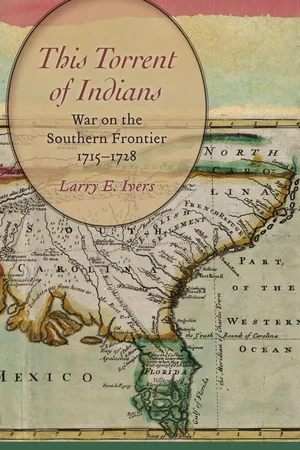
The southern frontier could be a cruel and unforgiving place during the early eighteenth century. The British colony of South Carolina was in proximity and traded with several Native American groups. The economic and military relationships between the colonialists and natives were always filled with tension but the Good Friday 1715 uprising surprised Carolinians by its swift brutality. Larry E. Ivers examines the ensuing lengthy war in
This Torrent of Indians. Named for the Yamasees because they were the first to strike, the war persisted for thirteen years and powerfully influenced colonial American history.
Ivers's detailed narrative and analyses demonstrates the horror and cruelty of a war of survival. The organization, equipment, and tactics used by South Carolinians and Native Americans were influenced by the differing customs but both sides acted with savage determination to extinguish their foes. Ultimately, it was the individuals behind the tactics that determined the outcomes. Ivers shares stories from both sides of the battlefield—tales of the courageous, faint of heart, inept, and the upstanding. He also includes a detailed account of black and Native American slave soldiers serving with distinction alongside white soldiers in combat. Ivers gives us an original and fresh, ground-level account of that critical period, 1715 to 1728, when the southern frontier was a very dangerous place.
"Comprehensive and highly readable . . . This book will be a classic of Southern history." —Lawrence S. Rowland, Professor Emeritus, University of South Carolina at Beaufort
- 304 pages
- English
- ePUB (mobile friendly)
- Available on iOS & Android
eBook - ePub
About this book
Trusted by 375,005 students
Access to over 1.5 million titles for a fair monthly price.
Study more efficiently using our study tools.
Information


Warnings of War, April 10–14, 1715
On Sunday, April 10, 1715, two South Carolinians, Samuel Warner and William Bray, saddled their horses in preparation for a long, difficult ride to Charles Town, present-day Charleston. They were in the Upper Yamasee Indian town of Pocotaligo on the mainland of southwestern South Carolina. The town was located about 13.5 miles northwest of the present-day city of Beaufort. Both men were in a hurry. Their lives and the lives of their fellow South Carolinians were in danger. Several prominent Yamasees and men from other Indian groups had recently conferred in Pocotaligo and debated whether to declare war on South Carolina. The Yamasees had already completed their war-making ritual. Warner and Bray crossed the adjacent Pocotaligo River to the east, probably in a dugout canoe, while their horses swam behind or alongside. They rode north and then east for about a dozen miles, across the head of swamps and through savannahs. Their route lay along an unimproved dirt path, through the Yamasee reservation, commonly known as the Indian Land. They crossed the Combahee River on Joseph Bryan’s Ferry and rode east into Colleton County.1
Samuel Warner was an Indian trader. He sold British guns, ammunition, iron tools, and cloth to the Yamasees and to the nearby Lower Creek Indians of Palachacola. Warner seems to have been an honest man; there are no records of any Indian complaints against his trading practices. While he was in Palachacola during early April, some warriors informed him that they were distressed because of the abuse and threats meted out by their white traders. They were angry with the government of South Carolina for its refusal to discipline the traders. They vowed that they and other Lower Creeks would kill the traders and go to war the next time a trader offended them.2
William Bray was an Indian trader to the Yamasees. He sometimes served as an interpreter for the South Carolina Indian commissioners. The Indians had made several complaints against him. One complaint involved his sale of a free Indian woman and her child into slavery, probably to collect payment for debts owed by her husband. Nevertheless an Indian, called Cuffy by South Carolinians, was his friend. Cuffy resided in the Yamasee town of Euhaw. During the first week in April, Cuffy visited his wife, Phillis, and daughter, Hannah, who were Indian slaves owned by Landgrave Edmund Bellinger. They may have resided on Bellinger’s Ashepoo Barony, located west of the conflux of the Ashepoo River and Horseshoe Creek in Colleton County. Either before or after his visit, Cuffy took a side trip to Bray’s plantation. He met with Bray’s wife and informed her that the Lower Creek Indians, most of whose towns were located to the west in present-day Butts County, Georgia, were planning to kill their traders and attack South Carolina’s plantations. When Bray returned home, his wife warned him of the threat.3
Warner and Bray may have initially questioned the seriousness of the information. However, on April 10, several angry and troubled Yamasee headmen and warriors approached them. The Indians complained regarding the conduct of the white traders who served their towns. Some traders were threatening to seize all of the Yamasees’ families and sell them into slavery as payment for the warriors’ trading debts. Their debts had grown so great as to be unpayable. Based on the traders’ past conduct, the threats seemed credible to the Yamasees. They demanded that the South Carolina governor meet with them and redress their grievances. Otherwise, they warned, they would kill the traders and attack the colony. Bray and Warner took the warning seriously and pleaded for time to inform the governor.4
The straight-line distance from Pocotaligo to Charles Town is about fifty-five miles. The dirt path that skirted the worst of the cypress swamps, marshes, and boggy savannahs caused the actual distance to increase by several miles. In their haste Bray and Warner would have taken less than two days to reach Charles Town.5
After crossing the Combahee River, Warner and Bray went east-northeast over the Combahee Marsh causeway. They passed John Jackson’s plantation and entered the widespread frontier cowpens of Colleton County on South Carolina’s southwestern frontier. About 120 families resided in two principal locations: on the western side of the county near the head of Chehaw River, now known as the Old Chehaw River, and on the eastern side close to the Edisto River, near present-day Jacksonboro. The riders continued generally east, through the forest of longleaf pine to a bridge over the Ashepoo River south of Horseshoe Creek. They were near the center of Colleton County.6
Warner and Bray rode fast, day and night, and would have exhausted their horses. The riders would have exchanged horses, more than once, with the owners or overseers of plantations known as cowpens, most of which were situated near large grass savannahs along the route. They would also have eaten some food, probably at the homes of cowpen owners. The two men may have warned the people living near the path of the impending danger, but there is no indication that anyone took effective precautions. It would have taken more than an unsubstantiated warning of a possible Indian attack to convince people to leave their homes and property.
After crossing the Ashepoo River, Warner and Bray rode north and east to the Edisto River. Much of the land along that portion of the path was cypress swamp. They likely crossed the Edisto on the newly constructed Pon Pon Bridge, close to another of John Jackson’s plantations, near present-day Jacksonboro. They left Colleton County and continued east in Berkeley County, present-day Charleston County, on the Charles Town Road. That part of the colony was more thickly settled. The land was mostly oak and hickory forest, and some savannah. Some land had been cleared and was planted in corn and beans. Rice was making its appearance as a cash crop.7
The riders crossed two branches of the upper reaches of the Stono River, probably using the bridges near the plantations of James LaRoche and Thomas Elliott. They continued eastward to the Ashley River Ferry. After crossing the Ashley River, they turned south and rode down the Broad Path on the “Neck,” or peninsula, toward Charles Town. They probably went directly to the recently constructed governor’s home. It was located about 3.75 miles north of the southern tip of present-day Charleston, and about half a mile west of the Cooper River.8
Werner and Bray arrived on April 12, 1715, and reported to Gov. Charles Craven (1712–16). The governor called together members of his council and some members of the Board of Commissioners of the Indian Trade. They listened to the reports of the two traders and realized the gravity of the situation. They decided that the governor should meet with the headmen of the Yamasees and Lower Creeks, as soon as possible, and hear their complaints. Letters from the governor were quickly prepared for the Yamasees in Pocotaligo and the Lower Creek towns of Palachacola and Coweta. The letters informed the headmen that the governor and a military escort were on the way to Savannah Town, also known as Savano Town, on the upper Savannah River. They would meet there and confer with the Indians’ representatives. Warner, who was apparently considered the more reliable of the two traders, was given the task of delivering the letters. He was directed to return to Pocotaligo, continue westward to Palachacola, and then ride on to Coweta on Ochese Creek, the present-day Ocmulgee River.9
The governor would have provided Warner and Bray with food and replacement horses during their short stay in Charles Town. They began their return ride late Tuesday, April 12, or early the next morning. They arrived, undoubtedly exhausted, in Pocotaligo on Thursday, April 14, and delivered the letters to Thomas Nairne, South Carolina’s Indian agent. Nairne read the letters and informed the Yamasees that the governor was en route to Savannah Town with a military escort. They, and the Lower Creeks, were to meet with the governor at that location and present their grievances. The Yamasees seemed content.10
South Carolinians, April 1715
In 1715 the British colony of South Carolina was forty-five years old. It was a proprietary colony. In theory it was owned and administered by a group of politically influential Englishmen who had received royal charters from King Charles II giving them the authority to organize settlements between Virginia in the north and Florida in the south. They planned to form colonies whose settlers would include a landed gentry and freemen from Great Britain. The colony of Carolina, soon divided into South Carolina and North Carolina, was the result. Few Lords Proprietors of Carolina ever left England to visit their colonies. They occasionally invested funds in the enterprise with the hope of ample profits; however the financial returns were minimal. Over time their relationship with South Carolinians became difficult. South Carolinians were independent, sometimes quarrelsome, and entrepreneurial, which often caused them to be less than cooperative with their absentee landlords. By 1715 the original proprietors were dead, and the second-generation owners had largely lost interest in the enterprise. The governor, his council, and the Commons House of Assembly governed South Carolina with only occasional interference from the proprietors. The proprietors continued to exercise some control, though, especially in regard to the ownership and conveyance of South Carolina real estate.1
During early 1715 South Carolina’s population was composed of four small groups of people. There are no precise population figures, but the white, mostly Protestant Christian, population totaled approximately six thousand people. Many people, or their parents or grandparents, had immigrated principally from the British Isles and the British colonies in the West Indies. Some commonly referred to their place of origin, rather than South Carolina, as their home. About 20 percent of the white people were French Huguenot Protestants who had originally fled religious persecution in France. Most of the white people were free persons of various social classes, but some, perhaps two hundred, were indentured servants. They were orphans, convicts, and financially poor of both sexes who agreed to work for South Carolina merchants and planters for an established term of service. Black slaves were owned by free white planters and merchants, and they may have numbered as many as eight thousand people. There were also approximately two thousand Indian slaves, mostly women and children, who had been captured by Indian war parties allied to South Carolina and sold into slavery. Several groups of free Indians, or Settlement Indians, lived in the vicinity of the colony’s plantations. Their total population was probably less than one thousand. Thus the entire population of South Carolina in April 1715 was probably about seventeen thousand, less than several present-day South Carolina cities.2
South Carolinians were governed by English common law, by several English statutes, and by laws passed by the colonial government. The provincial courts dealt with disputes between individuals and with criminal prosecutions. The only courts in the rural areas were the magistrates’ slave courts that dealt with crimes under the slave code. All other courts were in Charles Town. Plaintiffs and defendants had to travel to Charles Town and spend time there while their cases were being considered. The provincial courts included vice-admiralty, common pleas, assize, and general sessions. All of the courts were under the domination of the powerful, but unpopular, Chief Justice Nicholas Trott.3
The culture of South Carolinians was patriarchal; inheritance of property and family name passed through the father. Free white men had control of the colony. Most of them could vote, and many could hold public office. Women could do neither. Men were the farmers, merchants, Indian traders, artisans, and militia soldiers. When men married, they normally received ownership of the property owned by their wives. Women gave birth and raised children. They were in charge of their households and did the cooking, food preservation, tailoring and mending, washing, and house cleaning. In prosperous families women had the assistance of house-hold slaves and indentured servants. Women whose families were lower on the economic rung often did their chores and then assisted their husbands’ labors. However single women and widows could own property in their own right. Married women could retain any property they owned, if they and their fiancés signed prenuptial agreements prior to marriage. It was possible for a woman whose husband refused to support her to be awarded alimony. A man could bequeath and devise unlimited property to his wife by executing a last will and testament. If he died without leaving a will, and he and his widow had no children, she would receive one-half of his property, and his heirs would receive one-half. If he and his widow had children, she would receive a life estate in one-third of his real estate and would receive ownership of one-third of his personal property. The children received the remainder. Several older widows maintained investments, especially in the business of money lending. Many women exercised the ability to influence their husbands’ political and business decisions, either purposefully or inadvertently.4
Many planters, merchants, and their families could read and write. Charles Town had a public library. There were several schools that were staffed by male schoolmasters. Many other free whites could probably read and write; however it is doubtful that many indentured servants could, and most of the slaves could not. The manners and decorum of South Carolinians imitated people of similar social and economic classes in Great Britain. Some of the colony’s Anglican pastors were impressed with South Carolina polite society, but others believed the people were becoming morally depraved.5 Rev. Gideon Johnston, an Anglican Church cleric and the Bishop of London’s representative in South Carolina, wrote in 1708 that “the People here, generally speaking, are the Vilest race of Men upon the Earth they have neither honour, nor honesty nor Religion enough to entitle them to any tolerable Character, being a perfect Medley or Hotch potch made up of Bank[r]upts, pirates, decayed Libertines, Sectaries and Enthusiasts of all sorts … and are the most factious and Seditious people in the whole World.”6 Reverend Johnston was not respected by some South Carolinians. For example, the Commons House refused t...
Table of contents
- Cover
- Title Page
- Copyright
- Contents
- List of Illustrations
- Preface
- 1: Warnings of War, April 10–14, 1715
- 2: South Carolinians, April 1715
- 3: Southeastern Indians, April 1715
- 4: Path to War, 1712–15
- 5: Easter Weekend, April 15–17, 1715
- 6: Counterattack, April–May 1715
- 7: Preparations for Survival, May–July 1715
- 8: Northern Indians’ Invasion, May–June 1715
- 9: Western Indians’ Raid, July 1715
- 10: Scout Boatmen, July–October 1715
- 11: Reorganization, Late Summer 1715
- 12: Cherokee Expedition, November 1715–February 1716
- 13: Stalemate, 1716
- 14: South Carolinians, 1717–20
- 15: Southeastern Indians, 1717–20
- 16: Raids and Counterraids, 1721–27
- 17: Florida Expedition, 1728
- Conclusion
- Notes
- Bibliography
- Index
Frequently asked questions
Yes, you can cancel anytime from the Subscription tab in your account settings on the Perlego website. Your subscription will stay active until the end of your current billing period. Learn how to cancel your subscription
No, books cannot be downloaded as external files, such as PDFs, for use outside of Perlego. However, you can download books within the Perlego app for offline reading on mobile or tablet. Learn how to download books offline
Perlego offers two plans: Essential and Complete
- Essential is ideal for learners and professionals who enjoy exploring a wide range of subjects. Access the Essential Library with 800,000+ trusted titles and best-sellers across business, personal growth, and the humanities. Includes unlimited reading time and Standard Read Aloud voice.
- Complete: Perfect for advanced learners and researchers needing full, unrestricted access. Unlock 1.5M+ books across hundreds of subjects, including academic and specialized titles. The Complete Plan also includes advanced features like Premium Read Aloud and Research Assistant.
We are an online textbook subscription service, where you can get access to an entire online library for less than the price of a single book per month. With over 1.5 million books across 990+ topics, we’ve got you covered! Learn about our mission
Look out for the read-aloud symbol on your next book to see if you can listen to it. The read-aloud tool reads text aloud for you, highlighting the text as it is being read. You can pause it, speed it up and slow it down. Learn more about Read Aloud
Yes! You can use the Perlego app on both iOS and Android devices to read anytime, anywhere — even offline. Perfect for commutes or when you’re on the go.
Please note we cannot support devices running on iOS 13 and Android 7 or earlier. Learn more about using the app
Please note we cannot support devices running on iOS 13 and Android 7 or earlier. Learn more about using the app
Yes, you can access This Torrent of Indians by Larry E. Ivers in PDF and/or ePUB format, as well as other popular books in History & North American History. We have over 1.5 million books available in our catalogue for you to explore.