![]()
CHAPTER 1
Understanding David Mamet
Understanding David Mamet is no mean feat. As his friend and collaborator of forty years, William H. Macy, told an interviewer, “He’s an easy man to know a little [. . .] he’s a difficult man to know well.”1 Born in 1947, Mamet has been in the public eye since the 1970s, when his success with Sexual Perversity in Chicago (1974) and American Buffalo (1975) turned him into the theater’s boy genius from Chicago. In the decades since, the public has been treated to a series of David Mamet personae, decked out in a series of suitable costumes. In 1977 the twenty-nine-year-old Mamet was described by an interviewer as “looking as respectable as an assistant librarian” and “precisely the type of young man that corporate executives and university faculty love to write references for. He is young, bright and personable. Neat, sober and responsible. Honest, alert and probably dozens of other virtuous things as well.”2 It was hard to imagine that Mamet had been “the author of the foulest language on Broadway” in American Buffalo. A photograph shows an earnest Mamet with a stylish modified shag haircut and large glasses with clear plastic frames, wearing a neutral sweater with a scarf wrapped casually around his neck. Another interview from the same period describes him as “chunkily built and button-bright-eyed” with “a certain post-academic puppy-dog charm.”3 The photographs with this piece show a tousle-headed Mamet without glasses and in a dark pullover, jeans, and sandals.
In his younger days Mamet was voluble and enthusiastic in interviews, and a number of interviewers noticed his curious style of conversation, the tough-guy street talk of Chicago blending with multisyllabic words and references to his voluminous reading that ranged from Aristotle and Epictetus to Veblen and Tolstoy to Stanislavsky, Meyerhold, and Brecht. “David Mamet isn’t afraid of words; he makes you believe that words are afraid of him. They come pouring out of his mouth the same way they stream through his pen—in perfect rhythm,”4 wrote one interviewer. As Mamet grew older and experienced some of the not-so-welcome side effects of fame, however, he became more circumspect. In 1984 an interview preceding the production of Glengarry Glen Ross described his manner as “coiled, caustic, funny, slightly guarded.”5 In the years that followed, a Mamet interview increasingly became a contest between an interviewer trying to wrest information or opinions out of him and a writer who evaded questions with monosyllabic answers, jokes, tangential lectures, or questions of his own.
In the early nineties, after Mamet wrote some startlingly revelatory essays about his difficult childhood, his manner in interviews became even more closed. One interviewer commented that “it’s hard to know many things for sure about David Mamet because Mamet works hard at being unknowable.”6 Yet, even now, Mamet continues to give interviews, partly because, as playwright, director, and filmmaker, it is necessary to his job, and perhaps partly because he enjoys the performance and the contest. In 1999 the British reporter Andrew Billen, who was interviewing Mamet “with the non-confrontational purpose of celebrating The Winslow Boy,” Mamet’s film adaptation of Terrence Rattigan’s play, soon found himself in an interview “with David Mamet, Chicago’s native bard of lies, deceit and aggression. Mamet believes interviewers merely pose as honest truth-seekers and are actually there to catch him out.” Although “superficially polite,” Mamet, dressed “in his usual combat uniform of black shirt, black beard and black crew cut [. . .] likes getting his retaliation in first.”7 When Mamet began the interview with stories about men dueling with Bowie knives, Billen realized that “while I am content to do my best, this is an interview Mamet wants to win.”8 Mamet won.
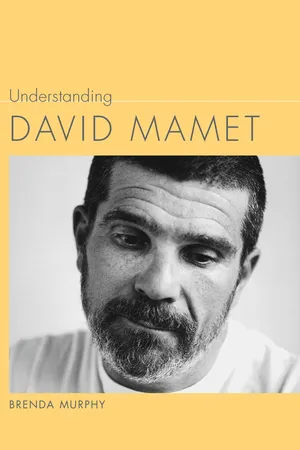
The classic image of Mamet from the 1990s and early 2000s is that of the film director in baseball cap, signature large, round, dark glasses, short beard, and casual clothes that suggest his beloved Vermont woods. In 2000 a Canadian reporter said that, although “his behaviour with strangers is polite, unassuming and almost courtly,” a conversation with him “is like trying to lure a wolf away from guarding its pup. He’ll pace back and forth, watching for a moment of weakness, but he won’t lunge until he feels he or his territory is threatened.”9 In the same year, a British reporter was surprised to find Mamet in a “cheery and affable mood” when he met him, but when they started to discuss his novel Wilson, “cheery-normal Mamet suddenly turns into odd, threateningly-playful Mamet, intent on coating each answer with a layer of comic strangeness and turning the interview into something akin to performance art.”10 In 2002 Mamet moved with his wife, Rebecca Pidgeon, and their two children from Newton, Massachusetts, and Cabot, Vermont, to Santa Monica, and he seemed to have undergone another sea change. Although he has not exactly “gone Hollywood,” Mamet, who produced his own television show, The Unit, from 2006 to 2010, has shed the backwoods look for more California-friendly clothes, favors a beret, often worn backwards, over a cap, and is occasionally seen in a jacket and tie. In his early sixties he does not seem to be through with his evolving persona. Over the years he has given thoughtful, straightforward statements about his work and ideas in interviews with academics and critics who show a serious interest in his work rather than curiosity about his life, and decades of study and criticism have yielded many insights into his plays and other writings. Still we are far from understanding David Mamet.
Interestingly, while revealing little about his inner life, in his eleven volumes of essays and the many interviews he has granted over forty years, Mamet has left a good record of the bare facts. He was born David Allen Mamet on 30 November 1947 in Flossmoor, Illinois, a suburb of Chicago. His father, Bernard, was a successful labor lawyer, his mother, Lenore (Lee) Silver Mamet, had been a special education teacher. All four of his grandparents were Ashkenazi Jews from within two hundred miles of Warsaw. When David was two years old, the family moved to Chicago’s South Side, settling on the edge of a Jewish neighborhood near Hyde Park and the University of Chicago. His sister, Lynn, was born in 1950, and the two have always been close, most recently working on the television show The Unit together. Mamet has fond memories of growing up on the South Side, although he has come to think that the religious training he received at the liberal Temple Sinai was too assimilationist, undermining his sense of Jewish identity. The elder Mamets’ marriage was difficult, ending, according to biographer Ira Nadel, in two incidents of physical violence.11 They were divorced in April 1959, when David was eleven years old, and three days later Lee Mamet married Bernard Kleiman, another lawyer who had worked with Bernard Mamet.
Bernard and Lee Kleiman bought a house in a new subdivision in the southwest Chicago suburb of Olympia Fields, where they lived with David and Lynn; Kleiman’s two children, David and Leslie, visited on weekends. As revealed in Mamet’s personal essay, “The Rake,” and his avowedly autobiographical play, Jolly, the new family was deeply dysfunctional with the children, particularly Lynn, subjected to both physical and emotional abuse. David miserably attended schools that he hated. When he was fourteen, he left that summer to live on Chicago’s North Side with his father and his new family, including two stepbrothers, Tony, who became an actor and appears in several of David’s films, and Bobby, who became a musician. David, who was not doing well academically, was sent to the progressive Francis Parker School, which did not have grades and focused on individual learning. He flourished there, studied the piano, and enjoyed forays around the city, hanging out in pool halls, hustling Ping-Pong, playing poker, going to film festivals, and haunting the stores on Wabash Avenue. Although he has belittled the education he got at Goddard College in Vermont, particularly in an essay titled “Sex Camp,” he has acknowledged that his academic record was such that he was lucky to be admitted, and the college’s unregimented academic program, which allowed students to pursue their own individual interests, was similar to the atmosphere of Francis Parker. As a boy Mamet had acted in television productions by the Chicago Board of Rabbis, and in high school he had worked at menial jobs in several Chicago theaters, including the improv troupe Second City. He reveled in the sense of being part of the theater. It was at Goddard, however, that his enthusiasm gelled into an ambition to make the theater his career. He spent his junior year studying acting at the Neighborhood Playhouse in New York and working backstage at the off-Broadway phenomenon The Fantasticks, and his senior project at Goddard was his first produced play, a Second City–style dramatic piece in thirty-four scenes, CAMEL / A Review by David Mamet.
After his graduation from Goddard in 1969, Mamet acted for a while in Montreal and then returned to Chicago, where he lived in a room in the Lincoln Hotel, near Francis Parker School and the Lincoln Park Zoo, relishing his view of Lake Michigan and the park, where he often sat on a bench writing. It was here that The Duck Variations (1972), dialogues between two elderly men sitting on a park bench, was conceived. During this time Mamet worked in the “boiler room” of a real estate office, generating leads for the salesmen, who would then go out and close the deals. He drew on this experience for Glengarry Glen Ross (1983). In 1970 and 1971 he taught acting at Marlboro College and at Goddard, where he taught William H. Macy and Steven Schachter, with whom he formed the St. Nicholas Theater Company, with Mamet as artistic director. When Mamet returned to Chicago in 1972, they, along with Patricia Cox, reconstituted the company there, and it soon became a significant part of the new off-Loop theater movement, producing Mamet’s plays among others. It was at this time that Mamet had his first success as a playwright, with his plays performed in various Chicago theaters, notably Sexual Perversity in Chicago (1974), his comedy about the lives of young Chicago singles, at the Organic Theatre, and American Buffalo (1975), his tragedy about the corruption of love and friendship by the pursuit of money among three men living on the margins of urban society, at the Goodman, Chicago’s most prestigious theater.
In 1975 an off-Broadway production of Sexual Perversity and Duck Variations won him an Obie for best play. In 1976 he resigned as artistic director of the St. Nicholas and moved to New York, where he lived in Chelsea, a neighborhood that reminded him of Chicago. American Buffalo opened on Broadway in 1977, marking Mamet’s arrival as a major American playwright and establishing his reputation as a genius of “foul-mouthed” dialogue. That year also saw productions of All Men Are Whores, A Life in the Theatre, The Water Engine, Reunion, Dark Pony, The Woods, and two children’s plays, The Revenge of the Space Pandas, or Binky Rudich and The Two-Speed Clock. The reception accorded these plays was mixed, but Mamet at the age of thirty had become an established playwright whose plays were being produced in both New York and Chicago’s Goodman Theatre as well as other major regional theaters. Sexual Perversity and Duck Variations were also produced in London that year.
The year 1977 was also important to Mamet for his marriage to the actress Lindsay Crouse. The daughter of playwright Russell Crouse, who, with Howard Lindsay, wrote some of the most successful plays in American theater history, including Life with Father, State of the Union, and The Sound of Music, Crouse grew up in a Park Avenue apartment surrounded by Broadway royalty. Mamet pursued her intensely, having, he said, fallen in love with her when he saw her in the movie Slap Shot, and going to New Haven expressly to meet her when she was in the Yale Repertory Theatre production of his Reunion. They were married in her mother’s apartment on 21 December 1977 and both rising stars were often interviewed together during the early years of their marriage. Crouse quickly joined what has come to be known as the “Mamet mafia,” the close group of actors and other theater and film artists who regularly work in his productions and films and function for him as an artistic family. With her help he was hired to write the script for The Verdict (1982), which won him an Oscar nomination, and she headed the cast of Mamet veterans in the first film he wrote and directed, House of Games (1987). In 1978 they bought the farm house with one hundred acres in Cabot, Vermont, that was to feed Mamet’s imagination in writing his novel The Village (1994) and his film State and Main (2000) as well as many essays. Shortly after they bought the house, Crouse made Mamet the gift of a small “writing cabin” near the house, where he was to write a good deal of his work. They have two daughters, Willa, a photographer, and Zosia, an actor. Mamet and Crouse were divorced in 1990.
The mid-1970s had truly seen a meteoric rise for Mamet, and his career perhaps inevitably cooled off a bit in the next few years. Audiences and critics were somewhat bewildered by some of the turns his playwriting took, most especially his exercise in lyrical mythmaking, The Lone Canoe (1979). This play, a historical musical based on a short story by Jack London, is about a British explorer lost in the wilds of Michigan’s Upper Peninsula. Its premiere, which unfortunately took place before the Society of American Theatre Critics, was panned far and wide. The year 1979 also saw the New York production of the intense and symbolic drama of a love relationship, The Woods. This play is in some sense the tragedy that is latent in the comedy of Sexual Perversity in Chicago. Mamet has counted it among the four plays he calls classical tragedies, and he has said that he originally composed it in verse. Rooted in what Mamet has called the “symbology” of dream and fairy tale and owing a good deal to Anton Chekhov and Ernest Hemingway in style, it is his most complex dramatization of the profound difficulty of honest communication between human beings, particularly men and women. It was received respectfully, but not enthusiastically, by the critics, and it was not a financial or popular success.
Lakeboat, produced in 1982 at the Goodman and at Long Wharf in New Haven, is an intensely personal play written just after Mamet’s graduation from Goddard College and based on his then-recent experience of working for a summer on an ore boat on the Great Lakes. It was first produced in 1970 at Marlboro College, while Mamet was teaching there. He later described it as one of his “feeling slices of interesting life [. . .] episodic glimpses of humanity.”12 The play is a series of twenty-eight brief scenes, some less than a page of dialogue, dramatizing the interaction among the sailors on the lakeboat T. Harrison. It is also an exploration of the meaning and use of narrative within this community. Perhaps because of its fondly nostalgic tone, it has never been as well received as Mamet’s edgier plays about male communities.
During the early 1980s Mamet came back with a vengeance, producing some of the best and most successful works of the kind that audiences and critics expected him to write. He began what would be a long career in film-making with the screenplays for The Postman Always Rings Twice (1981) and The Verdict. In 1982 he won an Obie for the Goodman Theatre’s production of Edmond, and he achieved his greatest success in the theater to date with Glengarry Glen Ross, which ran for 378 performances on Broadway and won a number of awards, including the Pulitzer Prize for Drama. Glengarry solidified Mamet’s reputation as the playwright of the hard-boiled world of men and the creator of what has come to be known ...