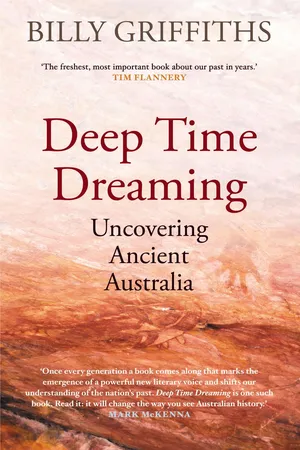
Deep Time Dreaming
eBook - ePub

Deep Time Dreaming

Uncovering Ancient Australia

  1. 384 pages
  2. English
  3. ePUB (mobile friendly)
  4. Available on iOS & Android
eBook - ePub

Deep Time Dreaming

Uncovering Ancient Australia

About this book

With a historian's inquiring mind, Billy Griffiths excavates two absorbing twentieth century histories: the reassertion of Aboriginal identity and the uncovering of traces of ancient Australia by pioneering archeologists.

Deep Time Dreaming is the passionate product of that journey. In this original, important book, Griffiths investigates a twin revolution- the reassertion of Aboriginal identity in the second half of the twentieth century, and the simultaneous uncovering of the traces of ancient Australia by pioneering archaeologists.

Deep Time Dreaming is about a slow shift in national consciousness. It explores what it means to live in a place of great antiquity, with its complex questions of ownership and identity. It brings to life the deep time dreaming that has changed the way many Australians relate to their continent and its enduring, dynamic human history.

'When John Mulvaney began his fieldwork in January 1956, it was widely believed that the first Australians had arrived on this continent only a few thousand years earlier. In the decades since, Australian history has been pushed back into the dizzying expanse of deep time. The human presence here has been revealed to be more ancient than that of Europe, and the Australian landscape, far from being terra nullius, is now recognised to be cultural as much as natural, imprinted with stories and law and shaped by the hands and firesticks of thousands of generations of Indigenous men and women. The New World has become the Old...'

Winner of the Felicia A. Holton Book Award, the Max Crawford Medal, the Ernest Scott Prize, the Book of the Year at the NSW Premier's Literary Awards, the Douglas Stewart Prize for Non-fiction and the John Mulvaney Book Award

Highly Commended in the Victorian Premier's Literary Awards

Shortlisted in the Queensland Literary Awards, the Prime Minister's Literary Awards, and the Educational Publishing Awards

Longlisted in the Australian Book Industry Awards and for the CHASS Book Prize

'This book is hugely impressive, a revelation, showing that archaeology has been far more important to Australian culture than anyone could have guessed. Every Australian should read it.' –Tim Low

'Beautifully written, with a cast of compelling characters both ancient and modern, and a storyline that traces one of humanity's great narratives, this is a book that will captivate both the general reader and the scholar... It is a book for our time, a deep history that allows us to imagine our way into the future.' -Kim Mahood, Australian Book Review

'Here is archaeology as passion; fierce and relevant. Here are dizzying meditations on time and human purpose. Here are the complex relationships between the hidden traces in the ground and the politics of the day... Deep Time Dreaming reads like a family tree of the hardy eccentrics and visionaries who defied a prevailing understanding to re-invent a discipline, to look at the land with new eyes and to teach us an appropriate kind of awe in which to behold it.' –Jock Serong, Meanjin

'A remarkable book, and one destined, I believe, to become a modern classic of Australian history writing. Written in vivid, evocative prose, this book will grip both the expert and the general reader alike. It tells a story of physical, political and cultural discovery, where fascinating individuals encounter and decipher awe-inspiring ancient places. Sensitive and scrupulous, the book does full justice to the achievements and concerns of the Indigenous peoples who shaped and inscribed this ancient land. Both ancient and modern Australia have here found a truly worthy historian.' –Iain McCalman

Frequently asked questions

Yes, you can cancel anytime from the Subscription tab in your account settings on the Perlego website. Your subscription will stay active until the end of your current billing period. Learn how to cancel your subscription.
No, books cannot be downloaded as external files, such as PDFs, for use outside of Perlego. However, you can download books within the Perlego app for offline reading on mobile or tablet. Learn more here.
Perlego offers two plans: Essential and Complete
  • Essential is ideal for learners and professionals who enjoy exploring a wide range of subjects. Access the Essential Library with 800,000+ trusted titles and best-sellers across business, personal growth, and the humanities. Includes unlimited reading time and Standard Read Aloud voice.
  • Complete: Perfect for advanced learners and researchers needing full, unrestricted access. Unlock 1.4M+ books across hundreds of subjects, including academic and specialized titles. The Complete Plan also includes advanced features like Premium Read Aloud and Research Assistant.
Both plans are available with monthly, semester, or annual billing cycles.
We are an online textbook subscription service, where you can get access to an entire online library for less than the price of a single book per month. With over 1 million books across 1000+ topics, we’ve got you covered! Learn more here.
Look out for the read-aloud symbol on your next book to see if you can listen to it. The read-aloud tool reads text aloud for you, highlighting the text as it is being read. You can pause it, speed it up and slow it down. Learn more here.
Yes! You can use the Perlego app on both iOS or Android devices to read anytime, anywhere — even offline. Perfect for commutes or when you’re on the go.
Please note we cannot support devices running on iOS 13 and Android 7 or earlier. Learn more about using the app.
Yes, you can access Deep Time Dreaming by Billy Griffiths in PDF and/or ePUB format, as well as other popular books in History & Australian & Oceanian History. We have over one million books available in our catalogue for you to explore.

Information

Endnotes
INTRODUCTION: THE OLD WORLD
1 Rachel Perkins, A Rightful Place: Correspondence, Quarterly Essay 56 (Melbourne: Black Inc., 2014), 82–86, 82.
2 Robert Pulleine, ‘The Tasmanians and Their Stone-Culture’, Australasian Association for the Advancement of Science 19 (1928), 294–314, 310.
3 John McPhee, Annals of the Former World (New York: Farrar, Straus and Giroux, 1998), 90.
4 Alistair Paterson, A Millennium of Cultural Contact (Walnut Creek: Left Coast, 2011).
5 This sentence paraphrases David Frankel’s words in Remains to Be Seen: Archaeological Insights into Australian Prehistory (Melbourne: Longman Cheshire, 1991), vii.
6 This is the first overview of Australian Aboriginal archaeology that has been written by someone outside the field, which makes it an explicitly cross-disciplinary endeavour. There has been a range of bigger-picture studies on the history of Aboriginal archaeology, such as David Horton’s edited collection of documents, Tim Murray’s work on the changing philosophies and methodologies in archaeology and Stephanie Moser’s research on the field’s disciplinary culture. More recently, Sarah Colley, Hilary Du Cros and Laurajane Smith have explored the practice, politics and ethics of Australian archaeology, teasing out the questions and ideas that have arisen from heritage debates and the struggles of Indigenous peoples for ownership and control of their land, cultural materials and ancestral remains. See, for example, David Horton, Recovering the Tracks: The Story of Australian Archaeology (Canberra: Aboriginal Studies Press, 1991); Tim Murray (ed.), Archaeology from Australia (Melbourne: Australian Scholarly Publishing, 2004); Stephanie Moser, ‘The Aboriginalisation of Archaeology: The Contribution of the Australian Institute of Aboriginal Studies to the Indigenous Transformation of the Discipline’, in Peter J Ucko (ed.), Theory in Archaeology: A World Perspective (London: Routledge, 1995), 150–177; Sarah Colley, Uncovering Australia: Archaeology, Indigenous People and the Public (Crows Nest, NSW: Allen & Unwin, 2002); Hilary du Cros, Much More Than Stones and Bones: Australian Archaeology in the Late Twentieth Century (Melbourne: Melbourne University Press, 2002) and Laurajane Smith, The Uses of Heritage (London: Routledge, 2006).
7 Hilary du Cros, ‘Popular Notions of Australian Archaeology’, Journal of Australian Studies 23(62) (1999), 190–97, 192.
8 Nicholas Jose, The Custodians (Sydney: Macmillan, 1997), 354.
9 Rosalind in William Shakespeare, As You Like It (New York: Penguin Books, 2000), 4:1:83–4; James Ussher, The Annals of the World (London: E Tyler, 1658), 12. The discovery of deep time is explored in Martin JS Rudwick, Earth’s Deep History: How It Was Discovered and Why It Matters (Chicago: University of Chicago Press, 2014); Clive Gamble and Theodora Moutsiou, ‘The Time Revolution of 1859 and the Stratification of the Primeval Mind’, Notes and Records of The Royal Society 65(1) (2011), 43–63.
10 McPhee coined the term in Basin and Range, the first book in his five-volume geological history of North America, which was published as Annals of the Former World (New York: Farrar, Straus and Giroux, 1998).
11 Paul Crutzen and Will Steffen, ‘How Long Have We Been in the Anthropocene Era?’, Climatic Change 61(3) (2003), 251–57; Alison Bashford, ‘The Anthropocene is Modern History: Reflections on Climate and Australian Deep Time’, Australian Historical Studies 44(3) (2013), 341–49.
12 John Mulvaney, ‘Archaeological Retrospect 9’, Antiquity 60(229) (1986), 96–107, 104.
13 Tim Winton, Island Home: A Landscape Memoir (Melbourne: Hamish Hamilton, 2015), 28–29.
14 Jim Bowler, ‘Perceptions of Australia: Towards Cultural Integration’, 27 Oct 1992, John Mulvaney Papers, National Library of Australia, MS 9615/1/40, Box 5.
15 Emphasis in original. WEH Stanner, ‘The Dreaming (1953)’, The Dreaming & Other Essays (Melbourne: Black Inc. Agenda, 2009), 57–72, 58.
16 Bill Gammage, The Biggest Estate on Earth: How Aborigines Made Australia (Crows Nest, NSW: Allen & Unwin, 2011), 123.
17 Patrick Wolfe, ‘On Being Woken Up: The Dreamtime in Anthropology and in Australian Settler Culture’, Comparative Studies in Society and History 33(2) (Apr 1991), 197–224, 199.
18 Howard Morphy, ‘Empiricism to Metaphysics: In Defence of the Concept of the Dreamtime’, in Tim Bonyhady and Tom Griffiths (eds), Prehistory to Politics: John Mulvaney, the Humanities and the Public Intellectual (Melbourne: Melbourne University Press, 1996), 163–89, 187.
19 These are the words used by Prime Minister Kevin Rudd in his apology to the Stolen Generations in 2008. Kevin Rudd, ‘Apology to Australia’s Indigenous Peoples’, Parliament of Australia, House of Representatives, 13 Feb 2008.
20 See Ian J McNiven and Lynette Russell, Appropriated Pasts: Indigenous Peoples and the Colonial Culture of Archaeology (Lanham, MD: AltaMira Press, 2005).
ONE Explorers in an Ancient Land: John Mulvaney at Fromm’s Landing
1 Newstead, as quoted in Martin Thomas, The Artificial Horizon...

Table of contents

  1. Cover Page
  2. Title Page
  3. Copyright
  4. Dedication
  5. Contents
  6. Introduction: The Old World
  7. One: Explorers in an Ancient Land: John Mulvaney at Fromm’s Landing
  8. Two: Haunted Country: Isabel McBryde in New England
  9. Interlude I: Before it is too late, 1961
  10. Three: The First Tasmanians: Rhys Jones at Rocky Cape
  11. Four: Tracks in the Desert: Richard and Betsy Gould at Puntutjarpa
  12. Five: A Desiccated Garden of Eden: Jim Bowler at Lake Mungo
  13. Interlude II: Eaglehawk and Crow, 1974
  14. Six: Landscapes of the Mind: Carmel Schrire and Betty Meehan in Arnhem Land
  15. Picture Section
  16. Seven: Marking Country: Lesley Maynard and ‘the Bob Edwards style’
  17. Eight: ‘You Have Entered Aboriginal Land’: The Franklin River Campaign and the Fight for Kutikina
  18. Interlude III: Australians to 1988
  19. Nine: A Social History of the Holocene: Sylvia Hallam, Harry Lourandos and the Archaeology of Documents
  20. Ten: Hunting the Pleistocene: The History and Politics of Jinmium and Madjedbebe
  21. Epilogue: Australia’s Classical Culture
  22. Acknowledgements
  23. Picture Credits
  24. Endnotes
  25. Index
  26. Back Cover