- 497 pages
- English
- PDF
- Available on iOS & Android
eBook - PDF
About this book
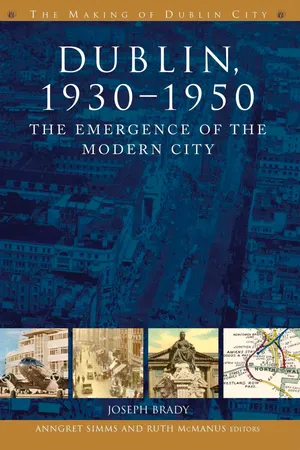
Using a great variety of source materials, and including a large number of photographs and other images, this book builds a picture of Dublin between 1930 and 1950. While this period is on the edge of living memory, there has not been much exploration of how the city looked and functioned in what was the beginning of a new era. It was the capital of a recently emerged state and it looked to the future with some confidence despite the problems that it faced as a legacy of its past. Dublin was growing in population and spreading out beyond its boundaries, even as the population of Ireland as a whole was slipping into decline. The book shows that the city was complex and interesting, and not all doom and gloom as has sometimes been suggested. For the poor, life was as difficult as it always had been and there was a serious problem with the provision of decent housing; the main focus of Dublin Corporation's activities. The middle classes had a different experience. New suburbs emerged as the city grew and the city center was a bright and vibrant place where shoppers could enjoy the latest international trends in consumer goods. Growth brought its own problems, and readers will learn that Dublin had serious traffic congestion and that the parking controls in the city were even more draconian than today. The book demonstrates the ways in which the capital city survived - and in some ways thrived - during the Emergency, and it shows how Dublin fared as tourism destination. Dublin 1930-1950: The Emergence of the Modern City is the fifth volume in The Making of Dublin City series, which sets out to examine the development of Dublin from its origins to the present day. All books in the series share a geographical perspective, which sees the city in a holistic way, exploring the evolution of Dublin's streetscapes and attempting to understand the complex variety of actors and processes which brought about these changes. (Series: The Making of Dublin City) [Subject: History, Iri
Information
Subtopic
Architecture GeneralIndex
HistoryTable of contents
- Cover
- Half-title page
- Other books in the series
- Title page
- Copyright page
- Contents
- Acknowledgments
- Series editors’ introduction
- 1. The city emerges
- 2. A profile of the city
- 3. Managing a growing city
- 4. Civic improvement
- 5. Keeping the city moving
- 6. Suburban growth and development
- 7. The shopping experience
- 8. Visiting and enjoying the city
- Epilogue: into the 1950s
- Appendix
- Sources and bibliography
- List of illustrations
- Index
Trusted by 375,005 students
Access to over 1.5 million titles for a fair monthly price.
Study more efficiently using our study tools.
Frequently asked questions
Yes, you can cancel anytime from the Subscription tab in your account settings on the Perlego website. Your subscription will stay active until the end of your current billing period. Learn how to cancel your subscription
No, books cannot be downloaded as external files, such as PDFs, for use outside of Perlego. However, you can download books within the Perlego app for offline reading on mobile or tablet. Learn how to download books offline
We are an online textbook subscription service, where you can get access to an entire online library for less than the price of a single book per month. With over 1.5 million books across 990+ topics, we’ve got you covered! Learn about our mission
Look out for the read-aloud symbol on your next book to see if you can listen to it. The read-aloud tool reads text aloud for you, highlighting the text as it is being read. You can pause it, speed it up and slow it down. Learn more about Read Aloud
Yes! You can use the Perlego app on both iOS and Android devices to read anytime, anywhere — even offline. Perfect for commutes or when you’re on the go.
Please note we cannot support devices running on iOS 13 and Android 7 or earlier. Learn more about using the app
Please note we cannot support devices running on iOS 13 and Android 7 or earlier. Learn more about using the app
Yes, you can access Dublin, 1930-1950 by Joseph Brady in PDF and/or ePUB format, as well as other popular books in History & Architecture General. We have over 1.5 million books available in our catalogue for you to explore.