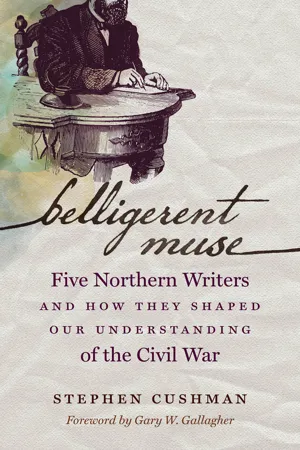
War destroys, but it also inspires, stimulates, and creates. It is, in this way, a muse, and a powerful one at that. The American Civil War was a particularly prolific muse — unleashing with its violent realities a torrent of language, from soldiers' intimate letters and diaries to everyday newspaper accounts, great speeches, and enduring literary works. In Belligerent Muse, Stephen Cushman considers the Civil War writings of five of the most significant and best known narrators of the conflict: Abraham Lincoln, Walt Whitman, William Tecumseh Sherman, Ambrose Bierce, and Joshua Lawrence Chamberlain. Considering their writings both as literary expressions and as efforts to record the rigors of the war, Cushman analyzes their narratives and the aesthetics underlying them to offer a richer understanding of how Civil War writing chronicled the events of the conflict as they unfolded and then served to frame the memory of the war afterward.
Elegantly interweaving military and literary history, Cushman uses some of the war’s most famous writers and their works to explore the profound ways in which our nation’s great conflict not only changed the lives of its combatants and chroniclers but also fundamentally transformed American letters.
eBook - ePub
Belligerent Muse
Five Northern Writers and How They Shaped Our Understanding of the Civil War
- 232 pages
- English
- ePUB (mobile friendly)
- Available on iOS & Android
eBook - ePub
Belligerent Muse
Five Northern Writers and How They Shaped Our Understanding of the Civil War
About this book
Information
Chapter One: When Lincoln Met Emerson, and the Two Addresses
In the history of the United States the convergence of Civil War writing with verbal artistry remains particularly notable in the case of Abraham Lincoln. In part this distinction has to do with the fact that Lincoln’s written English—with its distinct blendings of the elegantly lyrical and the pungently vernacular; the rhetoric of the courtroom and the rhetoric of the pulpit; the slap of short, simple sentences and the extended caresses of syntactically parallel units, so often parceled into groups of three—is simply more sonorous, memorable, and meaningful than the written English not only of his presidential successors or their professional speechwriters, but of most people who write in English. Many commentators have already done important work in appraising Lincoln’s verbal artfulness, among them Douglas L. Wilson, whose 2006 book, Lincoln’s Sword: The Presidency and the Power of Words, won the Lincoln Prize.1 But before turning to the language of Lincoln’s two most famous addresses, in the second part of this chapter, my aim is to meditate first on the convergence of statecraft with the world of letters, and especially on one aspect of Lincoln’s awareness of that world, from another angle, that of his meeting with Ralph Waldo Emerson in Washington, D.C., on Saturday, February 1, and Sunday, February 2, 1862. By looking closely at this particular meeting and its implications, we can deepen our understanding of the mind that produced such powerful public utterances in response to military exigencies.
Emerson had been invited to lecture at the Smithsonian Institution, where he delivered an address entitled “American Civilization” on January 31, only a few hundred yards from the site of wartime hospitals standing between the Smithsonian and the Capitol. Focusing on slavery and the war, while calling for immediate emancipation, “American Civilization” spoke to the “existing administration” with “the utmost candor”: “The end of all political struggle is to establish morality as the basis of all legislation. . . . Morality is the object of government.” Emerson’s biographers disagree about whether or not Lincoln heard the Sage of Concord the night before they met.2 Lincoln’s biographers make almost no mention of either the lecture or the meeting.3 Newspaper coverage of the lecture included nothing about the president’s going to hear it.4 Whether or not Lincoln attended the lecture, the best pictures we have of his meetings with Emerson come from the latter’s journal, which he started keeping the first month of the new year in a copybook, on the cover of which he wrote in ink “1862” above the word “WAR.”5
The pictures that emerge from Emerson’s journal give us richly textured glimpses of the president, whose weekend included mulling over the conviction and sentence of Nathaniel P. Gordon, hanged in New York three weeks later for slave trading and the first person in the United States to be executed for this crime. It also included skipping church to read Charles Sumner’s speech on the Trent affair, the international aftermath of which continued in the form of communications with Lord Lyons, the British minister in Washington, and messages on the same topic from France and Spain, all of which were mentioned or discussed with Secretary of State William Seward, Emerson’s guide for the day, in Emerson’s presence.6
The pictures from the journal contain precious candid shots of Lincoln as well: Seward telling Emerson that Lincoln had told him not to tell Emerson a “smutty” story, although the secretary of state apparently ignored the president’s instructions and delivered an anecdote involving the punch line, “I can’t say I have carnal knowledge of him,” an anecdote the reserved Emerson described as an “extraordinary exordium”;7 Lincoln overseeing the Sabbath barbering of his sons, which the father called “whiskeying their hair,” as he watched Tad and Willie, noted by Emerson as “his two little sons,—boys of 7 & 8 years perhaps,” though in reality Tad was almost nine at the time and Willie, who would die eighteen days later, eleven; Lincoln listening to the Episcopalian Seward tell him about the Reverend Smith Pyne’s sermon, which the lapsed-Unitarian Emerson judged to be an instance of a “hopeless blind antiquity of life & thought,” though Lincoln, whom Seward had chided for not going to church that day, told his secretary of state that “he intended to show his respect for him some time by going to hear him” at St. John’s, just across Lafayette Park from the White House.8
Although perhaps lacking the spontaneity of some of his other more casual observations of Lincoln, Emerson’s initial study of the president at their first meeting in the White House also deserves attention: “The President impressed me more favorably than I had hoped. A frank, sincere, well-meaning man, with a lawyer’s habit of mind, good clear statement of his fact, correct enough, not vulgar, as described; but with a sort of boyish cheerfulness, or that kind of sincerity & jolly good meaning that our class meetings on Commencement Days show, in telling our old stories over. When he made his remark, he looks up at you with great satisfaction, & shows all his white teeth, & laughs.”9 In moments such as this one, narrative brakes and shifts into neutral, so that detailed description can take over for as long as necessary to introduce us to someone new, as in the case of a new character in certain kinds of prose fiction. Unlike, say, in a police description, which notes the common-denominator basics of height, weight, the color of eyes and hair, there is no pretension to complete objectivity here. In such moments the describer’s, here Emerson’s, own assumptions, biases, and moralizings are everywhere implicit and occasionally explicit. From this portrait of Lincoln we gather that Emerson, the educated, cultured, fastidious New Englander, had not expected much from the rough westerner, especially since, like many members of his intellectual class and geographical section, he had supported Seward for the presidential nomination in 1860. We also hear the man of poetry, philosophy, inspiration, and imagination sizing up “a lawyer’s habit of mind,” not unfavorably but perhaps with a whiff of condescension, a condescension also informing the remark about “boyish cheerfulness” and the extended comparison of Lincoln’s “jolly” demeanor to the storytelling, backslapping tone of college reunions.
A little over three years later Emerson described Lincoln once again, this time when delivering “Remarks at the Funeral Services Held in Concord, April 19, 1865,” and the description then polished these initial impressions, with the help of the elegiac past tense, into a eulogistic glow:
A plain man of the people, an extraordinary fortune attended him. He offered no shining qualities at the first encounter; he did not offend by superiority. He had a face and manner which disarmed suspicion, which inspired confidence, which confirmed good will. He was a man without vices. He had a strong sense of duty, which it was very easy for him to obey. Then, he had what farmers call a long head; was excellent in working out the sum for himself; in arguing his case and convincing you fairly and firmly. Then, it turned out that he was a great worker; had prodigious faculty of performance; worked easily. . . . Then, he had a vast good nature, which made him tolerant and accessible to all; fair-minded, leaning to the claim of the petitioner; affable, and not sensible to the affliction which the innumerable visits paid to him when President would have brought to any one else.10
Among those innumerable visits was Emerson’s own in February 1862, and as part of the general idealizing of this postmortem portrait the onetime presidential visitor retrospectively projected onto his subject an inexhaustible goodwill at odds with the account of at least one other visitor to the White House, Walt Whitman, who upon seeing Lincoln the evening of his second inauguration described him as “drest all in black, with white kid gloves, and a claw-hammer coat, receiving, as in duty bound, shaking hands, looking very disconsolate, as if he would give anything to be somewhere else.”11
Having shown us how the laughing president appeared to him in February 1862—less than a year after, as “the new pilot” recalled in Emerson’s 1865 eulogy, Lincoln had been “hurried to the helm in a tornado”12—the visitor from New England then let his host speak: “When I was introduced to him, he said, ‘O Mr Emerson, I once heard you say in a lecture, that a Kentuckian seems to say by his air & manners, ‘Here am I; if you don’t like me, the worse for you.’”13 Here the journal captured a fascinating and complex moment, Emerson’s own botched quotation marks reflecting the twists and turns of quoting Lincoln quoting Emerson back to Emerson. In greeting Emerson by repeating this remembered sentence, Lincoln immediately identified himself with Kentucky, which he left with his family for Indiana when he was only four, as he also identified himself with it the previous year, during February 1861, as he made his way east for his inauguration as president. As Harold Holzer has shown, Lincoln had cut and pasted from a draft of his inaugural address several paragraphs he hoped to deliver to “an audience of my native state,” along with the declaration, “Gentlemen, I too am a Kentuckian.” But for security reasons, “Kentucky remained off limits,” and the cut-and-pasted speech went undelivered there.14 Meanwhile, the passage from Emerson’s journal would seem to support those who argue that Lincoln did not attend Emerson’s Smithsonian lecture the night before, since, first, it would be a rare lecturer who would fail to notice, and note in his journal, the president of the United States in his audience and, second, Lincoln’s greeting would make no sense if he had just heard Emerson lecture a few hours before.
In the remainder of my discussion I want to follow out various lines of thought radiating from this small moment, lines that may help us reconsider Lincoln’s connection to the world of letters. To begin with, we might ask whether Lincoln ever really went to hear Emerson lecture, or was he simply performing as a smooth and savvy politician, replaying for Emerson a stray line he remembered having heard or read somewhere, perhaps even a line someone else had prepped him with a few minutes earlier? But to begin this way is to surrender to an anachronistic cynicism, one derived from too many films and television shows about smiling politicians turning on a dime to glad-hand, as well-met friends, people they would know nothing about if not for their loyal entourages of prompting aides. Even if we risk appearing naive and gullible, we stand a much better chance of discovering something useful if instead we follow Douglas Wilson, in remarks he delivered on accepting the Lincoln Prize, and consider questions such as these: “So Lincoln had been in the audience for one of Emerson’s famous lectures, but when? where? and which lecture? And what, if anything, did Lincoln make of what Emerson had to say?”15
Wilson responded to his own questions by claiming that “there is a fairly straightforward answer” to the first two of them, the when and the where. This straightforward answer begins with F. A. Moore, editor of the (Springfield) Illinois Daily Journal, whom Emerson described as “a young New Hampshire editor, who overestimated the strength of both of us” and urged the touring lecturer to add Springfield to his itinerary after he finished with his commitments in St. Louis early in January 1853. Emerson obliged by traveling to Springfield, where he wrote to his wife, “Here I am in the deep mud of the prairie,” and where he delivered three lectures on the successive nights of January 10, 11, and 12. Thanks to the Illinois Daily Journal, we know the names of the lectures as “The Anglo-Saxon,” “Power,” and “Culture,” respectively, but at this point the straightforwardness begins to break down, for although the diary of future U.S. senator Orville Hickman Browning tells us that he himself was in Emerson’s audience at the Illinois State House each of the three successive nights, Browning does not state positively that he took his friend Lincoln with him to any or all of the lectures. Instead of noting this desirable information, Browning gives us these three brief summaries instead:
[Monday, January 10, 1853]
At night I attended in the hall of the house, and heard a lecture from Ralph Waldo Emmerson [sic] on the Anglo Saxon. His language was chaste, strong and vigorous—much of his thought just—his voice good—his delivery clear, distinct and deliberate—his action [meaning his physical gestures?] nothing. He limned a good picture of an Englishman, and gave us some hard raps for our apishness of English fashions & manners.
[Tuesday, January 11, 1853]
Heard Emmerson’s lecture in the House of Rep: upon power. He is chaste & fascinating, and whilst I cannot approve all his philosophy, I still listen with delight to his discourses. They contain much that is good, and are worth hearing. After the lecture I attended a supper in the Senate Chamber given by the ladies of the first Presbyterian Church and spent a pleasant evening. The weather is still very cloudy & disagreeable—the mud making the streets almost impassable.
[Wednesday, January 12, 1853]
Went to Ridgelys to supper, and attended Miss Julia to the State House to hear Emmersons third lecture on culture
No improvement in the weather16
When Lincoln met Emerson in Washington in February 1862 and claimed to have heard him lecture once, was he referring to one or more of the three lectures in Springfield in January 1853? Among those who have thought about the question at all, the consensus seems to be that despite the silence of Browning’s diary, yes, these are the where and the when of Lincoln’s hearing Emerson. The assumptions behind this consensus apparently are that an Emerson lecture would have been too large an attraction for Lincoln to pass up in 1853 and that wherever Browning went in Springfield, there went Lincoln.17 But even if Lincoln was not in the audience, Emersonianism had come to Springfield, however briefly, and between the people he knew and the newspapers he read it seems reasonable to assume that Lincoln would have absorbed something of what Emerson had to say there.
What did Emerson have to say in Springfield in January 1853, as he earned $110 for the three-lecture series?18 If we consider briefly each of his three lectures in turn, we can begin to recreate something of the intellectual ambience surrounding Lincoln at this particular moment. To begin with the Monday lecture, “The Anglo-Saxon,” full disclosure requires an admission that Orville Browning seems to have missed the point, since he came away from it with the mistaken impression that Emerson meant to chastise his American audience for aping English manners. To be sure, Emerson carried out such chastisement elsewhere, as in his celebrated address of 1837, “The American Scholar,” delivered at Harvard. But the closest he came in “The Anglo-Saxon” to dealing out what Browning calls a “hard rap” for chronic North American Anglo-mimicry would be something like this:
The English are stiff to their own ways. . . . It is the remark of our people employing English workmen, that they show great reluctance to deviate from their own methods, or proper work; whilst an American will turn his hand to anything. The very existence of our manufactures is a proof of aptitude: The stone cutters become sculptors. The house painters take to landscape portraits. We can make everything but music and poetry. But also he has chambers opened in his mind which the English have not. He is intellectual and speculative, an abstractionist. He has solitude of mind and fruitful dreams.19
One can argue about whether or not this excerpt limns a good portrait of the English, but although it does contain some implicit criticism of Americans, as people who cannot make music or poetry (this latter charge would soon drop with the advent of Whitman), one cannot argue persuasively that it concerns itself with American imitation of the English. If anything, the passage, like much of the lecture, concerns itself with basic differences between Anglo-Saxon Americans and their English ancestors.
But Browning’s apparent misunderstanding or oversimplification was not his fault and is part of the point. Like many of Emerson’s best-known essays, such as Nature or “Self-Reliance,” “The Anglo-Saxon” made few concessions either to cohesiveness, in its movement from sentence to sentence, or to coherence, in its larger focus on one or two main ideas. Appropriately enough for someone who elsewhere dismissed consistency as foolish, Emerson built a distinctive style of isolated, solitary sentences, which at their best continue to resonate in aphoristic autonomy and at their worst maintain an antisocial alienation from the sentences around them. Likewise, in moving from paragraph to paragraph, “The Anglo-Saxo...
Table of contents
- Cover Page
- Belligerent Muse
- Copyright Page
- Dedication
- Contents
- Foreword
- Acknowledgments
- Introduction
- Chapter One: When Lincoln Met Emerson, and the Two Addresses
- Chapter Two: Walt Whitman’s Real Wars
- Chapter Three: Sherman the Writer
- Chapter Four: Ambrose Bierce, Chickamauga, and Ways to Write History
- Chapter Five: Joshua Lawrence Chamberlain Repeats Appomattox
- Last Words
- Notes
- Index
Trusted by 375,005 students
Access to over 1.5 million titles for a fair monthly price.
Study more efficiently using our study tools.
Frequently asked questions
Yes, you can cancel anytime from the Subscription tab in your account settings on the Perlego website. Your subscription will stay active until the end of your current billing period. Learn how to cancel your subscription
No, books cannot be downloaded as external files, such as PDFs, for use outside of Perlego. However, you can download books within the Perlego app for offline reading on mobile or tablet. Learn how to download books offline
Perlego offers two plans: Essential and Complete
- Essential is ideal for learners and professionals who enjoy exploring a wide range of subjects. Access the Essential Library with 800,000+ trusted titles and best-sellers across business, personal growth, and the humanities. Includes unlimited reading time and Standard Read Aloud voice.
- Complete: Perfect for advanced learners and researchers needing full, unrestricted access. Unlock 1.5M+ books across hundreds of subjects, including academic and specialized titles. The Complete Plan also includes advanced features like Premium Read Aloud and Research Assistant.
We are an online textbook subscription service, where you can get access to an entire online library for less than the price of a single book per month. With over 1.5 million books across 990+ topics, we’ve got you covered! Learn about our mission
Look out for the read-aloud symbol on your next book to see if you can listen to it. The read-aloud tool reads text aloud for you, highlighting the text as it is being read. You can pause it, speed it up and slow it down. Learn more about Read Aloud
Yes! You can use the Perlego app on both iOS and Android devices to read anytime, anywhere — even offline. Perfect for commutes or when you’re on the go.
Please note we cannot support devices running on iOS 13 and Android 7 or earlier. Learn more about using the app
Please note we cannot support devices running on iOS 13 and Android 7 or earlier. Learn more about using the app
Yes, you can access Belligerent Muse by Stephen Cushman in PDF and/or ePUB format, as well as other popular books in History & American Civil War History. We have over 1.5 million books available in our catalogue for you to explore.