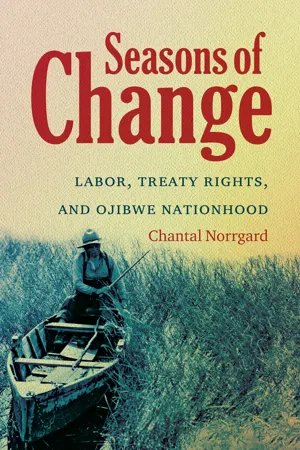
From the 1870s to the 1930s, the Lake Superior Ojibwes of Minnesota and Wisconsin faced dramatic economic, political, and social changes. Examining a period that began with the tribe’s removal to reservations and closed with the Indian New Deal, Chantal Norrgard explores the critical link between Ojibwes' efforts to maintain their tribal sovereignty and their labor traditions and practices. As Norrgard explains, the tribe’s “seasonal round” of subsistence-based labor was integral to its survival and identity. Though encroaching white settlement challenged these labor practices, Ojibwe people negotiated treaties that protected their rights to make a living by hunting, fishing, and berrying and through work in the fur trade, the lumber industry, and tourism. Norrgard shows how the tribe strategically used treaty rights claims over time to uphold its right to work and to maintain the rhythm and texture of traditional Ojibwe life.
Drawing on a wide range of sources, including New Deal–era interviews with Ojibwe people, Norrgard demonstrates that while American expansion curtailed the Ojibwes’ land base and sovereignty, the tribe nevertheless used treaty-protected labor to sustain its lifeways and meet economic and political needs — a process of self-determination that continues today.
- 216 pages
- English
- ePUB (mobile friendly)
- Available on iOS & Android
eBook - ePub
About this book
Information
CHAPTER ONE
From Berries to Orchards
The Transformation of Gathering
During the Great Depression, Ojibwe families journeyed to the berry patches of northern Minnesota and Wisconsin to make a much needed income from the fruit they harvested. They picked berries for days and even weeks, occasionally pausing to enjoy the summer weather or to socialize in berry camps that consisted of makeshift shelters and tents. In 1938, Florina Denomie of Bad River described the economic importance of berry picking, or berrying. “One of the leading industries of the Chippewas of Lake Superior is blueberry picking,” she wrote.1 Indeed it became an important source of seasonal income. “This, of course, like other occupations which are the endowments of nature, is seasonal, and outside of the more substantial industries, such as farming and lumbering; blueberry picking ranks first in the point of dollars and cents,” wrote Denomie.2 Denomie’s statement speaks to the importance of berrying as both a form of subsistence and a substantial commercial industry that emerged in late nineteenth century and continued through the 1930s.
The history of berrying illustrates how Ojibwes transformed traditional forms of subsistence into commercial activities as they experienced the pressures and constraints imparted by federal Indian policy and settler colonialism. Berrying was one of many forms of labor that constituted “gathering.”3 Ojibwe headmen reserved the rights to gather in the treaties of 1837 and 1842, recognizing the importance of these activities to the economies of their communities.
During treaty negotiations, Ojibwe headmen emphasized the importance of these plant resources. In 1837, Flat Mouth, an important headman from Leech Lake, spoke for all the Ojibwe leaders present when he said: “My Father. Your children are willing to let you have their lands, but they wish to reserve the privilege of making sugar from the trees and getting their living from the Lakes and Rivers, as they have done heretofore, and of remaining in this Country. It is hard to give up the lands. They will remain, and cannot be destroyed—but you may cut down the Trees, and others will grow up. You know we cannot live, deprived Lakes and Rivers; there is some game on the lands yet; & for that reason also, we wish to remain upon them, to get a living. Sometimes we scrape the trees and eat of the bark. The Great Spirit above, made the Earth, and causes it to produce, which enables us to live.”4 By reserving the rights to continue to practice seasonal subsistence activities and granting the United States access to certain resources on their lands, such as pine timber, Ojibwe headmen believed that they had assured their people’s ability to continue to pursue their customary lifeways in their homelands. The right to gather was a crucial part of Ojibwe survival. Flat Mouth made specific reference to the harvest of maple sugar, and by employing the phrase “getting a living from the lakes and rivers,” he was quite likely referring to the harvest of wild rice and fishing.
Ojibwe headmen also emphasized the importance of gathering rights alongside hunting and fishing rights in the negotiations leading up to the treaty of 1842. When Marten, the head leader of the La Court Oreilles Band of Ojibwe, signed the treaty, he did so under the condition that “we should remain on the land, as long as we are peaceable.”5 Elaborating on this point, he explained, “We have no objections to the white man’s working the mines, and the timber and making farms, but we reserve the birch bark and cedar for canoes, the rice and sugar tree and the privilege of hunting without being disturbed by the whites.”6 Just as Ojibwe leaders had done in 1837, Marten outlined the importance of having access to birch bark, cedar, maple trees, and wild rice. He made it clear that gathering was a key part of their survival, and by reserving it in the treaty, he designated it as a right to a specific form of livelihood.
The emergence of a berry industry in Ojibwe communities began with their relocation to reservations in the 1870s and ended during World War II, when the market for berries changed drastically as the result of the expansion of mechanized agriculture on the West Coast and in some areas of the South. While northern Wisconsin and Minnesota never became agricultural centers due to the short growing season and soil quality, the opening of Indian lands to logging and, subsequently, the availability of cutover acreage generated a regional interest in farming in the early twentieth century. Many local Euro-Americans tried their hands at growing a range of crops as well as dairy farming.
In the process, Ojibwe berrying practices underwent dramatic changes. The federal government capitalized on the agricultural movement to farm the cutover to transform Ojibwe livelihoods. Federal officials observed that Ojibwe subsistence practices encouraged a sense of tribalism that interfered with assimilation. They tried to instill a sense of individualism and economic competition among Ojibwe people. They encouraged Ojibwes to make a living in the capitalist market and to farm in hopes that these economic activities would replace traditional livelihoods and undermine the extensive web of social connections that held Ojibwe communities together. Some Ojibwes adapted berrying to mechanized agriculture, growing and selling berries in response to the pressures by the Indian Service to turn to farming. Large numbers of Ojibwe men and women also traveled to berry fields to pick berries for a wage or to sell them to commercial buyers.
What Indian agents failed to recognize were the ways in which traditional livelihoods could be transformed instead of being erased. It might have appeared that Ojibwes who planted rows of berry plants in plowed fields or cultivated orchards or picked berries and sold them in local cities and towns were no different from Euro-Americans who engaged in the same economic activities. Yet, the larger purposes that these activities served for Ojibwe people distinguished them from Euro-Americans. Despite Indian agent efforts to contain Ojibwes on reservations and to undermine community networks, Ojibwe people continued to exercise their treaty rights, traveling to familiar places off-reservation to pick and sell berries and to socialize in berry camps. Instead of subscribing to the ideas of individualism and economic production embedded in the agricultural activities the federal government promoted, some Ojibwes utilized fruit farming as means to retain connections to their lands and to share resources with others.
As a form of gathering, berrying was central to the traditional economies of Ojibwe people. However, it took on new importance under the conditions of colonialism that Ojibwes faced following the treaties. By transforming berrying into a number of different livelihoods, Ojibwes withstood Indian agents’ pressure to farm and navigated the capitalist market in ways that served their own interests. In the process, this labor became a vehicle through which Ojibwes sustained and built community and articulated their sense of identity.
GATHERING
Historically, gathering was a critical component of Ojibwe subsistence. Ojibwe women oversaw and took part in a majority of the labor that fell under the category of gathering, as well as the activities that took place in sugaring, ricing, and berrying camps. Women allocated the stands of maple trees used for sugaring to specific families, and they tended to the process of boiling the sap and turning the sap into sugar.7 They designated rice beds, harvested rice, and oversaw the drying process, which involved parching it, jigging on it to loosen the husks, and winnowing it to get rid of the chaff.8 Women and children picked berries and dried them for later consumption. Ojibwe women essentially held authority over the labor that gathering encompassed and the distribution of food.9
Gathering took place from early spring until late fall. In early autumn, Ojibwe women navigated the shallows of rivers and lakes to harvest wild rice. With two people in the canoe, one person stood in the back of canoe, poling and navigating the craft, while the other folded the rice plants over the edge of the canoe and gently tapped the hulls of the rice into the canoe using knocking sticks. Once they filled the canoes, they hauled the rice ashore to begin a complex process of drying, parching, dancing on, and winnowing it so that the wind would blow the husks away. When they completed the process, they stored extra rice underground in containers made of birch bark, woven cedar, or animal skins. As a staple food, wild rice was a critical resource year-round. In 1852, William Warren made note of the “large quantities [of wild rice] of which the Indian women gather sufficient for the winter consumption of their families.”10
In early spring, Ojibwe families moved to sugar camps where the women tapped maple trees to collect the sweet, nutritious sap. The extent to which the sap flowed depended on a precise combination of freezing nights and warm days that usually occurred between February and March. Through a process that was as complex as harvesting and preserving wild rice, Ojibwe women tapped the maple trees, collected the sap in birch-bark baskets, and boiled it until it became a fine, condensed sugar. Prior to contact with Europeans, the sugar was boiled in birch-bark baskets filled with hot rocks. Following contact, Ojibwe women used large cast-iron kettles to boil the sap. Like wild rice, maple sugar was stored and consumed throughout the year.
From the late spring until the early fall, Ojibwe women harvested a plethora of wild plants that they used for foods and medicines or dried and stored for future use. Among these plants were a wide range of berries that grew in abundance in the forests and marshes of the western Great Lakes. The kinds of berries that Ojibwes harvested depended on their geographical location and the time of year during which particular berries were ripe. Blueberries, raspberries, blackberries, and strawberries were available in the summer months and grew abundantly in the clay and sandy soils of the region. High-bush and low-bush cranberries grew in the wetlands and ripened in the summer and early fall. These berries were a key source of food, but Ojibwe women also harvested many other species of berries, such as bane, bear, bunch, June, snow, and thimble berries, for medicine.11
Traditionally, when Ojibwe women harvested blueberries, raspberries, blackberries, or strawberries they dropped them into a small birch-bark basket, or “mak-kak,” which could be carried or hung on a sash around their waist. They would then empty the smaller basket into a larger basket shared by the group.12 Berries could then be eaten immediately or dried and stored for winter use.13 Later, as Ojibwes began to harvest berries on a larger scale for cash, individuals used ten-quart buckets that they would empty into a thirty- to forty-quart box.14 Ojibwes picked low-bush cranberries by hand as well. Later, as the berry industry grew, some pickers used open-ended boxes with the lower edges cut out like a rake. They would use this device to take the upper half off of the plant including the leaves, stems, and berries.15
In the winter, families depended on rice, berries, and maple sugar that they had preserved and stored. Charles Cleland has argued that wild rice and garden production were vital because they were the only foods that could be produced in great quantity and stored for later use.16 Robert Keller also suggests that maple sugar ranked with wild rice as a staple but far surpassed wild rice in its variety of uses and sustained Ojibwes when there was a shortage of other resources.17 In a like manner, berries sustained Ojibwe families and communities when other resources were thin. Frances Densmore recorded at least fourteen different kinds of berries and wild fruits that Ojibwes ate, and all of them could be dried and used for times when other foods were scarce.18
The social dynamics that surrounded gathering were just as important as the labor itself. While harvesting and processing wild rice, maple sugar, and berries, Ojibwe families lived together in camps. The numbers of families that occupied camps and the numbers camps located in a particular area varied depending on the abundance of these resources. For example, ricing camps were comprised of two to five extended families. A lake that had an abundance of rice beds could have several camps comprised of as many as fifteen to twenty families.19 Berry picking drew large groups where many families and in some cases, communities, camped in areas where berries grew.20 As was the case with ricing and sugaring camps, the numbers of people who congregated at berry camps depended on the quantity of berries available, which varied from year to year. Paul Buffalo remembered that his community sent out scouts to find berries and then “whoever wanted to go would go.” The group encountered “other Indians.” If they were newcomers to the particular berry field, he added, they “probably . . . were going to be invited to join in with them.” He continued, “The tribe had much of the territory in those days and everybody pretty much used whatever area they wanted to, even though they most generally returned to the same places year after year.”21
The camps served as places for social gathering where individuals and families renewed ties with one another or forged new ones. Vennum notes, for instance, that despite the work of harvesting and processing wild rice, camps were places in which people joked and horseplayed, told stories, formed romantic relationships, exchanged news, danced, sang, played games, and passed on knowledge of ricing to younger generations.22 Similar activities took place in sugaring camps and berrying camps. Lorraine Wilson remembered that every evening, her family from Grand Portage and several other families “would congregate by one sugar bush, talk Indian, which was enjoyable, and make a big fire.”23 Paul Buffalo recalled that families in berry camps would “cooperate” as they set up the camps. “Strangers or no strangers, they worked together, and were in friendship,” he remembered.24
The renewal of ties to the land and the spirits of the plants themselves were also an important part of the labor of harvesting and processing them. Ojibwes considered (and consider) wild rice a sacred plant, and they treated it as such. Wild rice featured prominently into the Ojibwe migration story, which explains how Ojibwes came to the Great Lakes from the Eastern Seaboard; according to the story, an important stopping place was the place where food grows on the water.25 Wild rice, maple sugar, and berries were also feast foods, and Ojibwes placed them in offerings and considered them some of the most valuable foods of all.26
There were important ceremonies that were proscribed for harvesting these and other plants as way of establishing respect for and sustaining a good relationship with the natural world. Before harvesting any kind of plants, groups or individuals said prayers and put offerings out so as to honor the plant and to avoid causing offense.27 Rules also outlined respectful behavior during the harvesting process. For example, women who were menstruating or individuals who were grieving were to refrain from harvesting wild rice.28 Prior to eating any of the harvest, families or communities also made sure to honor the plant that had provided them with food, usually by holding a feast for the first harvest of the season.
Following contact with Europeans, Ojibwes traded or sold their surplus berries, rice, and maple sugar, adapting their subsistence strategies to the capitalist market. Integration into the capitalist economy meant ...
Table of contents
- Cover Page
- Title Page
- Copyright Page
- Dedication
- Contents
- Acknowledgments
- Introduction
- CHAPTER ONE From Berries to Orchards
- CHAPTER TWO They Can't Arrest Me. We Got Treaty Rights!
- CHAPTER THREE Capital and Commercialization
- CHAPTER FOUR From Landlords to Laborers
- CHAPTER FIVE Tourist Colonialism
- Conclusion
- APPENDIX Treaties with the Chippewa, 1837, 1842, and 1854
- Notes
- Bibliography
- Index
Trusted by 375,005 students
Access to over 1.5 million titles for a fair monthly price.
Study more efficiently using our study tools.
Frequently asked questions
Yes, you can cancel anytime from the Subscription tab in your account settings on the Perlego website. Your subscription will stay active until the end of your current billing period. Learn how to cancel your subscription
No, books cannot be downloaded as external files, such as PDFs, for use outside of Perlego. However, you can download books within the Perlego app for offline reading on mobile or tablet. Learn how to download books offline
Perlego offers two plans: Essential and Complete
- Essential is ideal for learners and professionals who enjoy exploring a wide range of subjects. Access the Essential Library with 800,000+ trusted titles and best-sellers across business, personal growth, and the humanities. Includes unlimited reading time and Standard Read Aloud voice.
- Complete: Perfect for advanced learners and researchers needing full, unrestricted access. Unlock 1.5M+ books across hundreds of subjects, including academic and specialized titles. The Complete Plan also includes advanced features like Premium Read Aloud and Research Assistant.
We are an online textbook subscription service, where you can get access to an entire online library for less than the price of a single book per month. With over 1.5 million books across 990+ topics, we’ve got you covered! Learn about our mission
Look out for the read-aloud symbol on your next book to see if you can listen to it. The read-aloud tool reads text aloud for you, highlighting the text as it is being read. You can pause it, speed it up and slow it down. Learn more about Read Aloud
Yes! You can use the Perlego app on both iOS and Android devices to read anytime, anywhere — even offline. Perfect for commutes or when you’re on the go.
Please note we cannot support devices running on iOS 13 and Android 7 or earlier. Learn more about using the app
Please note we cannot support devices running on iOS 13 and Android 7 or earlier. Learn more about using the app
Yes, you can access Seasons of Change by Chantal Norrgard in PDF and/or ePUB format, as well as other popular books in History & North American History. We have over 1.5 million books available in our catalogue for you to explore.