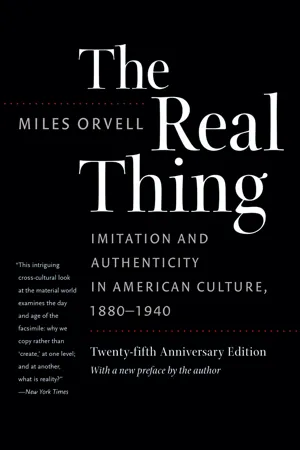
In this classic study of the relationship between technology and culture, Miles Orvell demonstrates that the roots of contemporary popular culture reach back to the Victorian era, when mechanical replications of familiar objects reigned supreme and realism dominated artistic representation. Reacting against this genteel culture of imitation, a number of artists and intellectuals at the turn of the century were inspired by the machine to create more authentic works of art that were themselves “real things.” The resulting tension between a culture of imitation and a culture of authenticity, argues Orvell, has become a defining category in our culture.
The twenty-fifth anniversary edition includes a new preface by the author, looking back on the late twentieth century and assessing tensions between imitation and authenticity in the context of our digital age. Considering material culture, photography, and literature, the book touches on influential figures such as writers Walt Whitman, Henry James, John Dos Passos, and James Agee; photographers Alfred Stieglitz, Walker Evans, and Margaret Bourke-White; and architect-designers Gustav Stickley and Frank Lloyd Wright.
- 420 pages
- English
- ePUB (mobile friendly)
- Available on iOS & Android
eBook - ePub
About this book
Part One: The Condition of Future Development
One: Whitman’s Transformed Eye
In trying to understand the relationship between the American artist and the new technological civilization of the nineteenth century, we can do no better than begin with the poet who attempted to reinvent poetry in America and who would thereby provide a model for so many artists coming after him, who were likewise seeking to establish an art appropriate to the conditions of the country. More than any other artist of his time, Whitman had tried to reproduce in his work the entirety of American civilization—its industrial and urban character as well as its spiritual, aesthetic, and demotic wealth. The lifelong creation of Leaves of Grass was to be a kind of counterpart to the United States, an epic embodiment of the national character and landscape, a poetic equivalent of the new reality of America, and also, of course, the picture of an ideal self—“Walt Whitman, a kosmos”—that the poet created out of his historical identity to serve as a model for his readers.
Whitman is our first modern poet because he was first to invent a new form appropriate to the modern age, a form that would reflect the new relationship between part and whole that a mass civilization would establish, a form that could contain within the bounds of the artwork the rich particularity and clashing contradictions of American life. That form is, of course, the free-verse catalogue—a series of unrhymed lines of varying length, sometimes numbering over a hundred at a stretch, each of which names some single, concrete, complete image of a person or thing or place; it is a form that stands classical epic poetry on its head, making what used to be an extended pause in the action into the main substance and structure of the poem.
There can be no single explanation for Whitman’s great invention, but we can, to begin with, offer certain literary precedents for Whitman’s verse.1 Milton, and much later Carlyle, for example, had argued that rhyme was not essential to poetry; and the popular Englishman Martin Farquhar Tupper gave supporting evidence of a sort in his thousands of lines of sententious wisdom, composed in a verse that was indeed unrhymed, but otherwise wholly congenial to the sentiments and imagery of the parlor. Moreover, Emerson’s advice in “The Poet” about meter-making arguments undoubtedly gave Whitman strength in his experiment, along with Emerson’s notion that “bare lists of words are found suggestive to an imaginative and excited mind.”2 A reviewer for the London Examiner tried to give a lineage to the anomalous Whitman and came up with the following description, which Whitman had the good humor to include among the reviews at the back of the 1856 Leaves of Grass:
Suppose that Mr. Tupper had been brought up to the business of an auctioneer, then banished to the backwoods, compelled to live for a long time as a backwoodsman, and thus contracting a passion for the reading of Emerson and Carlyle? Suppose him maddened by this course of reading, and fancying himself not only an Emerson but a Carlyle and an American Shakespeare to boot when the fits come on, and putting for his notion of that combination in his own self-satisfied way, and in his own wonderful cadences? In that state he would write a book exactly like Walt Whitman’s “Leaves of Grass.”3
The reviewer was probably not far from the mark; what he left out, however, was at least as important—namely, those “influences” that came not from the printed page but from the contemporary urban world that Whitman experienced so deeply and fully. Whitman was certainly right when he said that “my ‘Leaves’ could not possibly have emerged or been fashion’d or completed, from any other era than the latter half of the Nineteenth Century, nor any other land than democratic America.”4 An enormous cultural sponge, Whitman had spent the fifteen years before the first edition of Leaves in and out of journalism and had absorbed as much as anyone the transformations in American life in the mid-century—the growth of cities and manufactures and technology, the new scientific theories and discoveries, the currents of Orientalism and German philosophy, and not least the flourishing popular culture of his time—newspapers, opera, phrenology, photography, and exhibition halls.5 The poet must “flood himself with the immediate age as with vast oceanic tides,” Whitman wrote in the 1855 Preface, and that is exactly what Whitman had done, until he contained enough to “let it out,” as he put it in Song of Myself6
Modern criticism of Whitman has indeed taken notice of the influence of popular culture on the development of the poet (Paul Zweig’s recent biography most effectively), but in a somewhat piecemeal fashion. The popular urban culture of the mid-nineteenth century was crucial to the poet, providing Whitman with an angle of vision and a coherent matrix for his vision. In particular, I shall argue that the camera provided the foundation for Whitman’s way of looking at the world, and that the exhibition hall, in all of its various forms, provided a model for the structure of the long poem Whitman never stopped writing.
Whitman’s project was nothing less than a “readjustment of the whole theory and nature of Poetry,” as he put it in “A Backward Glance,” “for democratic America’s sake.”7 And what that came down to, first of all, was looking at the world with new eyes. Remy G. Saisselin has recently argued that the city in the nineteenth century transformed the eye of the observer, as novel kinds of urban spaces and entertainments, like the arcade, the panorama, and the department store, were created to satisfy a growing population of consumers. Saisselin affirms, moreover, that an unprecedented variety of aesthetic observer evolved along with these changes in urban experience: no longer was the observer a person “of taste in contemplation before a picture or a landscape . . . [but a] flaneur in the modern city.”8 (On the very first page of the 1855 Preface, Whitman had exalted the country’s “details magnificently moving in vast masses” and the “tremendous audacity of its crowds and groupings.”)9 Saisselin is speaking here primarily of the European city, of Paris especially, but his observations are valuable in considering the sources of Whitman’s art, for they point to a relationship between poetry and the urban milieu that has been generally overlooked.
Saisselin associates this new urban observer with the photographer, whose gaze was also ubiquitous, surveying urban types and spaces. In fact, during Whitman’s formative years—the 1840s—the camera was just being introduced to America and was an immediate popular sensation, taking on myriad functions from the portrait to the landscape, from the art photograph to the scientific study; and it became, I would argue, a crucial metaphor and model for the poet’s own creative processes, standing for the peculiarly modern apprehension of reality.10 For Whitman approached the world not on terms of an extended meditation, as did Bryant, Longfellow, and Emerson, but with the relatively brief perception of discrete particulars made possible by the camera. Susan Sontag has remarked on how twentieth-century photography has fulfilled Whitman’s own large aesthetic embrace of the world—indeed parodied it in recent years—by embracing low subjects, the ugly, along with the beautiful; what she failed to note was the degree to which Whitman’s own eye was transformed by photography.11
“Poet! beware lest your poems are made in the spirit that comes from the study of pictures of things,” Whitman warned, “—and not from the spirit that comes from the contact with real things themselves.”12 But what exactly does it mean to model your poem on “real things themselves”? The particular kind of “contact” Whitman wanted is based not upon the traditional imagery of painting, with its inevitable distance from reality, and its idealization of actuality; rather, it is based upon the new mechanical process of representing the reality immediately before the camera lens that had become, by the 1850s, a common feature of urban life, one that was changing the way the world was perceived and structured. In fact, Whitman may be the first poet to throw out the traditional Horatian analogy of poetry to painting (ut pictura poesis) and put in its place what would become, for many writers, the new prevailing analogy: ut camera poesis.13 Emerson had offered Whitman an image that would be close to the latter’s own habits when he had pictured the rich poets as mirrors, “carried through the street, ready to render an image of every created thing.”14 But Emerson’s mirror was not quite what Whitman needed; it suggested a removal from reality that was at odds with the poet’s need for “contact,” for a poetry in which “nothing is poetized, no divergence, not a step, not an inch, nothing for beauty’s sake, no euphemism, no rhyme.” For his approach to the world Whitman preferred instead the contemporary, the scientific metaphor—not the mirror but the camera: “In these Leaves everything is literally photographed.”15
Edward Everett Hale was alert to just this quality in Whitman—his concrete picturing of reality—when he noted in a review that some parts of Leaves of Grass “strike us as real,—so real that we wonder how they came on paper.”16 Hale’s phrasing interestingly recalls the universal amazement that greeted the first permanent transfers of visual images of the real world onto a flat surface—the daguerreotype process, which was at its peak of popularity in the late 1840s and early 1850s.17 Whether or not the allusion was intended by Hale, it is one the poet himself used on several occasions and it is a telling metaphor for Whitman’s creative process, at times explicitly named, at other times only hinted at obliquely.
The notion of the poet as camera plate, for example, seems hovering in the background of the famous lyric about the making of the poet in the 1855 edition:
There was a child went forth every day,
And the first object he look’d upon, that object he became
And that object became part of him for the day or a part of the day,
Or for many years or stretching cycles of years.18
Whitman here pictures himself as taking the imprint of the objects of the world, the city, the country, crowds, streets, goods, absorbing the world into the receptive plate of his consciousness until the later “development” of his poetry. Five years later, another poem about his formative years (taken to refer to the New Orleans sojourn) would make the metaphor even more explicit:
Once I pass’d through a populous city imprinting my brain for future use with its shows, architecture, customs, traditions (p. 109)
More inventive, if less explicit, is the metaphor Whitman uses in “Crossing Brooklyn Ferry” (1856), which likewise speaks of the poet’s genesis and seems to offer allusions to chemical processes (cosmic as well as photographic) and to the new technologies of mass production, as if Whitman’s “representative” quality derived from his being “reproduced” by contemporary industrial processes (with a touch of alchemical ones too, perhaps):19
I too had been struck from the float forever held in solution,
I too had receiv’d identity by my body (p. 162)
In retrospect, it seems inevitable that Whitman would introduce himself to the world with a frontispiece daguerreotype portrait of himself (reproduced as an engraving) that sets the style and tone of the whole of Leaves of Grass to follow and establishes implicitly its relationship to several major strands in the popular scientific culture of the age. (The soul “makes itself visible only through matter,” Whitman had written in an early notebook.)20 Whitman calls attention to the photographic image in one of his audacious self-reviews, this one written for the Brooklyn Eagle, when he notes that “its author is Walt Whitman and his book is a reproduction of the author. His name is not on the frontispiece, but his portrait, half-length, is. The contents of the book form a daguerreotype of his inner being, and the title page bears a representation of its physical tabernacle.”21 It is a striking conception, a linked circle of equivalents: portrait equals author equals book equals inner being equals body equals portrait equals book. . . . Taking the mechanical process of the daguerreotype as his starting point, Whitman moves to an interlocking vision of his volume—“a reproduction of the author”—that fulfills in practice the theories of organic form that Emerson, Greenough, and others were contemporaneously developing in their essays.22 It is not just that the portrait shows us the author of the poem that follows; the represented image is also the subject of the poem.
Moreover the photographic image embodies exactly the kind of representation of self Whitman was aiming at in the whole of Leaves of Grass: it was simultaneously a literal image and a representative one, both a “real thing” in itself and a larger, more suggestive, exemplary type of itself. (“Convey what I want to convey by models or illustrations of the results I demand,” Whitman had wri...
Table of contents
- Cover Page
- The Real Thing
- Copyright Page
- Dedication
- Contents
- Preface to the Twenty-fifth Anniversary Edition
- Acknowledgments
- Introduction
- Part One: The Condition of Future Development
- Part Two: A Culture of Imitation
- Part Three: Inventing Authenticity
- Epilogue: The Dump Is Full of Images
- Notes
- Bibliography
- Index
Trusted by 375,005 students
Access to over 1.5 million titles for a fair monthly price.
Study more efficiently using our study tools.
Frequently asked questions
Yes, you can cancel anytime from the Subscription tab in your account settings on the Perlego website. Your subscription will stay active until the end of your current billing period. Learn how to cancel your subscription
No, books cannot be downloaded as external files, such as PDFs, for use outside of Perlego. However, you can download books within the Perlego app for offline reading on mobile or tablet. Learn how to download books offline
Perlego offers two plans: Essential and Complete
- Essential is ideal for learners and professionals who enjoy exploring a wide range of subjects. Access the Essential Library with 800,000+ trusted titles and best-sellers across business, personal growth, and the humanities. Includes unlimited reading time and Standard Read Aloud voice.
- Complete: Perfect for advanced learners and researchers needing full, unrestricted access. Unlock 1.5M+ books across hundreds of subjects, including academic and specialized titles. The Complete Plan also includes advanced features like Premium Read Aloud and Research Assistant.
We are an online textbook subscription service, where you can get access to an entire online library for less than the price of a single book per month. With over 1.5 million books across 990+ topics, we’ve got you covered! Learn about our mission
Look out for the read-aloud symbol on your next book to see if you can listen to it. The read-aloud tool reads text aloud for you, highlighting the text as it is being read. You can pause it, speed it up and slow it down. Learn more about Read Aloud
Yes! You can use the Perlego app on both iOS and Android devices to read anytime, anywhere — even offline. Perfect for commutes or when you’re on the go.
Please note we cannot support devices running on iOS 13 and Android 7 or earlier. Learn more about using the app
Please note we cannot support devices running on iOS 13 and Android 7 or earlier. Learn more about using the app
Yes, you can access The Real Thing by Miles Orvell in PDF and/or ePUB format, as well as other popular books in History & 20th Century History. We have over 1.5 million books available in our catalogue for you to explore.