The story of a secular Jewish family uprooted by the Nazi occupation of Austria and Czechoslovakia who flee Europe to reunite in post-war America to rebuild their lives. Based primarily on the memoir of modern architectural designer and Frank Lloyd Wright apprentice Charles Paterson (born Karl Schanzer), who was nine years old when the Nazi invasion reached Vienna, as well as newly uncovered documents and accounts of events found in letters between family members, the book is a riveting tale of discovery and coming to terms with a past that casts a long shadow."An engrossing saga, profusely illustrated and fully documented, the stuff that makes an intriguing feature film. I heartedly endorse it."
— Bruce Brooks Pfeiffer, Former Director, The Frank Lloyd Wright Archives
"One of the more uplifting accounts of European émigré life that I have read in a long time.... It will touch you to tears right away, regardless of how many accounts of similar fates you believe to have studied and understood.... What a book!"
— Volker M. Welter, author of Ernest L. Freud, Architect Adopted by the Paterson family in Australia while their father Stefan made a harrowing escape through occupied France, it would be eight years, after much sorrow and loss, before Charles and his sister Doris would reunite their remaining small family in the United States.After Charles and Stefan settle in Aspen, Colorado, amidst the snow-capped peaks that remind them of the Austrian Alps, Stefan becomes a high school teacher known for his humor and adventure stories while Charles teaches skiing, serves as a Frank Lloyd Wright apprentice, and then builds his thesis project, the The Boomerang ski lodge. Charles lives with Stefan at The Boomerang and, as Aspen grows into a world-class ski resort, spends fifty years welcoming thousands of people to the town with Austrian warmth and gemütlichkeit. Based on archival documents and letters, together with the authors' personal reflections, Escape Home is a family memoir and a meditation on the domestic qualities of architecture, where the bonds of culture and family prove to be the true foundation for rebuilding meaningful lives and finding both security and freedom.
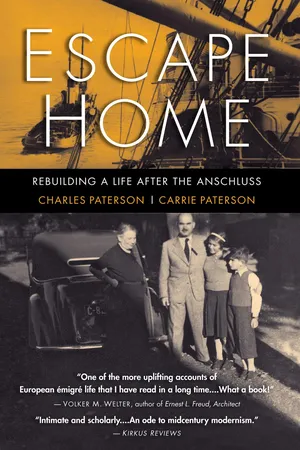
eBook - ePub
Escape Home
Rebuilding a Life After the Anschluss
- 570 pages
- English
- ePUB (mobile friendly)
- Available on iOS & Android
eBook - ePub
Escape Home
Rebuilding a Life After the Anschluss
About this book
Information
CHAPTER ONE
Foundations
My father Stefan Schanzer was born in Vienna in 1889—as he used to say, the same year as Adolf Hitler—in the last generation of the Habsburg Empire. Vienna, a great mixing ground for ethnicities, religions, and nationalities, was at that time one of the most culturally diverse places in the world. As a destitute artist Hitler lived a miserable life there for five years starting in 1908, and from that experience he formed his political opinions that would change the face and destiny of Europe.1 But my father never could nor would have blamed Vienna for what transpired in our lives. People, yes, but not the city. It was a singularly special place in his memories, the central jewel in all his stories, and the heart of his identity.
Among my father’s collection of items he felt were important to take with us when we abandoned the city after the Nazi occupation, the 1936 phone book demonstrates this fact. An imposing volume with “Habsburg” in white lettering on its red spine, it is testament to the smallness of that area of Europe and to its nostalgia, almost part of the grammar of a city with such historic culture and splendor. After World War II, when my father would meet people from Vienna, he would look them up—much could still be told about someone living in the new world if they used to call his great city home. With such a book published before tragedies and disasters, Vienna—for him a lost love—could be frozen in time.
A point of pride for my father was that our relatives were among a small number of Jewish families, a few hundred people, granted special permission by the Habsburg Monarchy to live in the city during the eighteenth century. We trace our ancestry back through one of the oldest recorded families, the Sinzheims. My third great-grandfather, Abraham Löwy, who married Regina Sinzheim, was born in Vienna circa 1749 and went by the name of Goldstein, as he was a jeweler.2 This profession would have uniquely enabled him and his large family to live year-round in Vienna because jewelers were court-appointed to evaluate the worth of items being presented as collateral by citizens who sought loans from the Emperor.3 This job provided an avenue for a kind of assimilation, possible in the Empire but eventually exposed as a lie only decades after the fabric of the monarchy unraveled in the First World War. When power shifted again in the mid-1930’s, people like us, who never considered we could be vulnerable to such charges, were labeled “outsiders.”
Even before then, my father’s family must have felt our origins were our vulnerability. He never actually mentioned that our direct Schanzer line originated along the western border of Galicia, now Poland. Immigrants from that area came to Vienna in waves, along with the Ostjuden—many desperately poor—who were looking for work and fleeing pogroms in the Russian Pale. The Schanzers, I was told by my father, were frequent guarantors for Galician immigrants to Vienna. That Galicians could have been relatives was unknown to me. But in 2011 we found that in Galicia, hundreds of Schanzers populate the birth and death records from the turn of the last century.4
When our family recently discovered a gravestone in the Vienna Central Cemetery we learned that my great-grandfather, Bernhard Baruch Schanzer, was born in Lipnik, Galicia in 1833. I like to entertain the thought that our family could have also been skiers from that picturesque region of the Carpathian Mountains; other Schanzers related to us are from the nearby ski town of Żywiec. My father may not have known—he never mentioned it—but I think he would have enjoyed the coincidence; skiing has been a favorite pastime for generations in our family. A Schanz is a “ski jump,” oddly enough.
Bernhard’s birthplace of Lipnik was famous for its textiles and dye works in the nineteenth century. Connected by railway to Krakow and Vienna, it became a major center for the trade.5 Bernhard started a shipping company, Schanzer Forwarding Co., which he later sold to Schenker & Co., now DB Schenker, still one of the largest in the world. This was an irony for my father, as he liked to point out—a shipping company, and there we were, having been sent by boat, on trains, and in cars under the cover of night, like packages, to fates around the globe.
My great-grandfather Bernhard married Katharina Pollack in Vienna in 1863. They had a son, Arnold, who died young, and two daughters, Leopoldine (Tina) and my grandmother, Rosa. Katharina died when Rosa and Tina were small children, and with his shipping company perhaps as the explanation for his absence, Bernhard left Rosa and her sister Tina to be brought up by their grandmother, Theresia Pollack. She and her husband Hermann Pollack had started textile mills at the beginning of the Industrial Revolution that became extremely successful while Rosa and Tina were growing into young women.
A brief look at the family at this time shows how lucrative textile businesses were in that transformative point in the nineteenth century. In 1889, by the time my father Stefan was born, his mother Rosa had become an heiress through the Pollack family to a fortune. On his father’s side of the family, there was also wealth. My grandfather Karl Schanzer descends from Emma Goldstein and Karl Hirschmann, who was at that time a well-known textile producer and merchant. Although my grandfather went into a different profession—banking—his choice echoes the professional progression of others in the family; Karl’s great-uncle Michael Lazar Biedermann, who also married into the Goldstein family, founded a banking empire that grew from humble origins in the wool trade at the turn of the nineteenth century.6
My grandfather Karl eventually became the representative to the stock exchange for the Creditanstalt, now known as the Austrian National Bank, where he worked under his second cousin and the general manager, Baron Gustav Springer. With family so enmeshed, it was still surprising to learn a few years ago when we were doing genealogical research that my great-grandfather Moritz, a merchandiser who died of tuberculosis when Karl was only four years old, was the brother of my other great-grandfather Bernhard.7 It seems that the two Schanzer brothers who came from Galicia to the big city of Vienna and both married into weaving families were destined to have their own family lines intertwined. If their children Rosa and Karl knew about the connection, however, will remain a mystery. According to my father, his mother Rosa told him she and his father Karl were “no relation” and remarked that the coincidence they both bore the name “Schanzer” was at least very convenient, as she did not have to change her name when they married, or, we noticed later, her monogram. Carrying it still is Rosa’s ten-foot long Seder tablecloth, a linen jacquard weave of white with blue. It has been at least a generation since our family practiced Judaism, and this cloth is one of the last remnants we have of this complicated and intricately woven history.
My father was born in central Vienna. The first apartment where he lived as a child was located in the block between the Austrian Parliament and the Rathaus (City Hall). This location, one block from the Ringstrasse, was just outside the site of Vienna’s ancient fortifications, which had defended the city against the Ottoman invasions of the fifteenth and sixteenth centuries and the sieges in the 1200’s by Mongolian hordes. Emperor Franz Josef built the great circular boulevard in 1850 and its construction foreshadowed the steady rise of Vienna as the center of European power and culture.
When my father was a little boy, he would spend time with his mother Rosa or his French governess in the many parks in Vienna bordering the Ringstrasse. He used to tell of being dressed in a sailor’s suit, riding in a horse-drawn carriage through the Stadtpark. He remembered seeing other children at play and how he wished to be with them rather than always alone. Sometimes he had to go along with his mother to the famous Viennese café Demel, where she had tea nearly every afternoon with her numerous cousins. Thankfully, there he could always look forward to Ischlerkrapfen, jam-filled Linzer cookies.
He and his parents lived at Schwarzspanierstrasse 4, the street of “Black Spanish Monks,” in District IX. He recalled his room had a beautiful view onto a garden with a terrace and tall trees. Adjoining the apartment was the Bosniakenregiment—military barracks—housing “Mohammedan” soldiers from Bosnia-Herzegovina, who wore the fez. One of his earliest memories was hearing their Turkish songs. Walking to his kindergarten on Horner Market my father recounted that he passed daily by the excavated site of Roman ruins—the foundations of Vindobona, which was the original settlement of what is now Vienna. Archeological evidence reveals that Jews were present even then, at the founding of Roman Austria.8
As a young man, my father continued the family tradition of going to the Opera, where even as a boy his mother Rosa had insisted he accompany her. Whenever he was at the Opera House on his own accord, his relative Countess Amalie Löwenstein would look for him and invite him to accompany her in her box seats. He recounted to me that he was perfectly happy to end up otherwise in the high rows on the fourth floor tier. These seats, almost up in the ceiling, were so cheap that the Opera House was accessible to virtually all levels of society, making it a popular venue for a cross-section of Viennese social life.
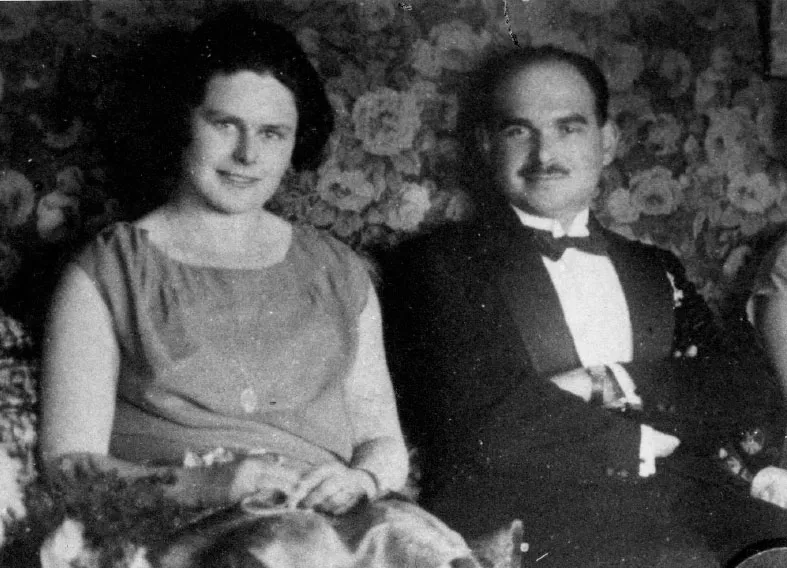
Wedding photo of my parents Eva Beck and Stefan Schanzer, 1926.
| Ich wünsch’ dem Bräutlein Evan, | I wish for the little bride Evan, |
| Dass ihrem Gatten Stevan, | That her groom Stevan, |
| Gelinge voll und ganz, | Can fully and truly |
| den Sprung zur Glückes Schanz. | Leap over the lucky jump. |
| Ich ruf mit Kraft mit ganzer, | I shout with all my might, |
| Hoch, immer höher, Schanzer! | Higher and higher, Schanzer! |
—[UNCLE] ROBERT
When my father told his childhood stories to my wife Fonda decades later, he would produce a map of Vienna, which he had specially obtained from his good friend Albin Schwab, who still lived there after World War II. His virtual tours of the city included all the important places in his life marked on the map with small square boxes: where he was born, his last address for his mother, important sites like the Looshaus on Michaelerplatz, and many more—all the memories of a life centered on the Ring.
I grew up quite differently. In 1932, a couple of years after I was born, my father Stefan, mother Eva, sister Doris, and I moved from a central Vienna apartment reserved for Austrian National Bank employees to Lainz, in Hietzing, the thirteenth district at the edge of the city. We had our own house in a small enclave-like village in a new settlement called the Werkbundsiedlung, surrounded by meadows and woods. As a young boy I loved to roam around with my friends in the fields of grass and among the forest pines. Adjacent to the village were the last Emperor’s former private hunting grounds in the Wienerwald, the Vienna Woods. All my memories of Vienna date back to this time and place, before I was ten years old.
I remember that when the streetlights turned on in the late afternoon, I was instructed to head for home without delay. This rule was not to be broken under threat of loss of privileges. After my sister and I had accumulated enough stars for good behavior and the satisfactory completion of tasks, we were taken to the Prater, the famous Viennese amusement park on the other side of the city, where there was a huge Ferris wheel.
We often made visits to our paternal grandmother Rosa Schanzer—“Little Omama”—at her apartment, Hörlgasse 16, at the edge of the Ringstrasse near the canal. I remember Little Omama as a woman of diminutive stature, and it was evident she came from a very aristocratic family, always elegantly dressed in black with a hat, veil, and white leather gloves. Sitting primly in our garden, maintaining an upright posture even in a casually slung canvas chair, it seemed she was from an entirely different century. I remember she used to wear on her lapel a little pin in the shape of a fly that I most admired. It was encrusted with precious stones, and one could move its hinged wings.
Little Omama was a very sweet grandmother, always exuding love. She was precious to us, as antique as the apartment where she lived. She had Biedermeier furniture and o...
Table of contents
- Cover
- Title Page
- Copyright
- Dedication
- Table of Contents
- Prologue
- Introduction
- Chapter 1: Foundations
- Chapter 2: The Werkbundsiedlung 1932-1938
- Chapter 3: Weaving
- Chapter 4: Childhood
- Chapter 5: Mutti
- Chapter 6: A Boy of Ten Is Already Grown
- Chapter 7: My Dear Children
- Chapter 8: Prisoners Don’t Ride Bicycles
- Chapter 9: Sauf Conduit
- Chapter 10: Australia
- Chapter 11: War Cry
- Chapter 12: Resurfacing
- Chapter 13: The Goldens
- Chapter 14: When War Is Over
- Chapter 15: To America
- Chapter 16: Finding Home
- Chapter 17: Summer of ‘49
- Chapter 18: Manna from Heaven
- Chapter 19: Dispossession
- Chapter 20: What Traces Are Left
- Chapter 21: Stefan and Max 1939–1947
- Chapter 22: Aspen, Early 1950’s
- Chapter 23: Prisoner of Fortune, Prisoner of War
- Chapter 24: At the End of Empire
- Chapter 25: Money Matters
- Chapter 26: Basic Training
- Chapter 27: The Tachinierer
- Chapter 28: Breaking Ground
- Chapter 29: Taliesin
- Chapter 30: A Critical Mix
- Chapter 31: A Sympathetic Chord
- Chapter 32: Architecture in Evolution
- Chapter 33: Building
- Chapter 34: Pencil to Paper
- Chapter 35: Silversmithing
- Chapter 36: Still Escaping
- Chapter 37: Adaptations
- Chapter 38: A Philosophy of Life
- Chapter 39: A Cabin Is A Castle
- Appendix I: Recipes
- Appendix II: Map of Escape from Nazi-Occupied France
- Appendix III: Family Trees
- Endnotes
- Selected Bibliography
- Acknowledgments
- Index
Trusted by 375,005 students
Access to over 1.5 million titles for a fair monthly price.
Study more efficiently using our study tools.
Frequently asked questions
Yes, you can cancel anytime from the Subscription tab in your account settings on the Perlego website. Your subscription will stay active until the end of your current billing period. Learn how to cancel your subscription
No, books cannot be downloaded as external files, such as PDFs, for use outside of Perlego. However, you can download books within the Perlego app for offline reading on mobile or tablet. Learn how to download books offline
Perlego offers two plans: Essential and Complete
- Essential is ideal for learners and professionals who enjoy exploring a wide range of subjects. Access the Essential Library with 800,000+ trusted titles and best-sellers across business, personal growth, and the humanities. Includes unlimited reading time and Standard Read Aloud voice.
- Complete: Perfect for advanced learners and researchers needing full, unrestricted access. Unlock 1.5M+ books across hundreds of subjects, including academic and specialized titles. The Complete Plan also includes advanced features like Premium Read Aloud and Research Assistant.
We are an online textbook subscription service, where you can get access to an entire online library for less than the price of a single book per month. With over 1.5 million books across 990+ topics, we’ve got you covered! Learn about our mission
Look out for the read-aloud symbol on your next book to see if you can listen to it. The read-aloud tool reads text aloud for you, highlighting the text as it is being read. You can pause it, speed it up and slow it down. Learn more about Read Aloud
Yes! You can use the Perlego app on both iOS and Android devices to read anytime, anywhere — even offline. Perfect for commutes or when you’re on the go.
Please note we cannot support devices running on iOS 13 and Android 7 or earlier. Learn more about using the app
Please note we cannot support devices running on iOS 13 and Android 7 or earlier. Learn more about using the app
Yes, you can access Escape Home by Charles Paterson, Carrie Paterson, Hensley Peterson, Paul Anderson in PDF and/or ePUB format, as well as other popular books in Social Sciences & Social Science Biographies. We have over 1.5 million books available in our catalogue for you to explore.