Finally – a people management guide that goes way beyond the typical "problem employee" books to help you understand and manage the entire emotional culture of your organization. Many of us have witnessed – sometimes in helpless horror – how a simple problem can spin into a corporate crisis as people take sides, outside professionals are brought in, and company reputations suffer, as this description illustrates: "Everything was exposed and raw as if a common energy had stripped away the veneer of civilized behaviors...People took sides, hid, ran, quit, overworked, underworked, ate too much, drank more, complained more, went silent, changed jobs, exited. They reacted as if all their system had been tossed into the air and was never going to land again." This wasn't the scene of a criminal act, earthquake, or terrorist attack. Rather, it was the disruptive and costly outcome of months of escalating workplace tension in the wake of changed management policies. Like a tornado, two violent co-workers had left 600 others in emotional rubble. That company could have been prepared with corporate policies and procedures to defuse such emotionally charged situations - long before alarming human and financial costs hit its bottom line. Managers could have learned to recognize and stop "emotional spinning" from gathering destructive force. The old paradigm of separating humans from humanity during work hours is not only antiquated thinking, it's high risk corporate behavior.
"Dr. Vali" calls her ground-breaking solution Emotional Continuity Management. She provides tools you can use right now to avoid costs in decreased productivity, injured goodwill, employee turnover, plummeting employee engagement, and severed business relationships.In this practical book, Dr. Vali gives you:
Real-life case studies that show you how to calculate bottom line, dollars and cents costs of disruptive employees and managers and emotionally charged incidents.
Proven techniques to help you identify variations in behavior that are early warning signs of trouble. She compares them to "tornado warnings" and provides a 5-point scale.
An understanding of the psychology driving "emotional terrorists," who stage themselves as victims and gather an army of acolytes to assist in their campaigns of emotional disruption, and a game-plan for managing such attacks before, during and after an event.
Practical tools for managing workplace emotions before, during and after an emergency, based on the author's extensive on-the-ground experience in counseling first responders and victims during major national and international disasters.
Policies and procedures for working with military veterans returning to the workplace - and the need to deal with PTSD.
Techniques for containing and mitigating the damage created by workplace bullies - and when to decide if an "amputation" is required or a less-extreme strategy is needed.
Sample policies and plans, and detailed instructions for company-wide training programs, up and down the organization.
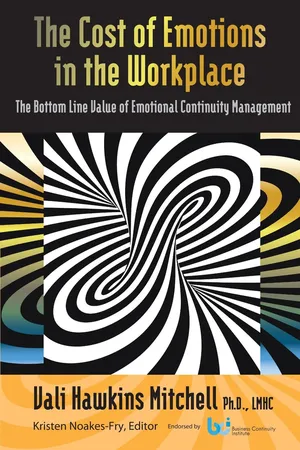
eBook - ePub
The Cost of Emotions in the Workplace
The Bottom-Line Cost of Emotional Continuity Management
- 276 pages
- English
- ePUB (mobile friendly)
- Available on iOS & Android
eBook - ePub
The Cost of Emotions in the Workplace
The Bottom-Line Cost of Emotional Continuity Management
About this book
Information

1
Emotions and Spinning
1.1 Emotions Are a Part of Work
Questions: What emotions are appropriate at work and what emotions are counterproductive? What is okay and what isn’t okay? How do you tell if someone is having normal emotions without getting an advanced degree in psychology? What if your co-worker, boss, supervisor, or manager is an emotional terrorist or bully? What if you are? Does your company have a policy and plan in place to manage emotions? How would you deal with an employee who is acting in a manner that is disrupting the entire organization?
Answers: Reasonable variations of human emotions are expected at the workplace. People have feelings. Emotions that accumulate, collect force, expand in volume, and begin to spin are another matter entirely. Spinning emotions can become as unmanageable as a tornado, and in the workplace they can cause just as much damage in terms of human distress and economic disruption.
All people have emotions. Emotions happen at home and at work. Different people have different sets of emotions. Some people let emotions roll off their backs like water off a duck. Other people swallow emotions and hold them in until they become toxic waste that needs a disposal site. Some have small, simple feelings and others have large, complicated emotions. Stresses of life tickle our emotions or act as fuses in a time bomb. Stress triggers emotion. Extreme stress complicates the wide range of varying emotional responses. Work is a stressor. Sometimes work is an extreme stressor.
If employees are not able to function because of emotional upheaval – for any reason – then there are fiscal risks that must be considered.
It is important to know what emotions are regular and what are irregular, abnormal, or damaging within the business environment. What happens if employees are engaged in emotional combat with other employees through gossip, innuendo, or out-and-out verbal warfare? And what if the entire company is in turmoil because you have a bully, who is like an “emotional terrorist” driving everyone bonkers? What if there is a disaster? What if? What if? The business answer in terms of bottom-line thinking is that productivity is productivity. If employees are not able to function because of emotional upheaval – for any reason – then there are fiscal risks that must be considered. The human compassion answer, in terms of bottom-line thinking, is that employees need to be safe at work. Both fiscal and human compassion needs must be in balance for an organization to function well. Mixing the “oil and water” of fiscal concerns and human feelings at the workplace isn’t something you can leave to chance.
Employees today face the possibility of biological, nuclear, incendiary, chemical, explosive, or electronic catastrophe while, at the same time, potentially working in the same cubicle with someone ready to suicide over personal or financial issues at home. They face rumors of downsizing and outsourcing while watching for anthrax amidst rumors that co-workers are having affairs. A random joke makes someone laugh and makes someone else upset. Productivity can falter when the focus is on emotions and not on tasks.
Emotions run rampant in human lives and therefore at worksites. High-demand emotions demonstrated by complicated workplace relationships, time-consuming divorce proceedings, addiction behaviors, violence, illness, and death are issues at worksites which people either manage well or do not manage well. Annoyances, petty bickering, competition, prejudice, bias, minor power struggles, health variables, politics, and daily grind feelings disrupt productivity as well as taking up emotional or mental space. Add a bully to the mix and you have a recipe for disaster from the inside out!
In documents directed at Human Resources (HR) professionals, you may have encountered the term emotional labor to describe the requirement, in certain professions, for the worker to hide or manipulate his or her inner emotions, while displaying another set of emotions, in order to get the job done. The term was originated by sociologist Arlie Russell Hothschild (2003) to describe the need for workers in some professions to adapt the normal process of suppressing emotions for commercial purposes and its personal cost to them. Concerned for the long-term emotional health of the workers, Hothschild warned that this requirement to assume a mask or false emotional facade could be regarded as an “occupational hazard.”
Use of the term emotional labor in recent years has moved away from Hothschild’s original concerns, urging that the requirements of emotional suppression need to become a recognized part of the training of persons whose jobs require interacting with the public. We mention this concept in order to make clear that this book 1) shares Hothschild’s concerns for the potential damage that can come from a policy of suppressing feelings at work and 2) does not advocate an approach of training workers to manifest artificial emotional responses. Rather, our purpose is to advocate the need to acknowledge, understand, and deal with strong emotions in the workplace in an honest, constructive, and healthy way in concert with fiscal responsibility.
Definitions
Emotions: All human feelings, those defined as positive and negative.
Spinning: Normal emotions that, for some reason, escalate and continue to develop an additional energy beyond the emotions of the original event. Emotional spinning occurs when a person, or several people, join forces with someone else to form a mutual or collective energy spin. The increasing collective emotional dynamic created by rampant, unmanaged, or poorly managed feelings.
Unintentional spinning: Being unconsciously caught in someone else’s strong emotional process and temporary emotional repercussions or consequences associated with the effects of an emotionally charged event.
Intentional spinning: The intentional use and action of displaying and using emotions of self or others to control a situation or to accumulate territory – either literally or figuratively – using force through physical, mental, emotional, or psychological mechanisms of fear, intimidation, implied threats, or outright control.
Emotional terrorism: The use of emotional mechanisms and behaviors to force or coerce an emotional agenda on someone else with the intention or action of controlling a situation, or accumulating territory – either real, perceived, or symbolic.
Bully: A person who is habitually overbearing, especially to weaker people. Bullying is a form of abuse that attempts to create power over another group or person to create an imbalance of power through social, physical, emotional, or verbal coercion/manipulation; an emotional terrorist.
1.1.1 Sometimes Emotions Get Things Spinning
Emotions can come and go. They can also gather speed and force like a tornado. At this point the emotional energy can take on a life of its own. Events as seemingly benign as a fully involved gossip chain or a computer upgrade can go away or they can lead to the exit of valuable employees. Each emotional charge can add energy to an emotional spin that can become a full blown disruption including time loss, recruitment nightmares, disruptions in customer service, additional management hours, remediation and trainings, consultation fees, health care costs, consultant fees, employee assi...
Table of contents
- Cover Page
- Title Page
- Copyright Page
- Dedication
- Acknowledgments
- Foreword
- Foreword
- Table of Contents
- Preface
- Introduction: Bottom-line Impact of Emotions in the Workplace
- Chapter 1: Emotions and Spinning
- Chapter 2 : Some Workplace Spins Turn into Emotional Tornadoes
- Chapter 3: Causes of Emotional Spinning
- Chapter 4: Bullies and Emotional Terrorists
- Chapter 5: Tools for Emotions: Managing Your Feelings and Dealing with Bullies and Emotional Terrorists
- Chapter 6: Tools for Companies Dealing with Bullies and Emotional Terrorists
- Chapter 7: Emotional Continuity Management for Disasters
- Chapter 8: Where Are We Going?
- Epilogue
- References and Links
- Bullying Policy Links
- Glossary
- Index
- Credits
- About the Author
Trusted by 375,005 students
Access to over 1.5 million titles for a fair monthly price.
Study more efficiently using our study tools.
Frequently asked questions
Yes, you can cancel anytime from the Subscription tab in your account settings on the Perlego website. Your subscription will stay active until the end of your current billing period. Learn how to cancel your subscription
No, books cannot be downloaded as external files, such as PDFs, for use outside of Perlego. However, you can download books within the Perlego app for offline reading on mobile or tablet. Learn how to download books offline
Perlego offers two plans: Essential and Complete
- Essential is ideal for learners and professionals who enjoy exploring a wide range of subjects. Access the Essential Library with 800,000+ trusted titles and best-sellers across business, personal growth, and the humanities. Includes unlimited reading time and Standard Read Aloud voice.
- Complete: Perfect for advanced learners and researchers needing full, unrestricted access. Unlock 1.5M+ books across hundreds of subjects, including academic and specialized titles. The Complete Plan also includes advanced features like Premium Read Aloud and Research Assistant.
We are an online textbook subscription service, where you can get access to an entire online library for less than the price of a single book per month. With over 1.5 million books across 990+ topics, we’ve got you covered! Learn about our mission
Look out for the read-aloud symbol on your next book to see if you can listen to it. The read-aloud tool reads text aloud for you, highlighting the text as it is being read. You can pause it, speed it up and slow it down. Learn more about Read Aloud
Yes! You can use the Perlego app on both iOS and Android devices to read anytime, anywhere — even offline. Perfect for commutes or when you’re on the go.
Please note we cannot support devices running on iOS 13 and Android 7 or earlier. Learn more about using the app
Please note we cannot support devices running on iOS 13 and Android 7 or earlier. Learn more about using the app
Yes, you can access The Cost of Emotions in the Workplace by Vali Hawkins Mitchell, Kristen Noakes-Fry in PDF and/or ePUB format, as well as other popular books in Business & Human Resource Management. We have over 1.5 million books available in our catalogue for you to explore.